neco model questions vol1 2018 agricultural_science | Objective

Prepare for your exams with neco model questions vol1 questions? Reviewing past/model questions is one of the most effective ways to guarantee a high score. This practice hub features authentic 2018 agricultural_science (Objective) questions designed to simulate the real exam environment.

Practice these randomly selected questions to test your readiness.

Question 1 View Details
A farmer plans to grow maize with a fixed cost of N10,000 per season and a variable cost of N0.5 per kilogram. He expects a yield of 20,000 kg. He will sell the first 10,000 kg at a price of \(P\) per kg and the remaining 10,000 kg at a 5 % lower price. A sales tax of 10 % is levied on the total revenue. What minimum selling price \(P\) (in N per kg, to two decimal places) must be set so that the farmer achieves a net profit of N30,000 after tax?
A. 2.95
B. 2.65
Correct C. 2.85
D. 3.10

Correct Answer: C

Want to see the full step-by-step solution? Unlock AI Explanation & Analytics
Question 2 View Details
In a herd of 200 cattle, 30 show clinical signs of disease X. Among these, 18 test positive for pathogen A and 12 test negative. Of the 170 apparently healthy cattle, 20 test positive for pathogen A (asymptomatic carriers). Calculate the relative risk (RR) of disease X associated with the presence of pathogen A and state whether pathogen A is a risk factor (RR > 1). Give the RR to one decimal place.
Correct A. 6.4
B. 4.8
C. 7.1
D. 5.2

Correct Answer: A

Want to see the full step-by-step solution? Unlock AI Explanation & Analytics
Question 3 View Details
A farmer needs a tractor for five years. Option A: purchase for N500,000, straight‑line depreciation over 5 years with a salvage value of N50,000, and an annual operating cost of N80,000. Option B: rent at N120,000 per year. Using a discount rate of 12 % per annum, which option has the lower present value of total cost over the 5‑year period? Show the present values for both options (rounded to the nearest thousand N).
Correct A. Renting (PV ≈ N433,000) is cheaper than purchasing (PV ≈ N760,000).
B. Renting (PV ≈ N433,000) is cheaper than purchasing (PV ≈ N700,000).
C. Renting (PV ≈ N500,000) is cheaper than purchasing (PV ≈ N750,000).
D. Purchasing (PV ≈ N433,000) is cheaper than renting (PV ≈ N760,000).

Correct Answer: A

Want to see the full step-by-step solution? Unlock AI Explanation & Analytics
Question 4 View Details
An agricultural extension service aims to train 1,200 small‑holder farmers on integrated pest management. Each farmer must attend two separate sessions (theory and field). One extension agent can conduct one 2‑hour training session per day for up to 15 farmers. Agents work 5 days a week for 40 weeks a year, but 10 % of their time is spent on preparation and reporting, reducing effective training days. Additionally, due to fatigue, an agent can conduct at most 120 training sessions in a year. What is the minimum number of extension agents required to train all farmers within the year?
A. 4
B. 1
C. 3
Correct D. 2

Correct Answer: D

Want to see the full step-by-step solution? Unlock AI Explanation & Analytics
Question 5 View Details
A farmer harvests 10 tonnes (10,000 kg) of fresh cassava roots with an initial moisture content of 70 % (wet basis). The target moisture for safe storage is 20 % (wet basis). The dryer used can remove only 80 % of the water present in the product (the remaining 20 % stays bound). Determine whether the target moisture can be achieved. If not, calculate the lowest moisture percentage attainable after drying and explain why the target cannot be reached.
Correct A. Target moisture not achievable; minimum attainable moisture is 31.8 %
B. Target moisture not achievable; minimum attainable moisture is 30.0 %
C. Target moisture not achievable; minimum attainable moisture is 28.5 %
D. Target moisture not achievable; minimum attainable moisture is 35.2 %

Correct Answer: A

Want to see the full step-by-step solution? Unlock AI Explanation & Analytics
Question 6 View Details
A goat farmer observes that several goats show anemia, jaundice and hemoglobinuria. Laboratory examination reveals a protozoan parasite that reproduces inside red blood cells and is transmitted by ticks. Identify the disease. The recommended treatment is imidocarb at a dose of \(0.2\) mg per kilogram body weight. If each affected goat weighs \(45\) kg and the farmer has \(12\) such goats, calculate the total amount of imidocarb (in milligrams) required for the whole group.
A. 120 mg
Correct B. 108 mg
C. 96 mg
D. 72 mg

Correct Answer: B

Want to see the full step-by-step solution? Unlock AI Explanation & Analytics
Question 7 View Details
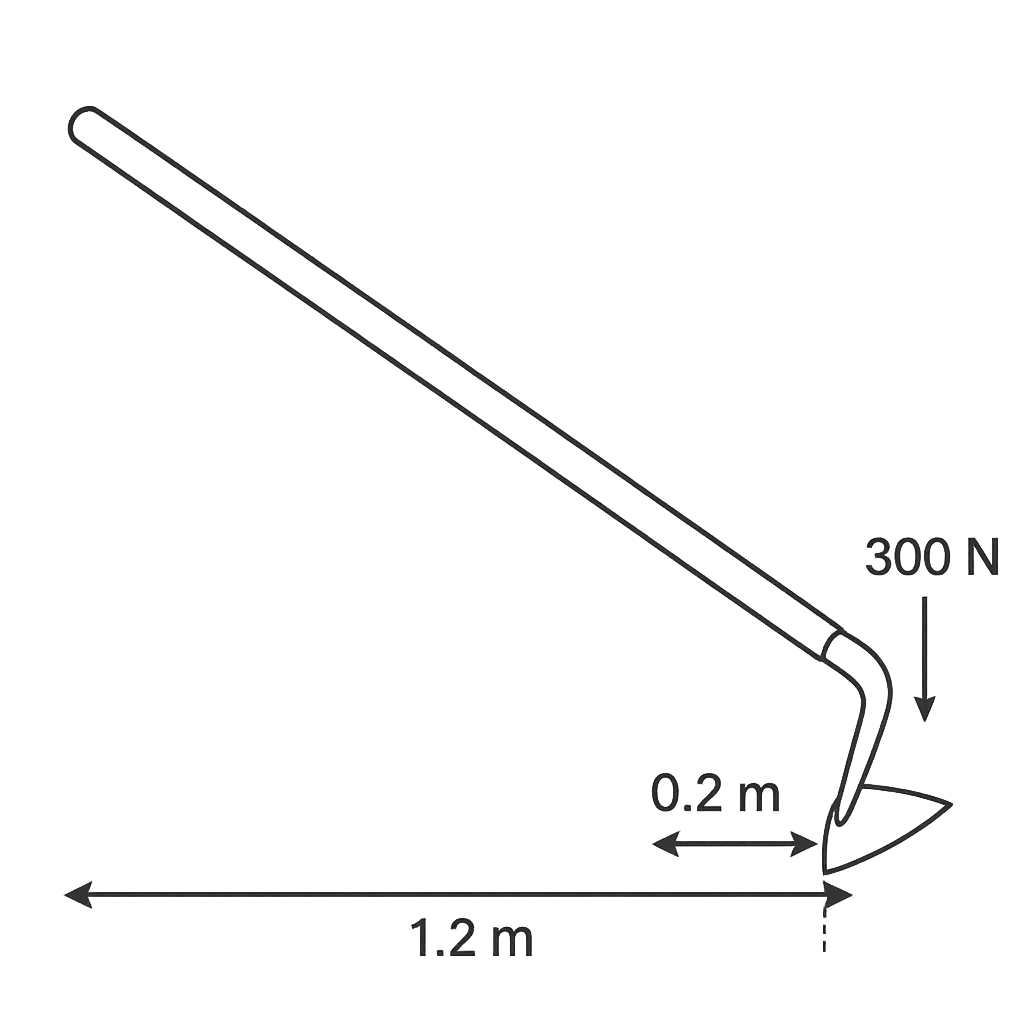
The diagram shows a hand hoe being used as a simple lever. The distance from the pivot (fulcrum) to the point where the effort is applied (the handle) is \(1.2\) m, and the distance from the pivot to the load (the blade) is \(0.2\) m. A load of \(300\) N acts on the blade. Determine the effort force (in newtons) that the farmer must apply at the handle to lift the load, assuming an ideal (frictionless) lever.
A. 40 N
Correct B. 50 N
C. 60 N
D. 75 N

Correct Answer: B

Want to see the full step-by-step solution? Unlock AI Explanation & Analytics
Question 8 View Details
A farmer aims to produce \(10{,}000\) eggs per month. Each laying hen lays on average \(0.85\) eggs per day and each egg weighs \(60\) g. The feed conversion ratio (FCR) for egg production is \(2.5\) kg feed per kilogram of egg produced. If the farmer has only \(500\) kg of feed available for the month, what is the maximum number of whole eggs that can be produced under this feed constraint?
A. 3000
Correct B. 3333
C. 3500
D. 3330

Correct Answer: B

Want to see the full step-by-step solution? Unlock AI Explanation & Analytics
Question 9 View Details
A tractor must pull a plough that requires a drawbar pull of \(3000\) N while moving at a speed of \(4\) km h\(^{-1}\). The transmission efficiency of the tractor is \(80\%\). Calculate the minimum engine power in kilowatts that the tractor must develop to perform this task.
Correct A. 4.2 kW
B. 4.0 kW
C. 5.0 kW
D. 3.3 kW

Correct Answer: A

Want to see the full step-by-step solution? Unlock AI Explanation & Analytics
Question 10 View Details
In a maize field, the economic injury level (EIL) for Fall Armyworm is given by \(\text{EIL} = \frac{C \times I}{V \times D}\), where \(C = ₦150\) per hectare (cost of control), \(I = 0.02\) kg loss per larva, \(V = ₦30\) per kilogram (market value of maize), and \(D = 0.9\) (proportion of damage prevented by control). A scouting survey records \(25\) larvae per \(10\) m\(^2\). The field size is \(2\) hectares. Should the farmer apply control measures? Provide a yes/no answer and state the calculated actual loss per hectare (in kilograms).
A. Yes, 250 kg per hectare
B. Yes, 600 kg per hectare
C. No, 500 kg per hectare
Correct D. Yes, 500 kg per hectare

Correct Answer: D

Want to see the full step-by-step solution? Unlock AI Explanation & Analytics
Question 11 View Details
A field initially has \(1,200\) insects per hectare. After applying a pesticide, the insect count is reduced by \(25\%\). How many insects remain per hectare?
A. 300
B. 1050
Correct C. 900
D. 1175

Correct Answer: C

Want to see the full step-by-step solution? Unlock AI Explanation & Analytics
Question 12 View Details
A farmer harvests \(5\) tonnes of maize with a moisture content of \(25\%\) (wet basis). The safe storage moisture content is \(13\%\) (wet basis).\n\n(a) After drying to the safe moisture level, what is the weight of the maize (in kg)?\n(b) The dried maize is stored for \(3\) months, during which it loses \(2\%\) of its dry weight each month due to pests. Assuming the moisture content remains at \(13\%\) during storage, what is the final weight of the maize after the storage period (rounded to the nearest kilogram)?
A. 4,150
B. 4,200
C. 3,980
Correct D. 4,052

Correct Answer: D

Want to see the full step-by-step solution? Unlock AI Explanation & Analytics
Question 13 View Details
A farmer uses a first‑class lever to lift a sack of grain weighing \(200\) kg. The distance from the fulcrum to the load is \(0.4\) m and the distance from the fulcrum to the effort point is \(1.2\) m.\n\n(a) What minimum effort force (in newtons) must be applied to lift the sack, assuming the lever is ideal?\n(b) If the farmer can only apply a maximum effort of \(400\) N, what is the greatest mass of grain (in kilograms) that can be lifted with this lever?
A. Effort required ≈ 667 N; maximum load ≈ 120 kg
B. Effort required ≈ 5880 N; maximum load ≈ 14 kg
C. Effort required ≈ 650 N; maximum load ≈ 121 kg
Correct D. Effort required ≈ 654 N; maximum load ≈ 122 kg

Correct Answer: D

Want to see the full step-by-step solution? Unlock AI Explanation & Analytics
Question 14 View Details
In a cattle herd of \(200\) animals, an outbreak of foot‑and‑mouth disease (FMD) has a basic reproduction number \(R_{0}=2.5\). A vaccine available for the disease is \(80\%\) effective. Using the formula \(p_{c}=1-\frac{1}{R_{0}\times E}\) where \(E\) is vaccine effectiveness, determine the minimum proportion of the herd that must be vaccinated to achieve herd immunity. Also state the corresponding number of cattle that need to be vaccinated.
Correct A. 100
B. 90
C. 80
D. 75

Correct Answer: A

Want to see the full step-by-step solution? Unlock AI Explanation & Analytics
Question 15 View Details
A farmer monitors three independent factors that must all be present for a fungal disease to develop in his tomato crop: presence of the pathogen (P) with probability \(0.6\), a susceptible host (H) with probability \(0.8\), and a favorable environment (E) with probability \(0.5\). If the disease occurs, it causes a 30 % loss of the total yield. The expected yield without disease is \(10,000\) kg. What is the expected yield after accounting for the risk of disease?
A. 9,720
B. 8,560
C. 7,600
Correct D. 9,280

Correct Answer: D

Want to see the full step-by-step solution? Unlock AI Explanation & Analytics
Question 16 View Details
A farmer cultivates 50 ha of maize. Fixed costs are ₦150,000. The variable cost per hectare depends on the amount of fertilizer applied (F kg per hectare, in multiples of 50 kg). The cost per hectare is ₦20,000 when no fertilizer is used and decreases by ₦2,000 for each additional 50 kg ha⁻¹ of fertilizer. The expected yield per hectare (in tonnes) is given by \( Y(F) = 2 + 0.05F - 0.0005F^{2} \). The market price of maize is ₦30,000 per tonne, but if total production from the 50 ha exceeds 100 tonnes, the price falls by 5 % because of market saturation. Determine the amount of fertilizer (in kg ha⁻¹) that maximizes the farmer's profit and state the maximum profit (in Naira).
A. Fertilizer = 0 kg ha⁻¹; Maximum profit = ₦2,850,000
Correct B. Fertilizer = 50 kg ha⁻¹; Maximum profit = ₦3,581,250
C. Fertilizer = 150 kg ha⁻¹; Maximum profit = ₦2,950,000
D. Fertilizer = 100 kg ha⁻¹; Maximum profit = ₦3,200,000

Correct Answer: B

Want to see the full step-by-step solution? Unlock AI Explanation & Analytics
Question 17 View Details
Rainfall in a region varies uniformly from 500 mm to 1100 mm and temperature varies uniformly from 15 °C to 35 °C. A crop requires at least 600 mm of rainfall and a temperature between 20 °C and 30 °C. Assuming the two variables are independent, what percentage of the region's land is suitable for this crop? Express your answer to one decimal place.
Correct A. 41.7 %
B. 25.0 %
C. 33.3 %
D. 50.0 %

Correct Answer: A

Want to see the full step-by-step solution? Unlock AI Explanation & Analytics
Question 18 View Details
Volume growth of a timber species follows the logistic function \( V(t)=\frac{2000}{1+9e^{-0.08t}} \) (m³ ha⁻¹), where t is the age in years. The annual increase in volume is \( \Delta V = V(t+1)-V(t) \). Determine the smallest age (in whole years) at which the annual increase falls to 30 m³ ha⁻¹. Give the age rounded to the nearest year.
A. 16
B. 13
Correct C. 14
D. 15

Correct Answer: C

Want to see the full step-by-step solution? Unlock AI Explanation & Analytics
Question 19 View Details
Fish biomass N (tonnes) in a lake obeys the Schaefer model \( \frac{dN}{dt}= rN\left(1-\frac{N}{K}\right)-qEN \) with intrinsic growth rate \( r=0.5\ \text{yr}^{-1} \), carrying capacity \( K=1000\ \text{t} \), catchability coefficient \( q=0.0002\ \text{(boat‑day)}^{-1} \), and fishing effort E (boat‑days yr⁻¹). Find the effort level that gives the maximum sustainable yield and compute that maximum yield (tonnes yr⁻¹). Round the effort to the nearest whole boat‑day.
Correct A. Effort = 1250 boat‑days yr⁻¹; Maximum sustainable yield = 125 t yr⁻¹
B. Effort = 1000 boat‑days yr⁻¹; Maximum sustainable yield = 100 t yr⁻¹
C. Effort = 1250 boat‑days yr⁻¹; Maximum sustainable yield = 130 t yr⁻¹
D. Effort = 1500 boat‑days yr⁻¹; Maximum sustainable yield = 150 t yr⁻¹

Correct Answer: A

Want to see the full step-by-step solution? Unlock AI Explanation & Analytics
Question 20 View Details
A farmer plans to apply nitrogen fertilizer to a maize field. Soil already supplies 30 kg N ha⁻¹. The yield response to added nitrogen (N kg ha⁻¹) follows \( \Delta Y = 0.05N - 0.0002N^{2} \) (tonnes ha⁻¹) for 0 ≤ N ≤ 250, after which no further increase occurs. The base yield without added nitrogen is 2 t ha⁻¹. Maize sells for ₦40,000 per tonne, fertilizer costs ₦120 per kg, and fixed costs are ₦15,000 ha⁻¹. Considering only whole‑ten kilogram increments of N, determine the amount of nitrogen to apply (kg ha⁻¹) that maximizes net profit per hectare and state the maximum profit (rounded to the nearest thousand Naira).
A. Nitrogen = 100 kg ha⁻¹; Maximum profit ≈ ₦165,000
B. Nitrogen = 110 kg ha⁻¹; Maximum profit ≈ ₦170,000
Correct C. Nitrogen = 120 kg ha⁻¹; Maximum profit ≈ ₦175,000
D. Nitrogen = 130 kg ha⁻¹; Maximum profit ≈ ₦180,000

Correct Answer: C

Want to see the full step-by-step solution? Unlock AI Explanation & Analytics
Question 21 View Details
A farmer plans to produce maize. Fixed costs are N500,000. Variable cost is N150,000 per ton. If the farmer produces more than 8 tons, an additional storage cost of N20,000 is incurred for each ton above 8. The market price per ton is N250,000, but for every ton produced above 10 the price falls by 5 % of the original price for each extra ton (i.e., price per ton = N250,000 × [1 - 0.05 ((q) - 10)] for (q) > 10). Determine the quantity of maize (in whole tons) that maximizes profit and state the maximum profit.
A. 12 tons; N380,000
B. 9 tons; N415,000
Correct C. 10 tons; N460,000
D. 11 tons; N440,000

Correct Answer: C

Want to see the full step-by-step solution? Unlock AI Explanation & Analytics
Question 22 View Details
A soil sample contains 40 % sand, 35 % silt and 25 % clay. According to the USDA soil texture triangle, what is the textural class of this soil?
A. Sandy loam
B. Loam
Correct C. Clay loam
D. Silt loam

Correct Answer: C

Want to see the full step-by-step solution? Unlock AI Explanation & Analytics
Question 23 View Details
The volume of timber (in m³ per hectare) from a stand of a fast‑growing species is modelled by ( V(t)=\begin{cases} 0.5\,t^{2}, & 0\le t\le 30,\\ 510-2t, & t>30, \end{cases} ) where \(t\) is the age in years. Timber sells for N200 per m³ and the annual discount rate is 10 %. Ignoring regeneration cost, find the rotation age that maximises the present value of a single harvest and give that maximum present value (rounded to the nearest N).
A. 22 years; N6,200
Correct B. 21 years; N5,959
C. 20 years; N5,500
D. 25 years; N6,100

Correct Answer: B

Want to see the full step-by-step solution? Unlock AI Explanation & Analytics
Question 24 View Details
The hand hoe works as a first‑class lever. The distance from the farmer's hands to the pivot is 1.2 m and the distance from the pivot to the blade edge (the point of soil resistance) is 0.15 m. Assuming an ideal lever with no friction, (a) what minimum effort force must the farmer apply to generate a soil‑penetration force of 300 N at the blade? (b) If the farmer can only apply a maximum effort of 250 N, what is the greatest soil‑penetration force that can be produced?
A. 30 N; 2,500 N
B. 40 N; 1,600 N
Correct C. 37.5 N; 2,000 N
D. 45 N; 1,800 N

Correct Answer: C

Want to see the full step-by-step solution? Unlock AI Explanation & Analytics
Question 25 View Details
A small tractor has a diesel engine rated at 25 kW at the crankshaft. The transmission efficiency is 85 % and the final‑drive efficiency is 90 %. The tractor must deliver a draw‑bar power of 12 kW to pull a plough. Diesel fuel contains 38 MJ per litre and the engine's thermal efficiency (fuel to brake power) is 30 %. Calculate the minimum amount of fuel the tractor will consume in one hour of operation (expressed in litres, rounded to one decimal place).
A. 5.8 L
Correct B. 5.0 L
C. 6.3 L
D. 4.2 L

Correct Answer: B

Want to see the full step-by-step solution? Unlock AI Explanation & Analytics

Master the Exam!

You've seen a preview, but there are thousands more questions plus AI tutor to break down complex solutions.

Unlock Full Access Available for Android & Windows
Help others prepare! Share this practice hub:
Chat with Support