neco model questions vol1 2018 agricultural_science | Essay

Prepare for your exams with neco model questions vol1 questions? Reviewing past/model questions is one of the most effective ways to guarantee a high score. This practice hub features authentic 2018 agricultural_science (Essay) questions designed to simulate the real exam environment.

Practice these randomly selected questions to test your readiness.

Question 1 View Details
A farmer wishes to adopt ecological principles to improve the sustainability of his farm.
Question Parts
(a)
Define the term “agro‑ecosystem” and list its main components.
(b)
Discuss two ways in which biodiversity enhances the productivity and resilience of an agro‑ecosystem.
Detailed Essay Solution & Marking Scheme Available

Get the step-by-step mathematical proofs, key points required by examiners, and a comprehensive breakdown from our AI Tutor.
Question 2 View Details
The diagram shows a practical laboratory setup used to determine the texture of a soil sample by the ribbon (feel) method.
Question Parts
(a)
Identify three pieces of equipment labelled A, B and C in the diagram and state the purpose of each.
(b)
Outline the step‑by‑step procedure carried out with this setup to obtain a soil ribbon, and explain how the length of the ribbon is interpreted to classify the soil as sandy, loamy or clayey.
(c)
A soil sample produced a ribbon of 2.5 cm when the procedure was followed. Using the interpretation guide given, state the texture class of the sample and justify your answer.
Detailed Essay Solution & Marking Scheme Available

Get the step-by-step mathematical proofs, key points required by examiners, and a comprehensive breakdown from our AI Tutor.

Question 3 View Details
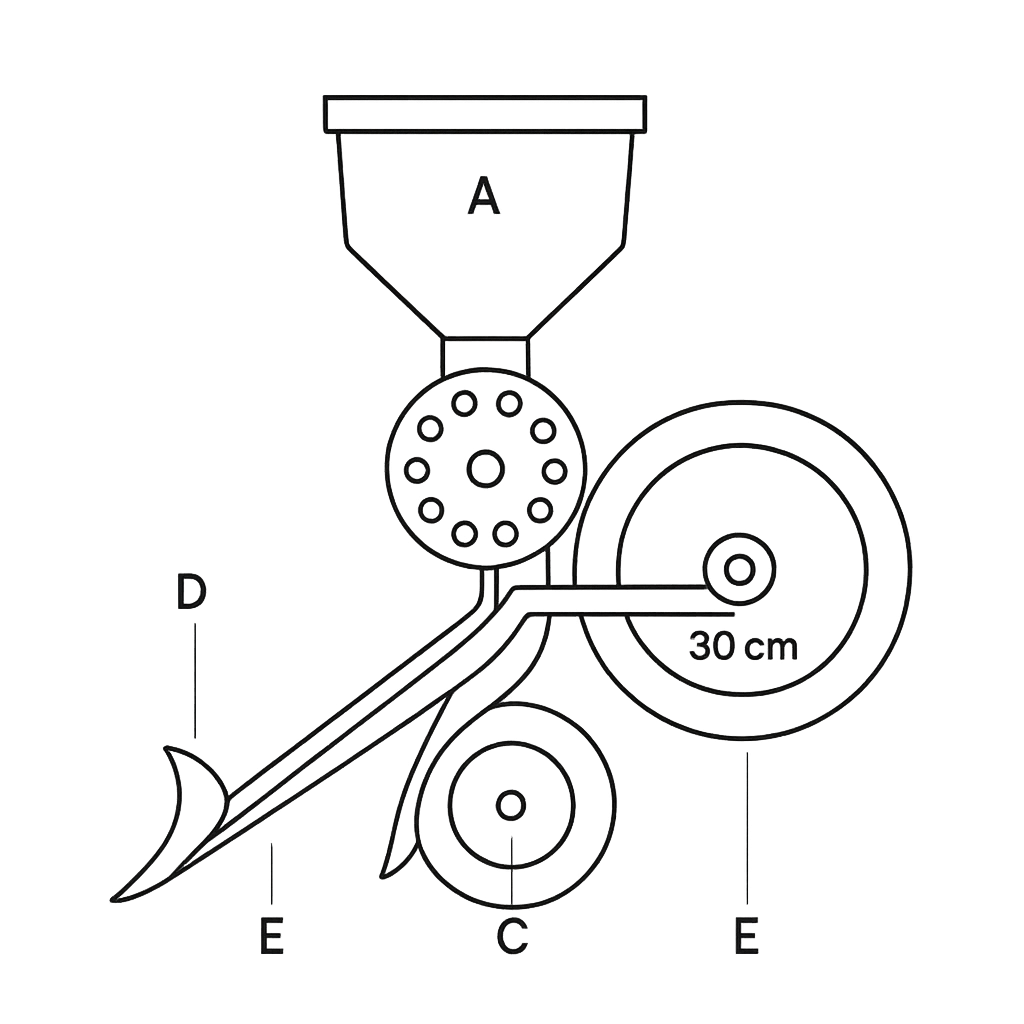
The diagram shows a seed drill used for planting maize seeds.
Question Parts
(a)
Identify any three labelled parts of the seed drill and state the function of each part.
(b)
If the driving wheel rotates at 120 rpm and the seed‑metering disc has 12 equally spaced holes, calculate the number of seeds that will be deposited in the soil per minute, assuming one seed is released from each hole for every wheel rotation.
(c)
Discuss two advantages of using a seed drill compared with broadcasting seeds by hand.
Detailed Essay Solution & Marking Scheme Available

Get the step-by-step mathematical proofs, key points required by examiners, and a comprehensive breakdown from our AI Tutor.

Question 4 View Details
A farmer intends to use a 4‑wheel tractor to operate a rotary tiller on a 5‑hectare field.
Question Parts
(a)
The tractor’s power take‑off (PTO) runs at 540 rpm and can deliver a maximum of 45 kW. The rotary tiller requires 30 kW to operate. State whether the tractor can supply sufficient power for the tiller and justify your answer.
(b)
The rotary tiller operates at 1 200 rpm. Calculate the gear ratio that must be used between the tractor’s PTO shaft and the tiller shaft.
(c)
Explain two possible effects on soil tillage if the gear ratio is set too low (i.e., the tiller rotates slower than its design speed).
(d)
Suggest two routine maintenance checks that should be performed on the tractor’s PTO system before the tilling operation.
Detailed Essay Solution & Marking Scheme Available

Get the step-by-step mathematical proofs, key points required by examiners, and a comprehensive breakdown from our AI Tutor.

Question 5 View Details
A farmer has 5 hectares of land in the middle‑belt region of Nigeria. The soil is sandy loam with a pH of 5.8. Average annual rainfall is 1200 mm and the farmer has access to a fertilizer containing NPK 12‑24‑12. The farmer wishes to cultivate maize and soybean in a two‑year rotation to improve soil fertility and increase food security.
Question Parts
(a)
Explain why a maize‑soybean rotation is suitable for the given soil and climate conditions.
(b)
Using the fertilizer recommendation of 100 kg N ha⁻¹ for maize and 50 kg N ha⁻¹ for soybean, calculate the total amount of the NPK 12‑24‑12 fertilizer (in kg) the farmer needs to apply each year for the 5‑ha farm, assuming the farmer applies only the recommended nitrogen. Show all steps of your calculation.
(c)
If the expected yields are 3.5 t ha⁻¹ for maize and 2.2 t ha⁻¹ for soybean, estimate the total production (in tonnes) over the two‑year rotation. Additionally, discuss two agronomic benefits the farmer gains from this rotation.
Detailed Essay Solution & Marking Scheme Available

Get the step-by-step mathematical proofs, key points required by examiners, and a comprehensive breakdown from our AI Tutor.

Question 6 View Details
A smallholder dairy farmer keeps a herd of 20 lactating cows. Each cow produces an average of 22 L of milk per day. The farmer feeds the cows a total mixed ration (TMR) consisting of 60 % maize silage (dry matter 35 %) and 40 % concentrate (dry matter 90 %). The concentrate contains 20 % crude protein (CP) and the silage contains 8 % CP. The cows require 2.5 % of their body weight as CP per day. The average live weight of the cows is 450 kg. The price of the concentrate is ₦150 per kg, and the price of maize silage is ₦30 per kg.
Question Parts
(a)
Determine the daily amount (in kg of dry matter) of concentrate and silage required per cow to meet the CP requirement. Show your calculations and state any assumptions used.
Detailed Essay Solution & Marking Scheme Available

Get the step-by-step mathematical proofs, key points required by examiners, and a comprehensive breakdown from our AI Tutor.

Question 7 View Details
A farmer in the northern savanna zone cultivates maize on 5 ha. During the early vegetative stage he notices an increase in stem‑borer larvae inside the stalks and a heavy population of aphids on the undersides of leaves. The market price of maize is ₦150 per kilogram and the farmer expects a yield of 5 tonnes per hectare. The cost of applying an appropriate insecticide to control the stem borer is estimated at ₦5 000 per hectare. Each stem‑borer larva is estimated to cause a loss of 0.5 kg of grain per hectare. The farmer wishes to adopt an integrated pest‑management (IPM) approach. Answer the following:
Question Parts
(a)
Identify the two major pests described and outline the key stages in their life cycles that are relevant for timing control measures.
(b)
Using the economic injury level (EIL) concept, calculate the threshold number of stem‑borer larvae per hectare at which control becomes economically justified. Show all steps.
(c)
Propose a concise integrated pest‑management (IPM) programme for the maize crop that combines cultural, biological and chemical control measures for both stem borer and aphids. Justify how each component reduces pest pressure.
Detailed Essay Solution & Marking Scheme Available

Get the step-by-step mathematical proofs, key points required by examiners, and a comprehensive breakdown from our AI Tutor.

Question 8 View Details
A horticulturist grows tomatoes on 2 ha in a humid tropical region. During the rainy season, some plants show irregular brown leaf spots while others exhibit wilting of the lower leaves and stunted growth. A random sample of 200 plants reveals 30 plants with leaf spots and 12 plants with wilting symptoms. The severity of leaf‑spot disease is rated as moderate (2 on a 0–3 scale) and wilt as severe (3 on the same scale). The market price of fresh tomatoes is ₦200 per kilogram and the expected yield is 30 tonnes per hectare. Answer the following:
Question Parts
(a)
Identify the most likely causal agents of the leaf‑spot and wilting symptoms. For each pathogen, describe its classification, main survival structure and the environmental conditions that favour infection.
Detailed Essay Solution & Marking Scheme Available

Get the step-by-step mathematical proofs, key points required by examiners, and a comprehensive breakdown from our AI Tutor.

Master the Exam!

You've seen a preview, but there are thousands more questions plus AI tutor to break down complex solutions.

Unlock Full Access Available for Android & Windows
Help others prepare! Share this practice hub:
Chat with Support