neco model questions vol1 2017 physics | Objective

Prepare for your exams with neco model questions vol1 questions? Reviewing past/model questions is one of the most effective ways to guarantee a high score. This practice hub features authentic 2017 physics (Objective) questions designed to simulate the real exam environment.

Practice these randomly selected questions to test your readiness.

Question 1 View Details
A copper block is heated to \(150^{\circ}\text{C}\) and then placed in an insulated container containing \(200\ \text{g}\) of water at \(20^{\circ}\text{C}\). After equilibrium the temperature of the system is \(30^{\circ}\text{C}\). The specific heat capacity of copper is \(0.385\ \text{J g}^{-1}\!^{\circ}\text{C}^{-1}\). Assuming no heat loss to the surroundings, determine the mass of the copper block (in grams) to the nearest gram.
A. 200 g
Correct B. 181 g
C. 150 g
D. 220 g

Correct Answer: B

Want to see the full step-by-step solution? Unlock AI Explanation & Analytics
Question 2 View Details
Vector \(\mathbf{A}\) has a magnitude of \(10\ \text{N}\) and acts \(30^{\circ}\) north of east. Vector \(\mathbf{B}\) has components \(6\ \text{N}\) east and \(8\ \text{N}\) north. Find the magnitude of the resultant vector \(\mathbf{R}=\mathbf{A}+\mathbf{B}\) (in newtons, to one decimal place).
A. 16.5 N
B. 18.2 N
C. 21.0 N
Correct D. 19.6 N

Correct Answer: D

Want to see the full step-by-step solution? Unlock AI Explanation & Analytics
Question 3 View Details
A pulley system lifts a load of \(200\ \text{N}\) through a vertical distance of \(2\ \text{m}\) in \(5\ \text{s}\). The effort applied to the rope is a constant force of \(80\ \text{N}\) acting over a distance of \(6\ \text{m}\). (a) Calculate the mechanical advantage, efficiency and power output of the pulley system. (b) An inclined plane of length \(5\ \text{m}\) raises the same load to the same height. A person pushes parallel to the plane with a constant force of \(100\ \text{N}\) over the full length in the same \(5\ \text{s}\). Which device is more efficient? State the efficiency of each device (to one decimal place) and identify the more efficient one.
A. Pulley: efficiency = 85.0 %, power = 85 W; Inclined plane: efficiency = 80.0 %; Pulley is more efficient.
B. Pulley: efficiency = 75.0 %, power = 70 W; Inclined plane: efficiency = 78.5 %; Inclined plane is more efficient.
C. Pulley: efficiency = 83.3 %, power = 80 W; Inclined plane: efficiency = 85.0 %; Pulley is more efficient.
Correct D. Pulley: efficiency = 83.3 %, power = 80 W; Inclined plane: efficiency = 80.0 %; Pulley is more efficient.

Correct Answer: D

Want to see the full step-by-step solution? Unlock AI Explanation & Analytics
Question 4 View Details
A sealed container holds \(0.5\ \text{mol}\) of an ideal gas at \(27^{\circ}\text{C}\) and a pressure of \(1.0\ \text{atm}\). The gas is heated to \(127^{\circ}\text{C}\) while the volume of the container is reduced by \(20\%\) of its original volume. Determine the final pressure of the gas in atmospheres (to two decimal places) and the percentage increase in pressure relative to the initial pressure.
Correct A. 1.67 atm, 66.7 % increase
B. 1.50 atm, 50.0 % increase
C. 1.80 atm, 80.0 % increase
D. 1.67 atm, 70.0 % increase

Correct Answer: A

Want to see the full step-by-step solution? Unlock AI Explanation & Analytics
Question 5 View Details
A car travels at a constant speed of \(90\ \text{km h}^{-1}\) for \(2\ \text{min}\ 30\ \text{s}\). Calculate the distance covered in metres.
Correct A. 3750 m
B. 3000 m
C. 4000 m
D. 3500 m

Correct Answer: A

Want to see the full step-by-step solution? Unlock AI Explanation & Analytics
Question 6 View Details
A siren on an ambulance emits a sound of frequency \(800\ \text{Hz}\). The ambulance moves directly towards a stationary observer with a constant speed \(v\). The observer hears a frequency of \(877\ \text{Hz}\). After the ambulance passes the observer and moves away with the same speed, the observer hears a frequency of \(735\ \text{Hz}\). Assuming the speed of sound in air is \(340\ \text{m s}^{-1}\), determine the speed \(v\) of the ambulance (in \(\text{m s}^{-1}\)).
A. 20
Correct B. 30
C. 55
D. 45

Correct Answer: B

Want to see the full step-by-step solution? Unlock AI Explanation & Analytics
Question 7 View Details
A light string of length \(1.00\ \text{m}\) passes over a frictionless, mass‑less pulley. A block of mass \(M\) hangs from one end, while a second block of mass \(m = 0.80\ \text{kg}\) rests on a horizontal table. The coefficient of kinetic friction between the block on the table and the table is \(\mu_k = 0.20\). When the system is released, the hanging block accelerates downward, and after the first \(0.50\ \text{s}\) the speed of the blocks is measured to be \(2.0\ \text{m s}^{-1}\). Determine the mass \(M\) of the hanging block (in kilograms, to three significant figures).
A. 0.650
Correct B. 0.823
C. 0.950
D. 0.500

Correct Answer: B

Want to see the full step-by-step solution? Unlock AI Explanation & Analytics
Question 8 View Details
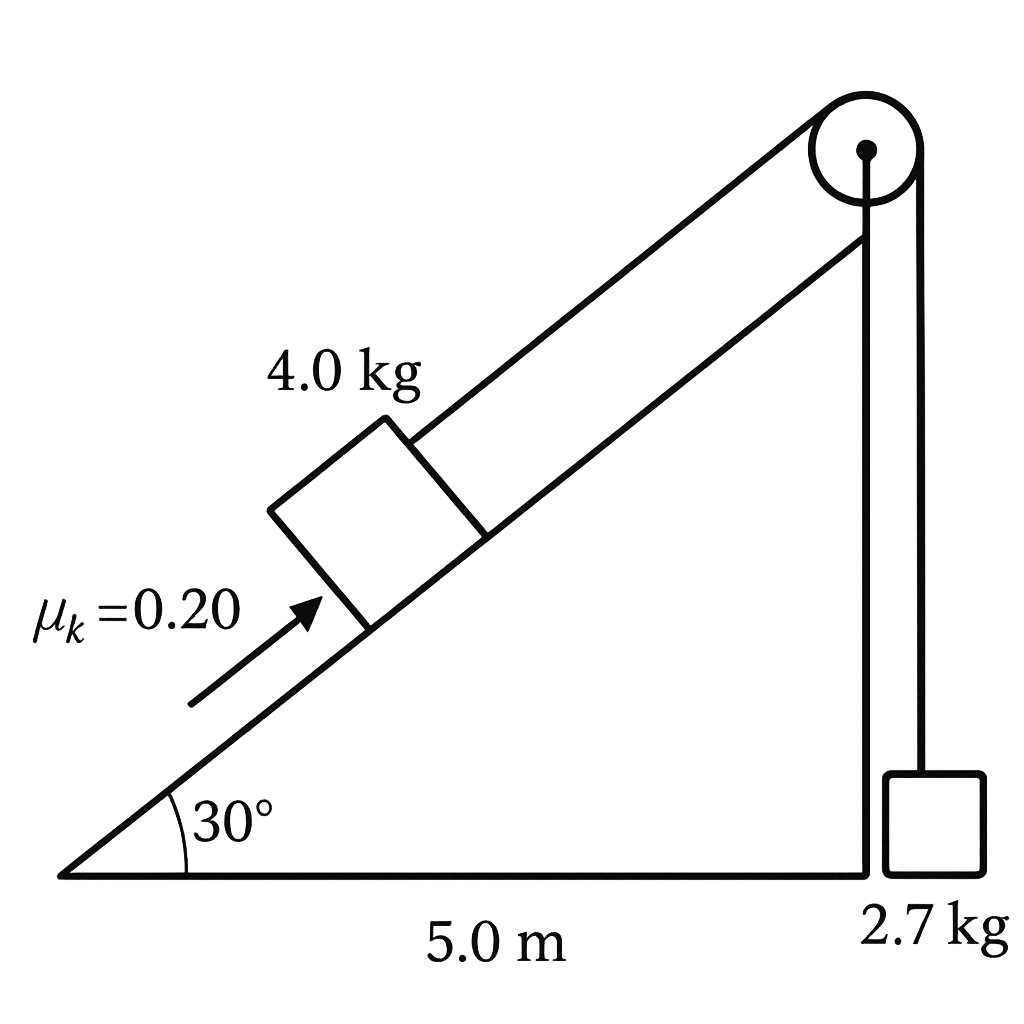
A diagram shows a \(30^{\circ}\) inclined plane of length \(5.0\ \text{m}\). A block of mass \(4.0\ \text{kg}\) rests on the plane and is connected by a light, inextensible string over a frictionless pulley at the top of the incline to a hanging mass of \(2.7\ \text{kg}\). The coefficient of kinetic friction between the block and the plane is \(\mu_k = 0.20\). The system moves up the incline at constant speed. If the block travels a distance of \(3.0\ \text{m}\) along the plane in \(6.0\ \text{s}\), calculate the power developed by the system (in watts, to two significant figures).
A. 20
B. 15
Correct C. 13
D. 10

Correct Answer: C

Want to see the full step-by-step solution? Unlock AI Explanation & Analytics
Question 9 View Details
A long solenoid of length \(0.50\ \text{m}\) has \(800\) turns and a radius of \(2.0\ \text{cm}\). The current through the solenoid varies with time as \(I(t) = 2 t^{2}\ \text{A}\) (where \(t\) is in seconds). (a) Write an expression for the magnetic field inside the solenoid as a function of \(t\). (b) At \(t = 3\ \text{s}\) the current is switched off instantaneously. During the first \(0.01\ \text{s}\) after switch‑off, a single circular loop of radius \(3.0\ \text{cm}\) placed coaxially at the centre of the solenoid experiences an induced emf. Assuming the loop's resistance is \(5\ \Omega\), calculate the energy dissipated as heat in the loop during this interval (express your answer in scientific notation with two significant figures).
A. 1.8e-7 J
B. 2.5e-7 J
C. 3.0e-7 J
Correct D. 2.1e-7 J

Correct Answer: D

Want to see the full step-by-step solution? Unlock AI Explanation & Analytics
Question 10 View Details
A \(150\ \text{g}\) piece of ice at \(-10^{\circ}\text{C}\) is placed in a \(200\ \text{g}\) sample of water at \(40^{\circ}\text{C}\). The calorimeter is assumed to have negligible heat capacity. The specific heat capacities are \(c_{\text{ice}} = 2.1\ \text{J g}^{-1}\text{K}^{-1}\) and \(c_{\text{water}} = 4.18\ \text{J g}^{-1}\text{K}^{-1}\). The latent heat of fusion of ice is \(L_f = 334\ \text{J g}^{-1}\). Determine the mass of ice that melts, giving your answer to the nearest gram.
A. 97
B. 84
C. 105
Correct D. 91

Correct Answer: D

Want to see the full step-by-step solution? Unlock AI Explanation & Analytics
Question 11 View Details
A stationary source emits sound of unknown frequency. An observer moves directly towards the source at a constant speed and hears a frequency of \(660\ \text{Hz}\). When the observer reverses direction and moves directly away from the source at the same speed, the heard frequency is \(540\ \text{Hz}\). The speed of sound in air is \(330\ \text{m\,s}^{-1}\). Determine (i) the speed of the observer and (ii) the original frequency emitted by the source.
A. Observer speed = 35 m\/s; original frequency = 580 Hz
Correct B. Observer speed = 33 m/s; original frequency = 600 Hz
C. Observer speed = 40 m\/s; original frequency = 560 Hz
D. Observer speed = 30 m\/s; original frequency = 620 Hz

Correct Answer: B

Want to see the full step-by-step solution? Unlock AI Explanation & Analytics
Question 12 View Details
A \(20\ \text{kg}\) block is lifted vertically by a compound pulley system consisting of a fixed pulley and a movable pulley attached to the block. The rope is pulled with a constant force \(F\). The system operates with an overall efficiency of \(80\%\) due to friction. The block is raised through a height of \(2.0\ \text{m}\) in \(5.0\ \text{s}\). Assuming the ideal mechanical advantage of the compound pulley is 2, calculate the magnitude of the pulling force \(F\) (in newtons).
A. 100 N
B. 150 N
C. 135 N
Correct D. 122.5 N

Correct Answer: D

Want to see the full step-by-step solution? Unlock AI Explanation & Analytics
Question 13 View Details
One hundred and fifty grams of water at \(80^{\circ}\text{C}\) is mixed with one hundred grams of ice at \(-10^{\circ}\text{C}\). The specific heat capacities are \(c_{\text{water}} = 4.18\ \text{J g}^{-1}\text{K}^{-1}\) and \(c_{\text{ice}} = 2.09\ \text{J g}^{-1}\text{K}^{-1}\). The latent heat of fusion of ice is \(L_f = 334\ \text{J g}^{-1}\). Assuming no heat loss to the surroundings, determine the final temperature of the mixture and state whether any ice remains.
A. Final temperature ≈ 20 °C; no ice remains
Correct B. Final temperature ≈ 14 °C; no ice remains
C. Final temperature ≈ 14 °C; ice remains
D. Final temperature ≈ 8 °C; no ice remains

Correct Answer: B

Want to see the full step-by-step solution? Unlock AI Explanation & Analytics
Question 14 View Details
A particle first moves \(5\ \text{km}\) due north and then \(12\ \text{km}\) due east. Find the magnitude of the resultant displacement and the angle it makes east of north (to one decimal place).
A. 15 km; 67.4° east of north
B. 13 km; 45.0° east of north
C. 13 km; 30.0° east of north
Correct D. 13 km; 67.4° east of north

Correct Answer: D

Want to see the full step-by-step solution? Unlock AI Explanation & Analytics
Question 15 View Details
A motor runs at \(1500\ \text{rpm}\) and drives gear A having 20 teeth. Gear A meshes with gear B of 40 teeth, which is fixed on the same shaft as gear C having 15 teeth. Gear C meshes with gear D of 45 teeth that is fixed on a conveyor roller of radius \(0.20\ \text{m}\). Assuming ideal gears with no slip, determine (i) the angular speed of the conveyor roller in rpm and (ii) the linear speed of the belt in \(\text{m\,s}^{-1}\) (to two decimal places).
A. Angular speed = 125 rpm; linear speed ≈ 2.62 m/s
B. Angular speed = 300 rpm; linear speed ≈ 6.28 m/s
Correct C. Angular speed = 250 rpm; linear speed ≈ 5.24 m/s
D. Angular speed = 500 rpm; linear speed ≈ 10.48 m/s

Correct Answer: C

Want to see the full step-by-step solution? Unlock AI Explanation & Analytics
Question 16 View Details
A metal rod is placed on the ruler as shown in the diagram. The left end of the rod aligns with the 0\,cm mark. The right end lies between the 12.3\,cm and 12.4\,cm marks, appearing exactly three‑quarters of the way between them. What is the length of the rod in millimetres?
A. 123.5
Correct B. 123.75
C. 124.75
D. 122.35

Correct Answer: B

Want to see the full step-by-step solution? Unlock AI Explanation & Analytics
Question 17 View Details
An ideal battery of emf \(E\) and internal resistance \(r\) supplies a resistor of resistance \(R\). When a second resistor of resistance \(2R\) is connected in parallel with the first resistor, the terminal voltage of the battery drops by 20\% compared with the terminal voltage when only the resistor \(R\) is connected. Determine the ratio \(\dfrac{r}{R}\).
A. 3
B. 2
C. 0
Correct D. 1

Correct Answer: D

Want to see the full step-by-step solution? Unlock AI Explanation & Analytics
Question 18 View Details
Two point charges are placed on a straight line. A charge \(+Q\) is at point \(A\) and a charge \(-2Q\) is at point \(B\), where the distance \(AB\) is \(12\;\text{cm}\). Determine the position(s) on the line where the net electric field is zero. Give the distance from point \(A\) to the required position, stating clearly whether it lies to the left of \(A\), between \(A\) and \(B\), or to the right of \(B\). Express your answer in centimetres to two decimal places.
Correct A. 28.97 cm to the left of A
B. 20.00 cm to the left of A
C. 8.00 cm between A and B
D. 12.00 cm to the right of B

Correct Answer: A

Want to see the full step-by-step solution? Unlock AI Explanation & Analytics
Question 19 View Details
A metal block of mass \(2.0\;\text{kg}\) and specific heat capacity \(0.45\;\text{kJ·kg}^{-1}\text{K}^{-1}\) is initially at \(150^{\circ}\text{C}\). It is placed into an insulated container that holds \(1.5\;\text{kg}\) of water at \(20^{\circ}\text{C}\). The container itself has a mass of \(0.5\;\text{kg}\) and a specific heat capacity of \(0.90\;\text{kJ·kg}^{-1}\text{K}^{-1}\). Assuming no heat is lost to the surroundings, calculate the final equilibrium temperature of the system in degrees Celsius, correct to one decimal place.
A. 31.0
B. 28.7
C. 42.1
Correct D. 35.4

Correct Answer: D

Want to see the full step-by-step solution? Unlock AI Explanation & Analytics
Question 20 View Details
A sample of ideal gas occupies a cylinder with a movable piston. Initially the gas is at \(20^{\circ}\text{C}\) and a pressure of \(100\;\text{kPa}\). The gas is first compressed isothermally until its volume is reduced to one‑half of the original volume. Then, while the volume is kept constant, the gas is heated until its temperature reaches \(80^{\circ}\text{C}\). What is the final pressure of the gas in kilopascals? Give your answer to one decimal place.
A. 120.5
B. 240.0
Correct C. 240.8
D. 200.0

Correct Answer: C

Want to see the full step-by-step solution? Unlock AI Explanation & Analytics
Question 21 View Details
A frictionless piston of mass 2.0 kg seals the top of a vertical cylindrical container of cross‑sectional area \(0.010\,\text{m}^2\). The outside of the piston is exposed to atmospheric pressure \(P_{\text{atm}}=1.0\times10^{5}\,\text{Pa}\). Initially the air inside the container is at atmospheric pressure and temperature \(300\,\text{K}\), occupying a volume of \(2.0\times10^{-2}\,\text{m}^3\). Air is slowly pumped in isothermally until the piston just begins to rise. (i) Find the absolute pressure of the air inside the container at that instant. (ii) If the piston rises by \(5.0\,\text{mm}\), calculate the number of moles of air added. Use \(R=8.314\,\text{J mol}^{-1}\text{K}^{-1}\) and \(g=9.8\,\text{m s}^{-2}\).
Correct A. Pressure = 1.0196×10⁵ Pa; moles added ≈ 0.018 mol
B. Pressure = 1.0250×10⁵ Pa; moles added ≈ 0.015 mol
C. Pressure = 1.0150×10⁵ Pa; moles added ≈ 0.022 mol
D. Pressure = 1.0096×10⁵ Pa; moles added ≈ 0.020 mol

Correct Answer: A

Want to see the full step-by-step solution? Unlock AI Explanation & Analytics
Question 22 View Details
A block of mass \(4.0\,\text{kg}\) rests on a rough inclined plane that makes an angle of \(30^{\circ}\) with the horizontal. The coefficients of static and kinetic friction are \(\mu_s = 0.25\) and \(\mu_k = 0.20\) respectively. The block is attached to a light inextensible string that passes over a frictionless pulley at the top of the incline and is connected to a hanging mass \(M\). Determine the range of values of \(M\) (in kilograms) for which the block remains at rest.
Correct A. 1.13 kg ≤ M ≤ 2.86 kg
B. 1.00 kg ≤ M ≤ 3.00 kg
C. 1.20 kg ≤ M ≤ 2.70 kg
D. 0.95 kg ≤ M ≤ 3.10 kg

Correct Answer: A

Want to see the full step-by-step solution? Unlock AI Explanation & Analytics
Question 23 View Details
A vertical cylindrical container of cross‑sectional area \(A=0.020\,\text{m}^2\) contains air at atmospheric pressure \(P_{\text{atm}}=1.0\times10^{5}\,\text{Pa}\) and temperature \(300\,\text{K}\). The initial volume of the gas is \(V_i=4.0\times10^{-3}\,\text{m}^3\). A frictionless piston of mass \(5.0\,\text{kg}\) rests on the gas, with atmospheric pressure acting on the top of the piston. An additional mass \(M\) (in kilograms) is placed on top of the piston, compressing the gas until the gas volume becomes \(V_f=3.0\times10^{-3}\,\text{m}^3\). Assuming the compression is isothermal, determine the value of \(M\) required to achieve this final volume.
A. M ≈ 9.9 kg
Correct B. M ≈ 8.6 kg
C. M ≈ 12.1 kg
D. M ≈ 7.4 kg

Correct Answer: B

Want to see the full step-by-step solution? Unlock AI Explanation & Analytics
Question 24 View Details
A long solenoid of length \(0.50\,\text{m}\) has \(800\) turns and carries a current \(I\). The magnetic field inside the solenoid is given by \(B=\mu_0 n I\) where \(n=N/L\) and \(\mu_0=4\pi\times10^{-7}\,\text{T·m·A}^{-1}\). A small bar magnet with magnetic dipole moment \(m=0.020\,\text{A·m}^2\) is placed at the centre of the solenoid, making an angle of \(30^{\circ}\) with the field direction. (i) Find the magnitude of the torque on the magnet when the solenoid current is \(2.0\,\text{A}\). (ii) If the current is increased at a constant rate of \(0.50\,\text{A s}^{-1}\), determine the magnitude of the emf induced in a single circular loop of radius \(0.040\,\text{m}\) that is coaxial with the solenoid.
A. Torque ≈ 8.0×10⁻⁵ N·m; emf ≈ 4.0 µV
B. Torque ≈ 2.0×10⁻⁵ N·m; emf ≈ 7.9 µV
C. Torque ≈ 5.5×10⁻⁵ N·m; emf ≈ 1.6 µV
Correct D. Torque ≈ 4.0×10⁻⁵ N·m; emf ≈ 5.1 µV

Correct Answer: D

Want to see the full step-by-step solution? Unlock AI Explanation & Analytics
Question 25 View Details
Two point charges are placed on the vertical \(y\)-axis. A charge \(+Q\) is at the origin and a charge \(-2Q\) is at \((0, a)\) where \(a = 0.10\,\text{m}\) and \(|Q| = 5.0\,\mu\text{C}\). Determine the point(s) on the \(x\)-axis where the electric potential is zero. Then calculate the magnitude of the electric field at that point. Use \(k = 8.99\times10^{9}\,\text{N·m}^2\text{C}^{-2}\).
A. x = 1.2×10⁻¹ m; |E| ≈ 6.0×10⁶ N·C⁻¹ (directed 45° above +x)
Correct B. x = 5.8×10⁻² m; |E| ≈ 1.2×10⁷ N·C⁻¹ (directed 30° above +x)
C. x = -5.8×10⁻² m; |E| ≈ 1.2×10⁷ N·C⁻¹ (directed 30° below +x)
D. x = 3.9×10⁻² m; |E| ≈ 2.4×10⁷ N·C⁻¹ (directed 15° above +x)

Correct Answer: B

Want to see the full step-by-step solution? Unlock AI Explanation & Analytics

Master the Exam!

You've seen a preview, but there are thousands more questions plus AI tutor to break down complex solutions.

Unlock Full Access Available for Android & Windows
Help others prepare! Share this practice hub:
Chat with Support