neco model questions vol1 2017 physics | Essay

Prepare for your exams with neco model questions vol1 questions? Reviewing past/model questions is one of the most effective ways to guarantee a high score. This practice hub features authentic 2017 physics (Essay) questions designed to simulate the real exam environment.

Practice these randomly selected questions to test your readiness.
Question 1 View Details
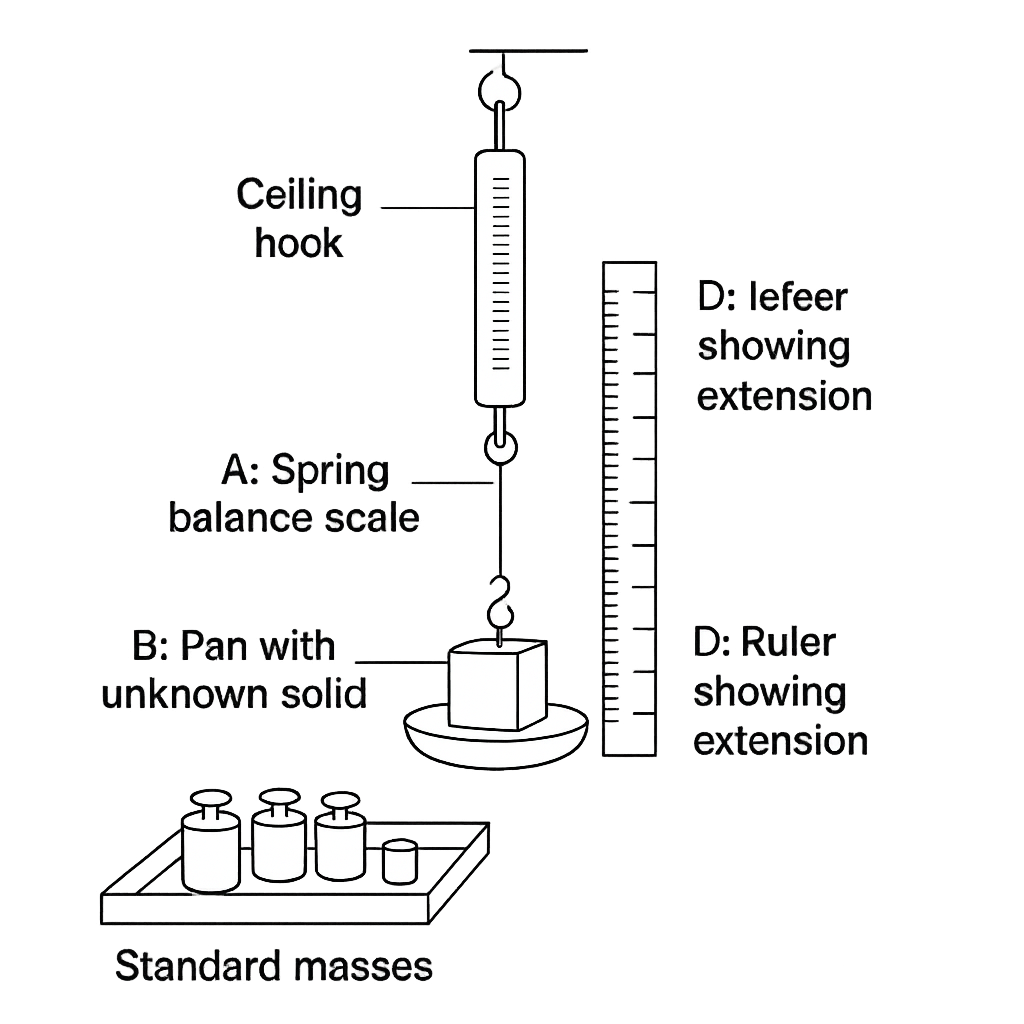
A laboratory setup is used to determine the mass of an unknown solid using a spring balance and a set of standard masses. The apparatus is shown in the diagram.
Question Parts
(a)
The spring balance reads 0.250 N when the pan is empty (zero error). When the unknown solid is placed, the reading is 3.45 N. Determine the true weight of the solid, correcting for zero error.
(b)
Given g = 9.80 m s⁻², calculate the mass of the solid in kilograms.
(c)
The student records the extension of the spring as 12.0 cm for the unknown solid and 1.0 cm for the zero‑error reading. Assuming the spring obeys Hooke's law and the spring constant is unchanged, determine the spring constant k in N m⁻¹.
(d)
If the student wants to measure a mass of 0.200 kg using the same spring, estimate the expected extension (in cm) ignoring zero error.
Detailed Essay Solution & Marking Scheme Available

Get the step-by-step mathematical proofs, key points required by examiners, and a comprehensive breakdown from our AI Tutor.
Question 2 View Details
A boat aims to cross a river that flows uniformly eastward at 3.0 m s⁻¹. The boat can travel at a speed of 5.0 m s⁻¹ relative to the water. The boat points directly north.
Question Parts
(a)
State the velocity vectors of the river and of the boat relative to the water, giving magnitude and direction.
(b)
Determine the resultant velocity of the boat relative to the ground by vector addition. Give the magnitude (to two significant figures) and the direction as the angle east of north.
(c)
If the river is 200 m wide, calculate the time taken for the boat to reach the opposite bank (to one decimal place).
(d)
To land directly opposite the starting point, the boat must aim at an angle west of north. Determine the required heading angle (to the nearest degree) and the resultant speed across the river.
Detailed Essay Solution & Marking Scheme Available

Get the step-by-step mathematical proofs, key points required by examiners, and a comprehensive breakdown from our AI Tutor.

Question 3 View Details
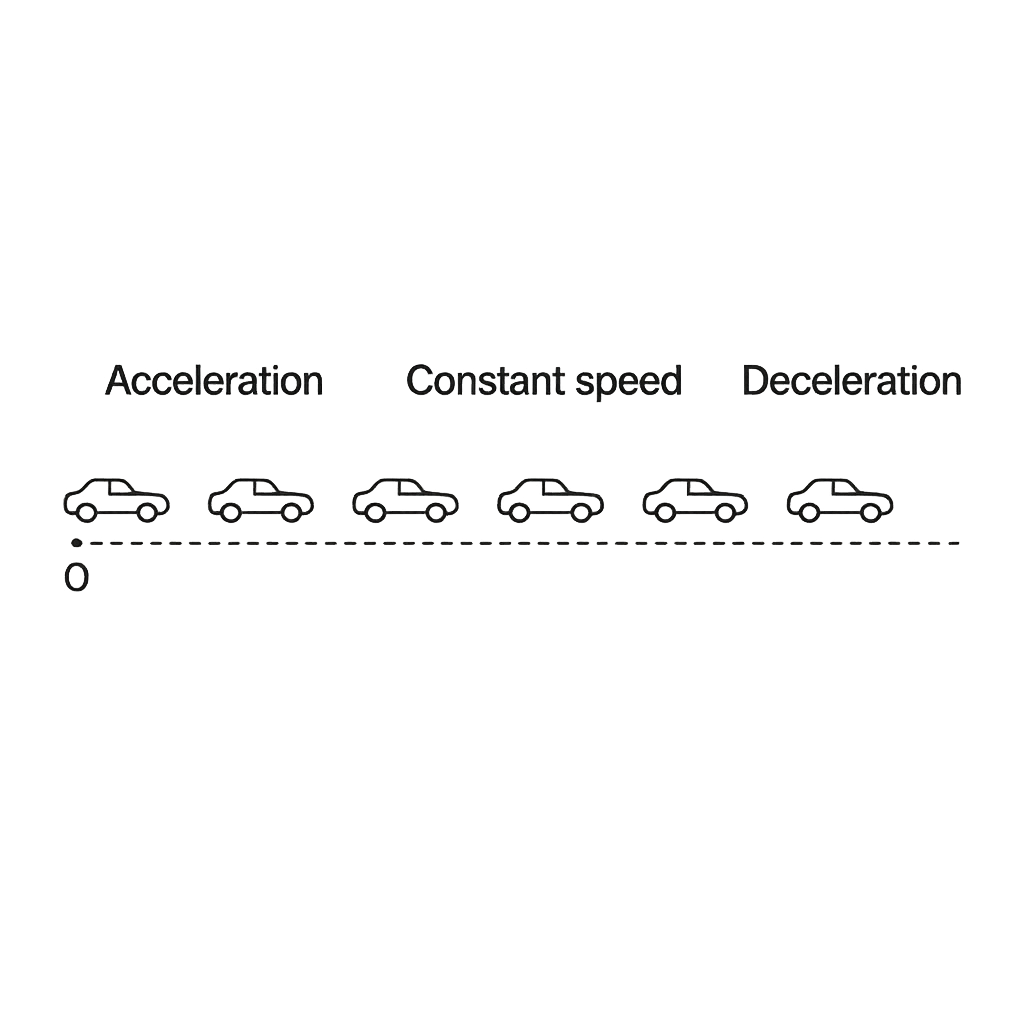
A car moves along a straight horizontal road. At time t = 0 s the car is at point O. It starts from rest and accelerates uniformly for 5 s, reaching a speed of 20 m s⁻¹. It then continues at this constant speed for 10 s before decelerating uniformly to rest in a further 4 s. The motion of the car is represented by the motion diagram supplied with the question.
Question Parts
(a)
Using the motion diagram, determine the total distance travelled by the car during the whole motion.
(b)
Calculate the average speed of the car over the entire motion.
(c)
Sketch the corresponding velocity–time graph and state the numerical value of the area under the graph.
Detailed Essay Solution & Marking Scheme Available

Get the step-by-step mathematical proofs, key points required by examiners, and a comprehensive breakdown from our AI Tutor.

Question 4 View Details
A 5.0 kg wooden crate rests on a rough inclined plane that makes an angle of 30° with the horizontal. The plane is 2.0 m long. The coefficient of static friction between the crate and the plane is 0.30 and the coefficient of kinetic friction is 0.25. A horizontal force \(F\) is applied to the crate at a point 0.40 m above the surface of the plane, as shown in the diagram.
Question Parts
(a)
Resolve the weight of the crate into components parallel and perpendicular to the plane. State their numerical values (use \(g = 9.8\,\text{m s}^{-2}\)).
(b)
Determine the minimum magnitude of the horizontal force \(F\) required to start moving the crate up the plane. Show all steps.
(c)
If the horizontal force is increased to \(F = 80\,\text{N}\), calculate the acceleration of the crate up the plane (assume it is already moving).
Detailed Essay Solution & Marking Scheme Available

Get the step-by-step mathematical proofs, key points required by examiners, and a comprehensive breakdown from our AI Tutor.

Question 5 View Details
A 5.0 kg block is released from rest at the top of a rough inclined plane that makes an angle of 30° with the horizontal. The length of the plane is 8.0 m and the coefficient of kinetic friction between the block and the plane is 0.20. At the bottom of the plane the block compresses a horizontal spring of force constant 400 N·m⁻¹ until it momentarily comes to rest. Using the work‑energy principle, answer the following:
Question Parts
(a)
Calculate the work done by gravity on the block while it moves down the plane.
(b)
Calculate the work done by the kinetic friction force during the descent.
(c)
Determine the maximum compression x of the spring when the block comes to rest at the bottom.
(d)
A motor now lifts the block back up the same plane at constant speed in 4.0 s. Find the average power output of the motor.
Detailed Essay Solution & Marking Scheme Available

Get the step-by-step mathematical proofs, key points required by examiners, and a comprehensive breakdown from our AI Tutor.

Question 6 View Details
A system of three pulleys is used to raise a load of 200 N. Two of the pulleys are fixed to the ceiling and the third pulley is movable and attached to the load. The rope is pulled with a constant effort of 55 N. While the load rises 0.30 m, the point of application of the effort moves 1.20 m. The system is not ideal; the effort required is 10 % greater than the effort for an ideal (frictionless) system. Answer the following:
Question Parts
(a)
Calculate the ideal mechanical advantage (IMA) of the pulley arrangement.
(b)
Determine the actual mechanical advantage (AMA) of the system.
(c)
Find the efficiency of the pulley system expressed as a percentage.
(d)
If the same load is to be raised a vertical distance of 5.0 m using this pulley system, calculate (i) the total work done by the effort, (ii) the work done on the load, and (iii) the energy lost due to friction.
Detailed Essay Solution & Marking Scheme Available

Get the step-by-step mathematical proofs, key points required by examiners, and a comprehensive breakdown from our AI Tutor.

Question 7 View Details
A car starts from rest and accelerates uniformly at \(2.0\,\text{m s}^{-2}\) for 10.0 s. It then continues at the attained speed for 20.0 s before decelerating uniformly to rest in 5.0 s.
Question Parts
(a)
Calculate the maximum speed reached by the car.
(b)
Determine the total distance travelled by the car during the whole motion.
Detailed Essay Solution & Marking Scheme Available

Get the step-by-step mathematical proofs, key points required by examiners, and a comprehensive breakdown from our AI Tutor.

Question 8 View Details
A stone is projected from the top of a 25.0 m high cliff with an initial speed of 15.0 m s⁻¹ at an angle of 30° above the horizontal.
Question Parts
(a)
Calculate the time taken for the stone to reach the ground.
(b)
Find the horizontal range from the foot of the cliff.
Detailed Essay Solution & Marking Scheme Available

Get the step-by-step mathematical proofs, key points required by examiners, and a comprehensive breakdown from our AI Tutor.

Master the Exam!

You've seen a preview, but there are thousands more questions plus AI tutor to break down complex solutions.

Unlock Full Access Available for Android & Windows
Help others prepare! Share this practice hub:
Chat with Support