neco model questions vol1 2017 chemistry | Objective

Prepare for your exams with neco model questions vol1 questions? Reviewing past/model questions is one of the most effective ways to guarantee a high score. This practice hub features authentic 2017 chemistry (Objective) questions designed to simulate the real exam environment.

Practice these randomly selected questions to test your readiness.

Question 1 View Details
A (2.00\ \text{L}\) container at (298\ \text{K}\) and (1.00\ \text{atm}\) contains a mixture of oxygen gas (O₂, molar mass \(32.00\ \text{g·mol}^{-1}\)) and hydrogen gas (H₂, molar mass \(2.016\ \text{g·mol}^{-1}\)). The total mass of the gas mixture is \(2.00\ \text{g}\). Determine the mass of oxygen and the mass of hydrogen present in the container.
A. O₂: 1.80 g; H₂: 0.20 g
B. O₂: 2.00 g; H₂: 0.00 g
Correct C. O₂: 1.96 g; H₂: 0.04 g
D. O₂: 1.50 g; H₂: 0.50 g

Correct Answer: C

Want to see the full step-by-step solution? Unlock AI Explanation & Analytics
Question 2 View Details
A hydrocarbon of molar mass \(58\ \text{g·mol}^{-1}\) is completely combusted in excess oxygen, producing \(44.8\ \text{g}\) of carbon dioxide and \(18.0\ \text{g}\) of water. (a) Determine the molecular formula of the hydrocarbon. (b) Calculate the mass of the hydrocarbon that was burned.
Correct A. Molecular formula: C₄H₈; Mass burned: 14.8 g
B. Molecular formula: C₄H₁₀; Mass burned: 15.2 g
C. Molecular formula: C₅H₁₀; Mass burned: 16.5 g
D. Molecular formula: C₃H₆; Mass burned: 12.0 g

Correct Answer: A

Want to see the full step-by-step solution? Unlock AI Explanation & Analytics
Question 3 View Details
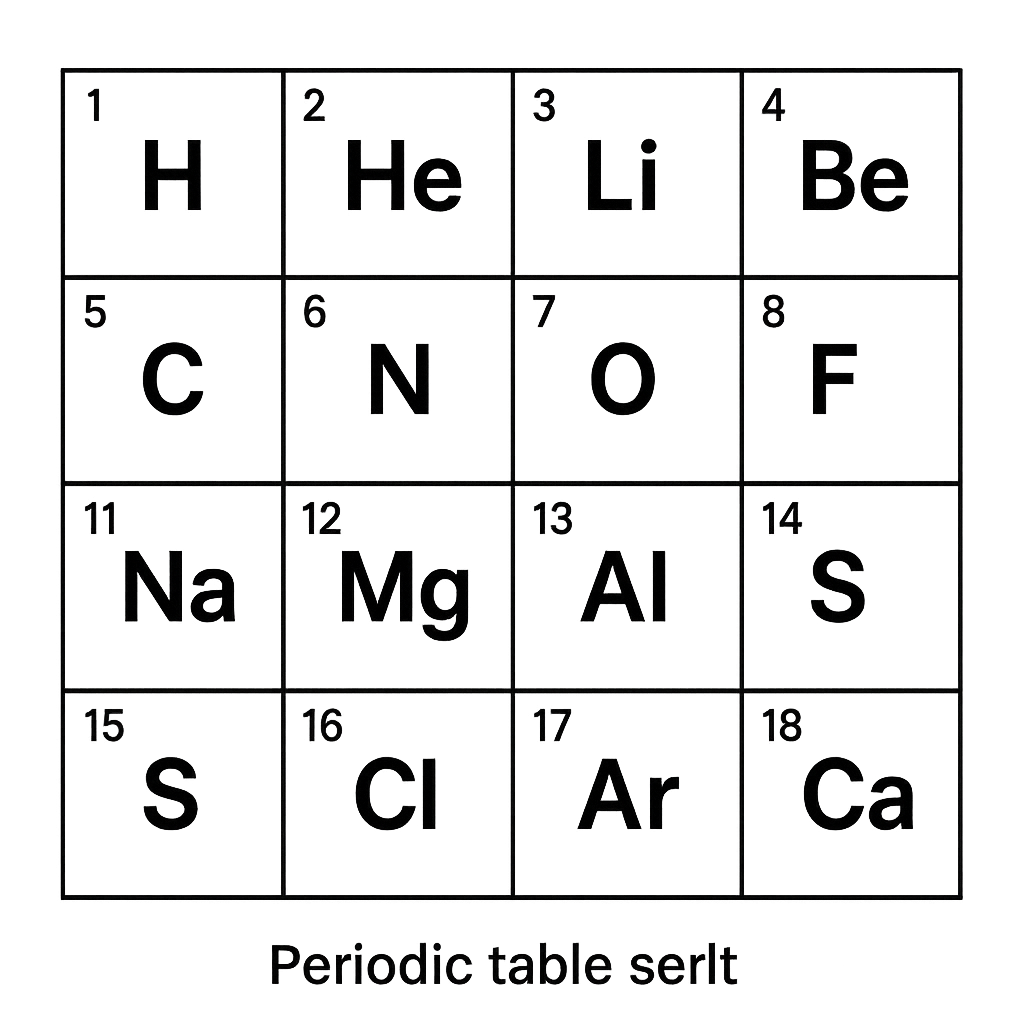
The diagram shows the first twenty elements of the periodic table with their symbols and atomic numbers. Which element shown has the highest first ionization energy?
A. Li
B. Ne
C. Ar
Correct D. He

Correct Answer: D

Want to see the full step-by-step solution? Unlock AI Explanation & Analytics
Question 4 View Details
An element X has the ground‑state electron configuration \(1s^{2}\,2s^{2}\,2p^{6}\,3s^{2}\,3p^{4}\). Identify the element, state its group number in the periodic table, and give the number of unpaired electrons in its ground state.
A. Chlorine; Group 17; 1 unpaired electron
B. Phosphorus; Group 15; 1 unpaired electron
C. Carbon; Group 14; 0 unpaired electrons
Correct D. Sulfur; Group 16; 2 unpaired electrons

Correct Answer: D

Want to see the full step-by-step solution? Unlock AI Explanation & Analytics
Question 5 View Details
Consider a galvanic cell constructed as Zn(s) | Zn^{2+}(0.010 M) || Cu^{2+}(0.10 M) | Cu(s). The standard reduction potentials are: \(\mathrm{Cu^{2+}+2e^- \rightarrow Cu(s)}\) (E^{\circ}=+0.34\ \text{V}\); \(\mathrm{Zn^{2+}+2e^- \rightarrow Zn(s)}\) (E^{\circ}=-0.76\ \text{V}\). Calculate the cell potential at 25 °C.
Correct A. 1.13 V
B. 1.16 V
C. 1.07 V
D. 1.10 V

Correct Answer: A

Want to see the full step-by-step solution? Unlock AI Explanation & Analytics
Question 6 View Details
A galvanic cell is constructed as follows: Zn(s) | Zn^{2+}(0.010\,M) || Cu^{2+}(0.050\,M) | Cu(s) at 25\(^\circ\)C. Standard reduction potentials are E°(Zn^{2+}/Zn) = -0.76\,V and E°(Cu^{2+}/Cu) = +0.34\,V. (a) Calculate the cell EMF under the given concentrations using the Nernst equation. (b) If the cell delivers a total charge of 0.500\,C, how many grams of copper are deposited on the copper electrode?
A. EMF = 0.96 V; mass of Cu deposited = 1.20×10^{-4} g
B. EMF = 1.05 V; mass of Cu deposited = 1.80×10^{-4} g
Correct C. EMF = 1.12 V; mass of Cu deposited = 1.65×10^{-4} g
D. EMF = 1.25 V; mass of Cu deposited = 2.00×10^{-4} g

Correct Answer: C

Want to see the full step-by-step solution? Unlock AI Explanation & Analytics
Question 7 View Details
A buffer solution is prepared by dissolving 0.250\,mol of acetic acid (CH_{3}COOH, Ka = 1.8\times10^{-5}) and 0.150\,mol of sodium acetate (CH_{3}COONa) in 1.00\,L of water. (a) Determine the initial pH of the solution. (b) After adding 0.020\,mol of HCl, what is the new pH?
Correct A. Initial pH = 4.52; pH after HCl addition = 4.43
B. Initial pH = 4.40; pH after HCl addition = 4.30
C. Initial pH = 4.68; pH after HCl addition = 4.55
D. Initial pH = 4.52; pH after HCl addition = 4.35

Correct Answer: A

Want to see the full step-by-step solution? Unlock AI Explanation & Analytics
Question 8 View Details
At 350\,K, the coexistence line between liquid and vapour of a certain substance has a slope \(\frac{dP}{dT}=0.013\,\text{atm·K}^{-1}\). The molar volume of the vapour at this temperature is 24.5\,L·mol^{-1}, while the liquid molar volume is negligible. Using the Clapeyron equation, calculate the enthalpy of vapourisation \(\Delta H_{vap}\) (in kJ·mol^{-1}) at 350\,K.
A. 9.8 kJ·mol^{-1}
B. 12.5 kJ·mol^{-1}
Correct C. 11.3 kJ·mol^{-1}
D. 10.2 kJ·mol^{-1}

Correct Answer: C

Want to see the full step-by-step solution? Unlock AI Explanation & Analytics
Question 9 View Details
Write the ground‑state electron configuration of chromium (Z = 24). Then give the electron configuration of the Cr^{3+} ion and state the number of unpaired electrons present in Cr^{3+}.
A. Cr: [Ar] 3d^{4} 4s^{2}; Cr^{3+}: [Ar] 3d^{2}; unpaired electrons = 2
B. Cr: [Ar] 3d^{5} 4s^{2}; Cr^{3+}: [Ar] 3d^{2}; unpaired electrons = 2
Correct C. Cr: [Ar] 3d^{5} 4s^{1}; Cr^{3+}: [Ar] 3d^{3}; unpaired electrons = 3
D. Cr: [Ar] 3d^{4} 4s^{1}; Cr^{3+}: [Ar] 3d^{4}; unpaired electrons = 4

Correct Answer: C

Want to see the full step-by-step solution? Unlock AI Explanation & Analytics
Question 10 View Details
A student carries out the Fischer esterification of acetic acid with ethanol to produce ethyl acetate: CH_{3}COOH + C_{2}H_{5}OH \rightleftharpoons CH_{3}COOC_{2}H_{5} + H_{2}O. The amounts used are 0.050\,mol of acetic acid and 0.060\,mol of ethanol, together with 5\,mL of 0.10\,M H_{2}SO_{4} as catalyst. After refluxing for 2\,h, the reaction reaches equilibrium and 70\% of the theoretical maximum amount of ethyl acetate is obtained. (a) Calculate the mass of ethyl acetate formed (M = 88.1\,g·mol^{-1}). (b) The crude product is washed with 0.150\,L of 0.10\,M NaOH solution to neutralise any unreacted acetic acid. How many moles of NaOH are consumed in this washing step? (c) Determine the overall percent yield of ethyl acetate based on the limiting reactant.
A. a) 2.45 g; b) 0.012 mol NaOH; c) 55 % yield
B. a) 2.90 g; b) 0.010 mol NaOH; c) 65 % yield
Correct C. a) 3.08 g; b) 0.015 mol NaOH; c) 70 % yield
D. a) 3.50 g; b) 0.018 mol NaOH; c) 80 % yield

Correct Answer: C

Want to see the full step-by-step solution? Unlock AI Explanation & Analytics
Question 11 View Details
A 5.00 g sample of an unknown monohydric alcohol reacts with excess sodium metal according to \(2\,\text{Na} + 2\,\text{ROH} \rightarrow 2\,\text{NaOR} + \text{H}_2\). The volume of hydrogen gas collected at STP is 1.22 L. (a) Determine the molar mass of the alcohol. (b) Identify the alcohol from the following options: methanol \(\text{CH}_3\text{OH}\), ethanol \(\text{C}_2\text{H}_5\text{OH}\), propan-1-ol \(\text{C}_3\text{H}_7\text{OH}\), butan-1-ol \(\text{C}_4\text{H}_9\text{OH}\).
Correct A. Ethanol (C₂H₅OH)
B. Butan-1-ol (C₄H₉OH)
C. Propan-1-ol (C₃H₇OH)
D. Methanol (CH₃OH)

Correct Answer: A

Want to see the full step-by-step solution? Unlock AI Explanation & Analytics
Question 12 View Details
2.50 g of the compound \(\text{C}_3\text{H}_6\text{O}\) is hydrogenated with excess \(\text{H}_2\) in the presence of a nickel catalyst to give \(\text{C}_3\text{H}_8\text{O}\). (a) Calculate the percent yield if 1.20 g of product is obtained. (b) How many moles of \(\text{H}_2\) are consumed in the reaction? (The reaction follows \(\text{C}_3\text{H}_6\text{O} + 2\,\text{H}_2 \rightarrow \text{C}_3\text{H}_8\text{O}\).)
A. Percent yield = 62.5 %; moles of H₂ consumed = 0.050 mol
Correct B. Percent yield = 46.4 %; moles of H₂ consumed = 0.086 mol
C. Percent yield = 55.0 %; moles of H₂ consumed = 0.075 mol
D. Percent yield = 38.2 %; moles of H₂ consumed = 0.092 mol

Correct Answer: B

Want to see the full step-by-step solution? Unlock AI Explanation & Analytics
Question 13 View Details
The molecule \(\text{CH}_3\text{Cl}\) has a measured dipole moment of 1.87 D and a C-Cl bond length of 0.177 nm. (a) State the hybridisation of the carbon atom. (b) Assuming the dipole arises solely from the C-Cl bond, calculate the effective partial charge on chlorine in units of the elementary charge \(e\). (Use \(1\,\text{D}=3.33564\times10^{-30}\,\text{C·m}\) and \(e=1.602\times10^{-19}\,\text{C}\).)
Correct A. sp³; effective charge on Cl ≈ 0.22 e
B. sp²; effective charge on Cl ≈ 0.15 e
C. sp; effective charge on Cl ≈ 0.22 e
D. sp³; effective charge on Cl ≈ 0.35 e

Correct Answer: A

Want to see the full step-by-step solution? Unlock AI Explanation & Analytics
Question 14 View Details
For a solid the vapour‑pressure relation is given by \(\ln P = -\frac{\Delta H_{fus}}{R}\frac{1}{T} + C\). At 300 K the vapour pressure of the solid is 0.10 atm and at 350 K it is 0.30 atm. Calculate the enthalpy of fusion \(\Delta H_{fus}\) in kJ mol⁻¹. (Use \(R = 8.314\,\text{J mol}^{-1}\text{K}^{-1}\).)
A. 31.8 kJ mol⁻¹
Correct B. 19.2 kJ mol⁻¹
C. 12.5 kJ mol⁻¹
D. 25.0 kJ mol⁻¹

Correct Answer: B

Want to see the full step-by-step solution? Unlock AI Explanation & Analytics
Question 15 View Details
A cyclic ether with molecular formula \(\text{C}_4\text{H}_8\text{O}\) is treated with aqueous \(\text{H}_2\text{SO}_4\) under reflux. The reaction yields a diol \(\text{B}\) with formula \(\text{C}_4\text{H}_{10}\text{O}_2\). Subsequent oxidation of \(\text{B}\) with sodium hypochlorite produces a dicarboxylic acid \(\text{C}\) having formula \(\text{C}_4\text{H}_6\text{O}_4\). (a) Identify the cyclic ether \(\text{A}\). (b) Write the IUPAC name of the acid \(\text{C}\). (c) Calculate the molar mass of \(\text{C}\).
Correct A. A = tetrahydrofuran; C = succinic acid (butan‑1,4‑dioic acid); Molar mass = 118.09 g mol⁻¹
B. A = oxetane; C = succinic acid (butan‑1,4‑dioic acid); Molar mass = 118.09 g mol⁻¹
C. A = tetrahydropyran; C = glutaric acid (pentan‑1,5‑dioic acid); Molar mass = 132.12 g mol⁻¹
D. A = tetrahydrofuran; C = adipic acid (hexan‑1,6‑dioic acid); Molar mass = 146.14 g mol⁻¹

Correct Answer: A

Want to see the full step-by-step solution? Unlock AI Explanation & Analytics
Question 16 View Details
A factory discharges treated effluent into a river. The effluent initially contains pollutant X at a concentration of \(120 \text{ mg L}^{-1}\). The treatment plant operates in two successive stages. The first stage removes 40 % of the pollutant, and the second stage removes 30 % of the amount remaining after the first stage. After treatment, the effluent mixes with river water whose flow rate is five times that of the effluent. (a) Calculate the concentration of pollutant X in the river water after mixing. (b) The environmental limit for X is \(10 \text{ mg L}^{-1}\). Does the concentration obtained in part (a) satisfy the limit? (c) If, instead, the river flow were only twice the effluent flow, what minimum overall removal efficiency must a third treatment stage achieve (applied to the concentration after the second stage) so that the final concentration after mixing meets the limit?
A. a) 6.3 mg L⁻¹; b) Yes, it meets the 10 mg L⁻¹ limit; c) At least 45.2 % removal in the third stage.
Correct B. a) 8.4 mg L⁻¹; b) Yes, it meets the 10 mg L⁻¹ limit; c) At least 40.5 % removal in the third stage.
C. a) 12.6 mg L⁻¹; b) No, it exceeds the 10 mg L⁻¹ limit; c) At least 35.0 % removal in the third stage.
D. a) 9.0 mg L⁻¹; b) No, it exceeds the 10 mg L⁻¹ limit; c) At least 50 % removal in the third stage.

Correct Answer: B

Want to see the full step-by-step solution? Unlock AI Explanation & Analytics
Question 17 View Details
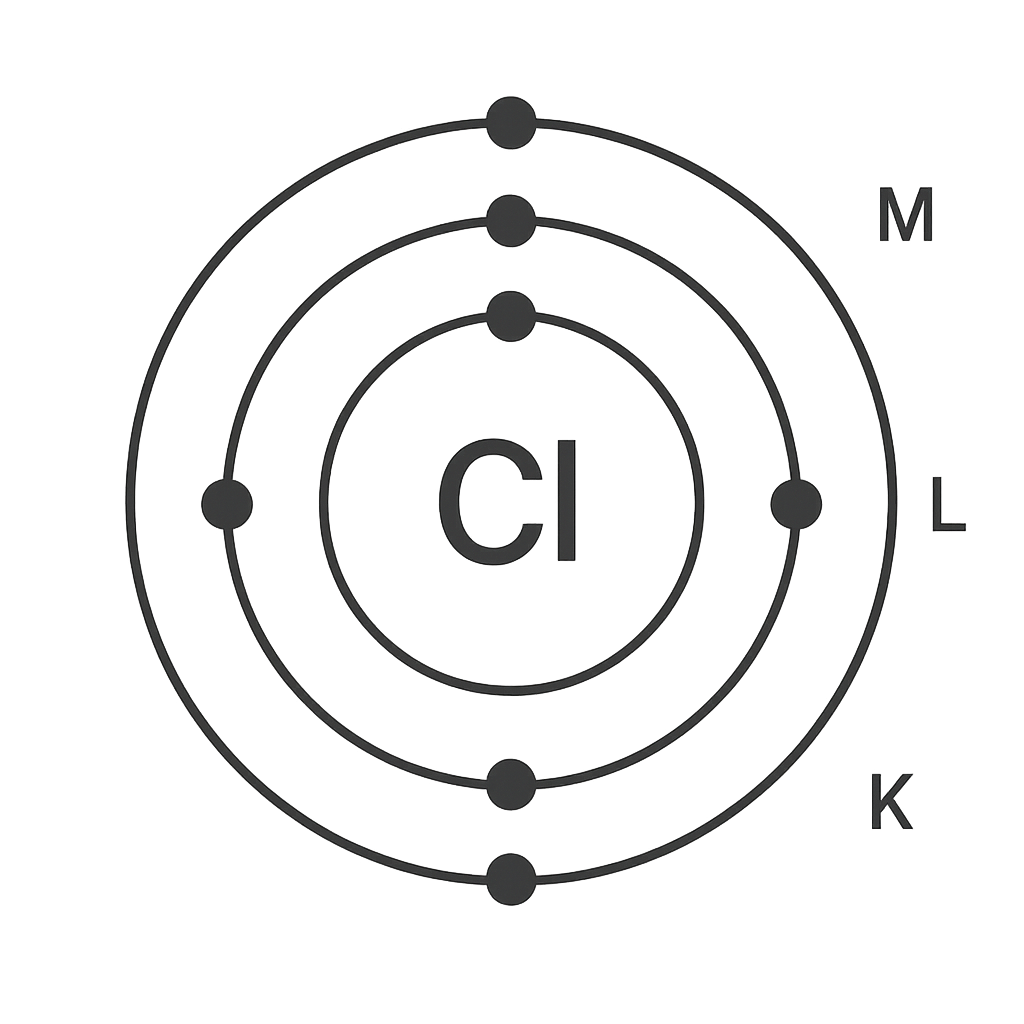
The diagram shows the Bohr model of a neutral atom of element X. The K shell contains 2 electrons, the L shell contains 8 electrons, and the M shell contains 7 electrons. (i) Determine the atomic number of element X. (ii) State the group number of element X in the periodic table. (iii) Give the most common oxidation state of element X.
A. Atomic number 16; group 16; oxidation state 0.
B. Atomic number 15; group 15; oxidation state +1.
Correct C. Atomic number 17; group 17; oxidation state -1.
D. Atomic number 18; group 16; oxidation state +2.

Correct Answer: C

Want to see the full step-by-step solution? Unlock AI Explanation & Analytics
Question 18 View Details
A steel pipe with an internal surface area of \(1500 \text{ cm}^2\) is immersed in seawater. The corrosion current density measured on the pipe surface is \(2.5 \;\mu\text{A cm}^{-2}\). The density of iron is \(7.87 \text{ g cm}^{-3}\) and its molar mass is \(55.85 \text{ g mol}^{-1}\). (a) Calculate the corrosion rate in millimetres per year. (b) If a protective coating reduces the corrosion current density by 80 %, what is the new corrosion rate (mm yr\(^{-1}\))? (c) Determine the mass of iron lost per year under the original (uncoated) condition, in kilograms.
A. a) 0.058 mm yr⁻¹; b) 0.0058 mm yr⁻¹ after coating; c) 0.068 kg of iron lost per year.
Correct B. a) 0.029 mm yr⁻¹; b) 0.0058 mm yr⁻¹ after coating; c) 0.034 kg of iron lost per year.
C. a) 0.0029 mm yr⁻¹; b) 0.00058 mm yr⁻¹ after coating; c) 0.0034 kg of iron lost per year.
D. a) 0.029 mm yr⁻¹; b) 0.0116 mm yr⁻¹ after coating; c) 0.034 kg of iron lost per year.

Correct Answer: B

Want to see the full step-by-step solution? Unlock AI Explanation & Analytics
Question 19 View Details
In an acidic solution, the following redox reaction occurs: \[ \mathrm{MnO_4^- + Fe^{2+} \rightarrow Mn^{2+} + Fe^{3+}} \] A 25.0 mL sample of 0.200 M \(\mathrm{KMnO_4}\) is titrated with excess \(\mathrm{Fe^{2+}}\) solution. The reaction is carried out in acidic medium supplied by \(\mathrm{H_2SO_4}\). (a) How many moles of \(\mathrm{Fe^{2+}}\) are required to react completely with the \(\mathrm{KMnO_4}\) sample? (b) How many millilitres of 0.500 M \(\mathrm{H_2SO_4}\) are needed to provide the required \(\mathrm{H^+}\) ions for the reaction?
A. a) 0.020 mol Fe²⁺; b) 32.0 mL of 0.500 M H₂SO₄.
B. a) 0.025 mol Fe²⁺; b) 20.0 mL of 0.500 M H₂SO₄.
Correct C. a) 0.025 mol Fe²⁺; b) 40.0 mL of 0.500 M H₂SO₄.
D. a) 0.050 mol Fe²⁺; b) 40.0 mL of 0.250 M H₂SO₄.

Correct Answer: C

Want to see the full step-by-step solution? Unlock AI Explanation & Analytics
Question 20 View Details
A 0.100 M solution of a monoprotic weak acid HA (unknown \(pK_a\)) is titrated with 0.100 M NaOH. At the half‑equivalence point the measured pH is 4.75. At the equivalence point the measured pH is 8.20. (a) Determine the \(pK_a\) and the acid dissociation constant \(K_a\) of HA. (b) Assuming the volume change during titration is negligible, calculate the concentration of \(\mathrm{OH^-}\) present at the equivalence point due to hydrolysis of the conjugate base \(\mathrm{A^-}\). (c) A buffer is prepared by mixing 25.0 mL of the 0.100 M HA solution with 25.0 mL of 0.100 M NaOH. Calculate the pH of this buffer.
A. a) pK_a = 3.75, K_a ≈ 1.78 × 10⁻⁴; b) [OH⁻] ≈ 2.0 × 10⁻⁶ M; c) pH of the buffer = 3.75.
Correct B. a) pK_a = 4.75, K_a ≈ 1.78 × 10⁻⁵; b) [OH⁻] ≈ 5.3 × 10⁻⁶ M; c) pH of the buffer = 4.75.
C. a) pK_a = 4.75, K_a ≈ 1.78 × 10⁻⁴; b) [OH⁻] ≈ 5.3 × 10⁻⁷ M; c) pH of the buffer = 4.00.
D. a) pK_a = 5.25, K_a ≈ 5.6 × 10⁻⁶; b) [OH⁻] ≈ 1.2 × 10⁻⁵ M; c) pH of the buffer = 5.25.

Correct Answer: B

Want to see the full step-by-step solution? Unlock AI Explanation & Analytics
Question 21 View Details
Hydrogen gas is passed over excess chlorine gas at 350 K and a total pressure of 1.20 atm. The resulting hydrogen chloride gas is collected over water and its volume measured as 2.50 L at the same temperature and pressure. The vapor pressure of water at 350 K is 0.55 atm. After the reaction, the remaining chlorine gas is contained in a 5.00 L vessel that was initially at 298 K and 1.00 atm. The pressure of the remaining chlorine gas in the vessel (still at 298 K) is found to be 0.86 atm. Calculate the initial mass of chlorine gas present in the vessel.
A. 13.2 g
Correct B. 14.5 g
C. 16.8 g
D. 12.0 g

Correct Answer: B

Want to see the full step-by-step solution? Unlock AI Explanation & Analytics
Question 22 View Details
An evacuated 10.0 L container at 298 K is heated with solid calcium carbonate. The decomposition of \(\mathrm{CaCO_3}\) produces \(\mathrm{CO_2}\), raising the pressure inside the container to 0.80 atm. The \(\mathrm{CO_2}\) is then allowed to react with excess magnesium metal according to \(\mathrm{CO_2 + 2\,Mg \rightarrow 2\,MgO + C}\). If 2.00 g of \(\mathrm{MgO}\) is obtained, calculate the mass of \(\mathrm{CaCO_3}\) that was originally present.
A. 3.12 g
B. 2.05 g
Correct C. 2.48 g
D. 1.90 g

Correct Answer: C

Want to see the full step-by-step solution? Unlock AI Explanation & Analytics
Question 23 View Details
What is the atomic number of the element that lies directly below chlorine in the periodic table?
A. 34
B. 36
Correct C. 35
D. 37

Correct Answer: C

Want to see the full step-by-step solution? Unlock AI Explanation & Analytics
Question 24 View Details
Given that the standard enthalpy change for the reaction \(\mathrm{N_2(g) + O_2(g) \rightarrow 2\,NO(g)}\) is +180.5 kJ, the standard enthalpy of formation of \(\mathrm{NH_3(g)}\) is -46.1 kJ·mol⁻¹, and that of liquid water \(\mathrm{H_2O(l)}\) is -285.8 kJ·mol⁻¹, calculate the standard enthalpy change for the combustion of ammonia: \(\mathrm{4\,NH_3(g) + 5\,O_2(g) \rightarrow 4\,NO(g) + 6\,H_2O(l)}\).
Correct A. -1.17×10^3 kJ
B. -1.07×10^3 kJ
C. -1.27×10^3 kJ
D. -1.17×10^2 kJ

Correct Answer: A

Want to see the full step-by-step solution? Unlock AI Explanation & Analytics
Question 25 View Details
A mixture containing 0.050 mol of 2‑bromo‑2‑methylpropane and 0.075 mol of aqueous NaOH is heated under reflux. The reaction follows an SN1 mechanism producing 2‑methyl‑2‑propanol and sodium bromide. Assuming 80 % of the alkyl bromide reacts, calculate the mass of 2‑methyl‑2‑propanol formed.
Correct A. 2.96 g
B. 2.12 g
C. 3.71 g
D. 5.56 g

Correct Answer: A

Want to see the full step-by-step solution? Unlock AI Explanation & Analytics

Master the Exam!

You've seen a preview, but there are thousands more questions plus AI tutor to break down complex solutions.

Unlock Full Access Available for Android & Windows
Help others prepare! Share this practice hub:
Chat with Support