neco model questions vol1 2017 biology | Objective

Prepare for your exams with neco model questions vol1 questions? Reviewing past/model questions is one of the most effective ways to guarantee a high score. This practice hub features authentic 2017 biology (Objective) questions designed to simulate the real exam environment.

Practice these randomly selected questions to test your readiness.

Question 1 View Details
During moderate exercise a person's heart rate rises to \(120\) beats per minute and the stroke volume increases by \(30\%\) from its resting value of \(70\) mL. The arterial oxygen content is \(20\) mL O₂ per \(100\) mL blood and the venous oxygen content is \(15\) mL O₂ per \(100\) mL blood. Calculate the rate of oxygen consumption (in mL O₂ per minute) at this exercise intensity.
A. 504
Correct B. 546
C. 600
D. 437

Correct Answer: B

Want to see the full step-by-step solution? Unlock AI Explanation & Analytics
Question 2 View Details
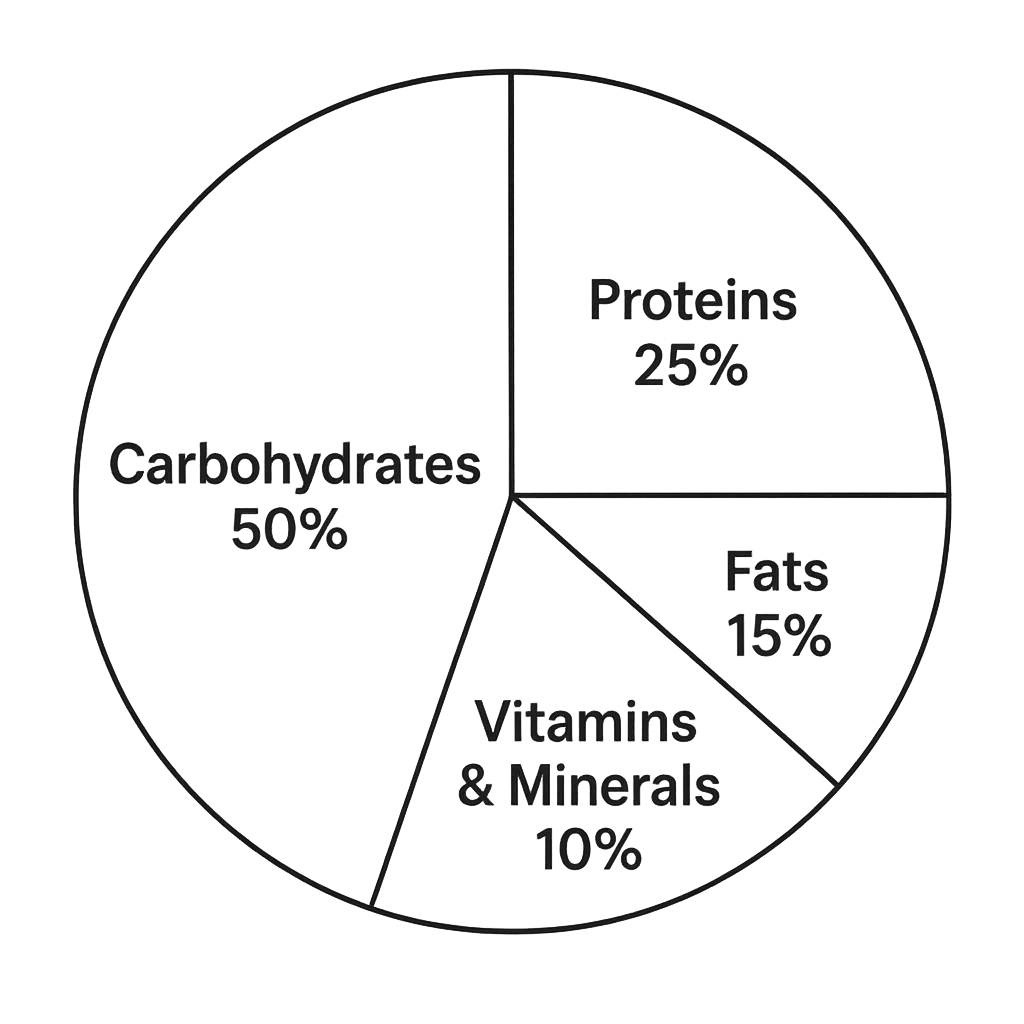
The diagram shows a balanced meal plate divided into four sections that represent the proportion of each nutrient group by weight: Carbohydrates \(50\%\), Proteins \(25\%\), Fats \(15\%\) and Vitamins & Minerals \(10\%\). If the total weight of the meal is \(500\) g and the caloric values are \(4\) kcal g⁻¹ for carbohydrates and proteins and \(9\) kcal g⁻¹ for fats, calculate the total energy content of the meal in kilocalories.
A. 1800
B. 2800
C. 2425
Correct D. 2175

Correct Answer: D

Want to see the full step-by-step solution? Unlock AI Explanation & Analytics
Question 3 View Details
In a community study, \(2\,000\) individuals are exposed to a certain risk factor and \(8\,000\) are not exposed. Among the exposed, \(150\) develop the disease, while among the non‑exposed, \(200\) develop the disease. (a) Calculate the relative risk (RR) of disease associated with the exposure. (b) Determine the attributable risk percent (ARP) among the exposed. (c) Compute the population attributable fraction (PAF) for the whole community.
A. RR = 2.5; ARP = 60 %; PAF = 22 %
B. RR = 3.4; ARP = 70 %; PAF = 30 %
Correct C. RR = 3.0; ARP = 66.7 %; PAF = 28.6 %
D. RR = 2.8; ARP = 55 %; PAF = 25 %

Correct Answer: C

Want to see the full step-by-step solution? Unlock AI Explanation & Analytics
Question 4 View Details
During prolonged exercise the body produces metabolic heat that raises core temperature at a rate of \(1.2^{\circ}\text{C h}^{-1}\). Heat is removed by sweating and by cutaneous vasodilation. The rate of heat loss by sweating is \(0.8^{\circ}\text{C h}^{-1}\) for each degree that the core temperature exceeds the normal set‑point of \(37^{\circ}\text{C}\). Vasodilation removes heat at \(0.5^{\circ}\text{C h}^{-1}\) per degree above the set‑point. Assuming steady‑state is reached, what is the core temperature (to one decimal place) at which heat production equals heat loss?
A. 38.7
B. 38.3
C. 37.5
Correct D. 37.9

Correct Answer: D

Want to see the full step-by-step solution? Unlock AI Explanation & Analytics
Question 5 View Details
A newly isolated virus, Virus X, has the following characteristics: (i) enveloped, (ii) double‑stranded RNA genome, (iii) icosahedral capsid, (iv) replication occurs in the cytoplasm. Using the classification table below, determine the family to which Virus X belongs. | Family | Genome | Envelope | Capsid symmetry | Replication site | |--------|--------|----------|----------------|-----------------| | A | dsRNA | enveloped | icosahedral | cytoplasm | | B | ssRNA(+) | enveloped | helical | nucleus | | C | ssRNA(-) | non‑enveloped | icosahedral | cytoplasm | | D | dsDNA | enveloped | icosahedral | nucleus | Select the correct family letter.
A. D
B. C
Correct C. A
D. B

Correct Answer: C

Want to see the full step-by-step solution? Unlock AI Explanation & Analytics
Question 6 View Details
Fossil measurements show that the length of a particular bone increased from 10 mm in a species that lived 5 million years ago to 30 mm in its descendant species that lived today. Using the darwin unit, where the rate of evolutionary change \(R\) is given by \(R = \frac{\ln (L_2/L_1)}{\Delta t}\) (with \(\Delta t\) in million years), calculate the rate of change in darwins. Give your answer to two decimal places.
A. 0.33
B. 0.44
Correct C. 0.22
D. 0.11

Correct Answer: C

Want to see the full step-by-step solution? Unlock AI Explanation & Analytics
Question 7 View Details
In a closed community, an infectious disease started with 5 cases. After three weeks, the number of cases rose to 80. The generation time of the disease is 7 days. Assuming discrete, non‑overlapping generations, estimate the basic reproduction number \(R_0\) (average number of secondary cases produced by one case). Provide your answer rounded to two decimal places.
A. 1.85
Correct B. 2.52
C. 2.10
D. 3.14

Correct Answer: B

Want to see the full step-by-step solution? Unlock AI Explanation & Analytics
Question 8 View Details
A phylogenetic tree shows taxa A and B as sister groups, both possessing a novel enzyme activity, while taxon C branches off earlier and its enzyme status is unknown. Using the principle of maximum parsimony, infer whether taxon C most likely has the enzyme activity or not. State "present" or "absent".
A. present
B. unknown
C. uncertain
Correct D. absent

Correct Answer: D

Want to see the full step-by-step solution? Unlock AI Explanation & Analytics
Question 9 View Details
Two genes, X and Y, are linked on the same chromosome with a recombination frequency of 10 %. In a test cross, what percentage of the offspring are expected to show recombinant phenotypes (i.e., new combinations of alleles)? Express your answer as a percentage.
A. 10
B. 40
C. 30
Correct D. 20

Correct Answer: D

Want to see the full step-by-step solution? Unlock AI Explanation & Analytics
Question 10 View Details
The photosynthetic rate of a leaf (in arbitrary units) is modeled by \(P(L) = 0.2L - 0.01L^{2}\), where \(L\) is the leaf area in cm\(^2\). Water loss from the leaf is given by \(W(L) = 0.05L\). The net benefit is \(B(L) = P(L) - W(L)\). Determine the leaf area \(L\) that maximizes \(B(L)\). Give your answer to one decimal place.
Correct A. 7.5
B. 12.5
C. 5.0
D. 10.0

Correct Answer: A

Want to see the full step-by-step solution? Unlock AI Explanation & Analytics
Question 11 View Details
In the regulation of blood glucose, insulin secretion follows the linear relation (s_i = a\,(G - G_{set})\) where (G) is the glucose concentration (mmol/L), (G_{set}=5\) mmol/L, and (a=0.5\) (units·min(^{-1}\)·mmol(^{-1}\)). Insulin removes glucose at a rate (R_{rem}=k_i\,I\) with (k_i=0.8\) (mmol·L(^{-1}\)·min(^{-1}\) per unit of insulin) and insulin degrades at a rate (0.1 I\) per minute. At steady state the net change in glucose is zero: \(\text{input}=R_{rem}\). After a meal the glucose input rises to \(0.6\) mmol·L(^{-1}\)·min(^{-1}\). Assuming the system quickly reaches a new steady state, what is the new steady‑state glucose concentration (G) (to one decimal place)?
A. 5.8
B. 4.8
C. 6.0
Correct D. 5.2

Correct Answer: D

Want to see the full step-by-step solution? Unlock AI Explanation & Analytics
Question 12 View Details
Two genes, \(A/a\) and \(B/b\), are located on the same chromosome with a recombination frequency of 20 %. A plant heterozygous for both genes has the coupling genotype \(AB/ab\). What is the probability that a gamete produced by this plant carries the recombinant genotype \(Ab\)? Express your answer as a decimal.
A. 0.05
B. 0.20
Correct C. 0.10
D. 0.15

Correct Answer: C

Want to see the full step-by-step solution? Unlock AI Explanation & Analytics
Question 13 View Details
A bacterial culture starts with \(2\times10^{6}\) cells. After 3 h the count is \(1.6\times10^{8}\) cells, and after a further 2 h (i.e., at 5 h total) the count reaches \(6.4\times10^{9}\) cells. Assuming exponential growth \(N = N_{0}\,2^{t/g}\) where \(g\) is the generation time (h),\n\n(a) Determine the generation time during the first 3 h interval.\n(b) Determine the generation time during the second 2 h interval.\n(c) Using the average generation time of the two intervals, predict the cell number after 8 h total culture time. Give your answer in scientific notation to two significant figures.
Correct A. 9.1×10^11
B. 7.5×10^11
C. 8.2×10^11
D. 1.0×10^12

Correct Answer: A

Want to see the full step-by-step solution? Unlock AI Explanation & Analytics
Question 14 View Details
A human somatic cell is diploid with a total of 46 chromosomes. During metaphase of mitosis each chromosome consists of two identical sister chromatids. How many chromosomes and how many chromatids are present in the cell at this stage?
Correct A. 46 chromosomes and 92 chromatids
B. 46 chromosomes and 184 chromatids
C. 46 chromosomes and 46 chromatids
D. 23 chromosomes and 46 chromatids

Correct Answer: A

Want to see the full step-by-step solution? Unlock AI Explanation & Analytics
Question 15 View Details
In an experiment the diffusion rate of oxygen across an alveolar membrane is measured as \(0.12\) cm³·s(^{-1}\) when the concentration difference across the membrane is \(0.04\) mol·cm(^{-3}\) and the membrane thickness is \(0.02\) cm. Assuming the rate follows Fick's law in the form \(R = D\,\frac{\Delta C}{d}\), where \(D\) is a constant for the given conditions, \(\Delta C\) is the concentration difference and \(d\) is the thickness,\n\n(a) Determine the value of \(D\).\n(b) If the membrane thickness is reduced to \(0.015\) cm and the concentration difference increases to \(0.05\) mol·cm(^{-3}\), what is the new diffusion rate? Give your answer to two decimal places in cm³·s(^{-1}\).
A. 0.22
B. 0.18
C. 0.25
Correct D. 0.20

Correct Answer: D

Want to see the full step-by-step solution? Unlock AI Explanation & Analytics
Question 16 View Details
During a post‑prandial state a person's blood glucose rises from (5\,\text{mmol/L}\) to (9\,\text{mmol/L}\). Insulin secretion at the basal glucose level (5 mmol/L) is (10\,\mu\text{U/mL}\) and increases by (10\,\mu\text{U/mL}\) for each additional mmol/L of glucose. Glucagon secretion at the basal level is (30\,\mu\text{U/mL}\) and decreases by (5\,\mu\text{U/mL}\) for each additional mmol/L of glucose. What is the ratio of the new insulin concentration to the new glucagon concentration (expressed as a decimal)?
A. 4.0
B. 6.0
C. 5.5
Correct D. 5.0

Correct Answer: D

Want to see the full step-by-step solution? Unlock AI Explanation & Analytics
Question 17 View Details
Two desert plant species differ in leaf adaptations. Species A has a stomatal density of 200 mm⁻², leaf thickness of 0.20 mm and a permeability constant of 0.8. Species B has a stomatal density of 120 mm⁻², leaf thickness of 0.15 mm and a permeability constant of 0.9. Assuming the same vapour‑pressure gradient for both, water‑loss rate is proportional to \(\dfrac{\text{density}\times k}{\text{thickness}}\). Which species shows the more effective xerophytic adaptation and by what percentage is its water‑loss rate lower than that of the other species?
A. Species B, 5%
B. Species A, 10%
C. Species A, 15%
Correct D. Species B, 10%

Correct Answer: D

Want to see the full step-by-step solution? Unlock AI Explanation & Analytics
Question 18 View Details
Two genes, \(A/a\) and \(B/b\), are linked on the same chromosome with a recombination frequency of 20 %. An individual heterozygous for both genes in the cis configuration (genotype \(AB/ab\)) is crossed with a homozygous recessive individual (genotype \(ab/ab\)). What proportion of the offspring will display a recombinant phenotype (i.e., \(Ab\) or \(aB\))?
A. 10%
B. 30%
Correct C. 20%
D. 40%

Correct Answer: C

Want to see the full step-by-step solution? Unlock AI Explanation & Analytics
Question 19 View Details
Renal plasma flow is measured at \(600\,\text{mL/min}\) and the filtration fraction is \(20\%\). Blood glucose concentration is \(12\,\text{mmol/L}\). Glucose is reabsorbed completely in the proximal tubule up to a plasma threshold of \(10\,\text{mmol/L}\). Calculate the amount of glucose (in \(\text{mmol/min}\)) that will be excreted in the urine per minute.
A. 0.60
B. 0.12
Correct C. 0.24
D. 0.48

Correct Answer: C

Want to see the full step-by-step solution? Unlock AI Explanation & Analytics
Question 20 View Details
Which cellular organelle is primarily responsible for the synthesis of ATP through oxidative phosphorylation?
Correct A. Mitochondrion
B. Nucleus
C. Endoplasmic reticulum
D. Chloroplast

Correct Answer: A

Want to see the full step-by-step solution? Unlock AI Explanation & Analytics
Question 21 View Details
An organelle in a eukaryotic cell is bounded by a double membrane, contains its own circular DNA, and is the site where most of the cell's ( \text{ATP} \) is produced through oxidative phosphorylation. Identify this organelle.
A. chloroplast
B. nucleus
Correct C. mitochondrion
D. ribosome

Correct Answer: C

Want to see the full step-by-step solution? Unlock AI Explanation & Analytics
Question 22 View Details
A filamentous fungus forms a mushroom with gills. Its hyphae are septate and possess clamp connections, and it reproduces by producing basidiospores. Based on these characteristics, to which taxonomic order does this fungus most likely belong?
A. Polyporales
B. Boletales
C. Russulales
Correct D. Agaricales

Correct Answer: D

Want to see the full step-by-step solution? Unlock AI Explanation & Analytics
Question 23 View Details
Chloroplasts, the site of photosynthesis in plant cells, are bounded by two membranes. How many membranes enclose a chloroplast?
A. 1
B. 3
Correct C. 2
D. 4

Correct Answer: C

Want to see the full step-by-step solution? Unlock AI Explanation & Analytics
Question 24 View Details
A desert plant exhibits a thick waxy cuticle and performs Crassulacean Acid Metabolism (CAM) photosynthesis. A floodplain plant possesses aerenchyma tissue and shallow root systems. If the regional climate shifts to a prolonged drought lasting several months, which plant's adaptation provides a greater survival advantage, and why?
A. The desert plant's thick cuticle actually hinders gas exchange, making the floodplain plant's adaptations more beneficial in prolonged drought.
B. Both plants would survive equally well, as their adaptations are equally effective in conserving water during drought.
Correct C. The desert plant's thick cuticle and CAM photosynthesis provide a greater advantage because they minimise water loss and allow carbon fixation with minimal transpiration.
D. The floodplain plant's aerenchyma tissue and shallow roots provide a greater advantage because they allow rapid water uptake during brief rain events.

Correct Answer: C

Want to see the full step-by-step solution? Unlock AI Explanation & Analytics
Question 25 View Details
A laboratory rat consumes \(20\ \text{g}\) of protein per day. Protein is approximately \(16\%\) nitrogen by weight, and \(16\%\) of the ingested nitrogen is excreted as urea. Each gram of urea contains \(0.467\ \text{g}\) nitrogen. Calculate the mass of urea (in grams, to two decimal places) excreted by the rat each day.
A. 0.95
Correct B. 1.10
C. 0.78
D. 1.25

Correct Answer: B

Want to see the full step-by-step solution? Unlock AI Explanation & Analytics

Master the Exam!

You've seen a preview, but there are thousands more questions plus AI tutor to break down complex solutions.

Unlock Full Access Available for Android & Windows
Help others prepare! Share this practice hub:
Chat with Support