neco model questions vol1 2017 agricultural_science | Objective

Prepare for your exams with neco model questions vol1 questions? Reviewing past/model questions is one of the most effective ways to guarantee a high score. This practice hub features authentic 2017 agricultural_science (Objective) questions designed to simulate the real exam environment.

Practice these randomly selected questions to test your readiness.

Question 1 View Details
A farmer has 1,200 maize plants. Initially 180 plants show symptoms of wilt disease. After applying a fungicide, only 30 plants remain infected. The fungicide costs N200 per hectare (field size = 1 ha). Each infected plant would otherwise lose a yield worth N150. Calculate (a) the percentage reduction in disease incidence, and (b) the net economic benefit of the treatment.
Correct A. 83.33 % reduction; net economic benefit = N22,300
B. 90.00 % reduction; net economic benefit = N25,000
C. 85.00 % reduction; net economic benefit = N23,500
D. 78.57 % reduction; net economic benefit = N19,800

Correct Answer: A

Want to see the full step-by-step solution? Unlock AI Explanation & Analytics
Question 2 View Details
The pH of a soil is 5.5. The farmer wants to raise it to 6.5. The soil's buffer capacity is 0.4 pH units per tonne of agricultural lime (CaCO₃) per hectare. How many tonnes of lime are required per hectare?
A. 3.0
Correct B. 2.5
C. 4.0
D. 2.0

Correct Answer: B

Want to see the full step-by-step solution? Unlock AI Explanation & Analytics
Question 3 View Details
A poultry farm has fixed costs of N150,000 per year. Variable cost per bird (feed, medication, etc.) is N2,500 and the selling price per bird is N3,500. (a) Determine the break‑even number of birds. (b) If the price of feed rises by 10 % causing the variable cost per bird to increase accordingly, what is the new break‑even number of birds and how many additional birds must be sold to cover the same fixed costs?
A. Initially 130 birds; after feed cost rise 180 birds (an additional 50 birds).
B. Initially 150 birds; after feed cost rise 210 birds (an additional 60 birds).
C. Initially 140 birds; after feed cost rise 190 birds (an additional 50 birds).
Correct D. Initially 150 birds; after feed cost rise 200 birds (an additional 50 birds).

Correct Answer: D

Want to see the full step-by-step solution? Unlock AI Explanation & Analytics
Question 4 View Details
In a wheat field a rust disease can develop only when three conditions of the disease triangle are satisfied: a susceptible wheat variety, presence of urediniospore inoculum, and leaf wetness for at least 6 hours. In the current season the wheat variety is resistant, but inoculum is abundant and leaf wetness lasts 8 hours. Identify which component of the disease triangle is missing and recommend one integrated management practice to prevent the disease if a susceptible variety were planted next season.
A. Missing component: susceptible host. Integrated practice: increase fertilizer application and delay planting.
B. Missing component: leaf wetness. Integrated practice: apply irrigation to keep foliage dry and rotate crops.
Correct C. Missing component: susceptible host. Integrated practice: use resistant varieties together with timely fungicide application and field sanitation.
D. Missing component: inoculum. Integrated practice: plant resistant varieties and apply soil solarization.

Correct Answer: C

Want to see the full step-by-step solution? Unlock AI Explanation & Analytics
Question 5 View Details
A herd of 25 goats each weighing 45 kg shows signs of parasitic infection. The recommended dose of ivermectin is 0.2 mg per kg body weight, administered as a 1 % (w/v) solution (1 g in 100 ml). The drug costs N500 per 100 ml vial. Calculate (a) the total amount of ivermectin required for the herd (in mg), (b) the total volume of the 1 % solution needed (in ml), and (c) the total cost of the drug assuming a whole vial must be purchased.
Correct A. 225 mg ivermectin; 22.5 ml of 1 % solution; total cost N500.
B. 200 mg ivermectin; 20 ml of 1 % solution; total cost N500.
C. 250 mg ivermectin; 25 ml of 1 % solution; total cost N500.
D. 225 mg ivermectin; 22.5 ml of 1 % solution; total cost N1000.

Correct Answer: A

Want to see the full step-by-step solution? Unlock AI Explanation & Analytics
Question 6 View Details
Maize is harvested weighing \(10\,000\) kg with a moisture content of \(25\%\) (wet basis). The safe storage moisture is \(13\%\). At \(35\,^{\circ}\text{C}\) the moisture content falls by \(0.5\) percentage points per day with no other loss. At \(45\,^{\circ}\text{C}\) the moisture content falls by \(0.8\) percentage points per day but a volatilisation loss of \(2\%\) of the current weight occurs each day in addition to the water removed. The farmer dries the crop for three days at \(35\,^{\circ}\text{C}\) and then switches to \(45\,^{\circ}\text{C}\) until the moisture reaches the target. Determine (a) the total weight of maize after drying (to the nearest kilogram), (b) the total number of drying days, and (c) the percentage loss of the original dry‑matter (dry matter corresponds to the weight at \(0\%\) moisture).
Correct A. Weight after drying ≈ 6 450 kg; total drying days = 17; dry‑matter loss ≈ 24.6 %
B. Weight after drying ≈ 5 950 kg; total drying days = 16; dry‑matter loss ≈ 30.0 %
C. Weight after drying ≈ 6 800 kg; total drying days = 18; dry‑matter loss ≈ 22.1 %
D. Weight after drying ≈ 6 200 kg; total drying days = 15; dry‑matter loss ≈ 27.3 %

Correct Answer: A

Want to see the full step-by-step solution? Unlock AI Explanation & Analytics
Question 7 View Details
During a six‑week maize season a farmer monitors the stem‑borer population. The population at the start of each week (larvae per plant) is: Week 1 = 3, Week 2 = 4.5, Week 3 = 6.75. If uncontrolled, the population multiplies by a factor of 1.5 each week. The economic threshold is 5 larvae per plant. The farmer can use (i) cultural control, which reduces the weekly multiplication factor to 1.0, (ii) biological control, which reduces the population by 30 % each week, or (iii) chemical control, which reduces the population instantly by 70 % and thereafter the population remains at that reduced level (no further growth). Assuming the season lasts six weeks, determine the earliest week in which chemical control must be applied so that the population stays below the threshold for the remainder of the season. Also, compare this with using biological control starting at the beginning of week 3 and calculate how many weeks of sub‑threshold population are saved by the chemical treatment.
A. Chemical control must be applied at the start of Week 5; it saves 1 full week of sub‑threshold population compared with using biological control from Week 3.
Correct B. Chemical control must be applied at the start of Week 3; it saves 1 full week of sub‑threshold population compared with using biological control from Week 3.
C. Chemical control must be applied at the start of Week 2; it saves 0 full weeks of sub‑threshold population compared with using biological control from Week 3.
D. Chemical control must be applied at the start of Week 4; it saves 2 full weeks of sub‑threshold population compared with using biological control from Week 3.

Correct Answer: B

Want to see the full step-by-step solution? Unlock AI Explanation & Analytics
Question 8 View Details
A soil test shows an exchangeable acidity of 2 cmol\(_c\) kg\(^{-1}\). To raise the pH by one unit, 1.5 t of agricultural lime are required per hectare for each cmol\(_c\) kg\(^{-1}\) of acidity. A farmer has a 5‑acre field. Determine the total amount of lime (in kilograms) needed for the field.
A. ≈ 6 500 kg of lime
B. ≈ 5 500 kg of lime
Correct C. ≈ 6 073 kg of lime
D. ≈ 7 200 kg of lime

Correct Answer: C

Want to see the full step-by-step solution? Unlock AI Explanation & Analytics
Question 9 View Details
A farmer has 2 t (2000 kg) of fresh cassava chips to store for six months. Two storage options are available:\n\n* Hermetic bags: cost \$2 per bag, each bag holds 50 kg, labour cost \$0.10 per bag per month, and post‑harvest loss is reduced to 2 %.\n* Traditional bags: cost \$0.5 per bag, each bag holds 25 kg, labour cost \$0.02 per bag per month, and post‑harvest loss is 15 %.\n\nThe market price of good cassava chips is \$0.30 per kg, and the purchase cost of the chips is \$0.20 per kg. Calculate for each option (a) total storage cost, (b) total loss (kg), (c) total revenue, (d) net profit, and (e) the difference in net profit between the two options.
A. Hermetic profit = $90; Traditional profit = $62.00; Hermetic yields $28.00 more profit.
Correct B. Hermetic profit = $84; Traditional profit = $60.40; Hermetic yields $23.60 more profit.
C. Hermetic profit = $80; Traditional profit = $60.40; Hermetic yields $19.60 more profit.
D. Hermetic profit = $78; Traditional profit = $55.20; Hermetic yields $22.80 more profit.

Correct Answer: B

Want to see the full step-by-step solution? Unlock AI Explanation & Analytics
Question 10 View Details
A goat requires daily 200 g of crude protein (CP) and 1 200 kcal of metabolizable energy (ME). Two feed ingredients are available:\n\n* Feed A: 15 % CP and 2 500 kcal kg\(^{-1}\) ME.\n* Feed B: 25 % CP and 2 000 kcal kg\(^{-1}\) ME.\n\nAssuming the feeds can be mixed in any proportion and the total daily feed intake cannot exceed 2.5 kg, determine the least amount (in kilograms) of each feed that will meet the protein requirement exactly while providing at least the required energy. Also state the amount of excess energy (kcal) supplied.
A. Feed A = 1.2 kg, Feed B = 0.3 kg; excess energy = 1500 kcal
B. Feed A = 0.5 kg, Feed B = 0.5 kg; excess energy = 250 kcal
C. Feed A = 0.8 kg, Feed B = 0 kg; excess energy = 1000 kcal
Correct D. Feed A = 0 kg, Feed B = 0.8 kg; excess energy = 400 kcal

Correct Answer: D

Want to see the full step-by-step solution? Unlock AI Explanation & Analytics
Question 11 View Details
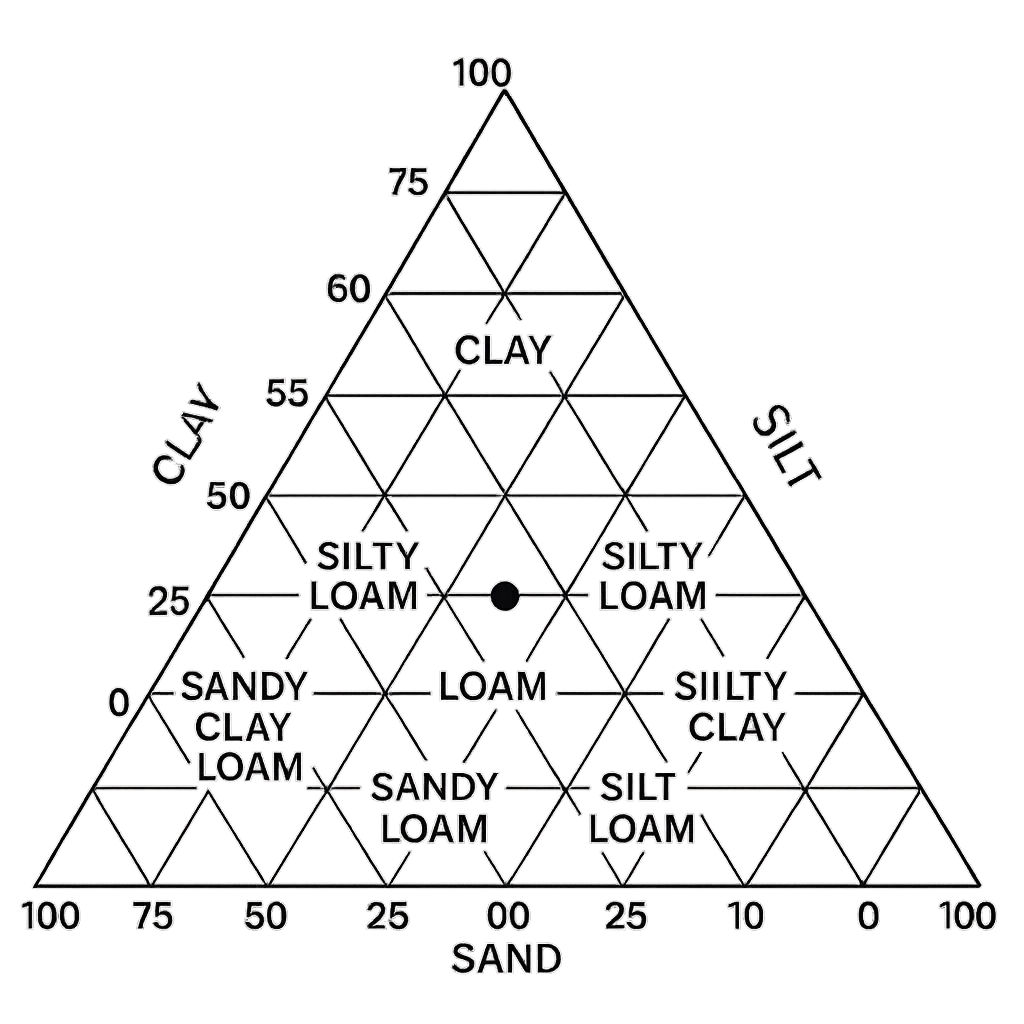
A soil sample is examined using the sedimentation method. The diagram shows the proportions of sand, silt and clay in the sample as \(30\%\), \(45\%\) and \(25\%\) respectively. Determine the soil texture class according to the USDA textural triangle.
A. Clay loam
Correct B. Loam
C. Sandy loam
D. Silt loam

Correct Answer: B

Want to see the full step-by-step solution? Unlock AI Explanation & Analytics
Question 12 View Details
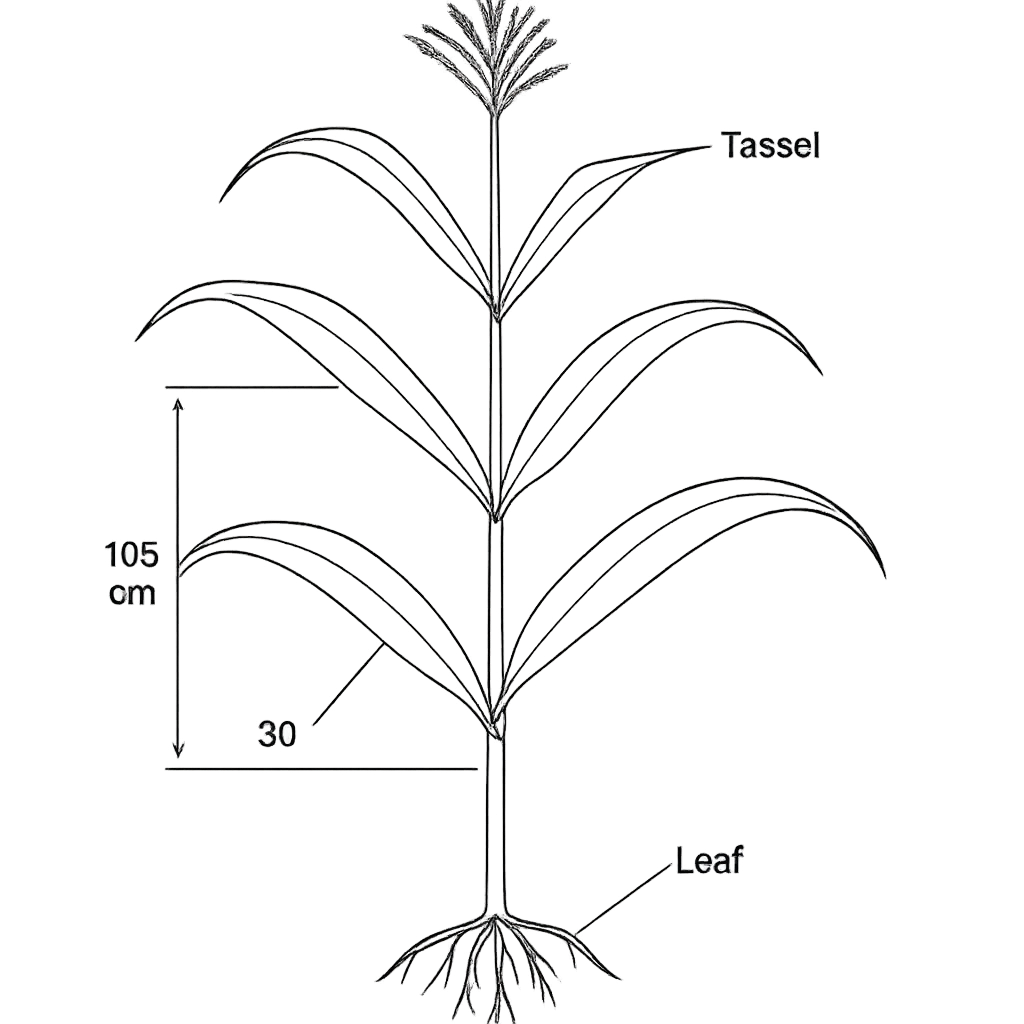
The diagram shows a mature maize plant with five leaves. Each leaf is \(150\) cm long, \(20\) cm wide and inclined at \(30^{\circ}\) from the vertical. Calculate the total effective leaf area exposed to sunlight (in square metres), taking into account the reduction by the cosine of the leaf angle.
A. 1.50 m^2
B. 1.20 m^2
C. 0.75 m^2
Correct D. 1.30 m^2

Correct Answer: D

Want to see the full step-by-step solution? Unlock AI Explanation & Analytics
Question 13 View Details
A farmer can use either a moldboard plough or a disc plough. The draft required for the moldboard plough is \(D_m = 0.8\,W\) (N) and for the disc plough \(D_d = 0.5\,W + 30\) (N), where \(W\) is the weight of soil turned per furrow in kilograms. The soil bulk density is \(1.4\) g cm\(^{-3}\). Each furrow is \(30\) cm wide, \(20\) cm deep and \(10\) m long. The tractor can supply a maximum draft of \(1500\) N. Which plough can be used without exceeding the tractor's capacity?
A. Disc plough (requires 600 N, lower than moldboard's 800 N)
B. Moldboard plough (requires 672 N, exceeds tractor capacity)
Correct C. Disc plough (requires 450 N, lower than moldboard's 672 N)
D. Moldboard plough (requires 450 N, lower than disc's 672 N)

Correct Answer: C

Want to see the full step-by-step solution? Unlock AI Explanation & Analytics
Question 14 View Details
A dairy farmer wants to formulate a least‑cost daily ration for a cow that produces \(28\) kg of milk. The cow requires \(0.09\) kg of crude protein (CP) and \(0.55\) MJ of metabolizable energy (ME) per kg of milk. Two feed ingredients are available:\n- Feed A: 20\% CP, 12 MJ kg\(^{-1}\) ME, cost \(\text{₦}150\) per kg.\n- Feed B: 12\% CP, 9 MJ kg\(^{-1}\) ME, cost \(\text{₦}100\) per kg.\nDetermine the least‑cost combination (kg of each feed) that meets the cow's daily CP and ME requirements, and state the total cost.
Correct A. 12.5 kg Feed A, 0 kg Feed B; total cost ₦1875
B. 0 kg Feed A, 20 kg Feed B; total cost ₦2000
C. 10 kg Feed A, 5 kg Feed B; total cost ₦2000
D. 15 kg Feed A, 0 kg Feed B; total cost ₦2250

Correct Answer: A

Want to see the full step-by-step solution? Unlock AI Explanation & Analytics
Question 15 View Details
An extension officer wishes to estimate the adoption rate of a new fertilizer among 2,000 farmers in a district. He uses a two‑stage cluster sample: first, 10 villages are selected at random from 50 villages; second, 20 farmers are selected at random from each chosen village (total sample size = 200). In the sample, 120 farmers have adopted the fertilizer. Assuming simple random sampling within villages and ignoring finite‑population correction, compute a 95 % confidence interval for the true adoption proportion in the district. Also, identify one possible source of bias in this design and suggest a way to reduce it.
A. 95 % CI ≈ (0.500, 0.640); bias - under‑coverage of villages, mitigate by increasing the number of villages sampled
B. 95 % CI ≈ (0.550, 0.690); bias - measurement error in adoption reporting, mitigate by cross‑checking with purchase records
Correct C. 95 % CI ≈ (0.532, 0.668); bias - intra‑cluster correlation, mitigate by sampling more villages or using a design‑effect adjustment.
D. 95 % CI ≈ (0.480, 0.620); bias - non‑random farmer selection, mitigate by randomizing farmer lists within villages

Correct Answer: C

Want to see the full step-by-step solution? Unlock AI Explanation & Analytics
Question 16 View Details
A farmer has a \(1.5\)-hectare field with a topsoil depth of \(20\) cm and a bulk density of \(1.2\) g cm\(^{-3}\). The soil currently contains \(0.1\%\) nitrogen by weight. The farmer wants to raise the nitrogen content to \(0.15\%\) by applying urea, which is \(46\%\) nitrogen by mass. How many kilograms of urea must be applied?
A. 4200
Correct B. 3913
C. 5000
D. 3500

Correct Answer: B

Want to see the full step-by-step solution? Unlock AI Explanation & Analytics
Question 17 View Details
A mixed farm plans to grow maize (yield \(4\) t ha\(^{-1}\)) and cowpea (yield \(2\) t ha\(^{-1}\)). The farmer needs to produce at least \(12\) tonnes of food per season and must allocate at least \(30\%\) of the cultivated land to cowpea for soil‑fertility reasons. What is the minimum total cultivated area (in hectares) required to meet the food target?
A. 4.20
B. 3.00
Correct C. 3.53
D. 2.80

Correct Answer: C

Want to see the full step-by-step solution? Unlock AI Explanation & Analytics
Question 18 View Details
A farmer intends to sow \(1\) ha of maize using two varieties, A and B, in the ratio \(3:2\) (by number of plants). The target plant population is \(60,000\) plants per hectare. Variety A seeds weigh \(0.25\) g each and have a germination rate of \(90\%\); variety B seeds weigh \(0.30\) g each and have a germination rate of \(80\%\). If the rows are spaced \(75\) cm apart, how many kilograms of seed mixture must be purchased?
A. 17
B. 23
C. 21
Correct D. 19

Correct Answer: D

Want to see the full step-by-step solution? Unlock AI Explanation & Analytics
Question 19 View Details
A first‑class lever is used to lift a \(200\) kg load. The distance from the fulcrum to the effort point is \(0.8\) m and the distance from the fulcrum to the load is \(0.2\) m. If the lever operates with an efficiency of \(85\%\), what is the magnitude of the effort force that must be applied (in newtons)?
Correct A. 577
B. 720
C. 650
D. 500

Correct Answer: A

Want to see the full step-by-step solution? Unlock AI Explanation & Analytics
Question 20 View Details
A farmer can cultivate two crops, X and Y, on a total of \(5\) ha. The costs and returns are:\n\n- Crop X: fixed cost ₦150 000, variable cost ₦50 000 ha\(^{-1}\), expected yield \(4\) t ha\(^{-1}\), market price \(P_X\) (₦ t\(^{-1}\)). The government gives a subsidy equal to \(10\%\) of the gross revenue from X.\n\n- Crop Y: fixed cost ₦100 000, variable cost ₦70 000 ha\(^{-1}\), expected yield \(3\) t ha\(^{-1}\), market price ₦150 000 t\(^{-1}\). No subsidy.\n\nThe farmer must allocate at least \(1\) ha to crop Y for crop‑rotation purposes. Determine the minimum market price of crop X (in ₦ per tonne) that makes it more profitable to plant the entire \(5\) ha with crop X (and \(0\) ha with Y) than to plant \(4\) ha with X and \(1\) ha with Y. Give your answer to the nearest thousand naira.
Correct A. 75000
B. 78000
C. 72000
D. 69000

Correct Answer: A

Want to see the full step-by-step solution? Unlock AI Explanation & Analytics
Question 21 View Details
A field requires (150\,\text{kg N}\) per hectare per season. A farmer plans to apply (90\,\text{kg}\) of urea (which is (46\%\) N) and to use a legume intercrop that fixes (20\,\text{kg N}\) per hectare. Will the combined nitrogen supply meet the requirement? Show the calculation and answer Yes or No.
Correct A. No
B. True
C. Affirmative
D. Yes

Correct Answer: A

Want to see the full step-by-step solution? Unlock AI Explanation & Analytics
Question 22 View Details
In the diagram, a rigid beam is pivoted at point O acting as a fulcrum. A load of (200\,\text{N}\) is attached (0.5\,\text{m}\) from O on the short arm, while effort is applied on the long arm (2.0\,\text{m}\) from O. Assuming the beam is weightless and frictionless, calculate the effort force required to balance the load.
A. 40 N
B. 55 N
Correct C. 50 N
D. 75 N

Correct Answer: C

Want to see the full step-by-step solution? Unlock AI Explanation & Analytics
Question 23 View Details
A survey of 100 wheat plants gave the following disease severity ratings (scale 0-5): 30 plants rated 0, 40 rated 1, 20 rated 2, 5 rated 3 and 5 rated 4. Using the disease severity index formula \(DS = \frac{\sum (rating \times number\;of\;plants)}{(max\;rating \times total\;plants)} \times 100\), calculate the disease severity percentage for the field.
A. 25%
B. 30%
Correct C. 23%
D. 20%

Correct Answer: C

Want to see the full step-by-step solution? Unlock AI Explanation & Analytics
Question 24 View Details
A maize field has an average of 1.5 fall armyworm larvae per plant. Each larva can cause a loss of \(0.01\,\text{kg}\) of grain. The field contains \(60{,}000\) plants per hectare. The market price of maize is \(\text{₦}200\) per kilogram. An insecticide treatment costs \(\text{₦}5{,}000\) per hectare and completely prevents loss from up to 10 larvae per plant. Should the farmer apply the insecticide? Show the economic comparison and answer Yes or No.
A. No
B. Maybe
Correct C. Yes
D. Undecided

Correct Answer: C

Want to see the full step-by-step solution? Unlock AI Explanation & Analytics
Question 25 View Details
A farmer needs to pump water from a well 25 m deep at a rate of 30 L min\(^{-1}\). The pump efficiency is 70 % and the motor (tractor PTO) efficiency is 85 %. Determine the minimum power in kilowatts that the PTO must supply. (Use \(\rho = 1000\,\text{kg m}^{-3}\) and \(g = 9.81\,\text{m s}^{-2}\)).
Correct A. 0.21 kW
B. 0.25 kW
C. 0.30 kW
D. 0.15 kW

Correct Answer: A

Want to see the full step-by-step solution? Unlock AI Explanation & Analytics

Master the Exam!

You've seen a preview, but there are thousands more questions plus AI tutor to break down complex solutions.

Unlock Full Access Available for Android & Windows
Help others prepare! Share this practice hub:
Chat with Support