neco 2025 physics | Essay

Prepare for your exams with neco questions? Reviewing past/model questions is one of the most effective ways to guarantee a high score. This practice hub features authentic 2025 physics (Essay) questions designed to simulate the real exam environment.

Practice these randomly selected questions to test your readiness.
Question 1 View Details
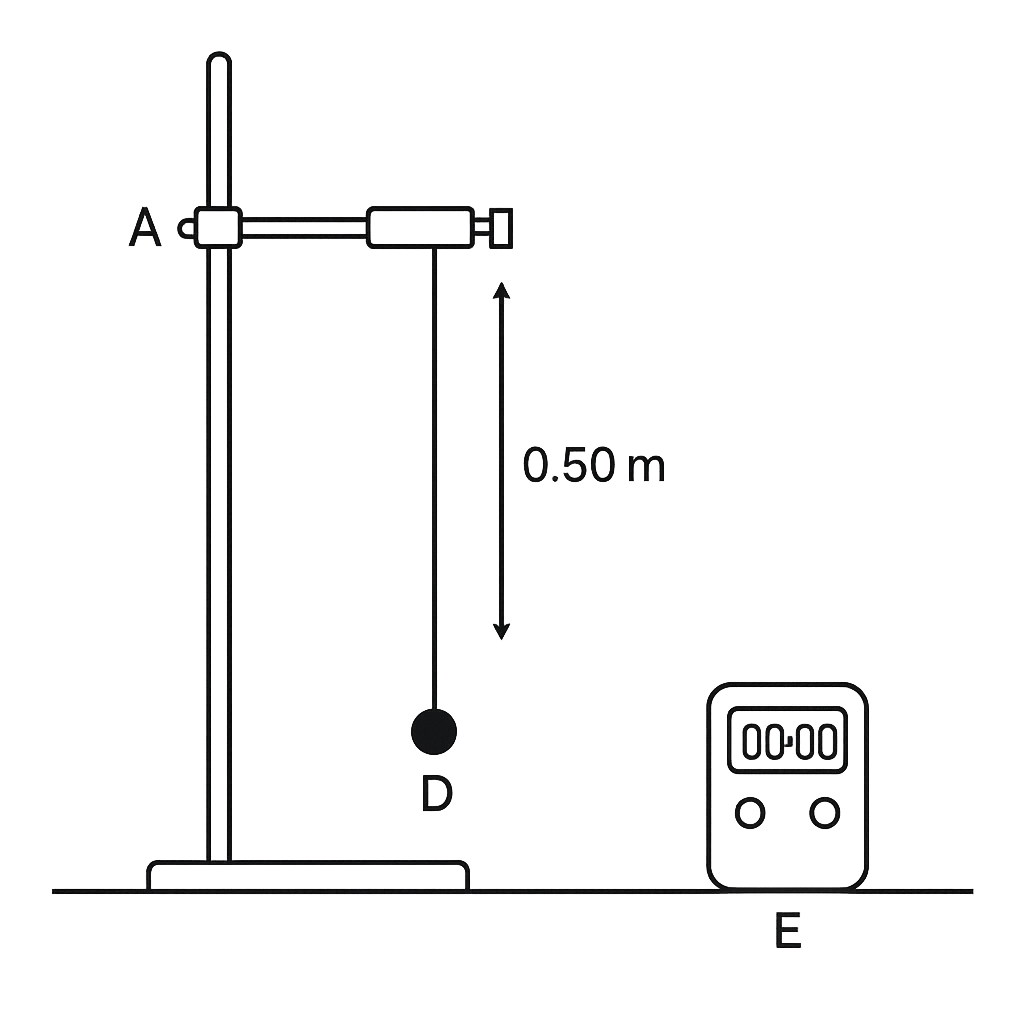
A physics practical is arranged to determine the acceleration due to gravity (g) using a simple pendulum. The apparatus consists of a light string attached to a small dense bob. The length of the string is measured from the point of suspension to the centre of the bob and recorded as 0.50 m (uncertainty ±0.005 m). A digital stopwatch is used to time 20 complete oscillations. The recorded times for three successive trials are: Trial 1 – 28.0 s, Trial 2 – 27.6 s, Trial 3 – 27.9 s. Using the relation \(T = 2\pi\sqrt{\frac{L}{g}}\) where \(T\) is the period of one oscillation, determine the value of g for each trial, the mean value of g and the percentage error with respect to the accepted value 9.80 m s⁻². Also discuss possible sources of error and suggest improvements.
Question Parts
(a)
Calculate the period of the pendulum for each trial.
(b)
Using the period obtained, calculate the value of g for each trial.
(c)
Find the mean value of g from the three trials and the percentage error relative to 9.80 m s⁻².
(d)
State two systematic errors and two random errors that could affect the result and suggest one practical improvement.
Detailed Essay Solution & Marking Scheme Available

Get the step-by-step mathematical proofs, key points required by examiners, and a comprehensive breakdown from our AI Tutor.
Question 2 View Details
A car moves along a straight road. It starts from rest and accelerates uniformly to a speed of 20 m s⁻¹ in 5 s. It then travels at this constant speed for 40 s, after which it decelerates uniformly to rest in 8 s. During the constant‑speed phase a steady wind exerts a force of 150 N opposite to the direction of motion. The mass of the car is 1200 kg.
Question Parts
(a)
Determine the magnitude of the acceleration during the first phase and the magnitude of the deceleration during the third phase.
(b)
Calculate the total distance covered by the car during the whole motion.
(c)
Sketch a velocity‑time graph for the motion and state the gradient of each segment and the area under the graph.
(d)
If the wind force of 150 N acts only during the constant‑speed phase, determine the power output of the engine during that phase.
Detailed Essay Solution & Marking Scheme Available

Get the step-by-step mathematical proofs, key points required by examiners, and a comprehensive breakdown from our AI Tutor.
Question 3 View Details
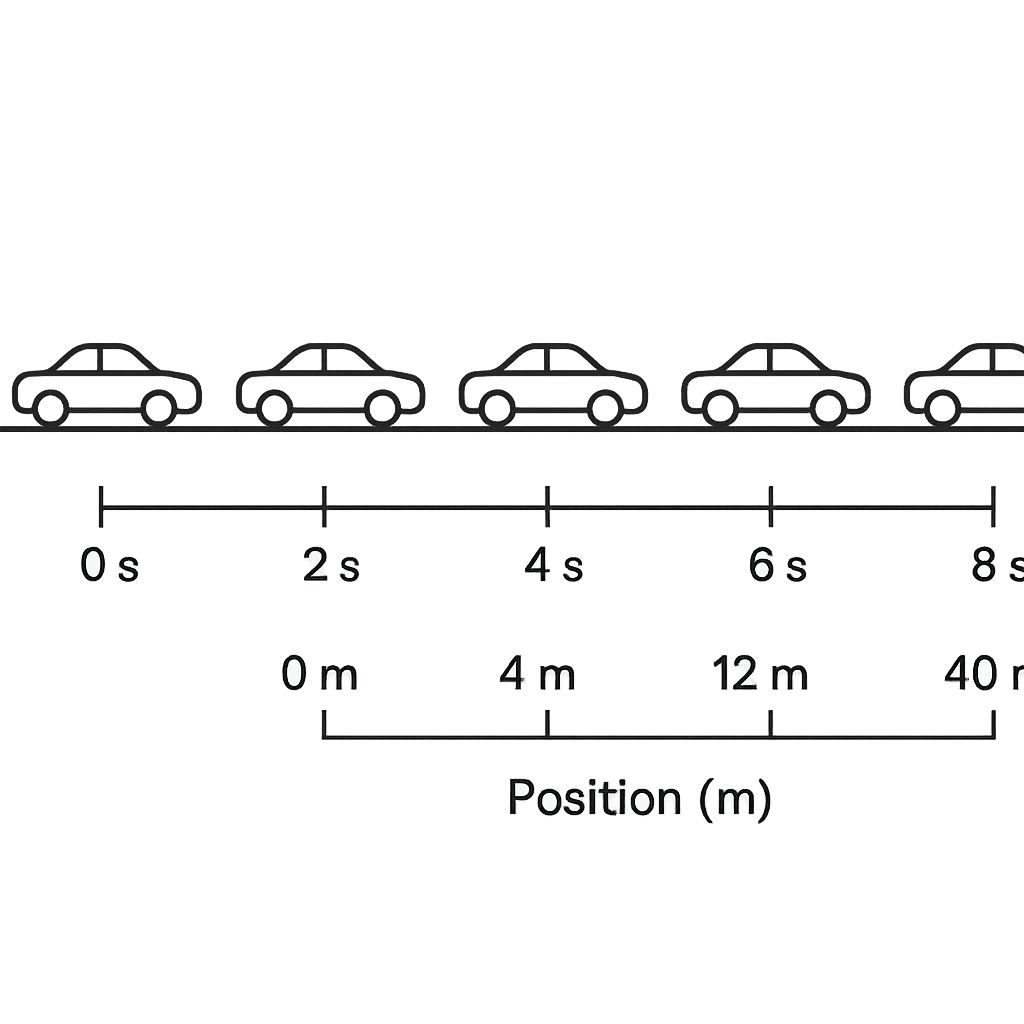
A car moves in a straight line on a horizontal road. A motion diagram of the car is provided, showing its position at successive 2‑second intervals. The positions measured from the starting point are 0 m, 4 m, 12 m, 24 m and 40 m.
Question Parts
(a)
Calculate the average speed of the car between the first and the last recorded positions.
(b)
Assuming the car moves with constant acceleration, determine the magnitude of the acceleration and the initial speed of the car.
(c)
Using the values obtained in part (b), predict the distance of the car from the start after 10 s.
(d)
Sketch the velocity–time graph for the motion of the car from t = 0 s to t = 10 s, clearly indicating the initial speed and the acceleration.
Detailed Essay Solution & Marking Scheme Available

Get the step-by-step mathematical proofs, key points required by examiners, and a comprehensive breakdown from our AI Tutor.

Question 4 View Details
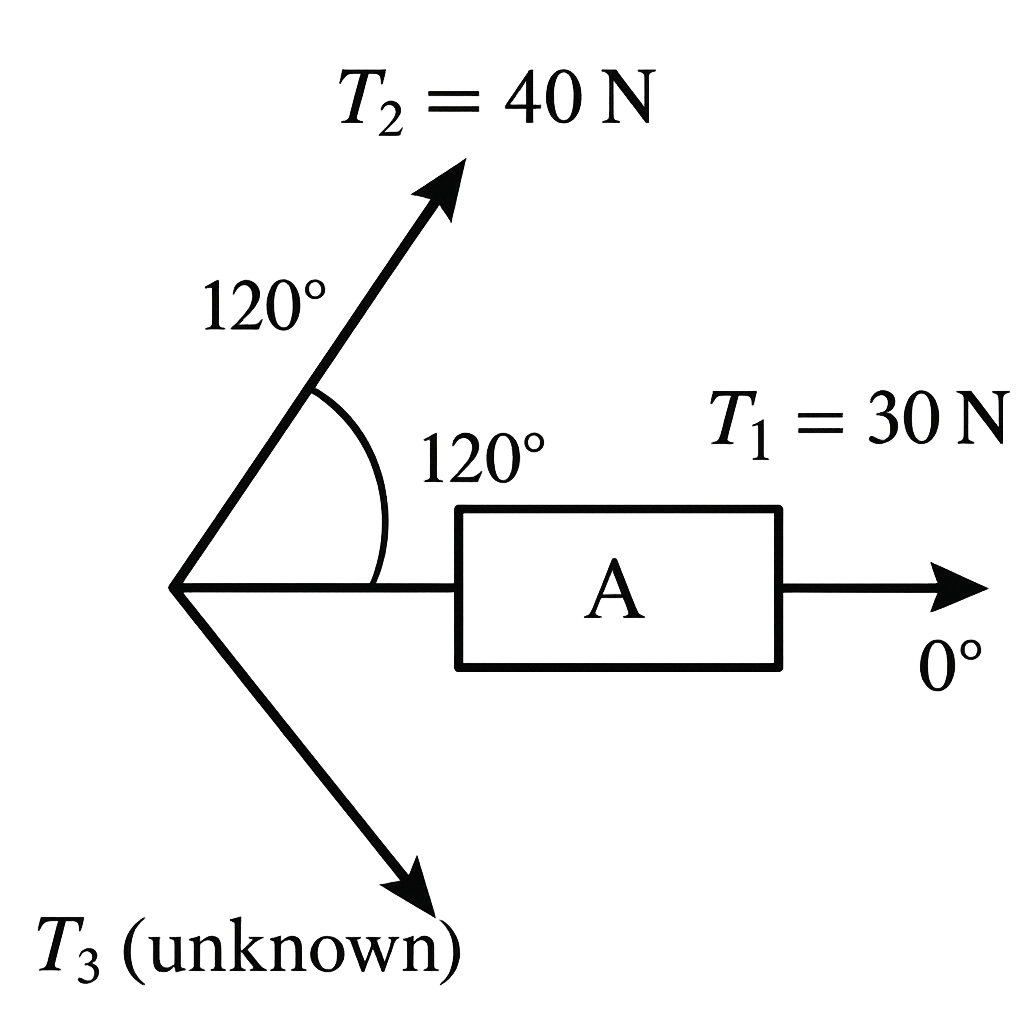
A block of mass 5.0 kg rests on a horizontal surface. Three forces act on the block as shown in the force diagram. \(T_{1}\) has a magnitude of 30 N and acts horizontally to the right (0°). \(T_{2}\) has a magnitude of 40 N and acts at 120° measured anticlockwise from the positive x‑axis. \(T_{3}\) acts at 210° and its magnitude is unknown. The surface is smooth unless otherwise stated. Using the diagram, answer the following:
Question Parts
(a)
Determine the magnitude and direction of the resultant of the known forces \(T_{1}\) and \(T_{2}\). Express the direction as the angle measured anticlockwise from the positive x‑axis and give the magnitude to one decimal place.
(b)
For the block to move with constant velocity on the smooth surface, the net force must be zero. Determine the magnitude and direction of the unknown force \(T_{3}\) required to satisfy this condition.
(c)
Now the surface is rough with a coefficient of kinetic friction \(\mu_k = 0.20\). The block again moves with constant velocity under the three forces (including the \(T_{3}\) found in part (b)). Calculate the magnitude of the kinetic friction force and state its direction relative to the resultant of the applied forces.
Detailed Essay Solution & Marking Scheme Available

Get the step-by-step mathematical proofs, key points required by examiners, and a comprehensive breakdown from our AI Tutor.

Question 5 View Details
A 1500 kg car is driven up a straight road that makes an angle of 30\(^\circ\) with the horizontal. The road is rough and the coefficient of rolling friction between the tyres and the road is 0.02. The car moves up the incline at a constant speed, covering a distance of 200 m in 25 s.
Question Parts
(a)
Determine the minimum constant force that the engine must exert to pull the car up the incline at constant speed.
(b)
Using the force found in part (a), calculate the average power output of the engine during the 25 s interval.
(c)
If the engine actually delivers 20% more power than the value obtained in part (b), determine the extra energy that is dissipated as heat during the ascent.
Detailed Essay Solution & Marking Scheme Available

Get the step-by-step mathematical proofs, key points required by examiners, and a comprehensive breakdown from our AI Tutor.

Question 6 View Details
The diagram shows a 12 kg block placed on a rough inclined plane that makes an angle of 30° with the horizontal. The coefficient of kinetic friction between the block and the plane is 0.2. The block is attached to a light inextensible rope which passes over a fixed, frictionless pulley at the top of the incline and is connected to an 8 kg hanging mass on the other side. A spring‑scale is used by a person to pull the rope on the block side and it reads an input tension of 100 N. The system moves at constant speed.
Question Parts
(a)
Determine the tension in the rope (the tension acting on the block) required to keep the system moving at constant speed.
(b)
Calculate the mechanical advantage (MA) of the arrangement, defined as the ratio of the load force (weight of the hanging mass) to the input force read on the spring‑scale.
(c)
Determine the efficiency of the system, expressed as a percentage, using the input force of 100 N and the distance the rope is pulled equal to the vertical rise of the hanging mass (0.5 m).
(d)
If the person pulls the rope through a distance of 0.5 m, (i) state the work done by the person, (ii) state the useful work obtained, and (iii) comment briefly on how the values relate to the efficiency found in part (c).
Detailed Essay Solution & Marking Scheme Available

Get the step-by-step mathematical proofs, key points required by examiners, and a comprehensive breakdown from our AI Tutor.

Question 7 View Details
A rectangular open tank measures 2.0 m in length, 1.5 m in width and is filled with water to a depth of 1.2 m. A small circular hole of area \(5.0\times10^{-4}\,\text{m}^2\) is opened near the bottom, exactly 0.2 m above the base of the tank. The tank is open to the atmosphere.
Question Parts
(a)
Determine the gauge pressure of the water at the centre of the hole.
(b)
Using Torricelli’s theorem, calculate the speed of the water jet as it emerges from the hole.
(c)
A vertical smooth wall is placed 0.8 m horizontally from the hole. Assuming the jet strikes the wall and is brought to rest, find the average horizontal force exerted on the wall by the jet. (Take the water density as \(1000\,\text{kg m}^{-3}\).)
(d)
State two practical measures that could be adopted to reduce the force exerted on the wall by the water jet.
Detailed Essay Solution & Marking Scheme Available

Get the step-by-step mathematical proofs, key points required by examiners, and a comprehensive breakdown from our AI Tutor.

Question 8 View Details
A rigid sealed container of volume \(2.0\,\text{L}\) contains \(0.05\,\text{mol}\) of an ideal gas at an initial temperature of \(300\,\text{K}\). The container is then heated until the pressure of the gas doubles. After this, the gas is allowed to expand isothermally until the volume becomes twice the original volume of the container.
Question Parts
(a)
Calculate the final temperature of the gas after the pressure has doubled.
Detailed Essay Solution & Marking Scheme Available

Get the step-by-step mathematical proofs, key points required by examiners, and a comprehensive breakdown from our AI Tutor.

Master the Exam!

You've seen a preview, but there are thousands more questions plus AI tutor to break down complex solutions.

Unlock Full Access Available for Android & Windows
Help others prepare! Share this practice hub:
Chat with Support