neco 2025 biology | Objective

Prepare for your exams with neco questions? Reviewing past/model questions is one of the most effective ways to guarantee a high score. This practice hub features authentic 2025 biology (Objective) questions designed to simulate the real exam environment.

Practice these randomly selected questions to test your readiness.

Question 1 View Details
An 25‑year‑old female weighing 55 kg and 160 cm tall has a basal metabolic rate (BMR) given by the Harris‑Benedict equation \( \text{BMR}=655+9.6W+1.8H-4.7A \) where \(W\) is weight in kg, \(H\) height in cm and \(A\) age in years. She has a moderate activity factor of 1.55. She wishes to gain 2 kg of body mass in 8 weeks, assuming that a gain of 1 kg requires an energy surplus of 7700 kcal. What daily caloric intake (in kcal, rounded to the nearest whole number) should she adopt to meet this goal?
A. 2350
Correct B. 2373
C. 2400
D. 2295

Correct Answer: B

Want to see the full step-by-step solution? Unlock AI Explanation & Analytics
Question 2 View Details
An ecosystem receives a daily solar energy input of \(1.2\times10^{6}\) kJ. Primary producers convert 3 % of this energy into biomass. Herbivores obtain 10 % of the producer biomass, and carnivores obtain 20 % of the herbivore biomass. What percentage of the original solar energy is stored in the carnivore biomass? Express your answer as a percentage to two decimal places.
Correct A. 0.06
B. 0.03
C. 0.12
D. 0.18

Correct Answer: A

Want to see the full step-by-step solution? Unlock AI Explanation & Analytics
Question 3 View Details
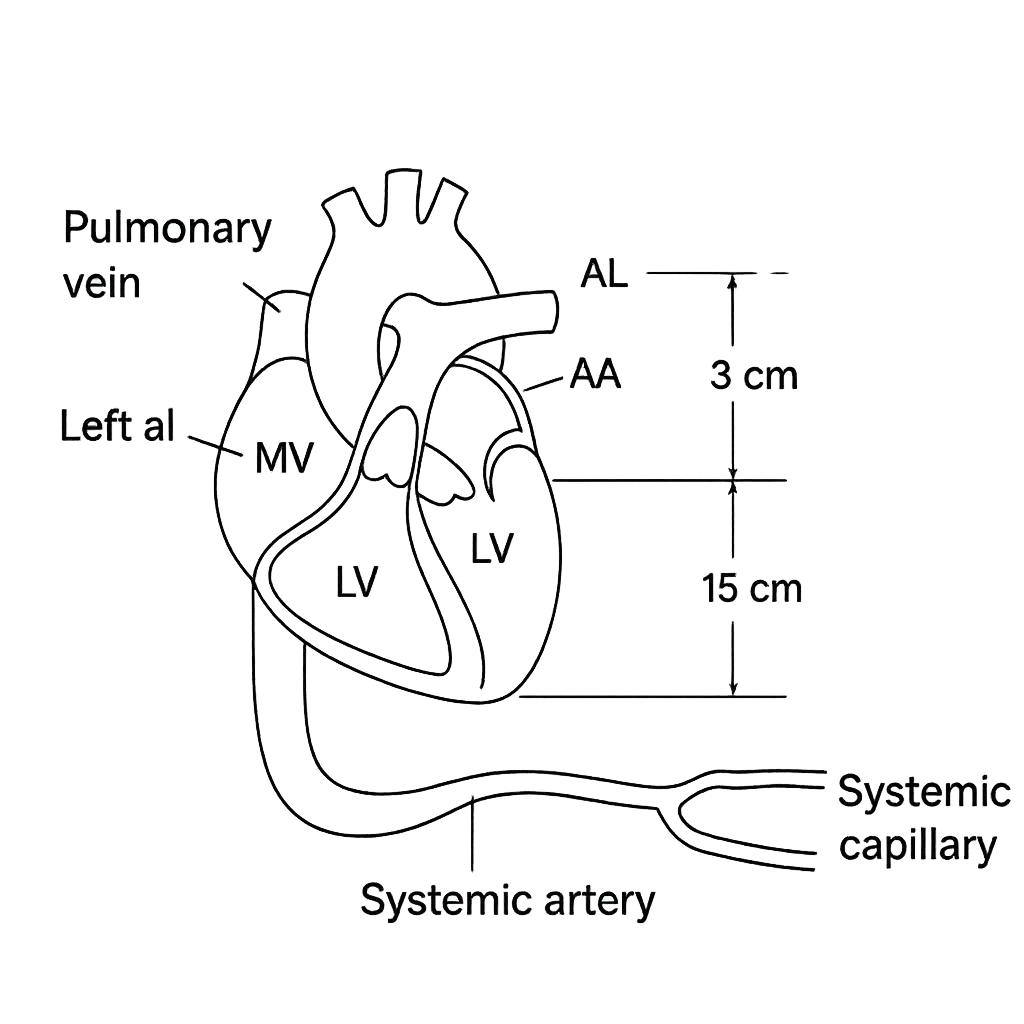
Refer to the labelled diagram of the human circulatory system. The diagram indicates the lengths of the following blood‑vessel segments: Pulmonary vein (PV) = 5 cm, Left atrium to Mitral valve (LA‑MV) = 2 cm, Left ventricle to Aortic arch (LV‑AA) = 3 cm, Aortic arch to Systemic artery (AA‑SA) = 15 cm, Systemic artery to Systemic capillary (SA‑SC) = 30 cm. An oxygen molecule that has just entered the pulmonary vein travels through these segments to reach a systemic capillary where gas exchange occurs. Calculate the total distance (in cm) travelled by the molecule along this path.
Correct A. 55
B. 45
C. 60
D. 50

Correct Answer: A

Want to see the full step-by-step solution? Unlock AI Explanation & Analytics
Question 4 View Details
During mitosis, at which stage are sister chromatids pulled apart to opposite poles of the cell?
Correct A. anaphase
B. telophase
C. prophase
D. metaphase

Correct Answer: A

Want to see the full step-by-step solution? Unlock AI Explanation & Analytics
Question 5 View Details
In a plant, two genes A and B are linked on the same chromosome with a recombination frequency of 12 %. An individual heterozygous for both genes (genotype AB/ab) is crossed with a homozygous recessive individual (ab/ab). What proportion of the progeny are expected to display a recombinant phenotype (i.e., possess only one dominant trait)? Express your answer as a percentage.
Correct A. 12
B. 6
C. 24
D. 50

Correct Answer: A

Want to see the full step-by-step solution? Unlock AI Explanation & Analytics
Question 6 View Details
During a 28‑day menstrual cycle, the plasma estrogen concentration (in pg/mL) on successive days is recorded as follows: day 9 = 180, day 10 = 210, day 11 = 220, day 12 = 190. An LH surge is known to occur on the day after estrogen has been above \(200\) pg/mL for at least two consecutive days, and ovulation takes place about 36 hours after the LH surge. On which day of the cycle is ovulation most likely to occur?
A. 15
B. 12
C. 14
Correct D. 13

Correct Answer: D

Want to see the full step-by-step solution? Unlock AI Explanation & Analytics
Question 7 View Details
Primary productivity in a freshwater lake is 1200 kcal m\(^{-2}\) day\(^{-1}\). Only 10 % of this energy is transferred to herbivorous zooplankton, 15 % of the energy assimilated by zooplankton is transferred to small fish, and 20 % of the energy assimilated by small fish is transferred to large predatory fish. If a 2 m\(^{2}\) area of the lake supports 5 large predatory fish, what is the average energy intake (in kcal per day) of each large predatory fish?
A. 7.2
B. 0.72
Correct C. 1.44
D. 1.92

Correct Answer: C

Want to see the full step-by-step solution? Unlock AI Explanation & Analytics
Question 8 View Details
Which organelle is primarily responsible for the synthesis of ATP through oxidative phosphorylation in eukaryotic cells?
A. ribosome
B. nucleus
C. chloroplast
Correct D. mitochondrion

Correct Answer: D

Want to see the full step-by-step solution? Unlock AI Explanation & Analytics
Question 9 View Details
In a simple spinal reflex, the sensory neuron conducts an impulse over a distance of 0.5 m to the spinal cord at a speed of 50 m s\(^{-1}\). The synaptic delay at the spinal cord is 0.5 ms. The motor neuron then conducts the impulse over 0.4 m to the effector muscle at a speed of 60 m s\(^{-1}\). Calculate the total time (in milliseconds) from the initial stimulus to the onset of muscle contraction. Give your answer to two decimal places.
A. 17.50
Correct B. 17.17
C. 16.26
D. 16.67

Correct Answer: B

Want to see the full step-by-step solution? Unlock AI Explanation & Analytics
Question 10 View Details
A small mammal has a body surface area of 0.09 m\(^{2}\) and a thermal conductance of 0.025 W m\(^{-2}\) °C\(^{-1}\). Its core temperature is normally 37 °C while the ambient temperature is 5 °C.\n\n(a) Calculate the minimum metabolic heat production (in watts) required to maintain the core temperature at 37 °C under these conditions.\n(b) If the animal can only produce 0.05 W of metabolic heat, what steady‑state body temperature (in °C) will be maintained? Give your answer to one decimal place.
A. 0.07 W; 26.5 °C
B. 0.8 W; 7.0 °C
C. 0.09 W; 28.0 °C
Correct D. 0.072 W; 27.2 °C

Correct Answer: D

Want to see the full step-by-step solution? Unlock AI Explanation & Analytics
Question 11 View Details
A batch culture of a bacterium is monitored by measuring optical density at 600 nm (\\(\\text{OD}_{600}\\)). At time 0 min the \\ (\\text{OD}_{600}\\) is 0.05, at 80 min it is 0.20 and at 120 min it is 0.80. Assuming exponential growth between 80 min and 120 min, calculate the generation time (in minutes). The bacterium is Gram‑negative, rod‑shaped, facultative anaerobe, oxidase negative and ferments lactose with gas production. Based on these characteristics, state the most likely genus.
Correct A. 20 minutes; Escherichia
B. 15 minutes; Klebsiella
C. 30 minutes; Salmonella
D. 40 minutes; Enterobacter

Correct Answer: A

Want to see the full step-by-step solution? Unlock AI Explanation & Analytics
Question 12 View Details
A virus isolated from a patient has the following properties: genome is double‑stranded RNA, capsid is icosahedral, the virion lacks a lipid envelope, and replication occurs in the cytoplasm. Using the standard virus classification criteria, identify the family to which this virus most likely belongs.
Correct A. Reoviridae
B. Adenoviridae
C. Picornaviridae
D. Orthomyxoviridae

Correct Answer: A

Want to see the full step-by-step solution? Unlock AI Explanation & Analytics
Question 13 View Details
A flowering plant species has five pistils, each containing three ovules. Each flower is pollinated by pollen from two different donor plants. The probability that a given pollen grain successfully fertilises an ovule is 0.80, independent of other ovules. (a) Calculate the expected number of seeds produced per flower. (b) State the type of reproduction exhibited by this species.
Correct A. 12 seeds; cross‑pollination
B. 12 seeds; self‑pollination
C. 10 seeds; cross‑pollination
D. 14 seeds; self‑pollination

Correct Answer: A

Want to see the full step-by-step solution? Unlock AI Explanation & Analytics
Question 14 View Details
Two closely related species of beetles differ by 12 % in the amino‑acid sequence of a conserved protein. The molecular clock for this protein is estimated at 1 % sequence divergence per million years. (a) Estimate the time (in million years) since the two species diverged. (b) If the species are found on opposite sides of a mountain range that arose 15 million years ago, which mode of speciation is most consistent with this information?
A. 10 million years; peripatric speciation
B. 15 million years; allopatric speciation
Correct C. 12 million years; allopatric speciation
D. 12 million years; sympatric speciation

Correct Answer: C

Want to see the full step-by-step solution? Unlock AI Explanation & Analytics
Question 15 View Details
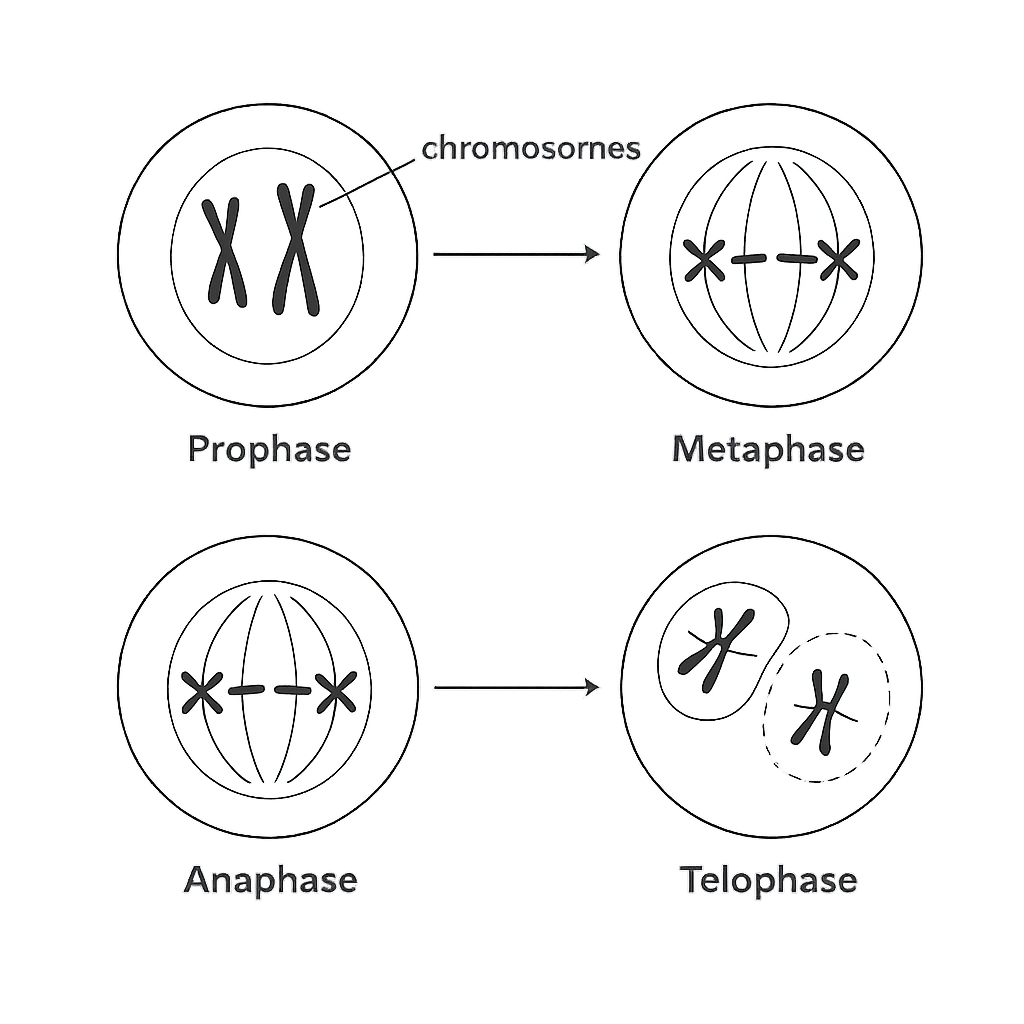
The diagram shows a eukaryotic cell at successive stages of mitosis. Identify the stage in which the chromosomes are aligned at the cell centre and state the total number of chromatids present in a human somatic cell at that stage.
A. Anaphase; 92 chromatids
B. Metaphase; 46 chromatids
Correct C. Metaphase; 92 chromatids
D. Prophase; 92 chromatids

Correct Answer: C

Want to see the full step-by-step solution? Unlock AI Explanation & Analytics
Question 16 View Details
A person at rest has a heart rate of \(70\) bpm and a stroke volume of \(70\) mL. During moderate exercise the heart rate rises to \(130\) bpm and stroke volume to \(95\) mL. Muscles receive \(20\%\) of the cardiac output at rest and \(60\%\) during exercise. Each millilitre of blood carries \(0.2\) mL of O₂. Calculate the increase in oxygen delivered to the muscles (in mL O₂ min\(^{-1}\)) from rest to exercise.
Correct A. 1286
B. 1260
C. 1320
D. 1150

Correct Answer: A

Want to see the full step-by-step solution? Unlock AI Explanation & Analytics
Question 17 View Details
In a diagram of a typical plant cell the numbered structures are: 1 - nucleus (diameter \(6\) µm), 2 - chloroplast (ellipsoid \(5\) µm × \(2\) µm), 3 - vacuole (sphere radius \(15\) µm), 4 - mitochondrion (cylinder \(3\) µm × \(1\) µm). Identify the structure where the Calvin cycle occurs and calculate the percentage of the cell's total volume occupied by chloroplasts if the cell is a sphere of radius \(20\) µm and contains thirty chloroplasts. Give your answer to one decimal place.
A. Structure 1; 0.8%
Correct B. Structure 2; 0.9%
C. Structure 4; 1.2%
D. Structure 3; 1.0%

Correct Answer: B

Want to see the full step-by-step solution? Unlock AI Explanation & Analytics
Question 18 View Details
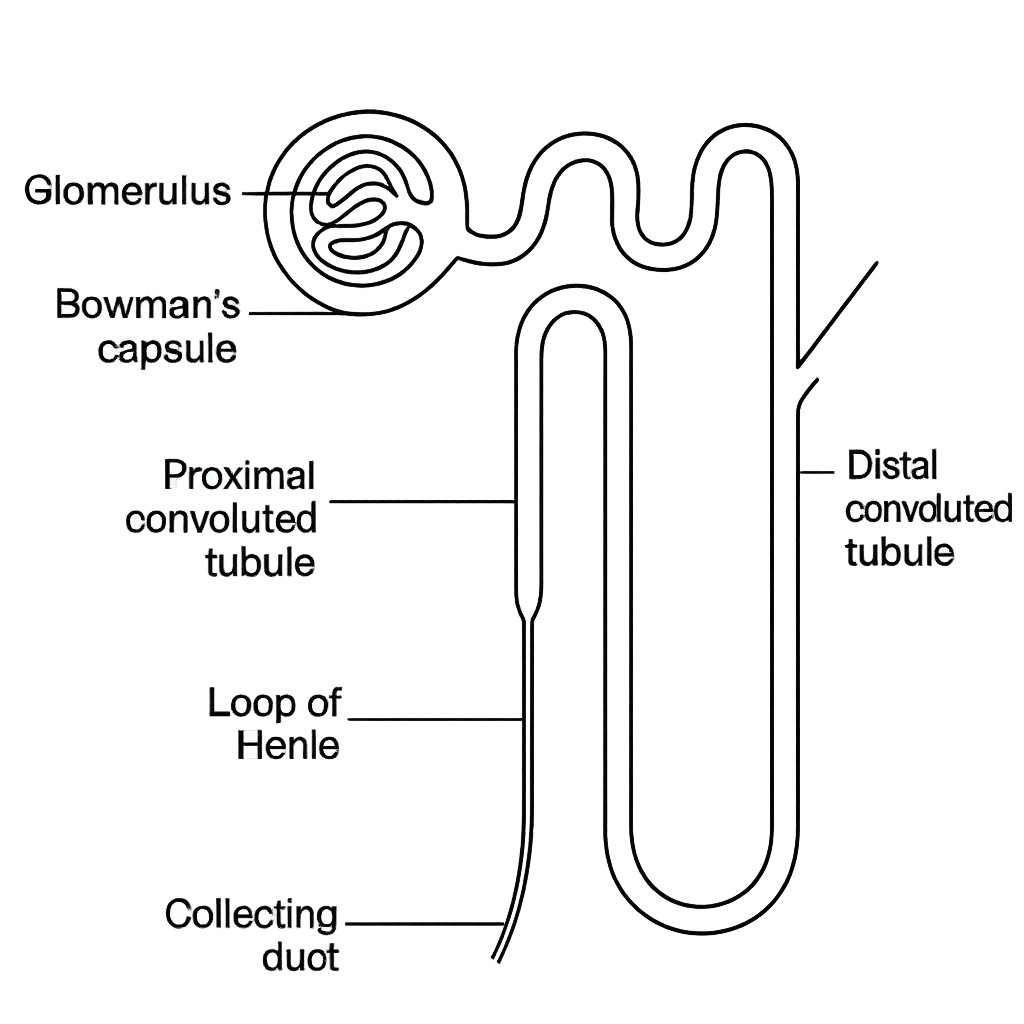
A person has a glomerular filtration rate (GFR) of \(120\) mL min\(^{-1}\). The filtrate initially contains \(140\) mM NaCl. In the proximal tubule 65 % of NaCl and 30 % of water are reabsorbed. In the loop of Henle an additional 15 % of the remaining NaCl and 20 % of the remaining water are reabsorbed. The distal tubule reabsorbs 10 % of the NaCl left and 25 % of the water left. The collecting duct reabsorbs 5 % of the remaining NaCl and 40 % of the remaining water. Calculate the final concentration of NaCl in the urine (in mM) and the urine flow rate (in mL min\(^{-1}\)).
Correct A. Urine flow ≈30.2 mL min⁻¹; NaCl concentration ≈141 mM
B. Urine flow ≈30.2 mL min⁻¹; NaCl concentration ≈130 mM
C. Urine flow ≈28.7 mL min⁻¹; NaCl concentration ≈135 mM
D. Urine flow ≈32.5 mL min⁻¹; NaCl concentration ≈150 mM

Correct Answer: A

Want to see the full step-by-step solution? Unlock AI Explanation & Analytics
Question 19 View Details
A tap on the patellar tendon produces a measurable latency of \(30\) ms between the tap and the onset of the quadriceps EMG signal. The afferent sensory pathway from the tap site to the spinal cord is \(0.5\) m long with a conduction velocity of \(55\) m s\(^{-1}\). The efferent motor pathway from the spinal cord to the quadriceps muscle is \(0.4\) m long with a conduction velocity of \(45\) m s\(^{-1}\). Assume a synaptic delay of \(0.5\) ms at the spinal interneuron. Calculate the total physiological time from tap to muscle contraction (including the EMG onset latency) and state how many milliseconds the measured latency exceeds this calculated time.
A. Calculated time ≈20.7 ms; measured latency exceeds by 9.3 ms
Correct B. Calculated time ≈18.5 ms; measured latency exceeds by 11.5 ms
C. Calculated time ≈19.4 ms; measured latency exceeds by 10.6 ms
D. Calculated time ≈18.0 ms; measured latency exceeds by 12.0 ms

Correct Answer: B

Want to see the full step-by-step solution? Unlock AI Explanation & Analytics
Question 20 View Details
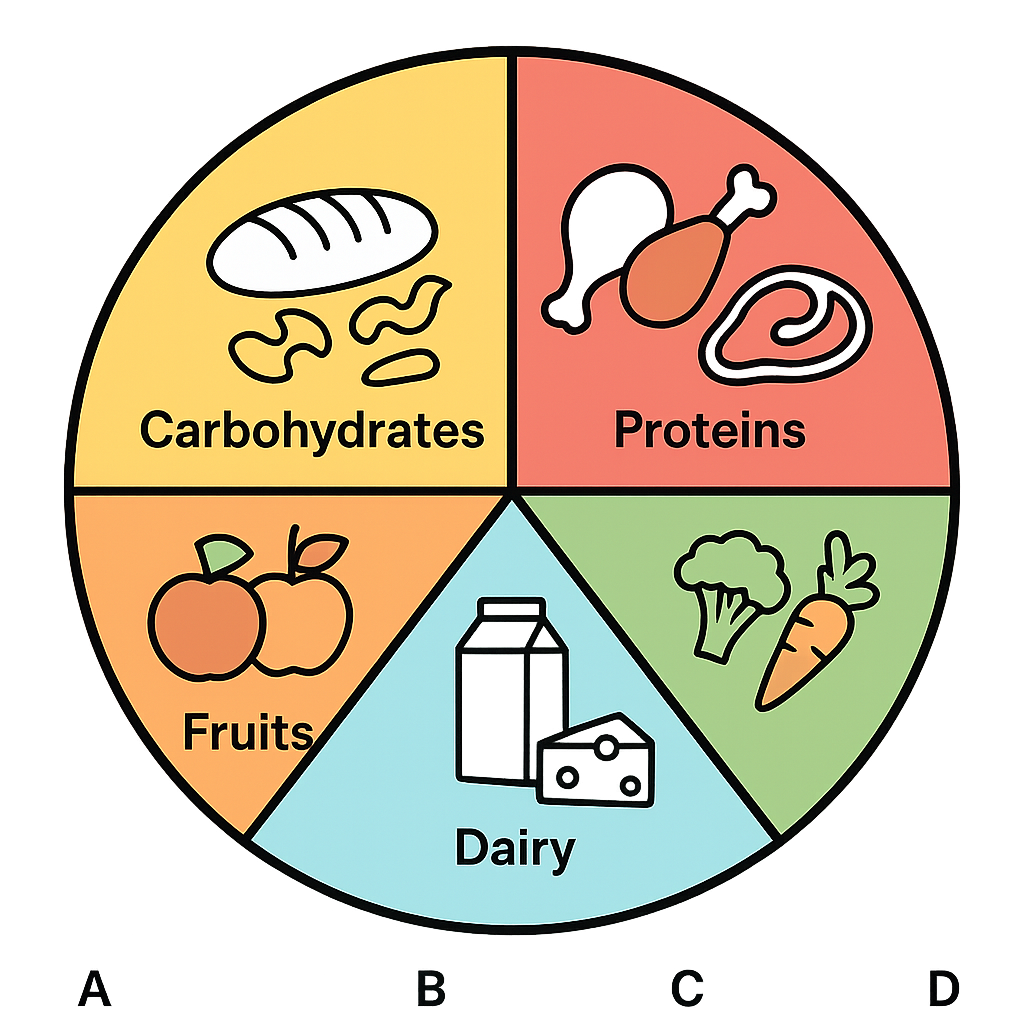
The diagram shows a balanced‑diet plate divided into five labelled sections: A - Carbohydrates, B - Proteins, C - Vegetables, D - Fruits, E - Dairy. A teenage athlete weighing \(60\) kg requires \(1.6\) g protein per kg body weight per day. Each serving of the protein section (label B) provides \(20\) g protein. Assuming the plate initially supplies one serving of each food group, which labelled section should be increased to meet the protein requirement and how many additional servings of that section are needed?
A. Increase section B; 3 additional servings
B. Increase section A; 4 additional servings
C. Increase section B; 5 additional servings
Correct D. Increase section B; 4 additional servings

Correct Answer: D

Want to see the full step-by-step solution? Unlock AI Explanation & Analytics
Question 21 View Details
Two desert plant species employ different adaptations to reduce water loss. Species A reduces its leaf area by 30 % and shortens its daily stomatal opening time by 2 h. Species B reduces leaf area by 15 % but its cuticle thickness lowers the transpiration rate per unit area by 40 %. Assuming a baseline leaf area of \(100\ \text{cm}^2\), a baseline transpiration rate of \(0.5\ \text{ml}\,\text{cm}^{-2}\,\text{h}^{-1}\), and a daily stomatal opening period of \(10\ \text{h}\) for an untreated plant, which adaptation results in the lower total water loss per day? State "Adaptation A" or "Adaptation B".
A. Adaptation A
B. Neither adaptation reduces water loss
Correct C. Adaptation B
D. Both adaptations equally reduce water loss

Correct Answer: C

Want to see the full step-by-step solution? Unlock AI Explanation & Analytics
Question 22 View Details
A newly emerging infectious disease has a basic reproduction number \(R_{0}=3.5\). The available vaccine is 80 % effective. Ten percent of the population is already immune due to prior infection. What minimum proportion of the total population must be vaccinated to achieve herd immunity? Give your answer as a percentage rounded to the nearest whole number.
A. 70
B. 80
Correct C. 77
D. 73

Correct Answer: C

Want to see the full step-by-step solution? Unlock AI Explanation & Analytics
Question 23 View Details
During intense exercise a person loses heat by sweating and by cutaneous vasodilation. Sweating evaporates \(0.8\ \text{g}\) of water per \(\text{cm}^2\) of skin each minute, and the latent heat of vaporisation of water is \(2.43\ \text{kJ}\,\text{g}^{-1}\). The skin surface area is \(1500\ \text{cm}^2\). Vasodilation increases blood flow that can remove \(5\ \text{kJ}\) of heat per minute for every \(100\ \text{cm}^2\) of skin. Which mechanism removes more heat per minute, sweating or vasodilation? State "Sweating" or "Vasodilation".
A. Both equally
B. Neither
Correct C. Sweating
D. Vasodilation

Correct Answer: C

Want to see the full step-by-step solution? Unlock AI Explanation & Analytics
Question 24 View Details
A botanist uses the following dichotomous key to identify an unknown plant.\n1a. Leaves opposite … go to step 2.\n1b. Leaves alternate … go to step 3.\n2a. Flowers radially symmetric … Species X.\n2b. Flowers bilaterally symmetric … Species Y.\n3a. Fruit a capsule … Species Z.\n3b. Fruit a berry … Species W.\nThe unknown plant has opposite leaves, bilaterally symmetric flowers, and a capsule fruit. Which species is it?
A. Species W
Correct B. Species Y
C. Species Z
D. Species X

Correct Answer: B

Want to see the full step-by-step solution? Unlock AI Explanation & Analytics
Question 25 View Details
A bacterial culture follows logistic growth: \(N(t)=\dfrac{K}{1+\left(\dfrac{K-N_{0}}{N_{0}}\right)e^{-rt}}\). Given an initial population \(N_{0}=2\times10^{6}\) cells, carrying capacity \(K=1\times10^{9}\) cells, intrinsic growth rate \(r=0.8\ \text{h}^{-1}\), and time \(t=5\ \text{h}\), calculate the population size \(N(5)\). Express your answer in scientific notation rounded to two decimal places (e.g., \(9.86\times10^{7}\)).
A. 9.86×10^{6}
Correct B. 9.86×10^{7}
C. 1.02×10^{8}
D. 8.75×10^{7}

Correct Answer: B

Want to see the full step-by-step solution? Unlock AI Explanation & Analytics

Master the Exam!

You've seen a preview, but there are thousands more questions plus AI tutor to break down complex solutions.

Unlock Full Access Available for Android & Windows
Help others prepare! Share this practice hub:
Chat with Support