neco 2025 agricultural_science | Objective

Prepare for your exams with neco questions? Reviewing past/model questions is one of the most effective ways to guarantee a high score. This practice hub features authentic 2025 agricultural_science (Objective) questions designed to simulate the real exam environment.

Practice these randomly selected questions to test your readiness.
Question 1 View Details
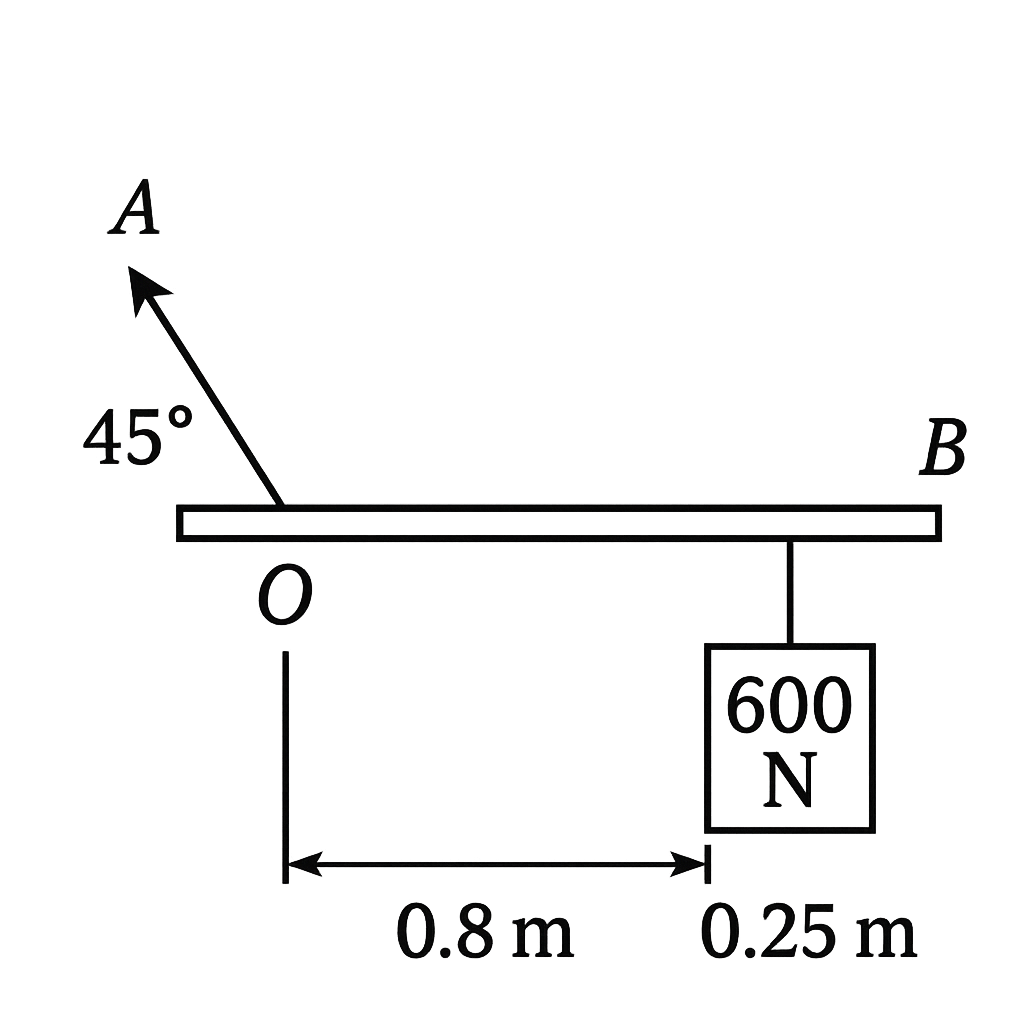
A lever used in a seed drill is shown in the diagram. The pivot O is fixed. An effort force F is applied at point A, which is \(0.8\) m from the pivot and the line of action makes an angle of \(45^{\circ}\) above the horizontal. The load of \(600\) N acts vertically downward at point B, \(0.25\) m from the pivot. Assuming the lever is in static equilibrium, calculate the minimum magnitude of the effort force F (in newtons) required to hold the load.
Correct A. 265
B. 250
C. 300
D. 280

Correct Answer: A

Want to see the full step-by-step solution? Unlock AI Explanation & Analytics
Question 2 View Details
A dairy farmer records that a cow produces 30 kg of milk per day. The milk contains 3.2% protein and protein is 16% nitrogen. The cow is fed a concentrate that contains 14% crude protein (protein is 16% nitrogen). The cow excretes \(0.85\) kg of nitrogen per day. Assuming the cow is in nitrogen balance, calculate the daily amount of concentrate dry matter (in kg) the cow must be fed.
A. 40.0
B. 52.0
C. 48.5
Correct D. 44.8

Correct Answer: D

Want to see the full step-by-step solution? Unlock AI Explanation & Analytics
Question 3 View Details
A farm has a total area of 120 ha. Forty percent of the land is planted with maize. Half of the remaining land is planted with legumes and the rest is left fallow. Determine the area (in hectares) under legumes.
Correct A. 36
B. 48
C. 72
D. 24

Correct Answer: A

Want to see the full step-by-step solution? Unlock AI Explanation & Analytics
Question 4 View Details
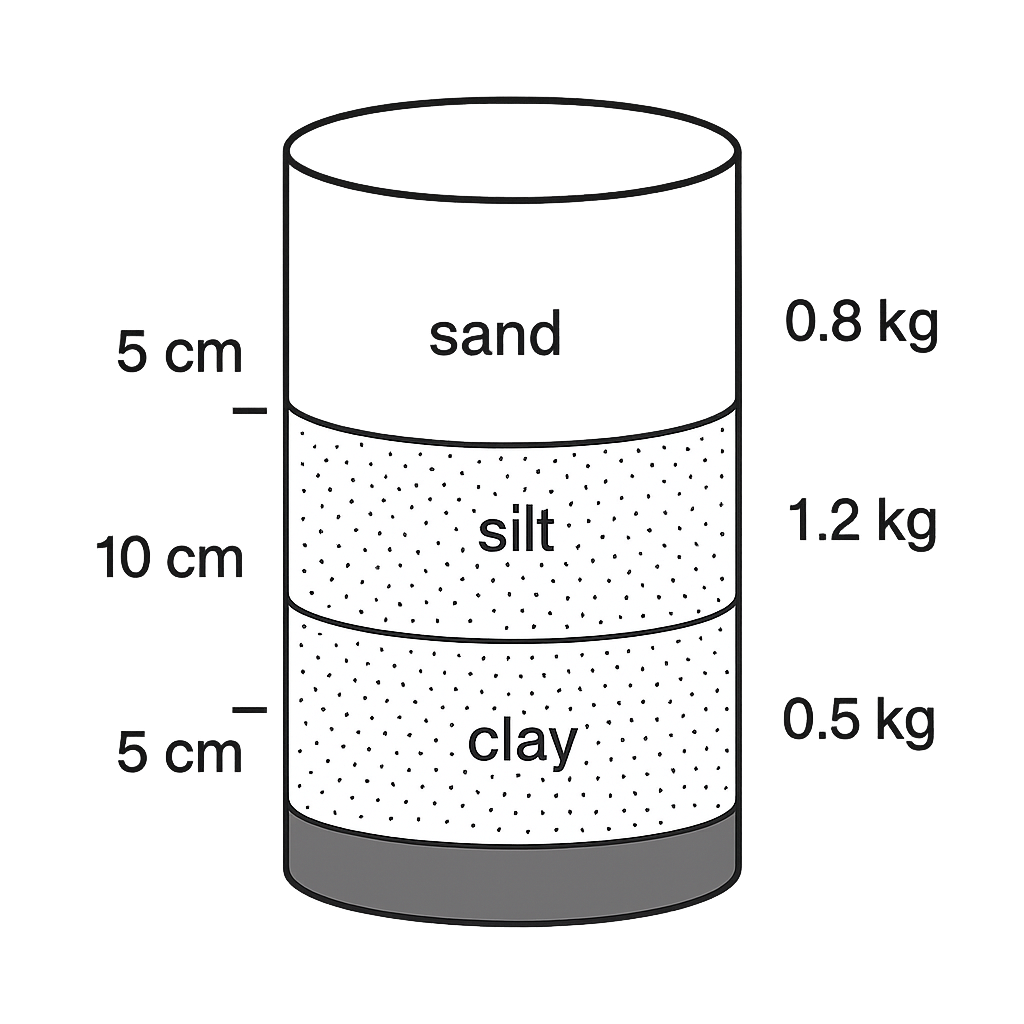
A cylindrical soil core of diameter 10 cm and height 20 cm is taken as shown in the diagram. The core consists of three horizontal layers: sand (top 5 cm) with a dry mass of 0.8 kg, silt (middle 10 cm) with a dry mass of 1.2 kg, and clay (bottom 5 cm) with a dry mass of 0.5 kg. Calculate the overall bulk density of the soil sample in \(\text{g cm}^{-3}\).
Correct A. 1.59
B. 1.25
C. 1.78
D. 1.45

Correct Answer: A

Want to see the full step-by-step solution? Unlock AI Explanation & Analytics
Question 5 View Details
A tilapia farm starts with 800 kg of fingerlings in a recirculating system. Over a 90‑day production cycle the average daily feed given is 2.5% of the live biomass present that day. The feed contains 35% protein and the protein conversion efficiency (PCE) is 20% (i.e., 20% of feed protein is retained as fish growth). At harvest the total biomass is 1500 kg.\n\n(a) Calculate the total amount of feed (in kg) supplied over the cycle (assume the biomass increases linearly so that the average biomass is the mean of the initial and final weights).\n(b) Determine the total protein intake from the feed (in kg).\n(c) Using the given PCE, find the total protein retained in the fish (in kg) and compare it with the theoretical protein gain calculated from the increase in biomass (assume fish body is 20% protein). State whether the PCE figure appears realistic.
A. a) 2500 kg; b) 875.0 kg; c) 175.0 kg retained, theoretical gain 140 kg - PCE appears slightly high.
B. a) 2550 kg; b) 892.5 kg; c) 160.0 kg retained, theoretical gain 140 kg - PCE appears moderate.
Correct C. a) 2587.5 kg; b) 905.6 kg; c) 181.1 kg retained, theoretical gain 140 kg - PCE appears unrealistically high.
D. a) 2600 kg; b) 910.0 kg; c) 150.0 kg retained, theoretical gain 140 kg - PCE appears realistic.

Correct Answer: C

Want to see the full step-by-step solution? Unlock AI Explanation & Analytics
Question 6 View Details
A farmer observed a disease incidence of 20% in a 5‑ha cassava field. After applying a fungicide at only 60% of the recommended rate, the incidence fell to 14%. Assuming disease reduction is directly proportional to the amount of fungicide applied, what would have been the expected incidence if the correct amount had been applied? Also, calculate the amount of money saved on fungicide if the recommended rate is 0.8 L per ha, the fungicide costs \(\text{₦}150\) per litre, and the farmer used only the 60% amount.
A. 12% and ₦180
Correct B. 10% and ₦240
C. 10% and ₦180
D. 12% and ₦240

Correct Answer: B

Want to see the full step-by-step solution? Unlock AI Explanation & Analytics
Question 7 View Details
A soil sample contains 2.5\% organic matter by weight. The total nitrogen content contributed by organic matter is approximately 0.1 times the organic‑matter percentage. In addition, the soil has 0.15\% nitrogen from recent fertilizer application. What is the overall nitrogen percentage in the soil?
A. 0.25%
B. 0.55%
Correct C. 0.40%
D. 0.15%

Correct Answer: C

Want to see the full step-by-step solution? Unlock AI Explanation & Analytics
Question 8 View Details
A batch of 500 kg fresh cassava roots has a moisture content of 60\% (wet basis). The roots are sliced into chips and dried in a solar dryer that removes moisture at a constant rate of \(2\) kg h^{-1} per 100 kg of wet chips. The target final moisture content is 12\% (wet basis). After the first 5 hours, the drying rate drops by 20\% because of increased ambient humidity. Determine the total drying time required to reach the target moisture content and the final weight of the dried chips.
A. approximately 30.0 hours and 240.0 kg
B. approximately 35.5 hours and 210.2 kg
C. approximately 28.9 hours and 235.0 kg
Correct D. approximately 32.8 hours and 227.3 kg

Correct Answer: D

Want to see the full step-by-step solution? Unlock AI Explanation & Analytics
Question 9 View Details
A rabbit farm feeds each rabbit \(0.15\) kg of concentrate per day. With a diet containing 18\% protein, the average daily gain (ADG) is \(30\) g. Reducing the protein level to 15\% lowers the ADG by 20\%. The 18\% protein feed costs \(\text{₦}250\) per kg, while the 15\% protein feed costs \(\text{₦}200\) per kg. To achieve a total weight gain of \(2.5\) kg per rabbit, determine the total amount of feed required at the 18\% protein level and the extra cost (if any) compared with using the 15\% protein feed.
Correct A. 12.5 kg and ₦0
B. 13.0 kg and ₦0
C. 15.6 kg and ₦0
D. 12.5 kg and ₦250

Correct Answer: A

Want to see the full step-by-step solution? Unlock AI Explanation & Analytics
Question 10 View Details
A two‑stroke engine delivers \(5\) kW at \(3000\) rpm. A rotary tiller requires a torque of \(150\) Nm at \(1200\) rpm for optimal operation. Assuming a mechanical efficiency of 85\% in the power transmission, (a) calculate the gear ratio (output:input) needed to match the engine speed to the tiller speed, and (b) determine the effective torque transmitted to the tiller. State whether the available torque meets the tiller's requirement and, if not, the shortfall.
Correct A. Gear ratio 5:2, effective torque ≈ 33.8 Nm, shortfall ≈ 116.2 Nm
B. Gear ratio 2:5, effective torque ≈ 33.8 Nm, shortfall ≈ 116.2 Nm
C. Gear ratio 5:2, effective torque ≈ 40.2 Nm, shortfall ≈ 109.8 Nm
D. Gear ratio 3:1, effective torque ≈ 45.0 Nm, shortfall ≈ 105.0 Nm

Correct Answer: A

Want to see the full step-by-step solution? Unlock AI Explanation & Analytics
Question 11 View Details
A batch of 500 kg of cassava roots initially contains 30% moisture (wet basis). They are dried in two phases. Phase 1: hot air at 70°C for 3 hours reduces moisture content by 40 % of the initial moisture amount. Phase 2: air at 45°C continues drying until the final moisture content reaches 12% (wet basis). During phase 2 the drying rate follows \( \frac{dM}{dt}= -k\,(M-E) \) where \(k = 0.08\ \text{h}^{-1}\) and the equilibrium moisture \(E = 5\%\) (wet basis). Determine the duration of phase 2 (in hours) required to achieve the target moisture.
Correct A. 9.9
B. 7.3
C. 8.5
D. 11.2

Correct Answer: A

Want to see the full step-by-step solution? Unlock AI Explanation & Analytics
Question 12 View Details
A soil sample contains 0.020 mol of H⁺ per kilogram. Its pH is calculated from \(pH = -\log_{10}[H⁺]\). A farmer adds 0.005 mol of CaCO₃ per kilogram, which neutralises an equal amount of H⁺. Determine the new pH of the soil after the amendment.
A. 1.60
B. 1.88
C. 1.70
Correct D. 1.82

Correct Answer: D

Want to see the full step-by-step solution? Unlock AI Explanation & Analytics
Question 13 View Details
A farmer produces 8 tonnes of groundnut. The current market price is ₦150,000 per tonne. Two marketing options are considered:\n\nOption A: Increase the selling price by 10 % (price becomes 1.10 × ₦150,000). The price elasticity of demand for groundnut is -1.5, so the quantity demanded changes by \(\%\Delta Q = \text{elasticity}\times\%\Delta P\).\n\nOption B: Add value‑added processing that raises the price by 20 % but incurs a processing cost of ₦15,000 per tonne and reduces the marketable quantity by 25 %.\n\nWhich option gives the higher net revenue and by how much (in ₦)?
A. Option A, ₦120,000
B. Option B, ₦150,000
C. Option B, ₦132,000
Correct D. Option A, ₦132,000

Correct Answer: D

Want to see the full step-by-step solution? Unlock AI Explanation & Analytics
Question 14 View Details
A tractor must pull a moldboard plough. The draft force required is given by \(D (\text{kN}) = 0.5 + 0.02 v^{2}\), where \(v\) is the tractor speed in km/h. The tractor travels at 5 km/h. Its rolling resistance equals 0.03 times its weight. The tractor weight is 3,000 kg and the transmission efficiency is 85 %. Determine the minimum engine power required (in kW).
Correct A. 3.1
B. 3.5
C. 2.8
D. 4.0

Correct Answer: A

Want to see the full step-by-step solution? Unlock AI Explanation & Analytics
Question 15 View Details
A forest stand follows the logistic growth model \(V(t)=\frac{K}{1 + a e^{-b t}}\) with carrying capacity \(K = 300\) m³ ha⁻¹ and growth rate constant \(b = 0.08\) yr⁻¹. At present (t = 0) the stand volume is 120 m³ ha⁻¹. A manager wishes to harvest a fixed proportion \(p\) of the standing volume every 5 years, immediately after the growth period, while ensuring the post‑harvest volume never falls below 80 m³ ha⁻¹. Find the greatest integer value of \(p\) (as a percent) that can be sustained indefinitely.
A. 30
Correct B. 24
C. 22
D. 27

Correct Answer: B

Want to see the full step-by-step solution? Unlock AI Explanation & Analytics
Question 16 View Details
A farmer uses a plough and a harrow. The plough can till \(0.8\) ha per hour when pulled by a tractor. The harrow can prepare \(0.5\) ha per hour when used after ploughing. However, when both are used simultaneously (plough attached ahead of the harrow), the combined effective area covered per hour is reduced by 15% of the sum of their individual rates. The farmer needs to till and prepare a \(12\) ha field. He will use the combined setup until the remaining area is less than what the plough alone can cover in one hour, then finish with the plough alone. How many total hours are required? Give your answer to two decimal places.
A. 9.87
B. 10.95
C. 12.04
Correct D. 11.13

Correct Answer: D

Want to see the full step-by-step solution? Unlock AI Explanation & Analytics
Question 17 View Details
In an agricultural extension programme, four villages are to be served. Each extension agent can work with up to 30 farmers per month. The probability that a farmer adopts a new technology when served by the first agent in a village is \(0.60\). For each additional agent assigned to the same village, the adoption probability per farmer decreases by \(0.05\) due to overlap. Each agent costs \(20{,}000\) Naira per month and the total monthly budget is \(120{,}000\) Naira. The target is to have at least 150 farmers adopt the technology in one month. Determine the minimum number of agents to hire and a feasible allocation of agents to the four villages that meets the target while staying within budget. State the allocation (agents per village) and the expected total number of adopters.
A. Hire 3 agents, placing one in three villages and none in the fourth, achieving exactly 150 adopters while remaining within the budget.
B. Hire 5 agents with a distribution of 2 agents in village 1 and 1 agent in each of the other villages, giving an expected 190 adopters and staying under the budget.
C. Hire 4 agents, assigning one to each village, which yields an expected 168 adopters within the budget.
Correct D. Not achievable under the given budget and constraints

Correct Answer: D

Want to see the full step-by-step solution? Unlock AI Explanation & Analytics
Question 18 View Details
A farmer uses a two‑stage lever to lift a \(200\) kg sack of grain. The first lever is a class‑2 lever with an effort arm of \(0.8\) m and a load arm of \(0.2\) m. The output force from the first lever is applied to the effort arm of a second class‑1 lever whose effort arm is \(0.5\) m and load arm is \(0.25\) m. Assuming no losses, what is the minimum effort force the farmer must apply at the end of the first lever to lift the sack? Give your answer in newtons (use \(g = 9.8\) m/s²).
A. 294
B. 220
Correct C. 245
D. 196

Correct Answer: C

Want to see the full step-by-step solution? Unlock AI Explanation & Analytics
Question 19 View Details
In a poultry farm of 500 chickens, a viral disease has a basic reproduction number \(R_0 = 2.5\). A vaccine with 80% efficacy is available. If \(p\) is the proportion of the flock that is vaccinated, the effective reproduction number becomes \(R_e = R_0 \times (1 - \text{efficacy} \times p)\). The disease will die out if \(R_e < 1\). What is the minimum integer number of chickens that must be vaccinated to ensure the disease cannot spread? Provide the number of chickens.
A. 390
Correct B. 376
C. 375
D. 380

Correct Answer: B

Want to see the full step-by-step solution? Unlock AI Explanation & Analytics
Question 20 View Details
A forest stand of a fast‑growing timber species follows the logistic growth model \(V(t) = \frac{K}{1 + e^{-r(t - t_0)}}\) where \(V\) is the standing volume (m³ per hectare), \(K = 200\) m³/ha, intrinsic rate \(r = 0.08\) yr⁻¹, and the inflection point \(t_0 = 25\) years. The forest is managed on a 40‑year rotation. The manager plans to harvest a proportion \(h\) of the standing volume at year 40 and then replant. To ensure the average annual increment (AAI) over the rotation is at least 4 m³/ha·yr, what is the maximum allowable harvest proportion \(h\) (expressed as a decimal, rounded to two decimal places)?
A. Maximum harvest proportion is 0.45
Correct B. Not feasible under the given growth parameters
C. Harvest proportion must be less than 0.30
D. Feasible with h = 0.60

Correct Answer: B

Want to see the full step-by-step solution? Unlock AI Explanation & Analytics
Question 21 View Details
A farmer intends to raise 50 goats from a weight of 12 kg to 25 kg in 90 days. The feed conversion ratio (FCR) is 5 kg of feed per kg of weight gain. Feed costs \(\text{₦}150\) per kg. The farmer has a budget of \(\text{₦}45,000\) for feed. Determine whether the budget is sufficient, and if not, calculate the maximum number of goats that can be raised to the target weight within the budget.
A. Budget insufficient; maximum 5 goats
B. Budget sufficient; maximum 4 goats
Correct C. Budget insufficient; maximum 4 goats
D. Budget insufficient; maximum 3 goats

Correct Answer: C

Want to see the full step-by-step solution? Unlock AI Explanation & Analytics
Question 22 View Details
In a herd of 200 cattle, a disease has an annual incidence of 12%. A vaccine with 80% efficacy is introduced and 70% of the herd is vaccinated. Assuming the vaccine reduces risk proportionally, estimate the expected number of disease cases in the next year.
Correct A. 11
B. 13
C. 15
D. 9

Correct Answer: A

Want to see the full step-by-step solution? Unlock AI Explanation & Analytics
Question 23 View Details
Identify the process in the nitrogen cycle where atmospheric nitrogen gas (N\(_2\)) is converted into ammonia (NH\(_3\)) by bacteria.
A. Denitrification
B. Nitrification
C. Ammonification
Correct D. Nitrogen fixation

Correct Answer: D

Want to see the full step-by-step solution? Unlock AI Explanation & Analytics
Question 24 View Details
A farmer raises 800 layer chickens. Fixed costs are \(\text{₦}120,000\) per month. Variable cost is \(\text{₦}150\) per bird per month. Expected mortality before sale is 5%. Each surviving bird produces 20 eggs per month, sold at \(\text{₦}30\) per dozen. Determine the minimum number of dozens of eggs that must be sold each month to cover total costs (break‑even point).
Correct A. 7,800
B. 7,200
C. 8,000
D. 7,500

Correct Answer: A

Want to see the full step-by-step solution? Unlock AI Explanation & Analytics
Question 25 View Details
A farmer produces maize. The total cost function is \(C(q)=5,000+5q+0.02q^{2}\) (₦), where \(q\) is output in tonnes. The market inverse demand is \(P=200-0.5q\) (₦ per tonne). The government imposes a per‑tonne tax of \(\text{₦}10\) on the farmer. Determine the output \(q\) that maximizes the farmer's profit after tax, and compute the maximum profit (rounded to the nearest ten naira).
Correct A. Quantity 178 tonnes; profit \(\text{₦}11,450\)
B. Quantity 185 tonnes; profit \\(\\text{₦}12,300\\)
C. Quantity 160 tonnes; profit \\(\\text{₦}9,500\\)
D. Quantity 170 tonnes; profit \\(\\text{₦}10,800\\)

Correct Answer: A

Want to see the full step-by-step solution? Unlock AI Explanation & Analytics

Master the Exam!

You've seen a preview, but there are thousands more questions plus AI tutor to break down complex solutions.

Unlock Full Access Available for Android & Windows
Help others prepare! Share this practice hub:
Chat with Support