neco 2024 physics | Essay

Prepare for your exams with neco questions? Reviewing past/model questions is one of the most effective ways to guarantee a high score. This practice hub features authentic 2024 physics (Essay) questions designed to simulate the real exam environment.

Practice these randomly selected questions to test your readiness.
Question 1 View Details
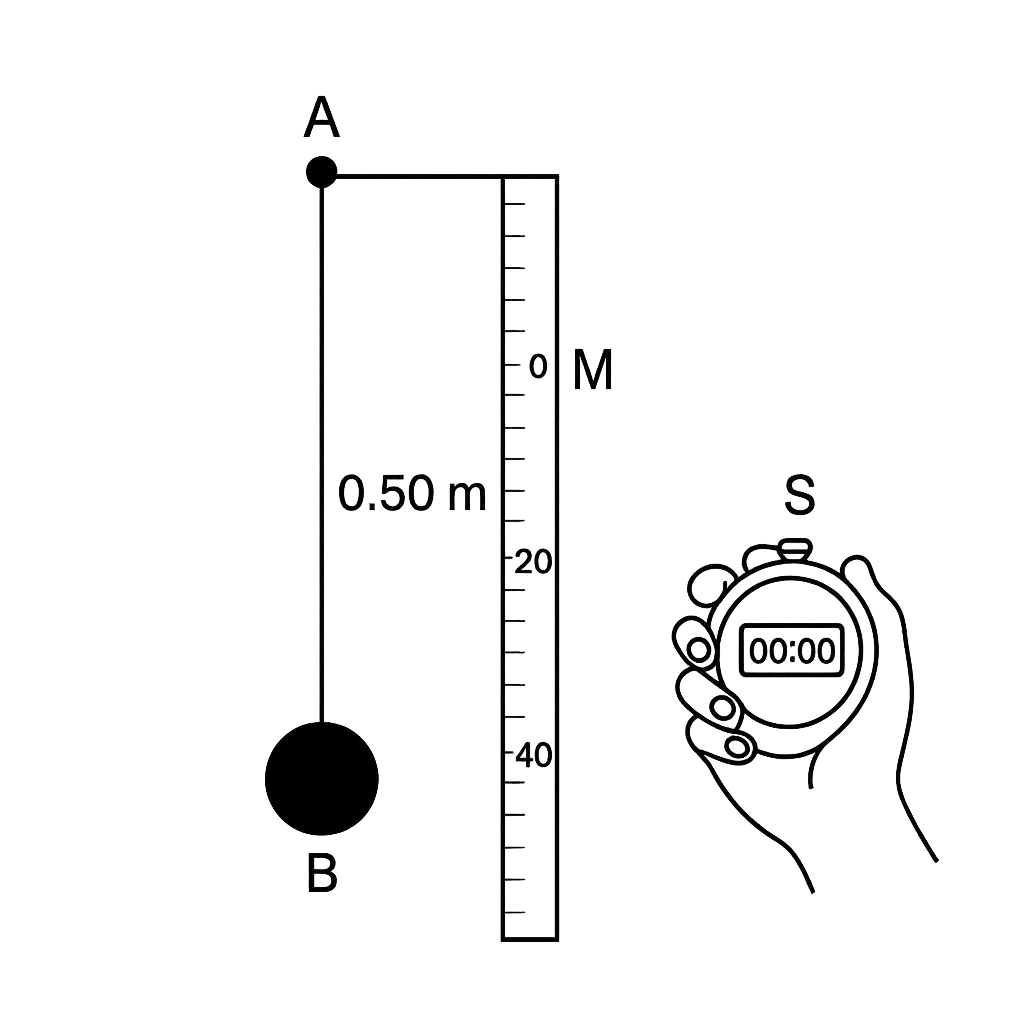
A simple pendulum is set up as shown in the diagram. The length of the string is measured with a metre rule and the period of the pendulum is determined using a stopwatch. The experiment is repeated to obtain a reliable average period.
Question Parts
(a)
State two possible sources of systematic error that could affect the measured length of the pendulum.
(b)
The length of the string is measured as 0.50 m. The time taken for 20 complete oscillations is recorded as 28.0 s. Calculate the average period of the pendulum.
(c)
Using the period obtained in (b), calculate the acceleration due to gravity g. Give your answer to two decimal places.
(d)
Suggest two ways to improve the accuracy of the experiment.
Detailed Essay Solution & Marking Scheme Available

Get the step-by-step mathematical proofs, key points required by examiners, and a comprehensive breakdown from our AI Tutor.
Question 2 View Details
A boat can travel at a speed of 10 m s⁻¹ in still water. It attempts to cross a river that flows uniformly eastwards at 4 m s⁻¹. The river is 200 m wide. The boat is steered so that its heading is directly northwards.
Question Parts
(a)
Determine the magnitude and direction (angle east of north) of the resultant velocity of the boat relative to the ground.
(b)
Calculate:
() The time taken for the boat to reach the opposite bank.
() The downstream displacement of the boat when it reaches the opposite bank.
Detailed Essay Solution & Marking Scheme Available

Get the step-by-step mathematical proofs, key points required by examiners, and a comprehensive breakdown from our AI Tutor.
Question 3 View Details
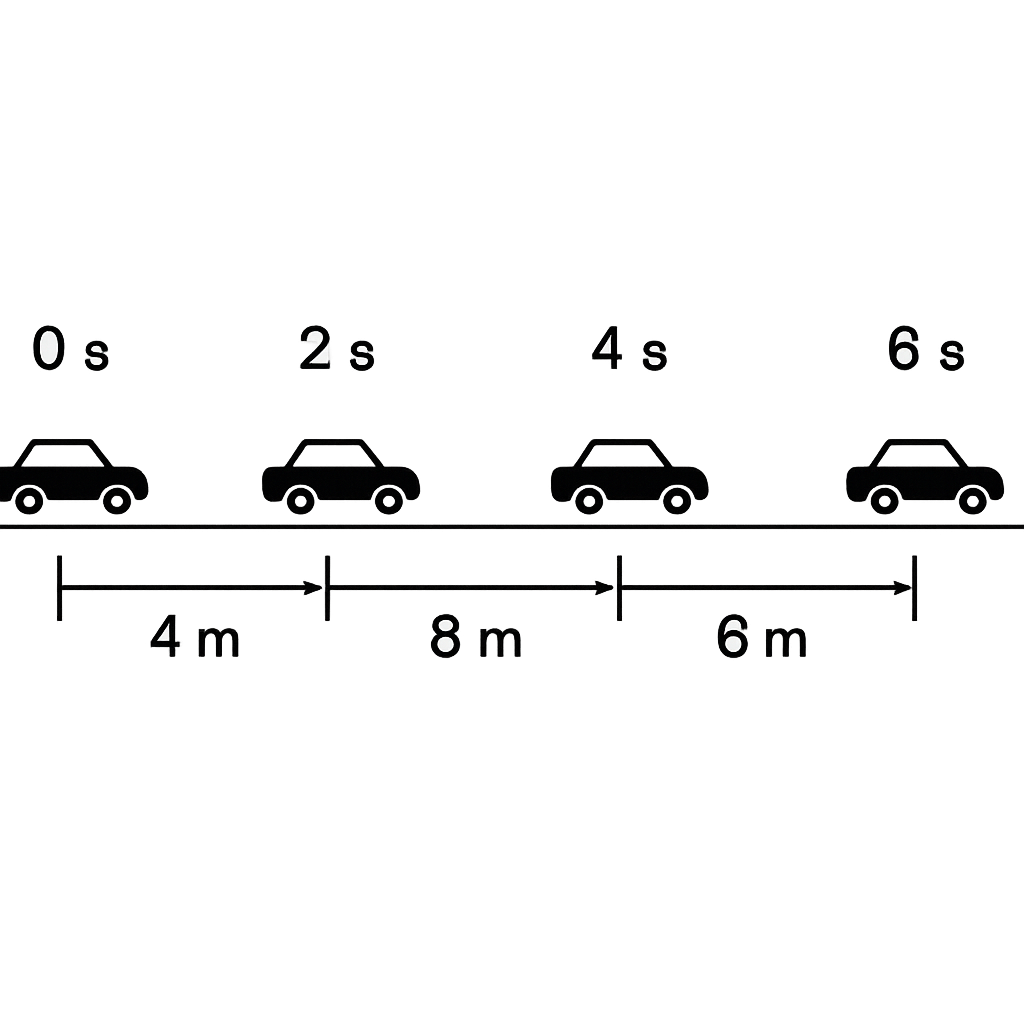
The motion diagram below shows a car moving in a straight line. The diagram records the positions of the car at successive 2‑second intervals. The distances between successive position markers are 4 m, 8 m and 12 m respectively.
Question Parts
(a)
Determine the constant acceleration of the car.
(b)
Calculate the speed of the car at t = 6 s.
(c)
Predict the distance the car will travel in the next 4 seconds (from t = 6 s to t = 10 s) assuming the same acceleration continues.
Detailed Essay Solution & Marking Scheme Available

Get the step-by-step mathematical proofs, key points required by examiners, and a comprehensive breakdown from our AI Tutor.

Question 4 View Details
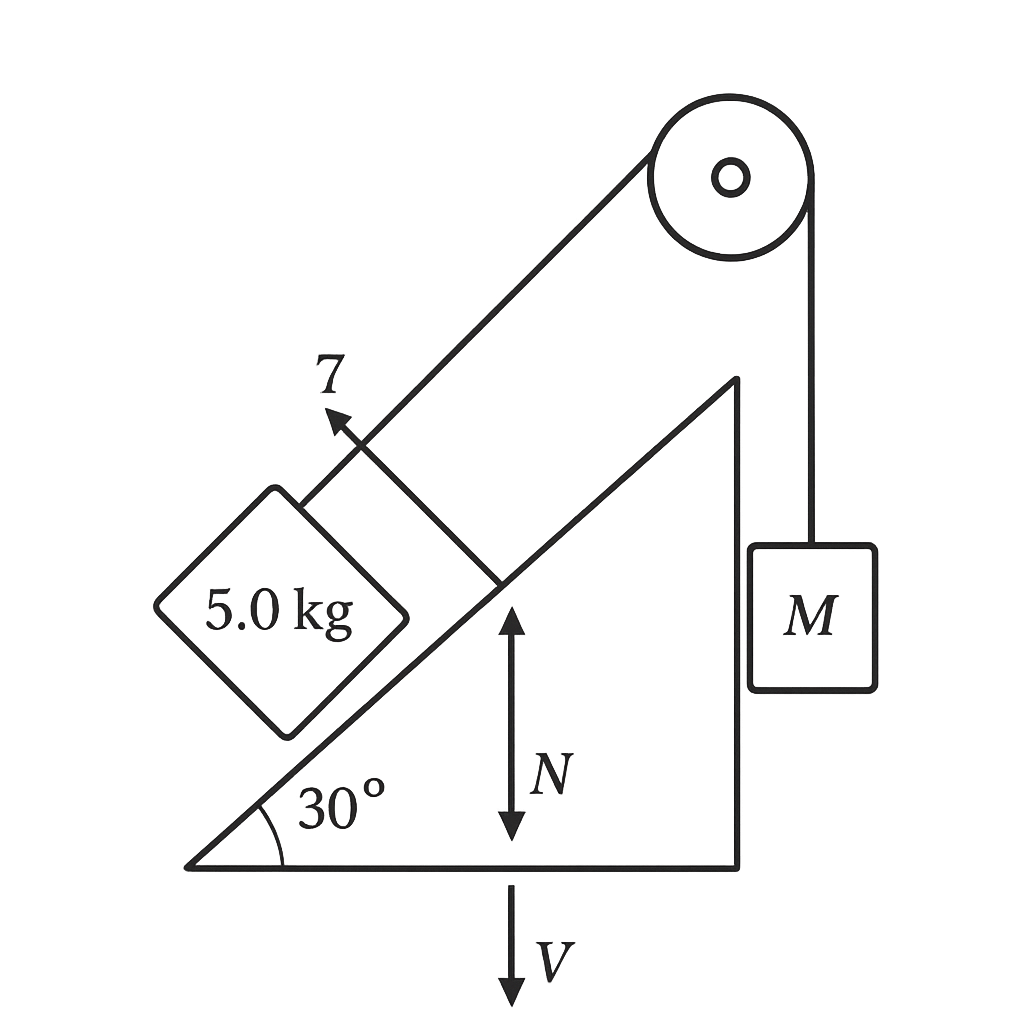
A block of mass 5.0 kg rests on a rough inclined plane that makes an angle of 30\(^\circ\) with the horizontal. The block is attached to a light string that passes over a smooth pulley at the top of the incline and is connected to a hanging mass M. The system is in equilibrium and the tension in the string is measured to be 30 N. The diagram of the system is shown in the force diagram.
Question Parts
(a)
Calculate the weight of the block and resolve it into components parallel and perpendicular to the plane.
(b)
Using the equilibrium condition, determine the normal reaction exerted by the plane on the block.
(c)
Find the value of the coefficient of static friction \(\mu_s\) between the block and the plane.
(d)
If the hanging mass M is increased until the block just begins to move up the plane, calculate the minimum value of M required. Assume the coefficient of static friction remains unchanged.
Detailed Essay Solution & Marking Scheme Available

Get the step-by-step mathematical proofs, key points required by examiners, and a comprehensive breakdown from our AI Tutor.

Question 5 View Details
A 5.0 kg block is released from rest at the top of an inclined plane that makes an angle of 30° with the horizontal. The smooth part of the incline is 4.0 m long, after which the surface becomes rough for a further 2.0 m. The coefficient of kinetic friction on the rough section is 0.20. At the bottom of the rough section the block compresses a horizontal spring of spring constant 800 N·m⁻¹ until it momentarily comes to rest.
Question Parts
(a)
Determine the speed of the block at the point where the smooth part ends and the rough part begins.
(b)
Calculate the work done by the kinetic friction force on the block while it travels the rough 2.0 m section.
(c)
Using the speed found in part (a) and the work of friction from part (b), determine the maximum compression of the spring.
Detailed Essay Solution & Marking Scheme Available

Get the step-by-step mathematical proofs, key points required by examiners, and a comprehensive breakdown from our AI Tutor.

Question 6 View Details
The diagram shows a simple machine system consisting of a fixed inclined plane, a small pulley at the top of the plane and a light inextensible string. A block of mass \(m_{1}=5\,\text{kg}\) rests on the plane, which makes an angle of \(30^{\circ}\) with the horizontal and has a length of \(4\,\text{m}\). The coefficient of kinetic friction between the block and the plane is \(\mu_{k}=0.20\). The string passes over the pulley (radius \(r=0.10\,\text{m}\)) to a hanging mass \(m_{2}=3\,\text{kg}\). A brake attached to the pulley exerts a constant opposing torque of \(2\,\text{N·m}\). The system is released from rest. Answer the following:
Question Parts
(a)
Determine the magnitude and direction of the linear acceleration of the system (ignore the brake).
(b)
Calculate the tension in the string for the situation in part (a).
(c)
Find the speed of the block when it reaches the top of the plane.
(d)
If the brake applies the given torque, determine the new magnitude and direction of the linear acceleration of the system.
Detailed Essay Solution & Marking Scheme Available

Get the step-by-step mathematical proofs, key points required by examiners, and a comprehensive breakdown from our AI Tutor.

Question 7 View Details
A gas is enclosed in a rigid container of volume 2.0 L. The container is connected to a U‑tube manometer that contains mercury (density 13 600 kg·m⁻³). The difference in mercury levels is 12.0 cm, with the left leg open to the atmosphere. The temperature of the gas is 27 °C and the atmospheric pressure is 101.3 kPa. The gas behaves as an ideal gas.
Question Parts
(a)
Determine the absolute pressure of the gas in the container in kPa.
(b)
Calculate the number of moles of gas present in the container.
(c)
If the gas is heated to 127 °C while the container remains rigid, what will be the new pressure (in kPa)? Assume no gas escapes.
Detailed Essay Solution & Marking Scheme Available

Get the step-by-step mathematical proofs, key points required by examiners, and a comprehensive breakdown from our AI Tutor.

Question 8 View Details
A uniform metal rod of length L₀ = 1.00 m at 20 °C is fixed at one end. Its coefficient of linear expansion is α = 12 × 10⁻⁶ °C⁻¹. The free end of the rod pushes against a spring of spring constant k = 150 N·m⁻¹. The rod is heated uniformly to 120 °C. The rod has a mass of 0.50 kg. After heating, the spring is released and the rod is allowed to cool back to 20 °C. Assume that all the elastic potential energy stored in the spring is converted into kinetic energy of the rod when it returns to its original length.
Question Parts
(a)
Calculate the linear expansion ΔL of the rod caused by the temperature rise.
(b)
Determine the extension of the spring and the force exerted by the spring on the rod after heating.
(c)
Calculate the elastic potential energy stored in the spring at this extension.
(d)
When the spring is released and the rod cools back to 20 °C, find the maximum speed of the rod’s free end, assuming all the stored elastic energy is converted into kinetic energy of the rod.
Detailed Essay Solution & Marking Scheme Available

Get the step-by-step mathematical proofs, key points required by examiners, and a comprehensive breakdown from our AI Tutor.

Master the Exam!

You've seen a preview, but there are thousands more questions plus AI tutor to break down complex solutions.

Unlock Full Access Available for Android & Windows
Help others prepare! Share this practice hub:
Chat with Support