neco 2024 mathematics | Essay

Prepare for your exams with neco questions? Reviewing past/model questions is one of the most effective ways to guarantee a high score. This practice hub features authentic 2024 mathematics (Essay) questions designed to simulate the real exam environment.

Practice these randomly selected questions to test your readiness.

Question 1 View Details
The integer N is 5,432,187.
Question Parts
(a)
Write N in expanded form.
(b)
Without performing long division, determine the remainder when N is divided by 9.
Detailed Essay Solution & Marking Scheme Available

Get the step-by-step mathematical proofs, key points required by examiners, and a comprehensive breakdown from our AI Tutor.
Question 2 View Details
A shopkeeper bought 250 kg of rice for ₦45,000.
Question Parts
(a)
Determine the cost price per kilogram of the rice (in whole naira).
(b)
Part of the rice is sold at a profit of 20% and the remaining part at a profit of 35%. If the total revenue obtained is ₦54,999, find how many kilograms were sold at each profit rate.
Detailed Essay Solution & Marking Scheme Available

Get the step-by-step mathematical proofs, key points required by examiners, and a comprehensive breakdown from our AI Tutor.

Question 3 View Details
Consider the following expressions involving indices, logarithms and surds:
Question Parts
(a)
Simplify \(\dfrac{2^{3}\,\times\,4^{x}}{8^{\,x-1}}\) and express the result as a single power of 2.
(b)
If the simplified result from part (a) is equal to \(2^{5}\), determine the value of \(x\).
(c)
Evaluate \(\log_{2}\bigl(\sqrt{32}\bigr)\) and give your answer as a rational number.
(d)
Using the value of \(x\) found in part (b), compute \(\log_{2}\bigl(2^{x}\times\sqrt{32}\bigr)\). Express the answer as a rational number.
Detailed Essay Solution & Marking Scheme Available

Get the step-by-step mathematical proofs, key points required by examiners, and a comprehensive breakdown from our AI Tutor.

Question 4 View Details
The Venn diagram below represents the participation of 100 students in three sports: football (set A), basketball (set B) and cricket (set C). The numbers shown in each region are the exact counts of students belonging to that region.
Question Parts
(a)
How many students take part in at least one of the three sports?
Detailed Essay Solution & Marking Scheme Available

Get the step-by-step mathematical proofs, key points required by examiners, and a comprehensive breakdown from our AI Tutor.

Question 5 View Details
Two integers \(a\) and \(b\) satisfy the simultaneous conditions \(a+b=10\) and \(a^{2}+b^{2}=58\).
Question Parts
(a)
Find the ordered pair \((a,b)\).
(b)
Using the values of \(a\) and \(b\) found in part (a), evaluate \(a^{3}+b^{3}\).
Detailed Essay Solution & Marking Scheme Available

Get the step-by-step mathematical proofs, key points required by examiners, and a comprehensive breakdown from our AI Tutor.

Question 6 View Details
Consider the system of linear equations \[\begin{cases} x + ky = 4 \\ 2x + (k+1) y = 9 \end{cases}\]
Question Parts
(a)
State the condition on \(k\) for which the system has a unique solution.
(b)
Find the value(s) of \(k\) for which the system has no solution.
(c)
State the condition on \(k\) for which the system has infinitely many solutions.
(d)
For \(k = 0\), solve the system and give the ordered pair \((x, y)\).
Detailed Essay Solution & Marking Scheme Available

Get the step-by-step mathematical proofs, key points required by examiners, and a comprehensive breakdown from our AI Tutor.

Question 7 View Details
Consider the quadratic equation \(x^{2}-(k-3)x+2k=0\) where \(k\) is a real parameter.
Question Parts
(a)
Determine the value of \(k\) for which the equation has two distinct real roots that differ by 3 units.
(b)
For the value of \(k\) found in part (a), calculate the two roots of the quadratic equation.
(c)
Find the sum of the squares of the two roots obtained in part (b).
Detailed Essay Solution & Marking Scheme Available

Get the step-by-step mathematical proofs, key points required by examiners, and a comprehensive breakdown from our AI Tutor.

Question 8 View Details
Solve the inequality involving an absolute value and a quadratic expression:
Question Parts
(a)
Find all real numbers \(x\) that satisfy \(|2x-5| < x^{2}-4x+3\).
(b)
List all integer values of \(x\) that satisfy the inequality obtained in part (a).
(c)
If \(x\) represents the number of units produced per day, what is the maximum possible integer production that meets the condition in part (a)?
Detailed Essay Solution & Marking Scheme Available

Get the step-by-step mathematical proofs, key points required by examiners, and a comprehensive breakdown from our AI Tutor.

Question 9 View Details
A certain sequence is defined as follows: the first term is 3. The second term is obtained by adding 4 to the first term. From the third term onward, each term is the sum of the two preceding terms.
Question Parts
(a)
Write the first six terms of the sequence.
(b)
Prove that for \(n \ge 3\), the \(n^{th}\) term can be expressed as \(a_n = 3F_{n-2} + 4F_{n-1}\), where \(F_k\) denotes the \(k^{th}\) term of the standard Fibonacci sequence (\(F_1 = 1, F_2 = 1\)).
(c)
Using the result in part (b), find the sum of the first ten terms of the sequence.
Detailed Essay Solution & Marking Scheme Available

Get the step-by-step mathematical proofs, key points required by examiners, and a comprehensive breakdown from our AI Tutor.

Question 10 View Details
In a manufacturing process the time \(T\) (in minutes) taken to complete a fixed batch varies directly as the square of the number of workers \(w\) and inversely as the efficiency rating \(E\) of the machine. When 5 workers operate a machine with efficiency rating 8, the batch is completed in 20 minutes.
Question Parts
(a)
Determine the constant of variation \(k\) and write the formula that relates \(T\), \(w\) and \(E\).
(b)
If the efficiency rating is increased to 12, how many workers are required to reduce the time to 15 minutes? Give your answer to one decimal place.
(c)
Keeping the number of workers at 6, by what factor must the efficiency be increased so that the time taken is halved compared with the original 20‑minute time? Express the required efficiency as a multiple of the original efficiency.
Detailed Essay Solution & Marking Scheme Available

Get the step-by-step mathematical proofs, key points required by examiners, and a comprehensive breakdown from our AI Tutor.

Question 11 View Details
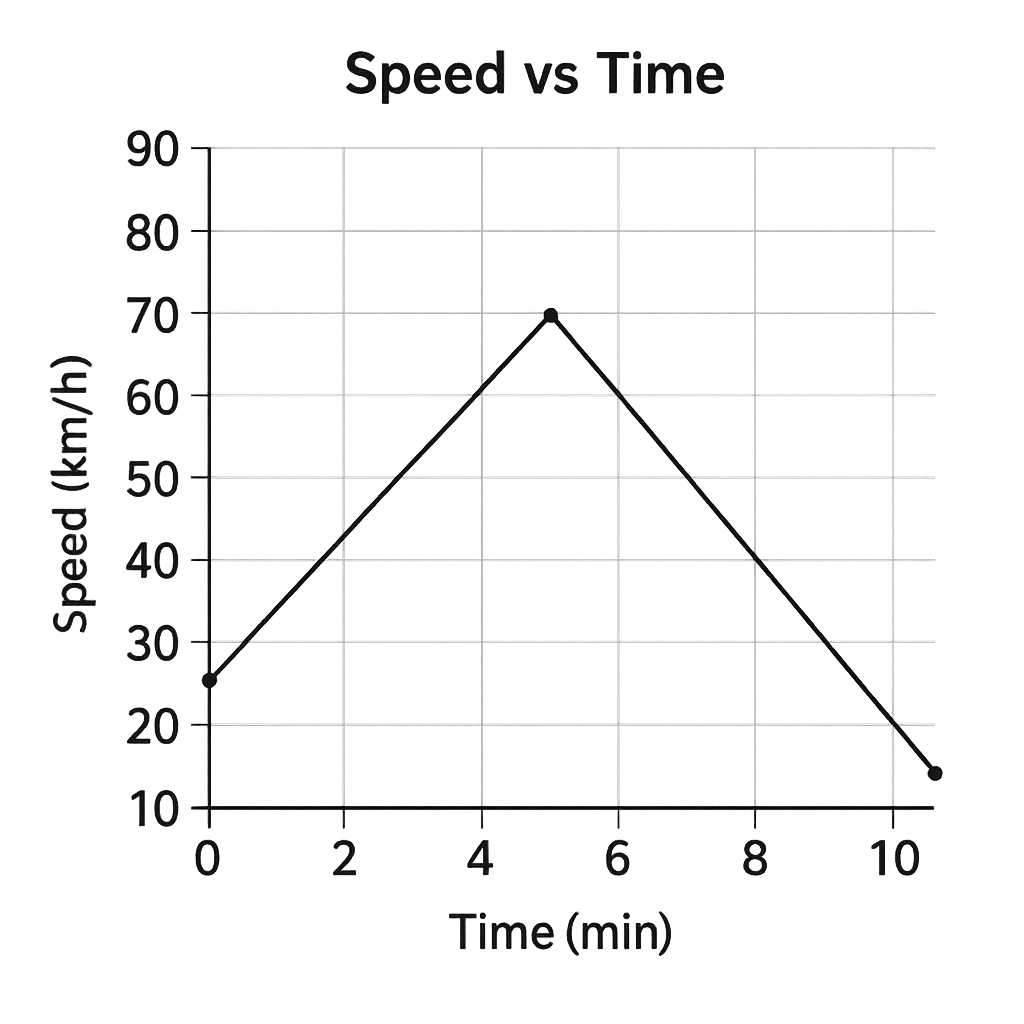
The graph below shows the speed \(v\) (in km/h) of a car as a function of time \(t\) (in minutes) from the start of a journey.
Question Parts
(a)
Calculate the total distance travelled by the car during the 10 minute interval.
(b)
Determine the average speed of the car over the whole 10 minute period.
(c)
The car accelerates uniformly from rest to its maximum speed. Find the magnitude of this acceleration expressed in km/h per minute.
(d)
After reaching the maximum speed, the car decelerates uniformly to rest. Determine the magnitude of this deceleration in km/h per minute.
Detailed Essay Solution & Marking Scheme Available

Get the step-by-step mathematical proofs, key points required by examiners, and a comprehensive breakdown from our AI Tutor.

Question 12 View Details
In the diagram, triangle \(ABC\) is shown with side \(AB = 10\) cm. The interior angles at vertices \(A\) and \(B\) are \(40^{\circ}\) and \(70^{\circ}\) respectively. The triangle is positioned so that side \(AB\) lies on the \(x\)-axis with \(A\) at the origin.
Question Parts
(a)
Determine the coordinates of vertex \(C\) (give answers correct to two decimal places).
(b)
Find the equation of the line \(AC\) in the form \(y = mx\) (give the slope \(m\) correct to three decimal places).
(c)
Using coordinate geometry, compute the area of \(\triangle ABC\) (give the answer to two decimal places).
(d)
Find the distance from vertex \(C\) to the midpoint of \(AB\) (give the answer to two decimal places).
Detailed Essay Solution & Marking Scheme Available

Get the step-by-step mathematical proofs, key points required by examiners, and a comprehensive breakdown from our AI Tutor.

Question 13 View Details
In triangle \(ABC\) the measures of \(\angle A\) and \(\angle B\) are \(40^{\circ}\) and \(70^{\circ}\) respectively and side \(AB\) is 8 cm long. Point \(D\) lies on side \(BC\) such that \(BD:DC = 1:2\).
Question Parts
(a)
Find the length of side \(BC\).
(b)
Determine the length of \(AD\).
(c)
Find the length of the altitude \(AH\) drawn from \(A\) to side \(BC\).
(d)
State the area of \(\triangle ABC\) (to two decimal places).
Detailed Essay Solution & Marking Scheme Available

Get the step-by-step mathematical proofs, key points required by examiners, and a comprehensive breakdown from our AI Tutor.

Master the Exam!

You've seen a preview, but there are thousands more questions plus AI tutor to break down complex solutions.

Unlock Full Access Available for Android & Windows
Help others prepare! Share this practice hub:
Chat with Support