neco 2024 biology | Objective

Prepare for your exams with neco questions? Reviewing past/model questions is one of the most effective ways to guarantee a high score. This practice hub features authentic 2024 biology (Objective) questions designed to simulate the real exam environment.

Practice these randomly selected questions to test your readiness.

Question 1 View Details
A plant is heterozygous for two genes A/a and B/b that are linked on the same chromosome in coupling phase (AB / ab). The recombination frequency between the genes is \(20\%\). The plant is crossed with a homozygous recessive individual (aabb). What is the probability that an offspring will have the genotype \(Aa\;bb\) (i.e., carry a dominant A allele and be recessive for b)?
A. 0.05
B. 0.08
C. 0.20
Correct D. 0.10

Correct Answer: D

Want to see the full step-by-step solution? Unlock AI Explanation & Analytics
Question 2 View Details
A toxin specifically inhibits the ATP synthase complex (Complex V) in mitochondria. Predict the immediate effect on (i) the rate of ATP synthesis and (ii) the proton gradient across the inner mitochondrial membrane.
A. ATP synthesis rate remains unchanged; the proton gradient across the inner membrane increases.
B. ATP synthesis rate rises slightly; the proton gradient across the inner membrane decreases.
Correct C. ATP synthesis rate drops sharply; the proton gradient across the inner membrane increases.
D. ATP synthesis rate drops sharply; the proton gradient across the inner membrane decreases.

Correct Answer: C

Want to see the full step-by-step solution? Unlock AI Explanation & Analytics
Question 3 View Details
An adult human has a basal heat loss of \(150\ \text{kcal\ h}^{-1}\) at thermal equilibrium. In a cold environment the body responds by (i) vasoconstriction, which reduces heat loss by \(30\%\), and (ii) shivering, which adds \(200\ \text{kcal\ h}^{-1}\) of heat production. Assuming basal metabolic heat production equals basal heat loss, calculate the net heat balance (in \(\text{kcal\ h}^{-1}\)) after these responses.
A. 350
B. 105
Correct C. 245
D. 305

Correct Answer: C

Want to see the full step-by-step solution? Unlock AI Explanation & Analytics
Question 4 View Details
An enzyme‑catalyzed reaction follows Michaelis-Menten kinetics. The following initial rates (V, µmol min\(^{-1}\)) were measured at different substrate concentrations ([S], mM) in the absence and presence of a reversible inhibitor I (10 µM).\n\nWithout I:\n[S] (mM): 0.5, 1.0, 2.0, 4.0\nV (µmol min\(^{-1}\)): 20, 33.3, 50, 66.7\n\nWith I:\n[S] (mM): 0.5, 1.0, 2.0, 4.0\nV (µmol min\(^{-1}\)): 12, 20, 33.3, 45.5\n\nUsing a Lineweaver-Burk plot, determine the type of inhibition exhibited by I (choose among competitive, non‑competitive, or uncompetitive).
Correct A. uncompetitive
B. mixed
C. non‑competitive
D. competitive

Correct Answer: A

Want to see the full step-by-step solution? Unlock AI Explanation & Analytics
Question 5 View Details
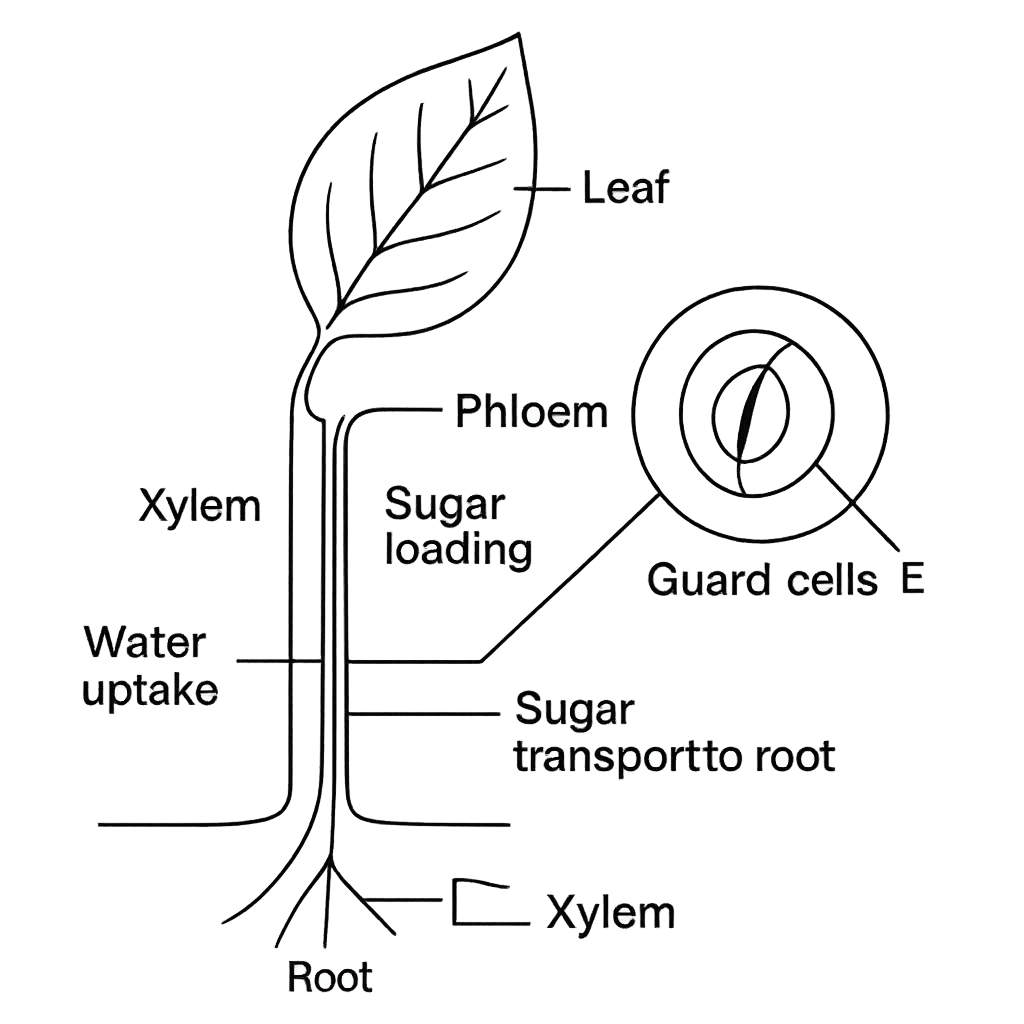
The diagram shows the main transport pathways in a typical dicot leaf. Arrow 1 indicates the movement of water from the root to the leaf, while Arrow 2 shows the movement of photosynthates from the leaf to the root. Identify the tissue through which water moves in Arrow 1 and state the primary physical mechanism that drives this movement.
A. Water moves through the phloem; the movement is driven by pressure flow (mass flow).
B. Water moves through the xylem; the movement is driven by root pressure.
C. Water moves through the bundle sheath; the movement is driven by osmotic diffusion.
Correct D. Water moves through the xylem; the movement is driven by transpiration pull (cohesion‑tension).

Correct Answer: D

Want to see the full step-by-step solution? Unlock AI Explanation & Analytics
Question 6 View Details
A woman has a regular menstrual cycle of \(28\) days. The luteal phase lasts \(14\) days. She records that her basal body temperature rises on day X, indicating that ovulation occurred the previous night. Sperm can survive up to 5 days in the female reproductive tract, and cervical mucus becomes fertile from day \(12\) to day \(14\) of the cycle. Determine the range of days (as day numbers of the cycle) on which she should have sexual intercourse to maximise the chance of conception.
Correct A. Days 12-13
B. Days 11-12
C. Days 10-11
D. Days 13-14

Correct Answer: A

Want to see the full step-by-step solution? Unlock AI Explanation & Analytics
Question 7 View Details
A newly discovered pathogen has the following properties: (i) a single‑stranded RNA genome of negative polarity, (ii) replication occurs in the cytoplasm using its own RNA‑dependent RNA polymerase, (iii) it possesses a lipid envelope derived from the host cell membrane, (iv) its capsid lacks icosahedral symmetry, and (v) it infects only plant cells. According to the Baltimore classification system, to which group does this virus belong?
A. Group III (positive‑sense ssRNA viruses)
B. Group I (double‑stranded DNA viruses)
Correct C. Group V (negative‑sense ssRNA viruses)
D. Group IV (ssRNA‑RT viruses)

Correct Answer: C

Want to see the full step-by-step solution? Unlock AI Explanation & Analytics
Question 8 View Details
In a beetle population the frequency of allele \(A\) is \(p=0.6\) and allele \(a\) is \(q=0.4\). The fitnesses of the three genotypes are \(w_{AA}=0.9\), \(w_{Aa}=0.8\) and \(w_{aa}=0.5\). Assuming random mating and Hardy-Weinberg proportions before selection, calculate the frequency of allele \(A\) after one generation of selection.
A. 0.670
Correct B. 0.655
C. 0.600
D. 0.645

Correct Answer: B

Want to see the full step-by-step solution? Unlock AI Explanation & Analytics
Question 9 View Details
During which phase of mitosis do sister chromatids separate and move toward opposite poles of the cell?
A. Metaphase
Correct B. Anaphase
C. Telophase
D. Prophase

Correct Answer: B

Want to see the full step-by-step solution? Unlock AI Explanation & Analytics
Question 10 View Details
In a community, 2,000 individuals are exposed to a contaminated water source, of whom 150 develop cholera. In a comparable unexposed group of 3,000 individuals, 90 develop cholera. (i) Calculate the relative risk (RR) of cholera associated with exposure. (ii) Determine the attributable risk percent (AR%) among the exposed. (iii) Based on these findings, which single public‑health intervention would most effectively reduce the incidence of cholera in this community?
A. RR = 2.0; AR% = 50 %; intervention: health education on handwashing
Correct B. RR = 2.5; AR% = 60 %; intervention: provision of safe drinking water (e.g., chlorination)
C. RR = 1.7; AR% = 40 %; intervention: distribution of oral rehydration salts (ORS)
D. RR = 3.0; AR% = 70 %; intervention: vaccination against cholera

Correct Answer: B

Want to see the full step-by-step solution? Unlock AI Explanation & Analytics
Question 11 View Details
An unlabeled transverse section of a dicot stem shows, from outer to inner: epidermis, cortex, vascular bundle with xylem and phloem separated by a cambium layer, and pith. (a) Name the tissue that transports sugars from the leaves to other parts of the plant. (b) If the cross‑sectional area of the phloem is \(0.8\) mm\(^2\) and that of the xylem is \(1.2\) mm\(^2\), and transport rates are directly proportional to these areas, calculate the ratio of the sugar transport rate to the water transport rate. Express your answer as a decimal to two places.
Correct A. 0.67
B. 0.53
C. 0.75
D. 0.80

Correct Answer: A

Want to see the full step-by-step solution? Unlock AI Explanation & Analytics
Question 12 View Details
A desert cactus has evolved leaf modifications that reduce its leaf surface area to 5% of a typical leaf which measures \(10\) cm\(^2\). The typical leaf has a stomatal density of \(300\) stomata per mm\(^2\), whereas the cactus leaf has a density of \(150\) stomata per mm\(^2\). Assuming transpiration rate is directly proportional to the total number of stomata, calculate the percentage reduction in water loss of the cactus leaf compared with the typical leaf. Give your answer to one decimal place.
A. 92.5
B. 95.0
Correct C. 97.5
D. 99.0

Correct Answer: C

Want to see the full step-by-step solution? Unlock AI Explanation & Analytics
Question 13 View Details
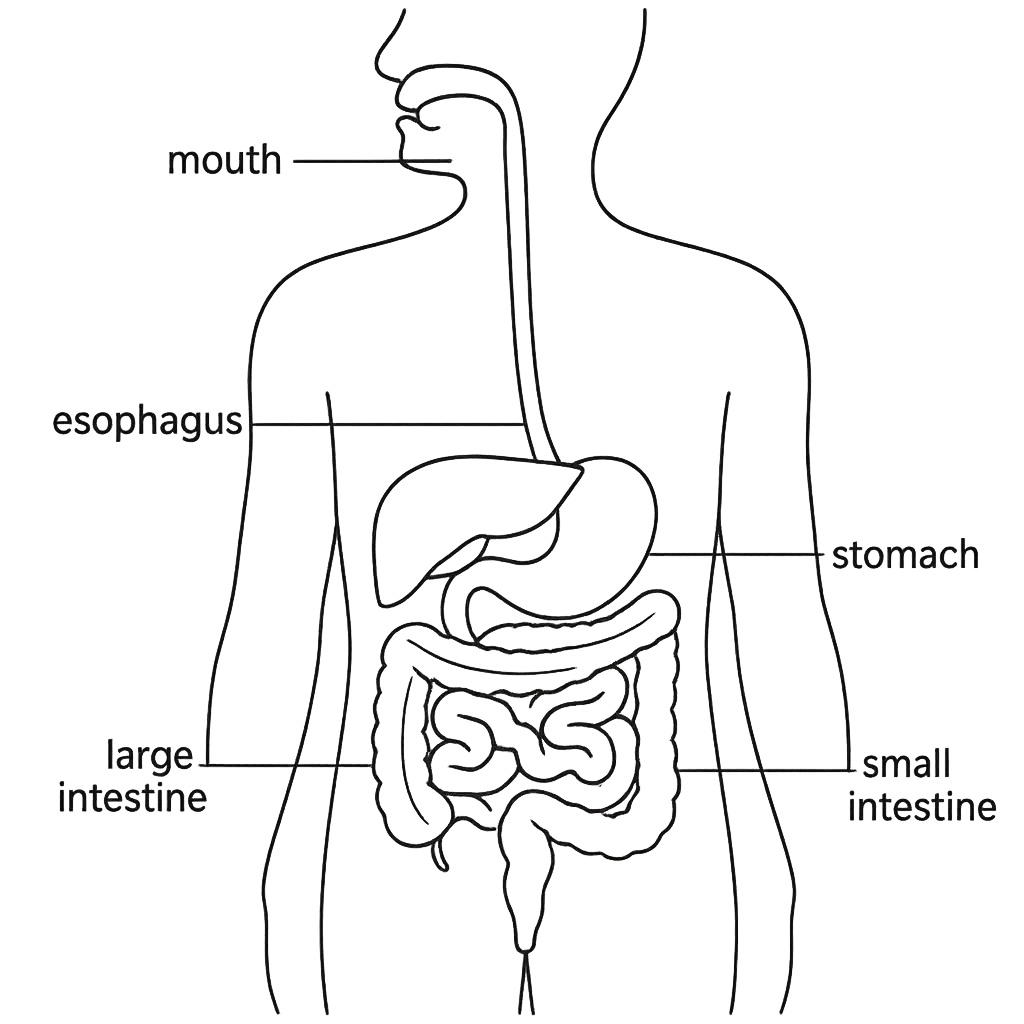
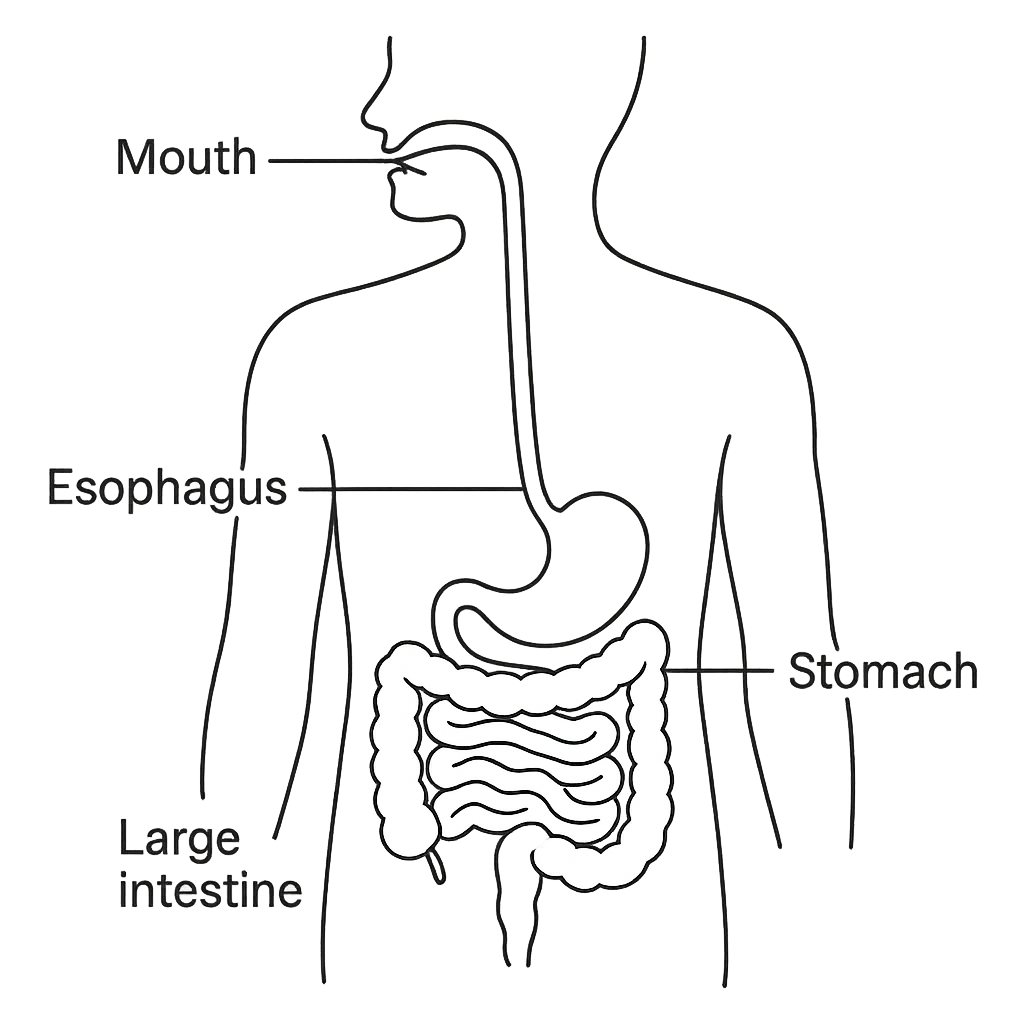
The diagram shows the human digestive system with the following labelled parts: Mouth, Esophagus, Stomach, Small intestine, Large intestine. List these organs in the order that food passes through them, starting from ingestion.
A. Mouth → Esophagus → Small intestine → Stomach → Large intestine
B. Mouth → Stomach → Esophagus → Small intestine → Large intestine
C. Mouth → Esophagus → Stomach → Large intestine → Small intestine
Correct D. Mouth → Esophagus → Stomach → Small intestine → Large intestine

Correct Answer: D

Want to see the full step-by-step solution? Unlock AI Explanation & Analytics
Question 14 View Details
A rabbit at rest has a heart rate of \(180\) beats per minute and a stroke volume of \(0.5\) mL per beat. During vigorous exercise its heart rate rises to \(300\) beats per minute and stroke volume increases by 20%. In addition, the rabbit's haemoglobin concentration rises by 10%, increasing the oxygen‑carrying capacity of the blood proportionally. If each millilitre of blood at rest carries \(0.20\) mL of O\(_2\), calculate the percentage increase in the rate of oxygen delivery to tissues during exercise compared with rest. Give your answer to one decimal place.
Correct A. 120.0
B. 105.0
C. 130.0
D. 115.0

Correct Answer: A

Want to see the full step-by-step solution? Unlock AI Explanation & Analytics
Question 15 View Details
In a grassland ecosystem the annual primary productivity is \(8000\) kJ m\(^{-2}\). Herbivores convert 15% of the energy they consume into their own biomass. Primary carnivores (secondary consumers) convert 10% of the energy they obtain from herbivores into biomass. A top predator (tertiary consumer) obtains 5% of the carnivore biomass. What percentage of the original primary productivity is present in the top‑predator biomass? Give your answer to three decimal places.
A. 5.000
Correct B. 0.075
C. 0.750
D. 0.008

Correct Answer: B

Want to see the full step-by-step solution? Unlock AI Explanation & Analytics
Question 16 View Details
During a bacterial growth experiment, the optical density at 600 nm (OD600) of a culture was 0.5 at time 0 h. After incubating at 37 °C for 4 h, the OD600 increased to 2.0. It is known that an OD600 of 0.5 corresponds to \(5\\times10^{8}\) cells mL\(^{-1}\). The temperature is then shifted to 42 °C, where the specific growth rate drops by 30 % compared with the rate at 37 °C. Assuming exponential growth continues, what is the expected OD600 after an additional 2 h at 42 °C? Give your answer to two decimal places.
Correct A. 3.25
B. 2.49
C. 4.00
D. 2.20

Correct Answer: A

Want to see the full step-by-step solution? Unlock AI Explanation & Analytics
Question 17 View Details
A diet provides 2500 kcal per day and contains 60 g of protein and 80 g of fat, the remainder being carbohydrate. (i) Calculate the percentage of the total caloric intake that comes from protein. (ii) Determine the amount of protein (in grams) required for protein to supply exactly 15 % of the total calories, assuming the total caloric intake remains 2500 kcal.
A. 12.0 % ; 112.5 g
B. 10.2 % ; 100.0 g
C. 8.0 % ; 85.0 g
Correct D. 9.6 % ; 93.8 g

Correct Answer: D

Want to see the full step-by-step solution? Unlock AI Explanation & Analytics
Question 18 View Details
A woman has a regular menstrual cycle of 28 days, with a luteal phase that is consistently 14 days long. She records the first day of her last menstrual period (LMP) as 3 March. (i) On which calendar date is she most likely to ovulate? (ii) Give the range of dates that constitute her fertile window (the six days ending on the day of ovulation).
A. Ovulation: 18 March; Fertile window: 13 March - 18 March
B. Ovulation: 17 March; Fertile window: 12 March - 17 March
C. Ovulation: 15 March; Fertile window: 10 March - 15 March
Correct D. Ovulation: 16 March; Fertile window: 11 March - 16 March

Correct Answer: D

Want to see the full step-by-step solution? Unlock AI Explanation & Analytics
Question 19 View Details
In a community health survey, 2000 individuals were examined. Among them, 400 are smokers and 1600 are non‑smokers. Chronic bronchitis was diagnosed in 80 smokers and 40 non‑smokers. (i) Calculate the incidence of chronic bronchitis in smokers and in non‑smokers (expressed as a percentage). (ii) Compute the relative risk (RR) of chronic bronchitis for smokers compared with non‑smokers. (iii) Determine the attributable risk percent among the exposed (AR%). (iv) Calculate the population attributable risk percent (PAR%).
A. Incidence smokers: 25 %; Incidence non‑smokers: 3 %; RR: 8.3; AR%: 87.9 %; PAR%: 60.0 %
B. Incidence smokers: 18 %; Incidence non‑smokers: 2.5 %; RR: 7.2; AR%: 86 %; PAR%: 57 %
C. Incidence smokers: 20 %; Incidence non‑smokers: 3 %; RR: 6.7; AR%: 85 %; PAR%: 55 %
Correct D. Incidence smokers: 20 %; Incidence non‑smokers: 2.5 %; RR: 8.0; AR%: 87.5 %; PAR%: 58.3 %

Correct Answer: D

Want to see the full step-by-step solution? Unlock AI Explanation & Analytics
Question 20 View Details
In the sequence of events of mitosis, which phase is characterized by the alignment of chromosomes along the middle of the cell, known as the metaphase plate?
A. Anaphase
B. Telophase
C. Prophase
Correct D. Metaphase

Correct Answer: D

Want to see the full step-by-step solution? Unlock AI Explanation & Analytics
Question 21 View Details
Species X and Y show a \(6\%\) difference in their mitochondrial DNA sequences. The molecular clock for this gene accumulates substitutions at a rate of \(1.2\%\) per million years per lineage. A third species Z differs from X by \(14\%\) and from Y by \(13\%\). Assuming a constant rate, (a) estimate the time (in million years) since X and Y diverged from their common ancestor. (b) Calculate the estimated divergence times for the pairs X-Z and Y-Z and state which pair diverged most recently.
A. X-Y: 5.0 Myr; X-Z: 5.8 Myr; Y-Z: 5.4 Myr; most recent pair: X-Z
B. X-Y: 2.5 Myr; X-Z: 7.0 Myr; Y-Z: 5.4 Myr; most recent pair: Y-Z
Correct C. X-Y: 2.5 Myr; X-Z: 5.8 Myr; Y-Z: 5.4 Myr; most recent pair: X-Y
D. X-Y: 2.5 Myr; X-Z: 5.8 Myr; Y-Z: 4.0 Myr; most recent pair: Y-Z

Correct Answer: C

Want to see the full step-by-step solution? Unlock AI Explanation & Analytics
Question 22 View Details
The axon of a myelinated motor neuron is 1.2\,m long and conducts impulses at \(80\ \text{m s}^{-1}\). An unmyelinated motor neuron of the same length conducts at \(20\ \text{m s}^{-1}\). Both neurons are stimulated simultaneously. (a) Calculate the time taken for the impulse to reach the synaptic terminal for each neuron. (b) If the synaptic delay at the neuromuscular junction is \(0.5\ \text{ms}\), which neuron will cause the muscle fibre to contract first and by how many milliseconds?
A. Myelinated neuron; 45 ms later
B. Unmyelinated neuron; 45 ms earlier
C. Myelinated neuron; 15 ms earlier
Correct D. Myelinated neuron; 45 ms earlier

Correct Answer: D

Want to see the full step-by-step solution? Unlock AI Explanation & Analytics
Question 23 View Details
Renal plasma flow is \(600\ \text{mL min}^{-1}\) and the filtration fraction is \(20\%\). The plasma sodium concentration is \(145\ \text{mmol L}^{-1}\). Of the filtered sodium, \(65\%\) is reabsorbed in the proximal tubule, \(25\%\) in the loop of Henle and \(5\%\) in the distal tubule. Calculate the amount of sodium excreted in the urine per minute (in \(\text{mmol min}^{-1}\)).
Correct A. 0.87 mmol min⁻¹
B. 0.97 mmol min⁻¹
C. 1.74 mmol min⁻¹
D. 0.44 mmol min⁻¹

Correct Answer: A

Want to see the full step-by-step solution? Unlock AI Explanation & Analytics
Question 24 View Details
In an experiment to test the effect of hormone H on the growth of a plant species, the heights (cm) of five control plants and five plants treated with hormone H were recorded:\n\nControl: 12.1, 11.8, 12.5, 12.0, 11.9\nTreatment: 13.4, 13.0, 13.6, 13.2, 13.5\n\nAssuming the data are normally distributed and the variances are equal, perform a two‑sample t‑test at the \(5\%\) significance level to determine whether hormone H significantly increases plant height. State the calculated t‑value, the critical t‑value, and your conclusion.
A. t = 7.9, critical t = 2.306; difference is not statistically significant (hormone does not increase growth)
B. t = 5.2, critical t = 2.306; difference is statistically significant (hormone increases growth)
Correct C. t = 7.9, critical t = 2.306; difference is statistically significant (hormone increases growth)
D. t = 2.1, critical t = 2.306; difference is not statistically significant (hormone does not increase growth)

Correct Answer: C

Want to see the full step-by-step solution? Unlock AI Explanation & Analytics
Question 25 View Details
Normal blood calcium concentration is \(2.5\ \text{mM}\). After a sudden loss, the concentration falls to \(2.0\ \text{mM}\). The parathyroid glands respond by increasing parathyroid hormone (PTH) secretion by \(40\%\) above the basal level. Each \(10\%\) increase in PTH raises blood calcium by \(0.02\ \text{mM min}^{-1}\) through bone resorption, while the basal secretion maintains the set point. Assuming no other regulatory mechanisms act, estimate how many minutes are required to restore the calcium concentration to the normal level. Give your answer to one decimal place.
A. 8.1 minutes
B. 7.4 minutes
Correct C. 6.3 minutes
D. 5.6 minutes

Correct Answer: C

Want to see the full step-by-step solution? Unlock AI Explanation & Analytics

Master the Exam!

You've seen a preview, but there are thousands more questions plus AI tutor to break down complex solutions.

Unlock Full Access Available for Android & Windows
Help others prepare! Share this practice hub:
Chat with Support