neco 2024 agricultural_science | Objective

Prepare for your exams with neco questions? Reviewing past/model questions is one of the most effective ways to guarantee a high score. This practice hub features authentic 2024 agricultural_science (Objective) questions designed to simulate the real exam environment.

Practice these randomly selected questions to test your readiness.

Question 1 View Details
A mixed farming system has \(60\%\) of its total area devoted to crops and the remainder to livestock. If the total farm area is \(150\) ha, calculate the area (in hectares) allocated to livestock.
Correct A. 60
B. 75
C. 45
D. 90

Correct Answer: A

Want to see the full step-by-step solution? Unlock AI Explanation & Analytics
Question 2 View Details
A tractor has an engine power rating of \(50\) kW and a transmission efficiency of \(85\%\). It must pull a plough that requires a constant drawbar pull of \(12\) kN while moving up a \(5\%\) slope at a speed of \(5\) km/h. Determine whether the tractor can maintain this speed. (Show the required engine power in kW.)
A. No, because required engine power is about 60.3 kW, which exceeds the 50 kW available.
B. No, because required engine power is about 19.6 kW, which exceeds the 50 kW available.
Correct C. Yes, because required engine power is about 19.6 kW, which is less than the 50 kW available.
D. Yes, because required engine power is about 55.0 kW, which is less than the 50 kW available.

Correct Answer: C

Want to see the full step-by-step solution? Unlock AI Explanation & Analytics
Question 3 View Details
A dairy cow consumes \(22\) kg of dry matter per day containing \(16\%\) crude protein. The cow produces \(25\) L of milk per day, and the protein content of the milk is \(3.2\%\) (i.e., \(32\) g protein per litre). Calculate the total daily protein intake (in grams) and determine the surplus or deficit of protein relative to the milk protein requirement.
A. Surplus of 3520 g protein
B. Surplus of 1920 g protein
Correct C. Surplus of 2720 g protein
D. Deficit of 2720 g protein

Correct Answer: C

Want to see the full step-by-step solution? Unlock AI Explanation & Analytics
Question 4 View Details
In a maize field, the average stem borer infestation is \(3\) larvae per plant. The economic injury level (EIL) is \(2\) larvae per plant, and each larva causes a \(0.5\%\) reduction in yield. The expected yield without pest damage is \(8\) tonnes per hectare. Compute the expected percentage yield loss and the corresponding loss in tonnes per hectare, and state whether control measures are justified if they are recommended only when the expected loss exceeds \(5\%\) of the yield.
Correct A. Expected loss is 1.5% (0.12 tonnes per ha); control measures are not justified
B. Expected loss is 1.5% (0.12 tonnes per ha); control measures are justified
C. Expected loss is 2.0% (0.16 tonnes per ha); control measures are not justified
D. Expected loss is 0.5% (0.04 tonnes per ha); control measures are not justified

Correct Answer: A

Want to see the full step-by-step solution? Unlock AI Explanation & Analytics
Question 5 View Details
An agricultural extension officer is organizing Farmer Field School (FFS) sessions on integrated pest management. The program must reach at least \(120\) farmer participants, each session can accommodate a maximum of \(25\) participants, and each participant must attend at least \(4\) sessions to be certified. The officer has \(6\) weeks available, with two possible session days per week (Tuesday and Thursday). However, the Thursday of week 3 coincides with a local market day and cannot be used. Each session lasts \(3\) hours. Determine the minimum number of sessions required to satisfy the attendance requirement, calculate the total contact hours delivered, and indicate whether the schedule fits within the available weeks.
Correct A. Minimum sessions = 20, total contact hours = 60 h; the schedule does not fit within the 6‑week period.
B. Minimum sessions = 20, total contact hours = 70 h; the schedule does not fit within the 6‑week period.
C. Minimum sessions = 18, total contact hours = 54 h; the schedule fits within the 6‑week period.
D. Minimum sessions = 22, total contact hours = 66 h; the schedule does not fit within the 6‑week period.

Correct Answer: A

Want to see the full step-by-step solution? Unlock AI Explanation & Analytics
Question 6 View Details
A field has an organic carbon content of \(2.5\%\) by weight. The bulk density of the soil is \(1.3\,\text{g/cm}^3\). If the field area is 1 hectare (\(10,000\,\text{m}^2\)) and the ploughing depth is \(15\,\text{cm}\), estimate the total mass of carbon in the soil in tonnes. Give your answer to two decimal places.
A. 52.30
Correct B. 48.75
C. 41.20
D. 45.60

Correct Answer: B

Want to see the full step-by-step solution? Unlock AI Explanation & Analytics
Question 7 View Details
A lake fish population follows the logistic growth model \(\frac{dN}{dt}=rN\left(1-\frac{N}{K}\right)\) with intrinsic growth rate \(r=0.4\) per year and carrying capacity \(K=8000\) fish. A constant annual harvest of \(H\) fish is imposed. Determine the maximum constant harvest \(H_{max}\) (in fish per year) that can be sustained without driving the population to extinction, and state the equilibrium population size at this harvest.
A. Maximum sustainable harvest: 400 fish per year; equilibrium population: 6000 fish
Correct B. Maximum sustainable harvest: 800 fish per year; equilibrium population: 4000 fish
C. Maximum sustainable harvest: 1600 fish per year; equilibrium population: 2000 fish
D. Maximum sustainable harvest: 800 fish per year; equilibrium population: 2000 fish

Correct Answer: B

Want to see the full step-by-step solution? Unlock AI Explanation & Analytics
Question 8 View Details
A sandy loam soil has a field capacity of \(0.20\,\text{cm}^3/\text{cm}^3\) and a wilting point of \(0.10\,\text{cm}^3/\text{cm}^3\). If the root‑zone depth is \(30\,\text{cm}\) over an area of \(1\,\text{m}^2\), calculate the amount of water (in litres) available to plants.
A. 15
Correct B. 30
C. 20
D. 60

Correct Answer: B

Want to see the full step-by-step solution? Unlock AI Explanation & Analytics
Question 9 View Details
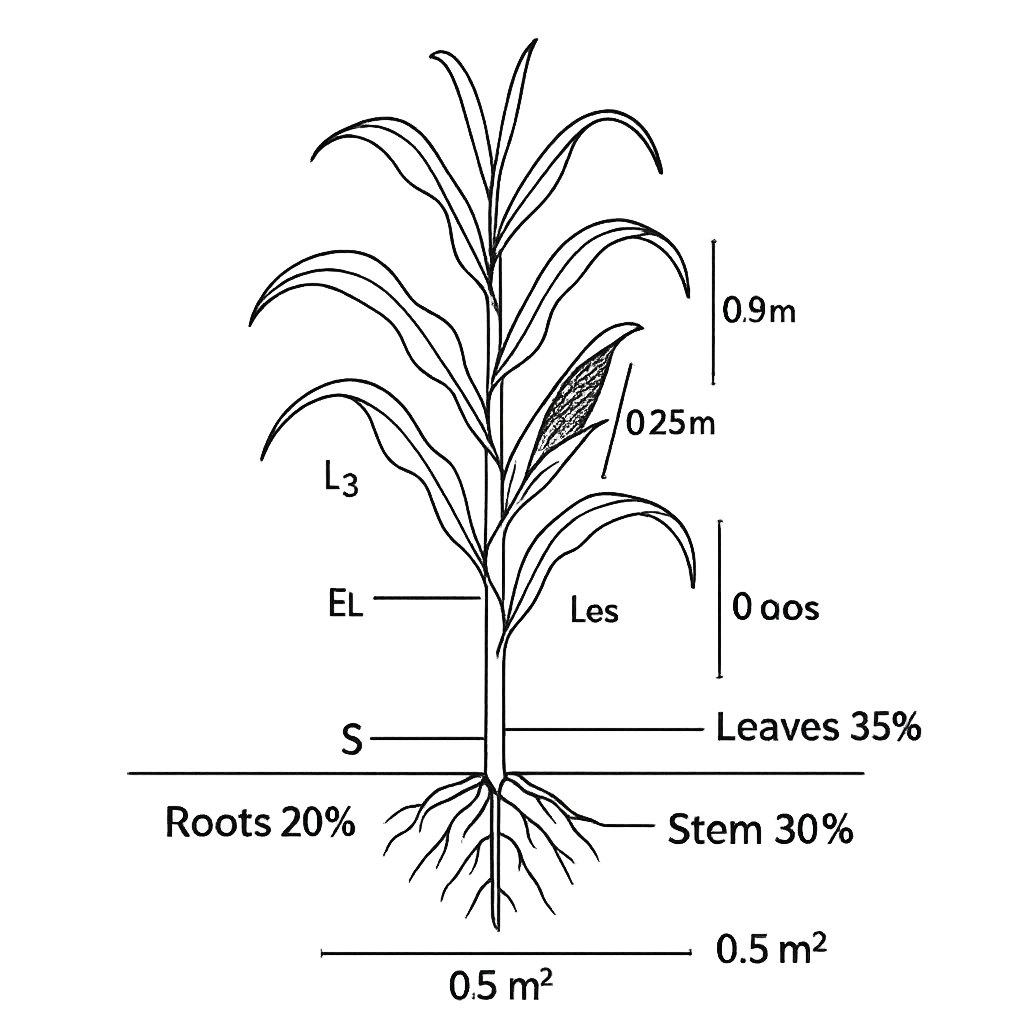
The diagram shows a mature maize plant with the following labelled measurements: stem height \(2.4\,\text{m}\); three leaves with lengths \(0.8\,\text{m},\,0.9\,\text{m},\,0.85\,\text{m}\) and a uniform width of \(0.15\,\text{m}\); ear length \(0.25\,\text{m}\). The dry‑biomass distribution is: roots 20\%, stem 30\%, leaves 35\%, ear 15\% of the total dry biomass. The ground area occupied by the plant is \(0.5\,\text{m}^2\). If the total dry biomass of the plant is \(1.2\,\text{kg}\), calculate (i) the dry weight of the ear, (ii) the average leaf length, and (iii) the leaf‑area index (LAI), defined as total leaf area divided by ground area. Give your answers to three decimal places where appropriate.
A. Ear weight: 0.20 kg; Average leaf length: 0.850 m; LAI: 0.765
B. Ear weight: 0.18 kg; Average leaf length: 0.850 m; LAI: 0.800
Correct C. Ear weight: 0.18 kg; Average leaf length: 0.850 m; LAI: 0.765
D. Ear weight: 0.18 kg; Average leaf length: 0.860 m; LAI: 0.765

Correct Answer: C

Want to see the full step-by-step solution? Unlock AI Explanation & Analytics
Question 10 View Details
A rural district contains 120,000 farming households. Each agricultural extension agent can effectively serve up to 150 households per month. The extension service aims to achieve at least 90\% coverage of households within a 6‑month period. Each agent receives a monthly salary of \(\text{\u20A6}120,000\) and a transport allowance of \(\text{\u20A6}30,000\). Determine the minimum number of extension agents required and the total monthly cost (in \(\text{\u20A6}\)) for the extension service to meet the target.
A. 115 agents; monthly cost \u20A618,000,000
B. 125 agents; monthly cost \u20A618,500,000
C. 120 agents; monthly cost \u20A617,500,000
Correct D. 120 agents; monthly cost \u20A618,000,000

Correct Answer: D

Want to see the full step-by-step solution? Unlock AI Explanation & Analytics
Question 11 View Details
A farmer plans to produce a cash crop. The fixed cost of production is ₦200,000. The total variable cost (in ₦) for producing \(Q\) thousand kilograms of the crop is known to be ₦1,200,000 when \(Q = 10\) and ₦1,800,000 when \(Q = 20\). The market price per kilogram (in ₦) follows a linear demand relationship: when \(Q = 10\) the price is ₦150 per kg and when \(Q = 30\) the price is ₦90 per kg. Assuming the farmer sells all output, determine the quantity \(Q\) (in thousand kilograms) that maximizes profit and calculate the maximum profit (in ₦).
A. Q = 10 (thousand kg); Maximum profit = ₦200,000
B. Q = 15 (thousand kg); Maximum profit = ₦300,000
Correct C. Q = 20 (thousand kg); Maximum profit = ₦400,000
D. Q = 25 (thousand kg); Maximum profit = ₦350,000

Correct Answer: C

Want to see the full step-by-step solution? Unlock AI Explanation & Analytics
Question 12 View Details
A farm has 120 hectares available for two crops: maize and beans. Maize requires 2 labor days per hectare and yields a profit of ₦150,000 per hectare. Beans require 3 labor days per hectare and yield a profit of ₦200,000 per hectare. The farm has a total of 300 labor days available, must allocate at least 30 hectares to maize, and may allocate at most 70 hectares to beans. Determine the optimal allocation of hectares to each crop that maximizes total profit and state the maximum profit (in ₦).
A. Maize = 40 ha, Beans = 70 ha; Maximum profit = ₦20,000,000
Correct B. Maize = 60 ha, Beans = 60 ha; Maximum profit = ₦21,000,000
C. Maize = 30 ha, Beans = 60 ha; Maximum profit = ₦16,500,000
D. Maize = 70 ha, Beans = 50 ha; Maximum profit = ₦20,500,000

Correct Answer: B

Want to see the full step-by-step solution? Unlock AI Explanation & Analytics
Question 13 View Details
Three feed ingredients are available for formulating a livestock diet.\n\n- Feed A costs ₦50 per kg and provides 12% protein and 2.5 MJ of energy per kg.\n- Feed B costs ₦40 per kg and provides 8% protein and 3.0 MJ of energy per kg.\n- Feed C costs ₦45 per kg and provides 10% protein and 2.8 MJ of energy per kg.\n\nThe diet must contain at least 10% protein and at least 2.7 MJ of energy per kg of total feed. Determine the least‑cost combination (kg of each feed per kg of total diet) that meets the nutritional requirements, and state the minimum cost (in ₦ per kg of diet).
A. Least cost = ₦46 per kg; one optimal mix is 0.5 kg Feed A + 0.5 kg Feed C (no Feed B).
B. Least cost = ₦44 per kg; one optimal mix is 0.4 kg Feed A + 0.6 kg Feed B (no Feed C).
Correct C. Least cost = ₦45 per kg; one optimal mix is 0.5 kg Feed A + 0.5 kg Feed B (no Feed C).
D. Least cost = ₦48 per kg; one optimal mix is 0.6 kg Feed A + 0.4 kg Feed B (no Feed C).

Correct Answer: C

Want to see the full step-by-step solution? Unlock AI Explanation & Analytics
Question 14 View Details
A soil sample is measured to have a pH of 5.8. According to the standard soil acidity classification, what is the correct category for this soil?
Correct A. moderately acidic
B. strongly acidic
C. neutral
D. slightly acidic

Correct Answer: A

Want to see the full step-by-step solution? Unlock AI Explanation & Analytics
Question 15 View Details
A tractor must pull a plough that requires a drawbar pull of 15 kN at a forward speed of 5 km/h. The drivetrain efficiency is 85%.\n\n(a) Calculate the minimum engine power (in kW) that must be delivered to the drawbar.\n(b) If the tractor's engine runs at 2000 rpm and the wheel radius is 0.5 m, determine the minimum gear ratio (engine rpm : wheel rpm) required to achieve the needed speed.
A. Engine power ≈ 22.8 kW; Minimum gear ratio ≈ 70:1
B. Engine power ≈ 20.0 kW; Minimum gear ratio ≈ 60:1
C. Engine power ≈ 30.2 kW; Minimum gear ratio ≈ 90:1
Correct D. Engine power ≈ 24.5 kW; Minimum gear ratio ≈ 75:1

Correct Answer: D

Want to see the full step-by-step solution? Unlock AI Explanation & Analytics
Question 16 View Details
A fungal disease incidence in a field follows the logistic model \(I(t)=\frac{100}{1+ae^{-bt}}\) where \(t\) is weeks and the maximum possible incidence is 100 %. At planting (\(t=0\)) the incidence was 5 %. After 4 weeks it was 20 % and after 8 weeks it was 45 %.\n\n(a) Determine the expected incidence after 12 weeks.\n\n(b) If each percent of incidence requires 0.8 L of fungicide per hectare, calculate the amount of fungicide needed (in L ha\(^{-1}\)) for the 12‑week incidence. Give your answer to two decimal places.
A. 53.79
B. 61.48
Correct C. 58.26
D. 55.13

Correct Answer: C

Want to see the full step-by-step solution? Unlock AI Explanation & Analytics
Question 17 View Details
An outbreak of a contagious disease in a herd of 200 goats has a basic reproduction number \(R_{0}=2.5\). A vaccine with efficacy 85 % is available.\n\n(a) What is the minimum number of goats that must be vaccinated to achieve herd immunity (i.e., effective reproduction number below 1)?\n\n(b) If each goat requires two doses and each dose costs ₦150, what is the total vaccination cost? Give your answer in Naira.
A. 36000
Correct B. 42600
C. 42300
D. 30600

Correct Answer: B

Want to see the full step-by-step solution? Unlock AI Explanation & Analytics
Question 18 View Details
In a lake stocked with tilapia, the biomass \(B\) (tons) follows the logistic growth equation \(\frac{dB}{dt}= rB\left(1-\frac{B}{K}\right)-H\) where \(r = 0.4\) yr\(^{-1}\), carrying capacity \(K = 500\) tons and \(H\) is the constant annual harvest (tons yr\(^{-1}\)). The market price is ₦250,000 per ton and the cost of harvesting is ₦80,000 per ton.\n\nDetermine the harvest level \(H\) (tons per year) that maximizes annual profit and compute the maximum profit. Express the harvest to the nearest ton and profit to the nearest thousand Naira.
A. Harvest 40 tons per year; maximum profit ₦7,200,000
B. Harvest 60 tons per year; maximum profit ₦9,600,000
C. Harvest 55 tons per year; maximum profit ₦9,350,000
Correct D. Harvest 50 tons per year; maximum profit ₦8,500,000

Correct Answer: D

Want to see the full step-by-step solution? Unlock AI Explanation & Analytics
Question 19 View Details
Name the process by which atmospheric nitrogen is converted into ammonia by soil bacteria.
Correct A. Biological nitrogen fixation
B. Denitrification
C. Nitrification
D. Ammonification

Correct Answer: A

Want to see the full step-by-step solution? Unlock AI Explanation & Analytics
Question 20 View Details
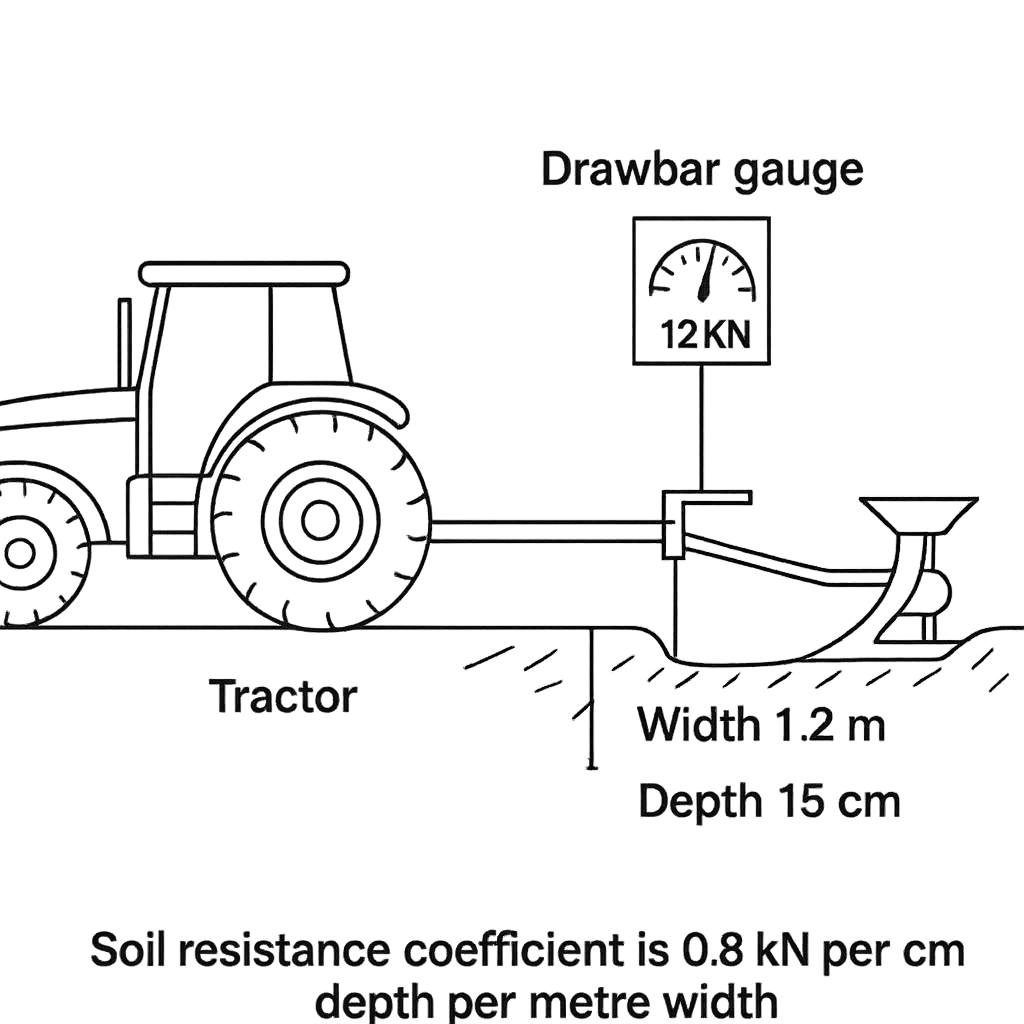
The diagram shows a tractor pulling a plough. The drawbar tension gauge attached to the tractor reads 12 kN when the plough depth is 15 cm. The plough width is 1.2 m. Soil resistance is proportional to plough depth with a coefficient of 0.8 kN per cm depth per metre width.\n\nIf the plough depth is increased to 20 cm, what drawbar pull will the gauge indicate? Give your answer in kilonewtons to one decimal place.
A. 16.8
B. 17.2
Correct C. 16.0
D. 19.2

Correct Answer: C

Want to see the full step-by-step solution? Unlock AI Explanation & Analytics
Question 21 View Details
A farmer plans to apply agricultural lime to three hectares of land. The recommended lime rate is \(2.5\) tonnes per hectare to raise the soil pH from 5.2 to 6.2. How many tonnes of lime are required in total?
A. 10.0
B. 5.0
Correct C. 7.5
D. 8.75

Correct Answer: C

Want to see the full step-by-step solution? Unlock AI Explanation & Analytics
Question 22 View Details
To lift a 120 kg log, a farmer uses a simple lever. The effort arm (distance from the fulcrum to the point where the farmer applies force) is 1.2 m and the load arm (distance from the fulcrum to the centre of the log) is 0.3 m. Assuming the acceleration due to gravity is \(9.81\ \text{m s}^{-2}\), what is the minimum effort force (in newtons) the farmer must apply to keep the log in static equilibrium?
A. 245.3
B. 4708.8
C. 300.0
Correct D. 294.3

Correct Answer: D

Want to see the full step-by-step solution? Unlock AI Explanation & Analytics
Question 23 View Details
A pest population in a field starts with 200 insects. Each week the population increases by a factor of 1.6. After the weekly growth, a pesticide can be applied that instantly kills 70\% of the insects present. The farmer may apply the pesticide at most once per week, immediately after the growth phase. To keep the population below 500 insects after four weeks, what is the minimum number of pesticide applications required?
A. 0
B. 3
Correct C. 1
D. 2

Correct Answer: C

Want to see the full step-by-step solution? Unlock AI Explanation & Analytics
Question 24 View Details
A tractor pulls a plough with a draft force of 12\,kN while moving at a speed of 5\,km\,h\(^{-1}\). The transmission efficiency of the tractor is 85\%. What minimum engine power in kilowatts is required to maintain this operation?
A. 18.9
B. 21.5
Correct C. 19.6
D. 20.2

Correct Answer: C

Want to see the full step-by-step solution? Unlock AI Explanation & Analytics
Question 25 View Details
In a goat herd, a contagious disease has a basic reproduction number \(R_{0}=2.5\). The vaccine available is 80\% effective. What minimum proportion of the herd must be vaccinated to achieve herd immunity and prevent an outbreak?
A. 80
B. 60
C. 70
Correct D. 75

Correct Answer: D

Want to see the full step-by-step solution? Unlock AI Explanation & Analytics

Master the Exam!

You've seen a preview, but there are thousands more questions plus AI tutor to break down complex solutions.

Unlock Full Access Available for Android & Windows
Help others prepare! Share this practice hub:
Chat with Support