neco 2024 agricultural_science | Essay

Prepare for your exams with neco questions? Reviewing past/model questions is one of the most effective ways to guarantee a high score. This practice hub features authentic 2024 agricultural_science (Essay) questions designed to simulate the real exam environment.

Practice these randomly selected questions to test your readiness.

Question 1 View Details
A farmer in the middle belt of Nigeria has been growing maize on the same 2‑hectare field for the past ten years. Concerned about declining yields and increasing pest pressure, the farmer is considering a shift to a more ecologically sustainable cropping system. Answer the following questions.
Question Parts
(a)
State three ecological benefits that crop diversification would bring to the farmer’s field.
(b)
Design a three‑year crop rotation that includes maize, a legume and a root crop. State the order of crops for each year and give a brief justification for the sequence.
(c)
Explain how the rotation you proposed in part (b) could affect soil organic matter and overall biodiversity in the field.
Detailed Essay Solution & Marking Scheme Available

Get the step-by-step mathematical proofs, key points required by examiners, and a comprehensive breakdown from our AI Tutor.
Question 2 View Details
A soil‑texture determination practical is set up as shown in the illustration. The apparatus consists of a transparent 500 mL jar (A) fitted with a tight‑fitting lid (B). Approximately 100 g of air‑dry soil sample (D) is placed in the jar, distilled water (C) is added up to the 250 mL mark on the graduated cylinder (E), and the mixture is shaken vigorously with a stirring rod (F) for two minutes. The jar is then left undisturbed for 24 hours to allow the particles to settle. Answer the following: a) Identify and label each component of the setup (A–F) in the illustration. b) After the 24‑hour settling period, the sediment layers measured in the jar are: sand layer 2.5 cm, silt layer 1.5 cm, and clay layer 0.5 cm. Using these measurements, calculate the percentage of sand, silt and clay in the sample (ignore the 0.5 cm of water above the clay layer). c) Based on the calculated texture percentages, recommend a suitable cash crop for this soil and justify your choice.
Question Parts
(a)
Identify and label each component of the setup (A–F) in the illustration.
(b)
Calculate the percentage of sand, silt and clay in the sample using the measured sediment thicknesses.
(c)
Recommend a suitable cash crop for this soil texture and justify your recommendation.
Detailed Essay Solution & Marking Scheme Available

Get the step-by-step mathematical proofs, key points required by examiners, and a comprehensive breakdown from our AI Tutor.

Question 3 View Details
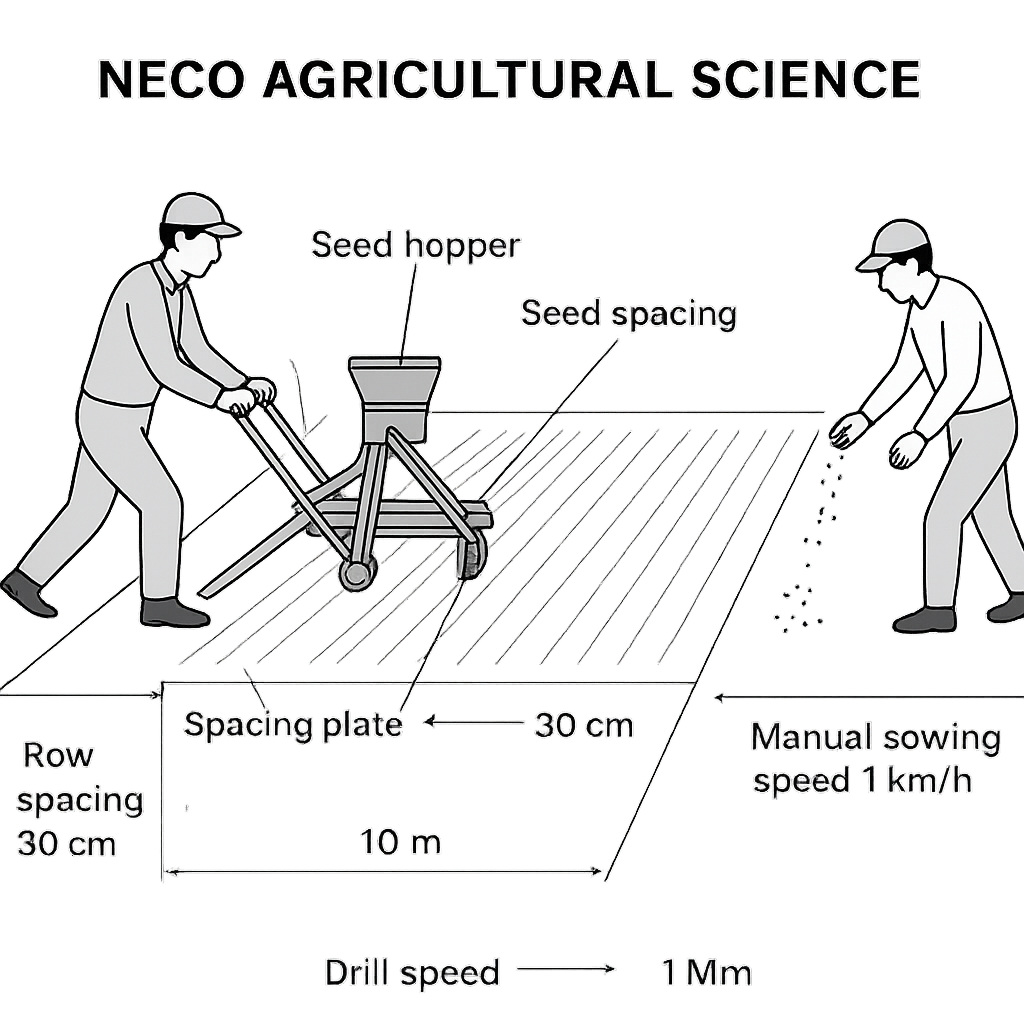
A farmer intends to sow a hectare of maize using a manual seed drill. The seed drill is set to place seeds at a spacing of 30 cm between rows and 10 cm between seeds within a row. The drill can be pushed at a constant speed of 5 km/h across the field. The farmer is considering whether to continue sowing manually (by scattering seed by hand) or to adopt the seed drill. The following information is provided:
Question Parts
(a)
Calculate the total number of seeds required to sow one hectare at the given row and seed spacing.
(b)
Determine the time required for the seed drill to cover one hectare, expressing the answer in hours and minutes.
(c)
Compare the total cost of sowing one hectare manually versus using the seed drill. Assume the following: - Manual sowing requires a labour cost of ₦500 per day (8 working hours). - Using the seed drill requires an initial purchase cost of ₦120,000 and the same labour rate of ₦500 per day. - The farmer values any labour saved at the same daily rate. State which method is more economical and justify your answer with calculations.
Detailed Essay Solution & Marking Scheme Available

Get the step-by-step mathematical proofs, key points required by examiners, and a comprehensive breakdown from our AI Tutor.

Question 4 View Details
A farmer plans to use a tractor‑drawn moldboard plough to prepare a field. The plough has a total width of 1.2 m. The soil resistance to ploughing is estimated at 15 kN per metre of plough width. The tractor can maintain a forward speed of 5 km/h while pulling the plough. The tractor's power take‑off (PTO) efficiency is 85 %. Fuel consumption of the tractor at full load is 0.25 L per kilowatt‑hour. Using this information, answer the following:
Question Parts
(a)
Calculate the total draw‑bar pull (in kilonewtons) required to pull the plough through the soil.
(b)
Determine the minimum engine power (in kilowatts) that the tractor must develop to sustain the required draw‑bar pull at the given speed.
Detailed Essay Solution & Marking Scheme Available

Get the step-by-step mathematical proofs, key points required by examiners, and a comprehensive breakdown from our AI Tutor.

Question 5 View Details
A farmer has 5 hectares of land that he wants to allocate between maize and soybean in order to maximise his profit. The following data are available: - Maize: expected yield = 4 tonnes per hectare, market price = ₦200 per kilogram, variable cost (seed, fertilizer, etc.) = ₦30,000 per hectare. - Soybean: expected yield = 2.5 tonnes per hectare, market price = ₦250 per kilogram, variable cost = ₦25,000 per hectare. - The farmer must allocate at least 1 hectare to each crop and cannot allocate more than 3 hectares to maize because of crop‑rotation requirements. Using this information, answer the questions below.
Question Parts
(a)
Formulate the profit function (in Naira) for the farmer in terms of the area (in hectares) allocated to maize (x) and soybean (y).
(b)
Determine the allocation of land to maize and soybean (values of x and y) that will give the maximum profit, subject to the constraints given. State the maximum profit obtained.
(c)
Briefly discuss two agronomic advantages of intercropping maize with soybean.
Detailed Essay Solution & Marking Scheme Available

Get the step-by-step mathematical proofs, key points required by examiners, and a comprehensive breakdown from our AI Tutor.

Question 6 View Details
A dairy farmer keeps 40 lactating cows. Each cow currently produces an average of 20 litres of milk per day on a total mixed ration (TMR) that supplies 14 % crude protein (CP) and costs ₦120 per kilogram. The farmer wishes to increase total milk production by 15 % over the next year by improving the cows' nutrition. He plans to introduce a new TMR that supplies 18 % CP and costs ₦150 per kilogram. Research indicates that for each 1 % increase in dietary CP above 14 %, milk yield rises by 0.8 L per cow per day, but the response plateaus after a 2 % increase in CP. Each cow consumes 25 kg of ration per day. The market price of milk is ₦180 per litre. Answer the following questions:
Question Parts
(a)
Calculate the expected new average daily milk yield per cow after the diet change.
(b)
Determine the additional total daily milk production for the whole herd.
(c)
Compute the increase in daily feed cost for the herd and state whether the increase in revenue (based on the milk price) justifies the higher feed cost.
(d)
Suggest two management practices, other than feed improvement, that could help sustain the higher milk yield.
Detailed Essay Solution & Marking Scheme Available

Get the step-by-step mathematical proofs, key points required by examiners, and a comprehensive breakdown from our AI Tutor.

Question 7 View Details
A farmer in the middle belt region of Nigeria cultivates maize on a 2.5‑hectare field. Recent scouting has revealed the presence of two major insect pests that are causing noticeable damage to the crop.
Question Parts
(a)
Identify two important insect pests of maize in Nigeria. For each pest, describe the stage(s) of its life cycle that are responsible for the greatest loss of yield.
(b)
During a six‑week monitoring period the following numbers of the first pest were recorded per 10 m²: Week 1: 4 Week 2: 7 Week 3: 12 Week 4: 18 Week 5: 26 Week 6: 35 (i) Calculate the average weekly increase in pest numbers. (ii) The economic threshold for this pest is 15 individuals per 10 m². State whether the threshold has been exceeded and, if so, at which week it first occurred. (iii) Recommend a suitable control measure that could be implemented at that stage, justifying your choice.
(c)
The farmer decides to use a synthetic insecticide whose label recommends a spray rate of 2.5 L ha⁻¹ at a concentration of 0.20 % (v/v). Calculate: (i) the total volume of spray mixture required for the whole 2.5‑ha field; (ii) the volume of the concentrate (undiluted insecticide) that must be mixed to obtain the required concentration.
(d)
Discuss the advantages and disadvantages of employing a biological control agent (e.g., a parasitoid wasp) instead of the chemical insecticide for managing the pest identified in part (a).
Detailed Essay Solution & Marking Scheme Available

Get the step-by-step mathematical proofs, key points required by examiners, and a comprehensive breakdown from our AI Tutor.

Question 8 View Details
A smallholder cultivates tomatoes in a semi‑arid zone of northern Nigeria. During the rainy season, several plants show typical symptoms of fungal diseases.
Question Parts
(a)
Name two common fungal diseases of tomato in Nigeria and, for each, identify the primary inoculum and the environmental conditions that favour infection.
(b)
In a field survey of 40 tomato plants, 12 plants exhibit early‑blight symptoms. The average severity rating (on a 1–5 scale) for the affected plants is 3.2. (i) Calculate the disease incidence (%). (ii) Compute the disease severity index (DSI) using the formula DSI = (Σ severity ratings)/(Maximum rating × Total plants) × 100.
(c)
A schematic diagram shows the infected field at the centre surrounded by three concentric zones representing increasing distance from the source. Explain how prevailing wind direction and distance influence secondary infection in the outer zones, and recommend one cultural practice that can limit this spread.
(d)
Compare the use of resistant tomato varieties with crop rotation as strategies for managing soil‑borne fungal pathogens such as *Fusarium* wilt. Include specific advantages and limitations of each approach.
Detailed Essay Solution & Marking Scheme Available

Get the step-by-step mathematical proofs, key points required by examiners, and a comprehensive breakdown from our AI Tutor.

Master the Exam!

You've seen a preview, but there are thousands more questions plus AI tutor to break down complex solutions.

Unlock Full Access Available for Android & Windows
Help others prepare! Share this practice hub:
Chat with Support