neco 2023 physics | Objective

Prepare for your exams with neco questions? Reviewing past/model questions is one of the most effective ways to guarantee a high score. This practice hub features authentic 2023 physics (Objective) questions designed to simulate the real exam environment.

Practice these randomly selected questions to test your readiness.

Question 1 View Details
A string of length L is fixed at both ends. When a tension of \(80\ \text{N}\) is applied, a standing wave with three complete loops is observed. When the tension is increased to \(180\ \text{N}\), the string shows four complete loops and the frequency of vibration is \(120\ \text{Hz}\). Assuming the linear mass density of the string remains unchanged, calculate the fundamental frequency of the string under the original tension of \(80\ \text{N}\).
A. 30 Hz
Correct B. 20 Hz
C. 25 Hz
D. 15 Hz

Correct Answer: B

Want to see the full step-by-step solution? Unlock AI Explanation & Analytics
Question 2 View Details
A \(2.0\ \text{g}\) sample of a radionuclide X (atomic mass \(120\ \text{g\,mol}^{-1}\)) decays by \(\beta\)-emission to Y with a half-life of \(8.0\ \text{h}\). The daughter nuclide Y subsequently decays by \(\alpha\)-emission to a stable nuclide Z with a half-life of \(2.0\ \text{h}\). Initially only X is present. (a) Determine the time after which the activity of Y reaches its maximum. (b) Calculate that maximum activity in becquerels (Bq). Use \(N_{A}=6.022\times10^{23}\ \text{mol}^{-1}\).
A. t \approx 4.00 h; A_{max} \approx 1.2\times10^{17}\ \text{Bq}
B. t \approx 6.50 h; A_{max} \approx 1.8\times10^{17}\ \text{Bq}
Correct C. t \approx 5.33 h; A_{max} \approx 1.5\times10^{17}\ \text{Bq}
D. t \approx 5.33 h; A_{max} \approx 1.0\times10^{17}\ \text{Bq}

Correct Answer: C

Want to see the full step-by-step solution? Unlock AI Explanation & Analytics
Question 3 View Details
A student drops a steel ball from rest and records the distance fallen \(s\) (in metres) at successive times \(t\) (in seconds) as follows: \( (0.0,0.0), (0.5,1.2), (1.0,4.8), (1.5,10.8), (2.0,19.2), (2.5,30.0) \). Assuming the motion follows \(s=\frac{1}{2}gt^{2}\) at early times, use the first three data points to estimate the acceleration due to gravity \(g\). Then, using the data for \(t\ge1.5\ \text{s}\), determine the terminal velocity \(v_{t}\) of the ball by fitting a straight line to \(s\) versus \(t\). Give \(g\) in \(\text{m\,s}^{-2}\) and \(v_{t}\) in \(\text{m\,s}^{-1}\).
Correct A. g = 9.6 m/s^2; v_t = 19.2 m/s
B. g = 10.2 m\/s^2; v_t = 21.5 m\/s
C. g = 9.8 m\/s^2; v_t = 20.0 m\/s
D. g = 8.9 m\/s^2; v_t = 18.0 m\/s

Correct Answer: A

Want to see the full step-by-step solution? Unlock AI Explanation & Analytics
Question 4 View Details
A sealed rigid container of volume \(2.0\ \text{L}\) initially contains dry air at \(300\ \text{K}\) and a pressure of \(1.0\ \text{atm}\). The gas is first heated at constant volume to \(350\ \text{K}\). It then expands isothermally at \(350\ \text{K}\) until the pressure returns to its original value of \(1.0\ \text{atm}\). Finally, the gas is cooled at constant volume back to \(300\ \text{K}\). Determine the final pressure of the gas after the three steps.
A. 0.92 atm
B. 0.78 atm
C. 1.04 atm
Correct D. 0.86 atm

Correct Answer: D

Want to see the full step-by-step solution? Unlock AI Explanation & Analytics
Question 5 View Details
A police car equipped with a siren of frequency \(f = 800\ \text{Hz}\) approaches a stationary observer. When the car is moving towards the observer, the observed frequency is \(933\ \text{Hz}\). After the car passes the observer and moves away, the observed frequency drops to \(700\ \text{Hz}\). Assuming the speed of sound in air is \(v = 340\ \text{m\,s}^{-1}\) and that only the source is moving, calculate the speed of the police car.
A. 60.0 m\/s
Correct B. 48.6 m/s
C. 42.1 m\/s
D. 52.3 m\/s

Correct Answer: B

Want to see the full step-by-step solution? Unlock AI Explanation & Analytics
Question 6 View Details
A block of mass 2.0 kg rests at the top of a smooth incline that makes an angle of 30\(^\circ\) with the horizontal. The vertical height of the block above the base is 3.0 m. At the bottom of the incline a horizontal spring of constant 400 N/m is initially uncompressed. The block is released, slides down, compresses the spring and momentarily comes to rest after compressing it a distance \(x\). (The diagram shows the incline, the block and the spring.) (a) Find the speed of the block just before it contacts the spring. (b) Determine the maximum compression \(x\) of the spring. (c) If a motor were used to pull the block back to its original position at a constant speed of 0.5 m/s, calculate the average power delivered by the motor.
A. a) 7.0 m\/s, b) 0.50 m, c) 10.2 W
Correct B. a) 7.7 m/s, b) 0.54 m, c) 9.8 W
C. a) 6.5 m\/s, b) 0.45 m, c) 12.0 W
D. a) 8.2 m\/s, b) 0.60 m, c) 8.5 W

Correct Answer: B

Want to see the full step-by-step solution? Unlock AI Explanation & Analytics
Question 7 View Details
Two point charges are placed on the x‑axis. Charge \(Q_{1}\) is at \(x = -0.20\) m and charge \(Q_{2}\) is at \(x = +0.30\) m. At the origin the resultant electric field has a magnitude of \(5.0\times10^{4}\ \text{N C}^{-1}\) and points to the right. The electric potential at the origin is zero. (a) Determine the values of \(Q_{1}\) and \(Q_{2}\). (b) A test charge \(q = 2.0\ \mu\text{C}\) is placed at the origin. Find the magnitude and direction of the force on the test charge.
A. Q1 = +0.150 µC, Q2 = -0.180 µC; Force on q = 0.12 N to the right
B. Q1 = -0.133 µC, Q2 = +0.200 µC; Force on q = 0.10 N to the left
C. Q1 = +0.133 µC, Q2 = -0.200 µC; Force on q = 0.08 N to the right
Correct D. Q1 = +0.133 µC, Q2 = -0.200 µC; Force on q = 0.10 N to the right

Correct Answer: D

Want to see the full step-by-step solution? Unlock AI Explanation & Analytics
Question 8 View Details
A simple pulley system is used to lift a load of 500 N. The rope is pulled through a distance of 2.00 m while the load rises only 0.50 m. The system is known to operate with an efficiency of 80\%. (a) Calculate the ideal input force required to lift the load. (b) Determine the actual input force taking the efficiency into account. (c) If the load is lifted in 4.0 s, find the input power delivered by the operator.
A. a) 150 N, b) 187.5 N, c) 93.8 W
B. a) 100 N, b) 125 N, c) 62.5 W
C. a) 250 N, b) 312.5 N, c) 156.3 W
Correct D. a) 125 N, b) 156.3 N, c) 78.1 W

Correct Answer: D

Want to see the full step-by-step solution? Unlock AI Explanation & Analytics
Question 9 View Details
A radioactive isotope A decays to isotope B (half‑life 30 min) and B subsequently decays to a stable nucleus C (half‑life 10 min). Initially there are \(1.0\times10^{6}\) atoms of A and none of B. After 1.0 h: (a) How many atoms of B are present? (b) What total energy has been released if each decay of A emits 2.0 MeV and each decay of B emits 1.5 MeV? (c) What is the activity of B at that instant (in Bq)?
A. a) 9.3×10^4 atoms, b) 2.10×10^6 MeV (≈3.36×10⁻⁷ J), c) 1.10×10² Bq
B. a) 1.45×10^5 atoms, b) 2.80×10^6 MeV (≈3.99×10⁻⁷ J), c) 1.50×10² Bq
C. a) 8.0×10^4 atoms, b) 1.95×10^6 MeV (≈2.78×10⁻⁷ J), c) 9.0×10¹ Bq
Correct D. a) 1.17×10^5 atoms, b) 2.45×10^6 MeV (≈3.92×10⁻⁷ J), c) 1.35×10² Bq

Correct Answer: D

Want to see the full step-by-step solution? Unlock AI Explanation & Analytics
Question 10 View Details
A student measures the period of a simple pendulum of length \(L = 0.500\) m using a stopwatch. Ten recordings of the time for 20 swings each are (in seconds): 28.4, 28.6, 28.5, 28.7, 28.3, 28.5, 28.6, 28.4, 28.5, 28.6. The stopwatch has a systematic error of +0.02 s per measurement and the length measurement has an uncertainty of ±0.001 m (random). (a) Determine the corrected value of \(g\) using \(T = 2\pi\sqrt{L/g}\). (b) Calculate the combined standard uncertainty of \(g\) (propagate uncertainties). (c) State whether the result agrees with the accepted value \(g = 9.81\) m s⁻² within the uncertainty.
A. g = 9.74 ± 0.04 m s⁻²; does not agree with 9.81 m s⁻² within uncertainty
Correct B. g = 9.74 ± 0.03 m s⁻²; does not agree with 9.81 m s⁻² within uncertainty
C. g = 9.74 ± 0.03 m s⁻²; agrees with 9.81 m s⁻² within uncertainty
D. g = 9.78 ± 0.03 m s⁻²; does not agree with 9.81 m s⁻² within uncertainty

Correct Answer: B

Want to see the full step-by-step solution? Unlock AI Explanation & Analytics
Question 11 View Details
A battery of emf E and internal resistance r is connected to two resistors R1 and R2 in series. When R1 = 4 \(\Omega\), the current through the circuit is 2 \(\text{A}\) and the terminal voltage across the external resistors is 12 \(\text{V}\). When R1 is replaced by an 8 \(\Omega\) resistor (R2 unchanged), the terminal voltage drops to 13 \(\text{V}\). Determine (i) the resistance R2, (ii) the internal resistance r, and (iii) the emf E of the battery.
A. R2 = 1 \\(\\Omega\\), r = \\frac{8}{7}\\ \\(\\Omega\\) (≈1.14 \\(\\Omega\\)), E = \\frac{96}{7}\\ \\text{V} (≈13.71 \\text{V})
Correct B. R2 = 2 \(\Omega\), r = \frac{10}{7}\ \(\Omega\) (≈1.43 \(\Omega\)), E = \frac{104}{7}\ \text{V} (≈14.86 \text{V})
C. R2 = 2 \\(\\Omega\\), r = \\frac{12}{7}\\ \\(\\Omega\\) (≈1.71 \\(\\Omega\\)), E = \\frac{108}{7}\\ \\text{V} (≈15.43 \\text{V})
D. R2 = 3 \\(\\Omega\\), r = \\frac{14}{7}\\ \\(\\Omega\\) (≈2 \\(\\Omega\\)), E = \\frac{112}{7}\\ \\text{V} (≈16 \\text{V})

Correct Answer: B

Want to see the full step-by-step solution? Unlock AI Explanation & Analytics
Question 12 View Details
A source S1 of frequency 600 \(\text{Hz}\) moves directly towards a stationary observer O with speed 30 \(\text{m/s}\). At the same time a second identical source S2 is fixed and also emits 600 \(\text{Hz}\). The observer moves away from the sources with speed u (unknown). The speed of sound in air is 340 \(\text{m/s}\). The observer hears a beat frequency of 50 \(\text{Hz}\). Determine the speed u of the observer (in \(\text{m/s}\), to two decimal places).
Correct A. u \approx 47.22 \(\text{m/s}\)
B. u \approx 52.30 \(\text{m\/s}\)
C. u \approx 39.80 \(\text{m\/s}\)
D. u \approx 42.15 \(\text{m\/s}\)

Correct Answer: A

Want to see the full step-by-step solution? Unlock AI Explanation & Analytics
Question 13 View Details
A 2 \(\text{kg}\) block is released from rest at the top of a smooth incline of height h. It then slides down onto a rough horizontal surface of length 4 \(\text{m}\) where the coefficient of kinetic friction is 0.20. The block finally compresses a spring of spring constant k = 800 \(\text{N/m}\) until it momentarily comes to rest, compressing the spring by 0.10 \(\text{m}\). Take g = 10 \(\text{m/s^2}\). Find the minimum height h required.
A. h = 1.5 \(\text{m}\)
Correct B. h = 1 \(\text{m}\)
C. h = 1.2 \(\text{m}\)
D. h = 0.8 \(\text{m}\)

Correct Answer: B

Want to see the full step-by-step solution? Unlock AI Explanation & Analytics
Question 14 View Details
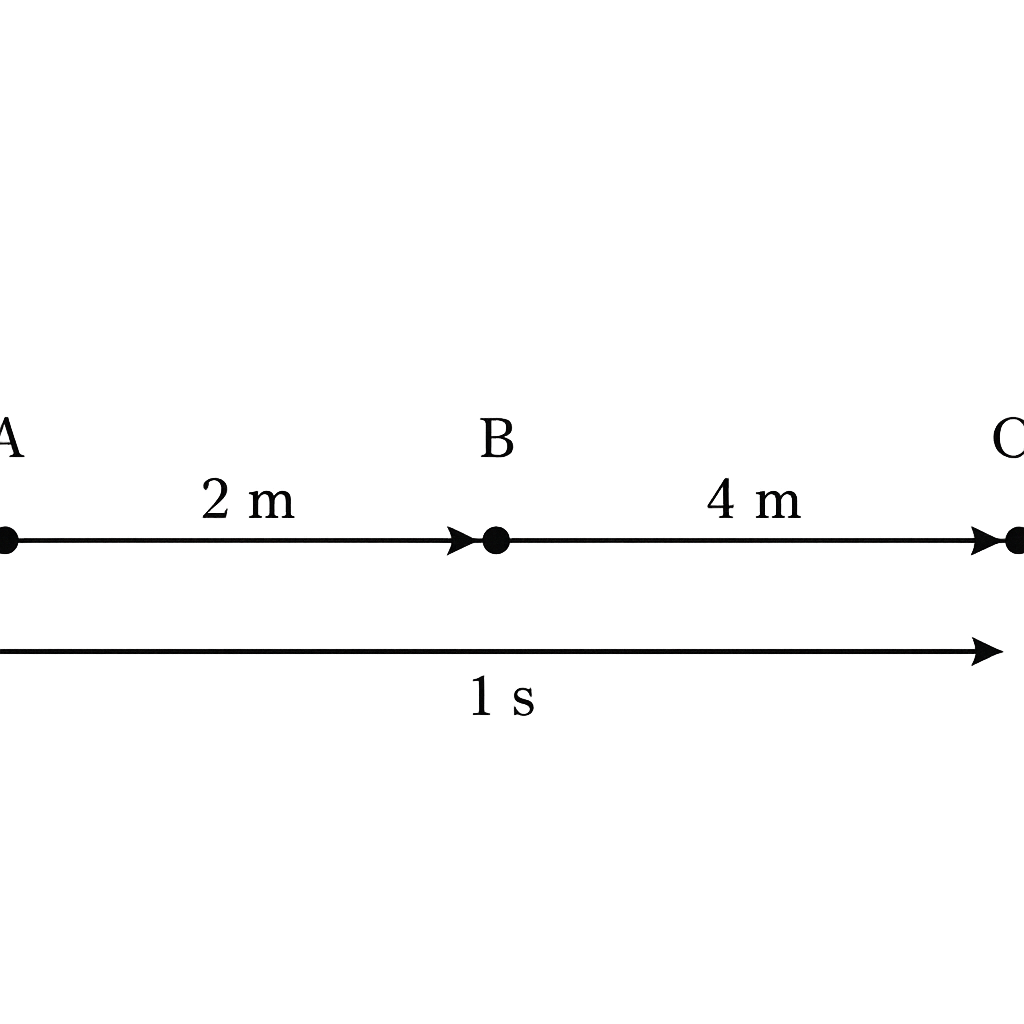
The diagram shows a particle moving in a straight line. Each of the three equal time intervals represents 1 s. During the first interval the particle moves 2 m to the right, during the second interval 4 m to the right, and during the third interval 2 m to the left. Using this information, calculate the average speed of the particle over the total time.
A. Average speed = \frac{8}{3}\ \text{m\/s} \approx 2.5\ \text{m\/s}
Correct B. Average speed = \frac{8}{3}\ \text{m/s} \approx 2.67\ \text{m/s}
C. Average speed = \frac{4}{3}\ \text{m\/s} \approx 1.33\ \text{m\/s}
D. Average speed = \frac{8}{2}\ \text{m\/s} \approx 4\ \text{m\/s}

Correct Answer: B

Want to see the full step-by-step solution? Unlock AI Explanation & Analytics
Question 15 View Details
A force of magnitude 30 \(\text{N}\) acts eastwards on a box. Another force of magnitude 40 \(\text{N}\) acts northwards on the same box. Determine (i) the magnitude of the resultant force and (ii) its direction measured north of east.
Correct A. Resultant magnitude = 50 \(\text{N}\); direction = 53.13° north of east.
B. Resultant magnitude = 70 \(\text{N}\); direction = 45° north of east.
C. Resultant magnitude = 50 \(\text{N}\); direction = 45° north of east.
D. Resultant magnitude = 30 \(\text{N}\); direction = 53.13° north of east.

Correct Answer: A

Want to see the full step-by-step solution? Unlock AI Explanation & Analytics
Question 16 View Details
A 150 g copper block (specific heat \(c_{Cu}=0.385\ \text{J g}^{-1}\text{°C}^{-1}\)) initially at \(200^{\circ}\text{C}\) is placed into 250 g of water at \(25^{\circ}\text{C}\) in an insulated container. After thermal equilibrium the mixture is transferred to another insulated container that contains 100 g of ice at \(0^{\circ}\text{C}\). Assuming no heat loss to the surroundings, what is the final temperature of the system (in \(^\circ\text{C}\), to one decimal place)?
A. 5.0°C
Correct B. 2.2°C
C. 10.8°C
D. -3.1°C

Correct Answer: B

Want to see the full step-by-step solution? Unlock AI Explanation & Analytics
Question 17 View Details
A metal rod of unknown material expands uniformly. When its length \(L_{0}\) at \(20^{\circ}\text{C}\) is heated to \(120^{\circ}\text{C}\) it becomes \(1.02\,L_{0}\). Using this information, determine the temperature to which a second rod of the same material and initial length \(2.00\ \text{m}\) must be heated so that its length increases by \(5.0\ \text{cm}\). Give your answer in \(^\circ\text{C}\).
A. 155°C
B. 150°C
Correct C. 145°C
D. 135°C

Correct Answer: C

Want to see the full step-by-step solution? Unlock AI Explanation & Analytics
Question 18 View Details
Two tuning forks of frequencies \(256\ \text{Hz}\) and \(260\ \text{Hz}\) are sounded together, producing beats. A stretched string fixed at both ends vibrates at its fundamental frequency equal to the average of the two fork frequencies. If the speed of transverse waves on the string is \(120\ \text{m s}^{-1}\), find (a) the length of the string in metres (to three decimal places) and (b) the beat frequency in hertz.
A. 0.233 m, 5 Hz
B. 0.200 m, 8 Hz
C. 0.250 m, 2 Hz
Correct D. 0.233 m, 4 Hz

Correct Answer: D

Want to see the full step-by-step solution? Unlock AI Explanation & Analytics
Question 19 View Details
A 0.500‑mol sample of an ideal gas occupies a \(2.00\ \text{L}\) vessel at \(27^{\circ}\text{C}\) and pressure \(P_{0}\). The gas is heated in two stages: first its temperature is raised to \(T_{1}\) (in °C) while the volume is kept at \(2.00\ \text{L}\), causing the pressure to double; then the gas expands isothermally at temperature \(T_{1}\) until the pressure returns to its original value \(P_{0}\). Determine (a) the final temperature \(T_{1}\) in °C and (b) the final volume after the expansion in litres (to one decimal place).
Correct A. 327°C, 4.0 L
B. 350°C, 3.5 L
C. 300°C, 4.5 L
D. 327°C, 3.0 L

Correct Answer: A

Want to see the full step-by-step solution? Unlock AI Explanation & Analytics
Question 20 View Details
An electron in a hydrogen atom makes a transition from the \(n=5\) level to the \(n=2\) level, emitting a photon. (a) If this photon is absorbed by another hydrogen atom whose electron is initially in the \(n=2\) state, to which principal quantum number \(n\) is the electron excited? (b) Assuming the same photon energy is instead given to a free electron (photoelectric effect), calculate the speed of that electron in metres per second, expressing your answer in scientific notation with two significant figures.
A. n = 4; 1.2×10^6 m\/s
Correct B. n = 5; 1.0×10^6 m/s
C. n = 3; 9.0×10^5 m\/s
D. n = 6; 2.0×10^6 m\/s

Correct Answer: B

Want to see the full step-by-step solution? Unlock AI Explanation & Analytics
Question 21 View Details
A block of mass 5 kg is pulled up a 30\(^\circ\) incline by a rope parallel to the plane. The system accelerates up the plane at 2 m\(/\)s\(^2\). The tension in the rope is 60 N. Determine the coefficient of kinetic friction \(\mu_k\).
A. 0.45
Correct B. 0.60
C. 0.30
D. 0.75

Correct Answer: B

Want to see the full step-by-step solution? Unlock AI Explanation & Analytics
Question 22 View Details
A 150 g ice sample at \(-5\)\(^\circ\)C is placed in a calorimeter containing 200 g of water at 30\(^\circ\)C. The calorimeter has a heat capacity of 50 J/K. No heat is lost to the surroundings. Determine the final temperature of the system after equilibrium is reached.
Correct A. 0\(^\circ\)C
B. -5\(^\circ\)C
C. 10\(^\circ\)C
D. 25\(^\circ\)C

Correct Answer: A

Want to see the full step-by-step solution? Unlock AI Explanation & Analytics
Question 23 View Details
A sealed container holds an ideal gas at an initial pressure of 1.0 atm and temperature \(T_0\). The gas is first compressed isothermally to a pressure of 3.0 atm. Then, while keeping the pressure constant at 3.0 atm, the volume is reduced to half its value after the first step. Find the final temperature of the gas in terms of \(T_0\).
A. 0.33 T_0
Correct B. 0.5 T_0
C. 1.5 T_0
D. 2 T_0

Correct Answer: B

Want to see the full step-by-step solution? Unlock AI Explanation & Analytics
Question 24 View Details
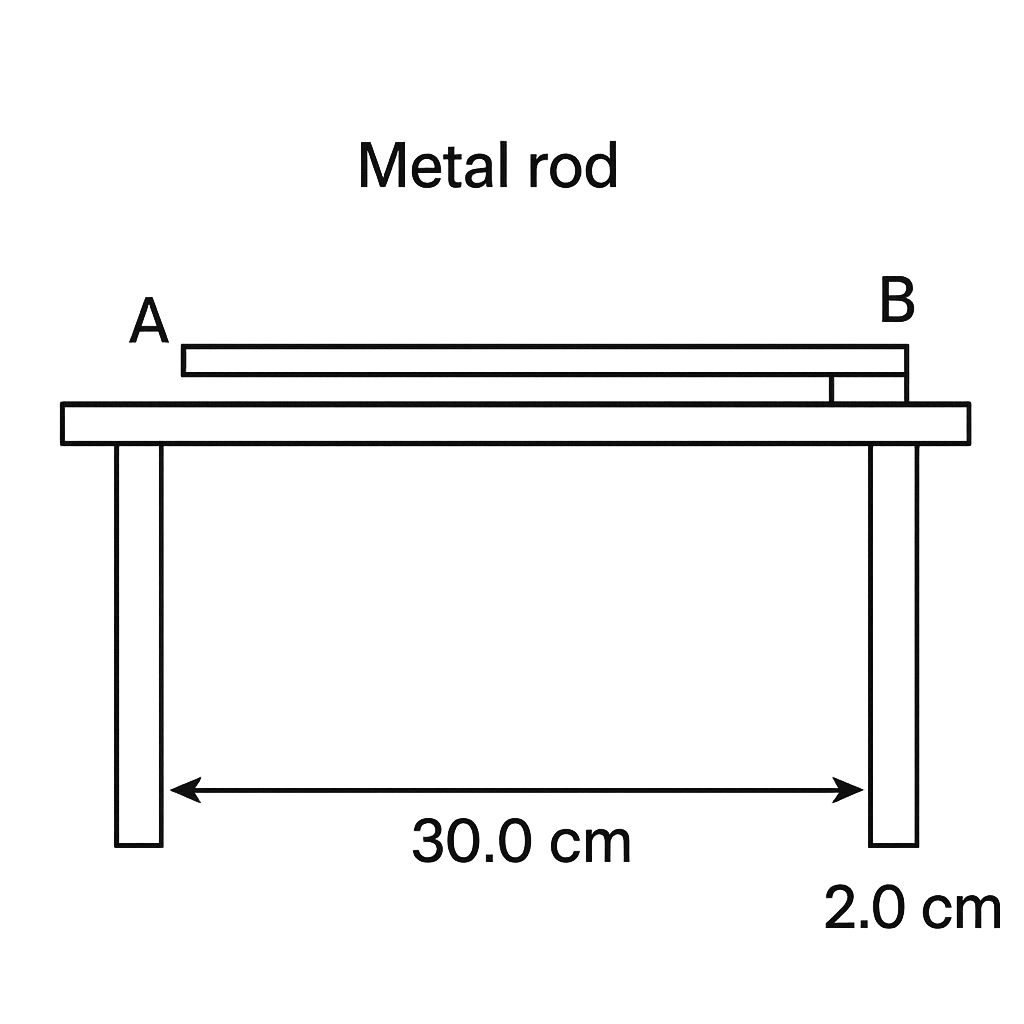
In the diagram, a metal rod rests on a table at point A and on a small block of height 2.0 cm at point B, forming a right‑angled triangle. The horizontal distance between A and B is measured as 30.0 cm. Calculate the actual length of the rod.
A. 30.20 cm
B. 30.04 cm
C. 28.00 cm
Correct D. 30.07 cm

Correct Answer: D

Want to see the full step-by-step solution? Unlock AI Explanation & Analytics
Question 25 View Details
A cylindrical container has an internal radius of 10 cm and a height of 25 cm. It is completely filled with water. Given that 1 litre = 1000 cm\(^3\), determine the volume of water in the container in litres (to two decimal places).
A. 31.42 L
B. 2.5 L
Correct C. 7.85 L
D. 7.5 L

Correct Answer: C

Want to see the full step-by-step solution? Unlock AI Explanation & Analytics

Master the Exam!

You've seen a preview, but there are thousands more questions plus AI tutor to break down complex solutions.

Unlock Full Access Available for Android & Windows
Help others prepare! Share this practice hub:
Chat with Support