neco 2023 physics | Essay

Prepare for your exams with neco questions? Reviewing past/model questions is one of the most effective ways to guarantee a high score. This practice hub features authentic 2023 physics (Essay) questions designed to simulate the real exam environment.

Practice these randomly selected questions to test your readiness.
Question 1 View Details
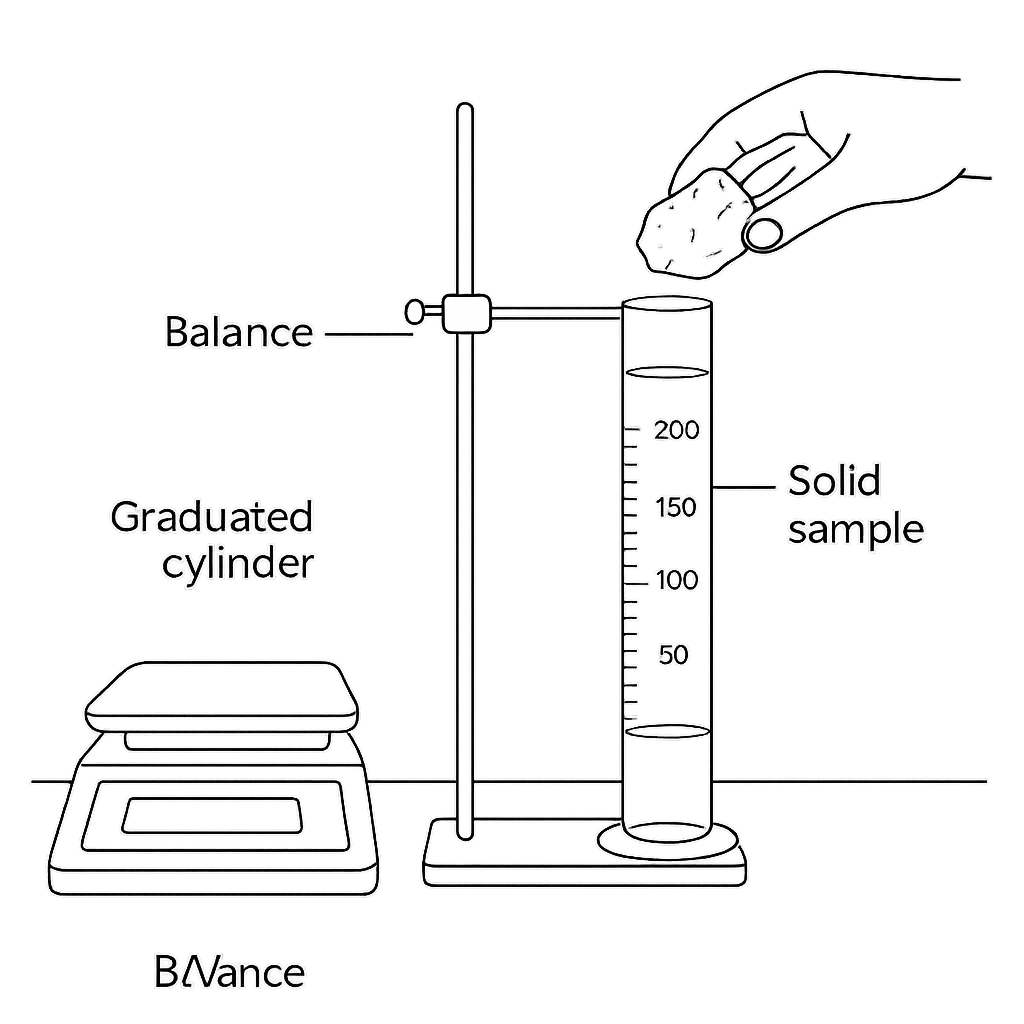
A student is required to determine the density of an irregular solid using the water‑displacement method in the laboratory. The apparatus consists of a graduated cylinder mounted on a stand, a balance, and the solid sample. The graduated cylinder is marked in millilitres (mL).
Question Parts
(a)
Describe the step‑by‑step procedure for measuring the density of the solid using water displacement, including how the mass of the solid is obtained.
(b)
The mass of the solid is measured as 45.0 g. When the solid is placed in the cylinder, the water level rises from 120.0 mL to 138.5 mL. Calculate the density of the solid, showing all intermediate steps and giving the final answer with the appropriate unit.
(c)
Identify two possible sources of error in this experiment and explain how each could affect the calculated density value.
Detailed Essay Solution & Marking Scheme Available

Get the step-by-step mathematical proofs, key points required by examiners, and a comprehensive breakdown from our AI Tutor.
Question 2 View Details
A river flows due east at a uniform speed of 3.0 m·s⁻¹. A boat can travel at a speed of 5.0 m·s⁻¹ relative to the water. The river is 200 m wide.
Question Parts
(a)
Draw a vector diagram showing the velocity of the river, the velocity of the boat relative to the water, and the resultant velocity of the boat with respect to the ground when the boat is aimed directly north.
(b)
To reach a point directly opposite the starting bank, the boat must head at an angle west of north. Determine the angle (to the nearest 0.1°) that the boat must steer and give the magnitude of the boat’s northward component of velocity.
(c)
Using the northward component found in part (b), calculate the time required for the boat to cross the 200 m wide river.
(d)
If the boat instead heads directly north (i.e., does not compensate for the river flow), determine the downstream displacement of the boat when it reaches the opposite bank.
Detailed Essay Solution & Marking Scheme Available

Get the step-by-step mathematical proofs, key points required by examiners, and a comprehensive breakdown from our AI Tutor.

Question 3 View Details
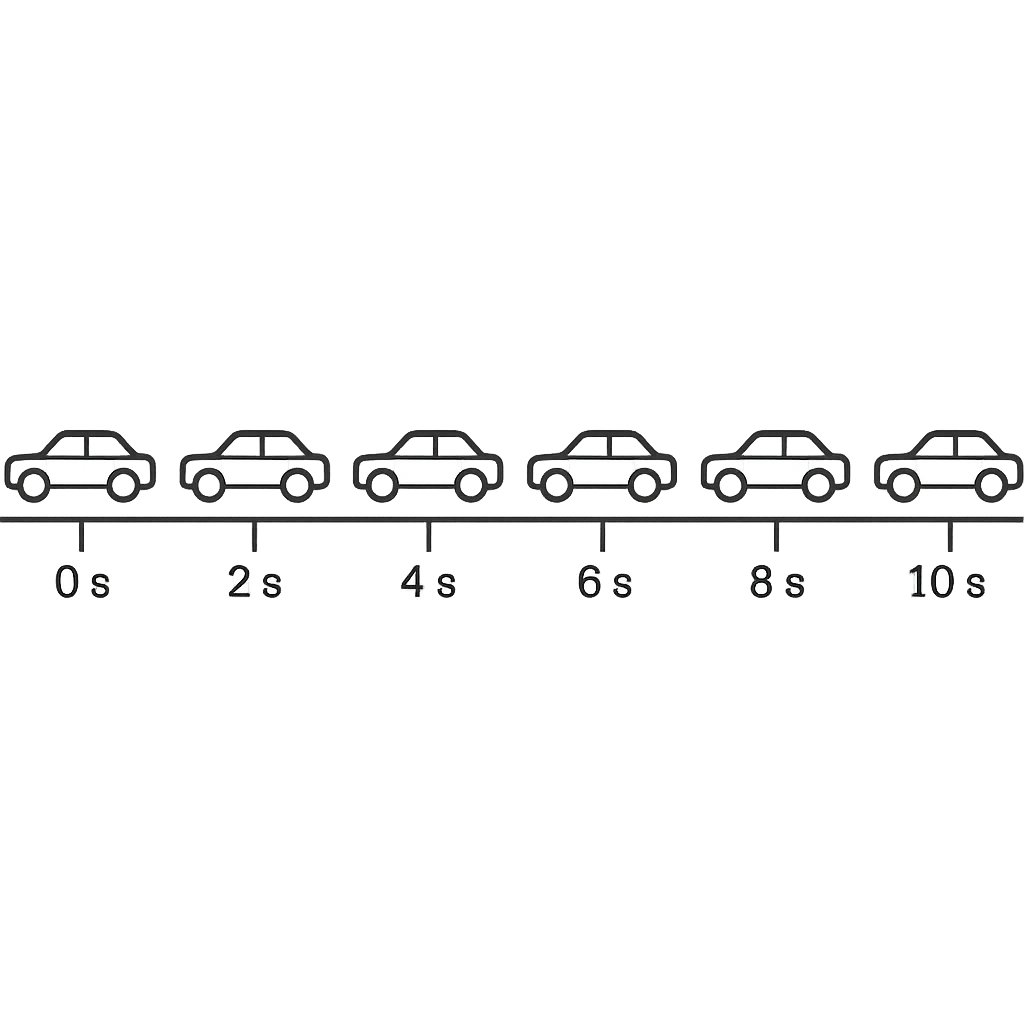
The diagram shows a motion diagram of a car moving in a straight line. The car is marked at successive equal time intervals of 2 s. The distances between successive marks are: 4 m between the 1st and 2nd marks, 8 m between the 2nd and 3rd marks, 12 m between the 3rd and 4th marks and 16 m between the 4th and 5th marks.
Question Parts
(a)
State the instantaneous speed of the car at the 3rd mark and at the 4th mark.
(b)
Assuming the car moves with constant acceleration, calculate the magnitude of that acceleration.
(c)
Predict the distance that would be shown between the 5th and 6th marks.
(d)
If the car started from rest, calculate the total distance covered in the first 10 s.
Detailed Essay Solution & Marking Scheme Available

Get the step-by-step mathematical proofs, key points required by examiners, and a comprehensive breakdown from our AI Tutor.

Question 4 View Details
A block of mass \(5.0\,\text{kg}\) rests on a rough inclined plane that makes an angle of \(30^{\circ}\) with the horizontal. The coefficient of static friction between the block and the plane is \(0.25\). A light inextensible string passes over a frictionless pulley at the top of the plane and is attached to a hanging mass \(M\). The system is initially in equilibrium. In addition, a horizontal force of \(20\,\text{N}\) can be applied to the block as shown in the diagram. Answer the following: a) Determine the minimum value of the hanging mass \(M\) required to start moving the block up the plane. b) If the hanging mass is \(M = 3.0\,\text{kg}\) and the horizontal force of \(20\,\text{N}\) is applied, calculate the acceleration of the block up the plane. c) Draw a free‑body diagram for the block, label all the forces, and write the net‑force equation used in part (b).
Question Parts
(a)
Determine the minimum value of the hanging mass \(M\) required to start moving the block up the plane.
(b)
If the hanging mass is \(M = 3.0\,\text{kg}\) and the horizontal force of \(20\,\text{N}\) is applied, calculate the acceleration of the block up the plane.
(c)
Draw a free‑body diagram for the block, label all the forces, and write the net‑force equation used in part (b).
Detailed Essay Solution & Marking Scheme Available

Get the step-by-step mathematical proofs, key points required by examiners, and a comprehensive breakdown from our AI Tutor.

Question 5 View Details
A block of mass 5.0 kg is released from rest at the top of an incline that makes an angle of 30° with the horizontal. The length of the incline is 8.0 m. The surface is rough with a coefficient of kinetic friction \(\mu_k = 0.20\).
Question Parts
(a)
Calculate the work done by gravity as the block slides down the incline.
(b)
Calculate the work done by the frictional force.
(c)
Determine the net work done on the block and the change in its kinetic energy.
(d)
Find the speed of the block at the bottom of the incline.
(e)
The block is then pulled back up the same incline by a motor at constant speed in 10.0 s. Calculate the average power output of the motor during this ascent.
Detailed Essay Solution & Marking Scheme Available

Get the step-by-step mathematical proofs, key points required by examiners, and a comprehensive breakdown from our AI Tutor.

Question 6 View Details
A compound machine is set up as shown in the diagram. An inclined plane makes an angle of 30° with the horizontal and has a length of 5.0 m. A smooth, frictionless pulley is fixed at the top of the plane. A block B of mass 2.0 kg rests on the plane and is attached to a light rope that passes over the pulley and is attached to a hanging mass H of mass 5.0 kg. The free end of the rope is wound around a circular handle of radius 0.20 m which is turned by a person. The person applies a tangential force on the handle, causing the system to move at a constant speed of 0.50 m s⁻¹ up the plane. Using the information in the diagram, answer the following:
Question Parts
(a)
Determine the tension in the rope.
(b)
Calculate the magnitude of the force that the person must exert on the handle to keep the motion at constant speed.
Detailed Essay Solution & Marking Scheme Available

Get the step-by-step mathematical proofs, key points required by examiners, and a comprehensive breakdown from our AI Tutor.

Question 7 View Details
A hydraulic lifting system consists of two pistons connected by an incompressible fluid. The small piston has a radius of 2.0 cm and the large piston has a radius of 20.0 cm. A load of 5000 N is to be raised vertically at constant speed. The system operates with an overall mechanical efficiency of 85% because of friction in the fluid lines.
Question Parts
(a)
Determine the minimum force that must be applied on the small piston to raise the load.
(b)
If the load is lifted through a vertical distance of 0.50 m in 5.0 s, calculate the average power that the operator must supply.
(c)
Explain briefly why the efficiency of the system is less than 100 % and how it influences the required input force.
Detailed Essay Solution & Marking Scheme Available

Get the step-by-step mathematical proofs, key points required by examiners, and a comprehensive breakdown from our AI Tutor.

Question 8 View Details
A 150 g metal block is heated in a furnace to 200 °C and then quickly transferred into a well‑insulated calorimeter containing 500 g of water at 25 °C. After thermal equilibrium is reached, the temperature of the water‑metal system is 30 °C.
Question Parts
(a)
Assuming no heat is lost to the surroundings, calculate the specific heat capacity (c) of the metal in J g⁻¹ °C⁻¹.
(b)
If the metal were replaced by a 150 g piece of aluminium (c = 0.385 J g⁻¹ °C⁻¹) initially at 200 °C, determine the final equilibrium temperature of the system under the same insulated conditions.
(c)
Discuss two possible sources of error that could make the calculated specific heat capacity differ from the true value.
Detailed Essay Solution & Marking Scheme Available

Get the step-by-step mathematical proofs, key points required by examiners, and a comprehensive breakdown from our AI Tutor.

Master the Exam!

You've seen a preview, but there are thousands more questions plus AI tutor to break down complex solutions.

Unlock Full Access Available for Android & Windows
Help others prepare! Share this practice hub:
Chat with Support