neco 2023 chemistry | Objective

Prepare for your exams with neco questions? Reviewing past/model questions is one of the most effective ways to guarantee a high score. This practice hub features authentic 2023 chemistry (Objective) questions designed to simulate the real exam environment.

Practice these randomly selected questions to test your readiness.

Question 1 View Details
A 25.0 mL sample of an aqueous solution of chlorine gas (Cl_2) is added to excess aqueous KI solution. The liberated iodine vapor is collected over water at 25°C and a total pressure of 750 mmHg. The volume of iodine vapor collected is 31.5 mL. The vapor pressure of water at 25°C is 23.8 mmHg. Assuming ideal gas behaviour and that the reaction proceeds according to \(\mathrm{Cl_2 + 2 KI \rightarrow 2 KCl + I_2}\), determine the molarity of the original chlorine solution (mol\,L^{-1}).
A. 0.0345 M
B. 0.0421 M
Correct C. 0.0493 M
D. 0.0587 M

Correct Answer: C

Want to see the full step-by-step solution? Unlock AI Explanation & Analytics
Question 2 View Details
The solubility of potassium nitrate (KNO_3) in water is 31.6 g per 100 g water at 20°C and 69.9 g per 100 g water at 40°C. Assuming the enthalpy of solution is constant over this temperature range, estimate the solubility at 60°C using the van\'t Hoff equation.
A. 150 g per 100 g water
Correct B. 140 g per 100 g water
C. 120 g per 100 g water
D. 100 g per 100 g water

Correct Answer: B

Want to see the full step-by-step solution? Unlock AI Explanation & Analytics
Question 3 View Details
A galvanic cell is constructed as Zn(s)\,|\,Zn^{2+}(0.010\,\text{M})\,||\,Cu^{2+}(x\,\text{M})\,|\,Cu(s) at 25°C. The measured cell EMF is 1.05 V. Given standard reduction potentials E^{\circ}(Zn^{2+}/Zn) = -0.76 V and E^{\circ}(Cu^{2+}/Cu) = +0.34 V, calculate the concentration x of Cu^{2+} in the right half‑cell.
Correct A. 2.0e-4 M
B. 2.0e-3 M
C. 5.0e-4 M
D. 1.0e-4 M

Correct Answer: A

Want to see the full step-by-step solution? Unlock AI Explanation & Analytics
Question 4 View Details
Two grams of an unknown non‑volatile liquid are dissolved in 100.0 g of water. The boiling point of the solution is 100.32°C. Given the boiling‑point elevation constant K_b for water is 0.512°C·kg·mol^{-1}, determine the molar mass of the unknown liquid and identify which of the following alcohols (methanol, ethanol, propanol, butanol) matches the calculated molar mass.
A. 46 g·mol^{-1}, ethanol
B. 60 g·mol^{-1}, propanol
C. 74 g·mol^{-1}, butanol
Correct D. 32 g·mol^{-1}, methanol

Correct Answer: D

Want to see the full step-by-step solution? Unlock AI Explanation & Analytics
Question 5 View Details
The intrinsic viscosity [\eta] of a dilute solution of polymethyl methacrylate (PMMA) in a given solvent at 25°C is measured to be 0.80 dL·g^{-1}. For this polymer-solvent system the Mark-Houwink parameters are K = 1.0\times10^{-4}\,\text{dL·g^{-1}} and a = 0.70. (a) Calculate the number‑average molecular weight M_n of the polymer. (b) Determine the degree of polymerization (DP) assuming the repeat‑unit molar mass is 100 g·mol^{-1}. (c) If a cross‑linking agent reduces the intrinsic viscosity by 20 % relative to the uncross‑linked polymer, estimate the fraction of repeat units that are involved in cross‑links, assuming the reduction in [\eta] is directly proportional to the fraction of cross‑linked units.
A. M_n \\approx 3.2\\times10^5 g·mol^{-1}; DP \\approx 3200; fraction cross‑linked = 0.10 (10\\%)
B. M_n \\approx 2.5\\times10^5 g·mol^{-1}; DP \\approx 2500; fraction cross‑linked = 0.16 (16\\%)
Correct C. M_n \approx 3.8\times10^5 g·mol^{-1}; DP \approx 3800; fraction cross‑linked = 0.20 (20\%)
D. M_n \\approx 4.5\\times10^5 g·mol^{-1}; DP \\approx 4500; fraction cross‑linked = 0.25 (25\\%)

Correct Answer: C

Want to see the full step-by-step solution? Unlock AI Explanation & Analytics
Question 6 View Details
An industrial step‑growth polymerisation of hexamethylenediamine (C6H16N2, M = 116 g·mol^{-1}) and adipic acid (C6H10O4, M = 146 g·mol^{-1}) yields nylon‑6,6. A 100 g sample of the product mixture contains 85 % (w/w) polymer and 15 % (w/w) unreacted monomers, the latter being present in equal masses of the two monomers. The number‑average molecular weight of the polymer fraction is 28 000 g·mol^{-1}.\n\n(i) Determine the degree of polymerisation (average number of repeat units) of the polymer.\n\n(ii) Using a mass‑balance, calculate the percentage of adipic‑acid monomer that remains unreacted in the sample.
A. DP = 120; adipic‑acid unreacted = 13.5 %
B. DP = 108; adipic‑acid unreacted = 11.2 %
C. DP = 130; adipic‑acid unreacted = 15.0 %
Correct D. DP = 115; adipic‑acid unreacted = 12.8 %

Correct Answer: D

Want to see the full step-by-step solution? Unlock AI Explanation & Analytics
Question 7 View Details
A wastewater sample has an initial chemical oxygen demand (COD) of 300 mg·L^{-1}. Primary treatment reduces the COD by 40 % of its original value. The secondary biological stage reduces the biochemical oxygen demand (BOD_{5}) by 70 % of the BOD_{5} present after primary treatment. For this wastewater the relationship between COD and BOD_{5} is given by \(COD = 1.5\,BOD_{5}+30\) (mg·L^{-1}).\n\n(i) Determine the final COD after both treatment stages, assuming the COD-BOD_{5} relationship holds after each stage.\n(ii) Calculate the overall percentage reduction in COD.
A. Final COD = 90 mg·L^{-1}; overall reduction = 70 %
B. Final COD = 120 mg·L^{-1}; overall reduction = 60 %
C. Final COD = 105 mg·L^{-1}; overall reduction = 65 %
Correct D. Final COD = 75 mg·L^{-1}; overall reduction = 75 %

Correct Answer: D

Want to see the full step-by-step solution? Unlock AI Explanation & Analytics
Question 8 View Details
A pure substance has a triple point at \(P_{tp}=0.5\ \text{MPa}\) and \(T_{tp}=250\ \text{K}\). Near the triple point the solid-liquid equilibrium line has a constant slope \(\frac{dP}{dT}=0.02\ \text{MPa·K^{-1}}\) and the liquid-vapor line has a constant slope \(\frac{dP}{dT}=0.12\ \text{MPa·K^{-1}}\).\n\n(i) Estimate the pressure at which the substance will boil (liquid-vapor equilibrium) at \(T=300\ \text{K}\).\n(ii) At \(T=300\ \text{K}\) and \(P=1.0\ \text{MPa}\), state whether the substance is in the solid, liquid or gas phase.
A. Boiling pressure ≈ 6.5 MPa; at 300 K and 1.0 MPa the substance is gas.
B. Boiling pressure ≈ 8.2 MPa; at 300 K and 1.0 MPa the substance is gas.
C. Boiling pressure ≈ 5.0 MPa; at 300 K and 1.0 MPa the substance is solid.
Correct D. Boiling pressure ≈ 6.5 MPa; at 300 K and 1.0 MPa the substance is liquid.

Correct Answer: D

Want to see the full step-by-step solution? Unlock AI Explanation & Analytics
Question 9 View Details
One of the C_{5}H_{12} isomers, when oxidised with hot \(KMnO_{4}\) under acidic conditions, yields a single carboxylic‑acid product. Identify the structure of the starting alkane and give its IUPAC name. Also state how many chiral centres are present in the acid product.
A. Starting alkane: n‑pentane (pentane); chiral centres in the acid = 1
B. Starting alkane: isopentane (2-methylbutane); chiral centres in the acid = 0
Correct C. Starting alkane: n‑pentane (pentane); chiral centres in the acid = 0
D. Starting alkane: neopentane (2,2-dimethylpropane); chiral centres in the acid = 0

Correct Answer: C

Want to see the full step-by-step solution? Unlock AI Explanation & Analytics
Question 10 View Details
Ethylene glycol (HO‑CH_{2}‑CH_{2}‑OH) has a first dissociation constant \(K_{a1}=1.0\times10^{-14}\) and a second dissociation constant \(K_{a2}=1.0\times10^{-15}\). Intramolecular hydrogen bonding in a 0.10 M solution reduces the effective \(K_{a1}\) by a factor of 5.\n\n(i) Calculate the pH of the 0.10 M ethylene glycol solution, assuming only the first dissociation contributes appreciably to \([H^{+}]\).\n(ii) If the hydrogen‑bonding effect were absent (i.e., using the original \(K_{a1}\)), what would the pH be? State the difference \(\Delta pH\) between the two cases.
Correct A. pH (with H‑bonding) = 7.85; pH (without) = 7.50; \(\Delta pH = 0.35\)
B. pH (with H‑bonding) = 7.80; pH (without) = 7.45; \(\Delta pH = 0.35\)
C. pH (with H‑bonding) = 7.85; pH (without) = 7.40; \(\Delta pH = 0.45\)
D. pH (with H‑bonding) = 7.90; pH (without) = 7.55; \(\Delta pH = 0.35\)

Correct Answer: A

Want to see the full step-by-step solution? Unlock AI Explanation & Analytics
Question 11 View Details
If \( \mathrm{K_{sp}}(\mathrm{AgCl}) = 1.8 \times 10^{-10} \) and the solution already contains \(0.050\ \text{M}\ \mathrm{NaCl},\) calculate the solubility of AgCl in mol\,L^{-1}. Then, if the temperature is raised so that \(\mathrm{K_{sp}}\) increases by 20%, what is the new solubility?
A. Initial solubility = 3.6×10⁻⁸ M; new solubility = 4.3×10⁻⁸ M
B. Initial solubility = 5.0×10⁻⁹ M; new solubility = 6.0×10⁻⁹ M
C. Initial solubility = 1.8×10⁻⁹ M; new solubility = 2.2×10⁻⁹ M
Correct D. Initial solubility = 3.6×10⁻⁹ M; new solubility = 4.3×10⁻⁹ M

Correct Answer: D

Want to see the full step-by-step solution? Unlock AI Explanation & Analytics
Question 12 View Details
A galvanic cell is constructed as \(\text{Zn(s)}\,|\,\text{Zn}^{2+}(0.010\ \text{M})\,||\,\text{Cu}^{2+}(\text{unknown})\,|\,\text{Cu(s)}\). The measured emf at 25 °C is \(1.05\ \text{V}.\) Given \(E^{\circ}(\text{Cu}^{2+}/\text{Cu}) = +0.34\ \text{V}\) and \(E^{\circ}(\text{Zn}^{2+}/\text{Zn}) = -0.76\ \text{V},\) determine the concentration of \(\text{Cu}^{2+}\) in the cell.
A. 5.0×10⁻⁴ M
B. 1.0×10⁻⁴ M
C. 2.0×10⁻³ M
Correct D. 2.0×10⁻⁴ M

Correct Answer: D

Want to see the full step-by-step solution? Unlock AI Explanation & Analytics
Question 13 View Details
A sample is suspected to contain three cations chosen from Ba²⁺, Pb²⁺ and Fe³⁺. The following qualitative tests are performed on separate portions of the sample solution:\n\n1. Addition of dilute \(\mathrm{H_{2}SO_{4}}\) gives a white precipitate that does not dissolve in dilute \(\mathrm{HCl}.\)\n2. Addition of \(\mathrm{K_{2}CrO_{4}}\) produces a yellow precipitate which turns red on heating.\n3. Addition of excess \(\mathrm{NaOH}\) yields a brown precipitate that remains insoluble in excess \(\mathrm{NaOH}.\)\n\nIdentify all the cations present in the sample and justify each identification.
A. Ba²⁺ and Pb²⁺ are present.
B. Pb²⁺, Fe³⁺ and Cu²⁺ are present.
C. Ba²⁺, Fe³⁺ and Zn²⁺ are present.
Correct D. Ba²⁺, Pb²⁺ and Fe³⁺ are all present.

Correct Answer: D

Want to see the full step-by-step solution? Unlock AI Explanation & Analytics
Question 14 View Details
A copper plating operation requires depositing \(5.00\ \text{g}\) of Cu from a \(\mathrm{Cu^{2+}}\) solution. The current efficiency of the process is 85 %. (a) Calculate the total charge that must be passed through the cell. (b) If a constant current of \(2.00\ \text{A}\) is used, how long will the plating take? (Atomic mass of Cu = 63.55 g mol⁻¹, \(F = 96485\ \text{C mol}^{-1}\)).
A. Total charge ≈ 1.90×10⁴ C; time ≈ 2.6 h (≈2 h 36 min).
B. Total charge ≈ 2.05×10⁴ C; time ≈ 2.8 h (≈2 h 48 min).
C. Total charge ≈ 1.60×10⁴ C; time ≈ 2.2 h (≈2 h 12 min).
Correct D. Total charge ≈ 1.79×10⁴ C; time ≈ 2.5 h (≈2 h 29 min).

Correct Answer: D

Want to see the full step-by-step solution? Unlock AI Explanation & Analytics
Question 15 View Details
Consider the redox reaction \(\mathrm{Fe(s) + Cu^{2+}(aq) \rightarrow Fe^{2+}(aq) + Cu(s)}\). (a) Using standard reduction potentials \(E^{\circ}(\mathrm{Cu^{2+}/Cu}) = +0.34\ \text{V}\) and \(E^{\circ}(\mathrm{Fe^{2+}/Fe}) = -0.44\ \text{V},\) calculate the standard cell potential \(E^{\circ}_{cell}\) and the standard Gibbs free energy change \(\Delta G^{\circ}\). (b) If the actual concentrations are \([\mathrm{Fe^{2+}}]=0.010\ \text{M}\) and \([\mathrm{Cu^{2+}}]=0.10\ \text{M},\) determine the cell potential at 25 °C.
A. E°cell = 0.70 V; ΔG° = -1.35×10⁵ J mol⁻¹; E (non‑standard) ≈ 0.73 V
B. E°cell = 0.82 V; ΔG° = -1.55×10⁵ J mol⁻¹; E (non‑standard) ≈ 0.85 V
Correct C. E°cell = 0.78 V; ΔG° = -1.51×10⁵ J mol⁻¹; E (non‑standard) ≈ 0.81 V
D. E°cell = 0.78 V; ΔG° = -1.45×10⁵ J mol⁻¹; E (non‑standard) ≈ 0.79 V

Correct Answer: C

Want to see the full step-by-step solution? Unlock AI Explanation & Analytics
Question 16 View Details
In acidic solution, the reaction between \(\mathrm{Fe^{2+}}\) and \(\mathrm{MnO_4^-}\) produces \(\mathrm{Fe^{3+}}\) and \(\mathrm{Mn^{2+}}\). Write the balanced overall equation with the smallest set of integer coefficients. Then, if \(5.00\) g of \(\mathrm{Fe^{2+}}\) reacts completely, calculate the mass of \(\mathrm{Mn^{2+}}\) formed.
A. 0.750 g
B. 0.842 g
C. 1.12 g
Correct D. 0.984 g

Correct Answer: D

Want to see the full step-by-step solution? Unlock AI Explanation & Analytics
Question 17 View Details
A mixture of propane (\(\mathrm{C_3H_8}\)) and butane (\(\mathrm{C_4H_{10}}\)) is burned in excess oxygen. The total volume of carbon dioxide produced at STP is \(44.8\) L. If the mixture contains twice as many moles of propane as butane, determine the volume of oxygen consumed at STP.
A. 68.5 L
Correct B. 73.9 L
C. 80.2 L
D. 55.0 L

Correct Answer: B

Want to see the full step-by-step solution? Unlock AI Explanation & Analytics
Question 18 View Details
The reaction \(2\,\mathrm{Al} + 3\,\mathrm{Cl_2} \rightarrow 2\,\mathrm{AlCl_3}\) is carried out by mixing \(5.0\) g of aluminium with \(10.0\) g of chlorine gas. After the reaction, \(9.0\) g of aluminium chloride is isolated. Calculate the percent yield of the reaction.
A. 62.0 %
B. 58.3 %
C. 84.5 %
Correct D. 71.8 %

Correct Answer: D

Want to see the full step-by-step solution? Unlock AI Explanation & Analytics
Question 19 View Details
A \(100\) g sample of a hydrocarbon mixture containing only ethane (\(\mathrm{C_2H_6}\)) and propane (\(\mathrm{C_3H_8}\)) is completely combusted, producing \(295\) g of carbon dioxide. Determine the mass percent of ethane in the original mixture.
Correct A. 66.9 %
B. 61.0 %
C. 55.2 %
D. 73.4 %

Correct Answer: A

Want to see the full step-by-step solution? Unlock AI Explanation & Analytics
Question 20 View Details
A wastewater treatment plant receives \(5000\) L of effluent containing \(120\) mg L^{-1} of ammonia‑nitrogen (\(\mathrm{NH_3\text{-}N}\)) and \(80\) mg L^{-1} of phosphate (\(\mathrm{PO_4^{3-}}\)). The plant operates as follows:\n1. A nitrification step converts \(85\)% of the ammonia‑nitrogen to nitrate‑nitrogen (\(\mathrm{NO_3\text{-}N}\)).\n2. A denitrification step removes \(90\)% of the nitrate‑nitrogen formed.\n3. A chemical precipitation step removes \(75\)% of the phosphate as calcium phosphate, using calcium hydroxide \(\mathrm{Ca(OH)_2}\) (M = 74.09 g mol^{-1}).\n\n(a) Determine the final concentrations (mg L^{-1}) of total nitrogen (as \(\mathrm{N}\)) and phosphate (as \(\mathrm{PO_4^{3-}}\)) in the treated water.\n(b) Calculate the mass of \(\mathrm{Ca(OH)_2}\) required per litre of effluent to achieve the phosphate removal.
Correct A. Total N = 28.2 mg L^{-1}; PO4^{3-} = 20.0 mg L^{-1}; Ca(OH)2 = 70.3 mg L^{-1}
B. Total N = 35.0 mg L^{-1}; PO4^{3-} = 20.0 mg L^{-1}; Ca(OH)2 = 70.3 mg L^{-1}
C. Total N = 28.2 mg L^{-1}; PO4^{3-} = 20.0 mg L^{-1}; Ca(OH)2 = 80.0 mg L^{-1}
D. Total N = 28.2 mg L^{-1}; PO4^{3-} = 30.0 mg L^{-1}; Ca(OH)2 = 70.3 mg L^{-1}

Correct Answer: A

Want to see the full step-by-step solution? Unlock AI Explanation & Analytics
Question 21 View Details
A 0.500 g sample of a solid mixture containing only sodium carbonate (\( \mathrm{Na_2CO_3} \)) and sodium bicarbonate (\( \mathrm{NaHCO_3} \)) is dissolved in water and titrated with 0.100 M HCl. Using phenolphthalein, the first endpoint is reached after 28.0 mL of acid has been added. After adding methyl orange, the second endpoint is reached at a total volume of 52.0 mL of acid. Calculate the mass percent purity of \( \mathrm{Na_2CO_3} \) in the sample.
A. 52.0
Correct B. 59.4
C. 45.2
D. 71.8

Correct Answer: B

Want to see the full step-by-step solution? Unlock AI Explanation & Analytics
Question 22 View Details
A 1.20 g sample of a solid mixture of potassium carbonate (\( \mathrm{K_2CO_3} \)) and sodium carbonate (\( \mathrm{Na_2CO_3} \)) is treated with excess 0.200 M HCl (100 mL). The excess acid is then back‑titrated with 0.100 M NaOH, requiring 10.0 mL to reach the endpoint. Determine the mass percent of \( \mathrm{K_2CO_3} \) in the original mixture.
A. 73.5
Correct B. 69.0
C. 55.0
D. 62.5

Correct Answer: B

Want to see the full step-by-step solution? Unlock AI Explanation & Analytics
Question 23 View Details
An element has atomic number 29 and an electron configuration \([ \mathrm{Ar} ]\,3d^{10}\,4s^{1}\). Identify the element, give its chemical symbol, and state two of its common oxidation states.
A. Zinc, Zn, +1 and +2
B. Nickel, Ni, +2 and +3
Correct C. Copper, Cu, +1 and +2
D. Copper, Cu, +2 and +3

Correct Answer: C

Want to see the full step-by-step solution? Unlock AI Explanation & Analytics
Question 24 View Details
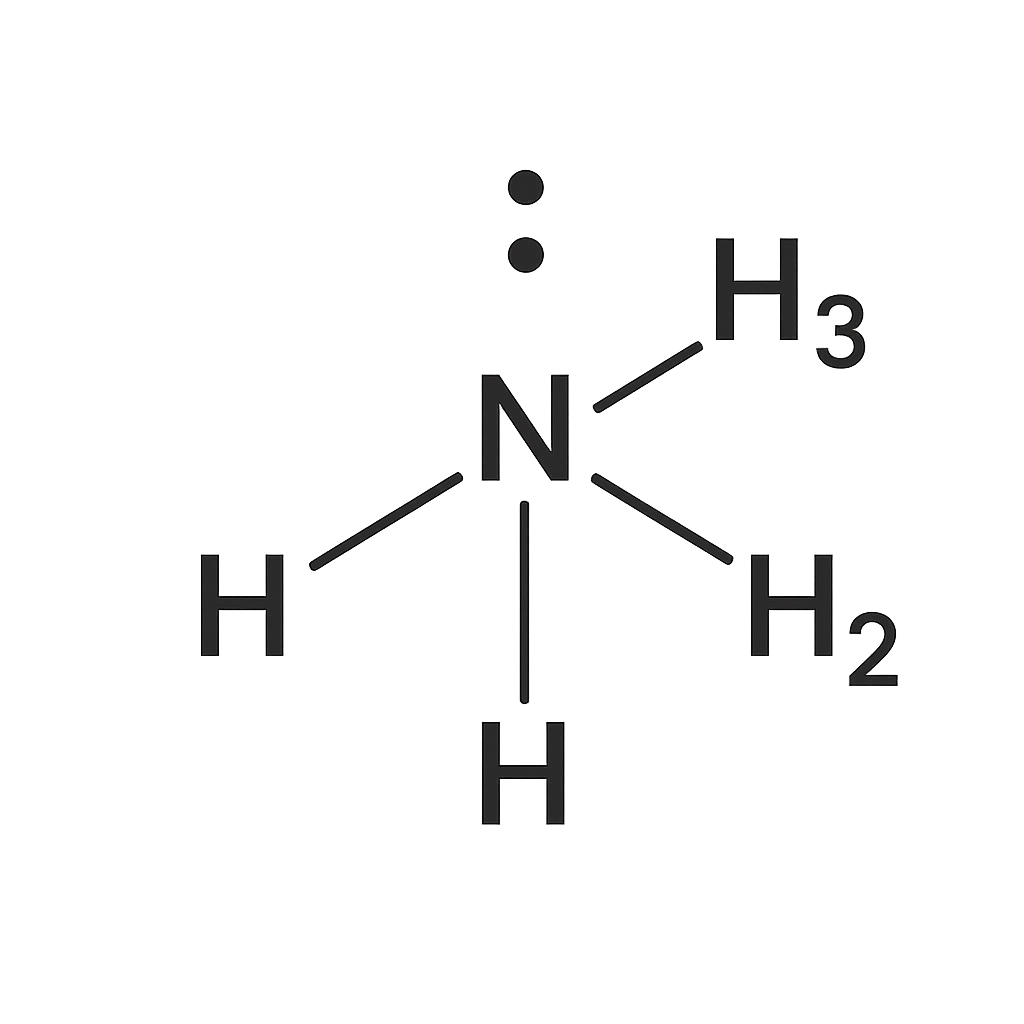
The diagram shows the Lewis structure of ammonia (\( \mathrm{NH_3} \)). Based on this structure, state the hybridisation of the nitrogen atom and give the approximate H-N-H bond angle.
Correct A. sp3, 107°
B. sp, 180°
C. sp2, 120°
D. sp3, 109.5°

Correct Answer: A

Want to see the full step-by-step solution? Unlock AI Explanation & Analytics
Question 25 View Details
In the esterification of benzoic acid with ethanol, 0.050 mol of benzoic acid (\( \mathrm{C_6H_5COOH} \)) is mixed with 0.075 mol of ethanol (\( \mathrm{C_2H_5OH} \)) in the presence of excess sulphuric acid. The reaction also contains 0.020 mol of acetic acid impurity, which can react with ethanol to give ethyl acetate. After work‑up, 6.00 g of ester mixture is obtained. Gas‑chromatography analysis shows that ethyl benzoate constitutes 80 % by mass of the mixture. Calculate the percent yield of ethyl benzoate based on the amount of benzoic acid initially present.
Correct A. 63.9
B. 55.4
C. 71.2
D. 48.0

Correct Answer: A

Want to see the full step-by-step solution? Unlock AI Explanation & Analytics

Master the Exam!

You've seen a preview, but there are thousands more questions plus AI tutor to break down complex solutions.

Unlock Full Access Available for Android & Windows
Help others prepare! Share this practice hub:
Chat with Support