neco 2023 biology | Objective

Prepare for your exams with neco questions? Reviewing past/model questions is one of the most effective ways to guarantee a high score. This practice hub features authentic 2023 biology (Objective) questions designed to simulate the real exam environment.

Practice these randomly selected questions to test your readiness.
Question 1 View Details
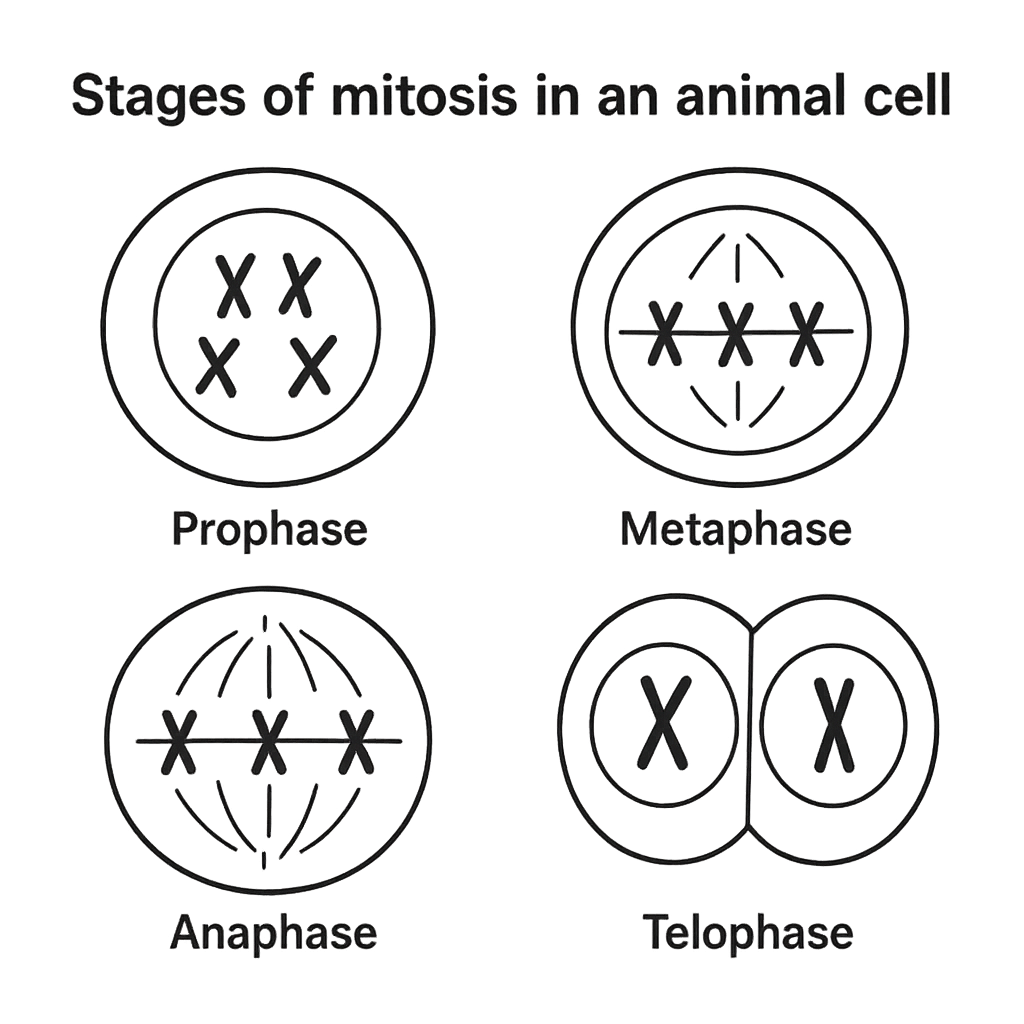
During mitosis, a diploid human somatic cell ( \(2n = 46\) ) divides. After cytokinesis, how many chromosomes are present in each daughter nucleus?
A. 48
B. 23
Correct C. 46
D. 92

Correct Answer: C

Want to see the full step-by-step solution? Unlock AI Explanation & Analytics
Question 2 View Details
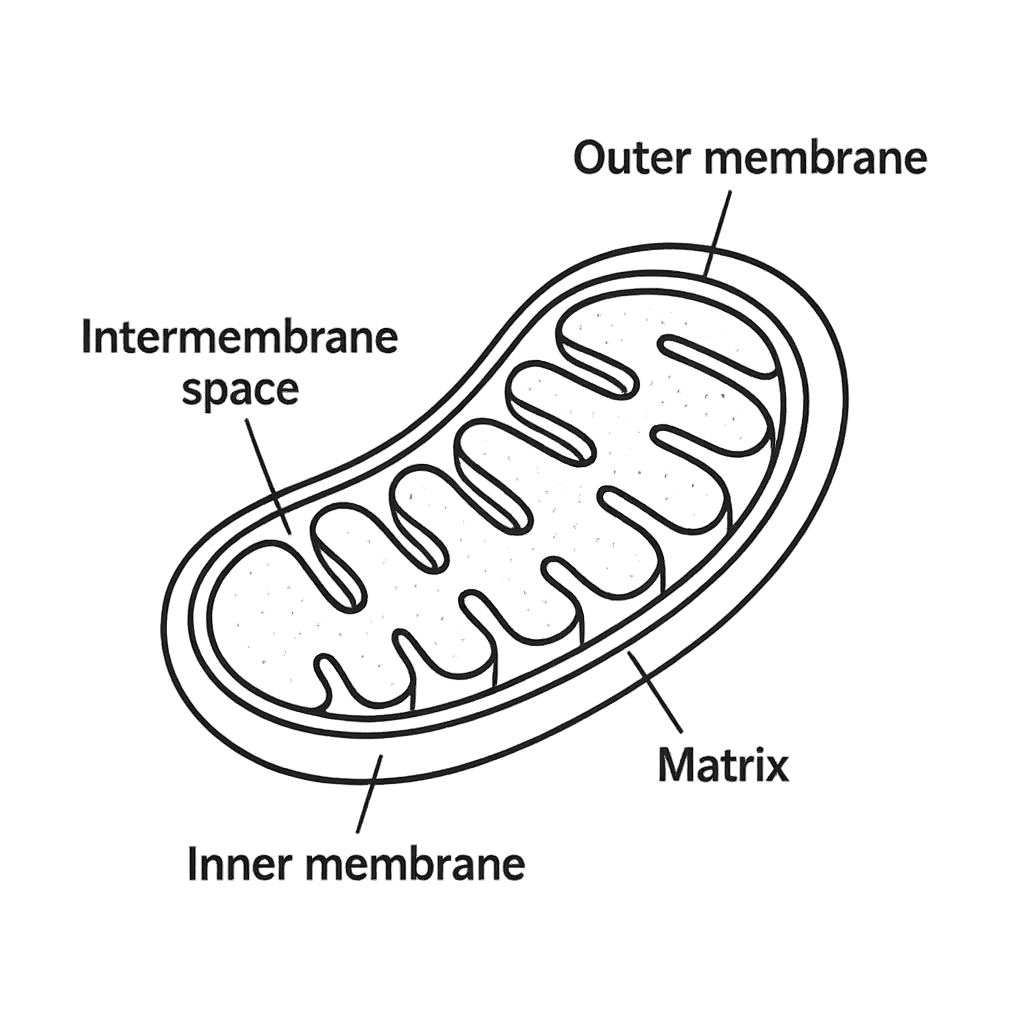
The diagram shows the structure of a mitochondrion. During aerobic respiration, NADH and FADH\(_2\) generated in earlier stages donate electrons to the electron transport chain located in the inner mitochondrial membrane. Given that glycolysis produces \(2\) NADH, the link reaction produces \(2\) NADH, and the Krebs cycle produces \(6\) NADH and \(2\) FADH\(_2\) per molecule of glucose, and assuming P/O ratios of \(2.5\) ATP per NADH and \(1.5\) ATP per FADH\(_2\), calculate the total number of ATP molecules synthesized from oxidative phosphorylation per glucose molecule. Also include the substrate‑level ATP formed in glycolysis (\(2\) ATP) and the Krebs cycle (\(2\) ATP).
Correct A. 32
B. 30
C. 34
D. 28

Correct Answer: A

Want to see the full step-by-step solution? Unlock AI Explanation & Analytics
Question 3 View Details
In a bacterial culture containing \(10^{8}\) cells, \(0.01\%\) of the cells initially carry a plasmid that confers resistance to antibiotic X. Each plasmid‑bearing cell can form a conjugative contact with 5 randomly chosen cells per hour, and each successful contact transfers the plasmid with probability 0.8. Assuming contacts are independent and that the number of contacts is small compared with the total population so that virtually all recipients are plasmid‑free, calculate the proportion of the total population that will carry the plasmid after 2 hours.
A. 0.12%
B. 0.08%
Correct C. 0.09%
D. 0.15%

Correct Answer: C

Want to see the full step-by-step solution? Unlock AI Explanation & Analytics
Question 4 View Details
An experiment was conducted to determine the effect of pH on the activity of amylase extracted from barley seeds. The rate of maltose production (µmol min⁻¹) was measured at different pH values as shown below: pH 4: 12 µmol min⁻¹ pH 5: 28 µmol min⁻¹ pH 6: 45 µmol min⁻¹ pH 7: 50 µmol min⁻¹ pH 8: 38 µmol min⁻¹ pH 9: 20 µmol min⁻¹ (a) Identify the optimum pH for amylase activity. (b) Calculate the percentage decrease in activity at pH 4 and at pH 9 relative to the optimum. (c) Provide a brief physiological explanation for the observed pattern.
A. Optimum pH = 8; 70% decrease at pH 4; 45% decrease at pH 9; explanation as above.
Correct B. Optimum pH = 7; 76% decrease at pH 4; 60% decrease at pH 9; explanation as above.
C. Optimum pH = 6; 67% decrease at pH 4; 52% decrease at pH 9; explanation as above.
D. Optimum pH = 7; 80% decrease at pH 4; 55% decrease at pH 9; explanation as above.

Correct Answer: B

Want to see the full step-by-step solution? Unlock AI Explanation & Analytics
Question 5 View Details
A plant cell observed under the microscope shows a large central vacuole occupying about 80 % of the cell volume, a rigid cell wall, and numerous chloroplasts. Based on these characteristics, which type of plant tissue is the cell most likely to belong to?
A. Sclerenchyma cell
Correct B. Parenchyma cell
C. Collenchyma cell
D. Xylem vessel element

Correct Answer: B

Want to see the full step-by-step solution? Unlock AI Explanation & Analytics
Question 6 View Details
A bacterial culture initially contains \(2\times10^{6}\) cells. At 30°C the specific growth rate is 50% of the optimal rate at 37°C, which is \(\mu_{opt}=0.8\ \text{h}^{-1}\). The culture experiences a 4‑hour lag phase, after which it is shifted to 37°C and grows exponentially for the remaining time. If the total incubation time is 10 h, calculate the approximate number of cells present at the end of the incubation.
A. ≈ \\(6.0\\times10^{8}\\) cells
B. ≈ \\(9.0\\times10^{8}\\) cells
Correct C. ≈ \(1.2\times10^{9}\) cells
D. ≈ \\(2.4\\times10^{9}\\) cells

Correct Answer: C

Want to see the full step-by-step solution? Unlock AI Explanation & Analytics
Question 7 View Details
In a labelled diagram of the human respiratory system, the structure marked as 4 is the alveolar region. Each alveolus can be approximated as a sphere of radius \(0.1\,\text{mm}\). Only 70% of the alveoli are functional, and the total number of alveoli is \(3\times10^{8}\). Determine which labelled structure is primarily responsible for gas exchange and calculate the total surface area available for diffusion (in \(\text{m}^{2}\)), using the formula for the surface area of a sphere.
A. Respiratory membrane (label 2); total surface area ≈ 22.0 m²
Correct B. Alveolar region (label 4); total surface area ≈ 26.4 m²
C. Bronchioles (label 3); total surface area ≈ 15.2 m²
D. Alveolar sac (label 5); total surface area ≈ 30.1 m²

Correct Answer: B

Want to see the full step-by-step solution? Unlock AI Explanation & Analytics
Question 8 View Details
A researcher samples macroinvertebrates in a pond using five 1‑m² quadrats and records the following abundances: chironomid larvae = 30, mosquito larvae = 20, water beetles = 10, dragonfly nymphs = 5, snails = 5. (a) Compute the Shannon-Wiener diversity index \(H'\) (use natural logarithms). (b) Given average biomass per individual: chironomid = 0.02 g, mosquito = 0.03 g, beetle = 0.5 g, dragonfly = 0.8 g, snail = 0.4 g, identify which trophic level contributes the greatest proportion of the total biomass.
Correct A. H' ≈ 1.38; the secondary‑consumer level (water beetles) contributes the greatest biomass.
B. H' ≈ 1.20; the primary‑consumer level (mosquito larvae) contributes the greatest biomass.
C. H' ≈ 1.55; the tertiary‑consumer level (dragonfly nymphs) contributes the greatest biomass.
D. H' ≈ 1.38; the primary‑producer level (snails) contributes the greatest biomass.

Correct Answer: A

Want to see the full step-by-step solution? Unlock AI Explanation & Analytics
Question 9 View Details
In a typical animal cell diagram, which organelle is the site of oxidative phosphorylation and ATP production?
Correct A. Mitochondrion
B. Chloroplast
C. Endoplasmic reticulum
D. Nucleus

Correct Answer: A

Want to see the full step-by-step solution? Unlock AI Explanation & Analytics
Question 10 View Details
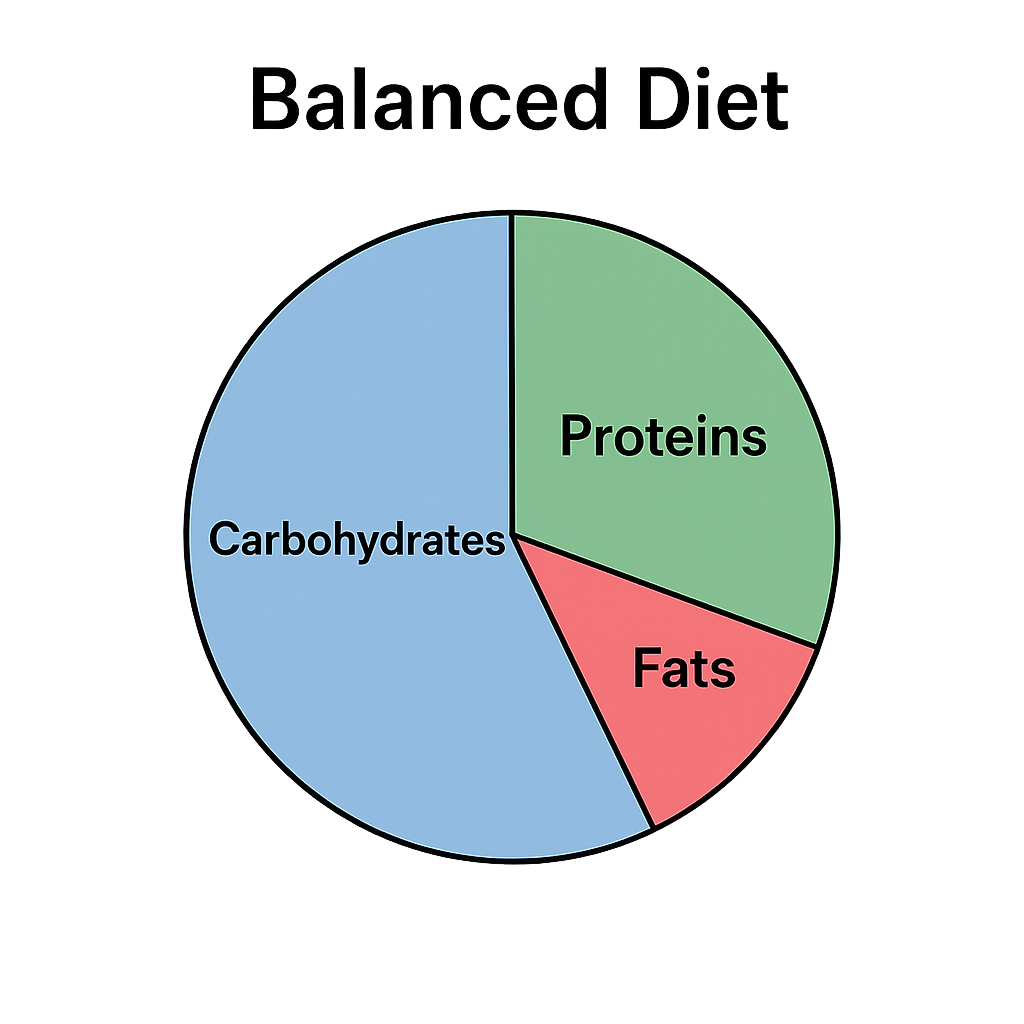
The diagram shows a balanced diet plate divided into three sections: Carbohydrates (50 % of the plate area), Proteins (30 %), and Fats (20 %). If the total daily caloric intake is 2000 kcal and each gram of carbohydrate or protein provides 4 kcal while each gram of fat provides 9 kcal, calculate the number of kilocalories supplied by the protein portion of the diet.
A. 400 kcal
B. 540 kcal
Correct C. 600 kcal
D. 800 kcal

Correct Answer: C

Want to see the full step-by-step solution? Unlock AI Explanation & Analytics
Question 11 View Details
A substance X is filtered at a glomerular filtration rate (GFR) of 125\(\text{mL}\)\(\text{min}^{-1}\) and its plasma concentration is 0.4\(\text{mg}\)\(\text{mL}^{-1}\). Seventy percent of the filtered load is reabsorbed and twenty percent of the remaining amount is secreted into the tubular fluid. If the urine concentration of X is 0.45\(\text{mg}\)\(\text{mL}^{-1}\), calculate the urine flow rate in \(\text{mL}\)\(\text{min}^{-1}\).
A. 45 mL\/min
Correct B. 40 mL/min
C. 35 mL\/min
D. 50 mL\/min

Correct Answer: B

Want to see the full step-by-step solution? Unlock AI Explanation & Analytics
Question 12 View Details
In a stretch reflex, the afferent (sensory) neuron conducts impulses at 80\(\text{m s}^{-1}\) over a distance of 0.5\(\text{m}\) and the efferent (motor) neuron conducts at 60\(\text{m s}^{-1}\) over 0.4\(\text{m}\) when the body temperature is 37\(^{\circ}\)C. For a child whose body temperature is 30\(^{\circ}\)C, conduction velocities change according to the Q10 rule with Q10 = 2.0. The synaptic delay at the spinal cord is 0.5\(\text{ms}\). Calculate the total reflex time (in milliseconds) at 30\(^{\circ}\)C and state whether it is less than 5\(\text{ms}\).
A. 25.0 ms, No
Correct B. 21.5 ms, No
C. 21.5 ms, Yes
D. 18.0 ms, No

Correct Answer: B

Want to see the full step-by-step solution? Unlock AI Explanation & Analytics
Question 13 View Details
At sea level (atmospheric pressure \(P_{atm}=760\) mmHg) the water vapour pressure is 47 mmHg. A person breathes air with a fractional oxygen concentration \(F_{IO2}=0.21\). Their arterial carbon‑dioxide tension is \(P_{aCO2}=40\) mmHg and the respiratory quotient is \(R=0.8\). Using the alveolar gas equation, calculate the alveolar oxygen tension \(P_{AO2}\). If the measured arterial oxygen tension is 80 mmHg, determine the A‑a gradient and state whether it indicates a diffusion impairment (gradient > 15 mmHg).
A. 5 mmHg, No
Correct B. 20 mmHg, Yes
C. 30 mmHg, Yes
D. 10 mmHg, No

Correct Answer: B

Want to see the full step-by-step solution? Unlock AI Explanation & Analytics
Question 14 View Details
Insulin is secreted continuously at a constant rate of 2\(\text{units}\)\(\text{min}^{-1}\) and is eliminated from the plasma by first‑order kinetics with a half‑life of 5 minutes. Assuming the initial plasma insulin concentration is zero, what concentration will be reached after 15 minutes? (Give your answer to one decimal place in \(\mu\)U mL\(^{-1}\).)
Correct A. 12.6 µU/mL
B. 14.8 µU\/mL
C. 10.2 µU\/mL
D. 9.5 µU\/mL

Correct Answer: A

Want to see the full step-by-step solution? Unlock AI Explanation & Analytics
Question 15 View Details
A plant specimen collected from a flooded paddy field shows the following characteristics: (i) stems are hollow with distinct nodes; (ii) leaves are long, narrow, with parallel venation and a sheath that wraps around the stem; (iii) the inflorescence is a panicle bearing spikelets each composed of two glumes; (iv) the fruit is a single caryopsis. Using these morphological clues, identify the family, genus and species of the plant.
A. Family Poaceae; Genus Zea; Species Zea mays
B. Family Cyperaceae; Genus Cyperus; Species Cyperus rotundus
C. Family Poaceae; Genus Triticum; Species Triticum aestivum
Correct D. Family Poaceae; Genus Oryza; Species Oryza sativa

Correct Answer: D

Want to see the full step-by-step solution? Unlock AI Explanation & Analytics
Question 16 View Details
A human somatic cell in \( G_{1} \) phase contains 46 chromosomes, each with a single chromatid. After DNA replication in S phase, the cell enters mitosis. How many chromatids are present at metaphase?
A. 184 chromatids
B. 46 chromatids
C. 48 chromatids
Correct D. 92 chromatids

Correct Answer: D

Want to see the full step-by-step solution? Unlock AI Explanation & Analytics
Question 17 View Details
In a simple reflex arc, the sensory neuron conducts an impulse at \(80\ \text{m/s}\) over a distance of \(0.5\ \text{cm}\) to the spinal cord, then a synaptic delay of \(0.5\ \text{ms}\) occurs, followed by the motor neuron conducting at \(60\ \text{m/s}\) over \(0.8\ \text{cm}\) to the effector muscle. Calculate the total reaction time in milliseconds.
A. 0.75 ms
Correct B. 0.70 ms
C. 0.80 ms
D. 0.65 ms

Correct Answer: B

Want to see the full step-by-step solution? Unlock AI Explanation & Analytics
Question 18 View Details
A newly discovered plant exhibits the following characteristics: (i) presence of vascular tissue, (ii) seeds enclosed within an ovary, (iii) leaves with net‑like venation, and (iv) flowers with five petals. Using standard plant classification criteria, to which major group does this plant belong?
A. Pteridophyte
B. Gymnosperm
Correct C. Dicotyledonous angiosperm
D. Monocotyledonous angiosperm

Correct Answer: C

Want to see the full step-by-step solution? Unlock AI Explanation & Analytics
Question 19 View Details
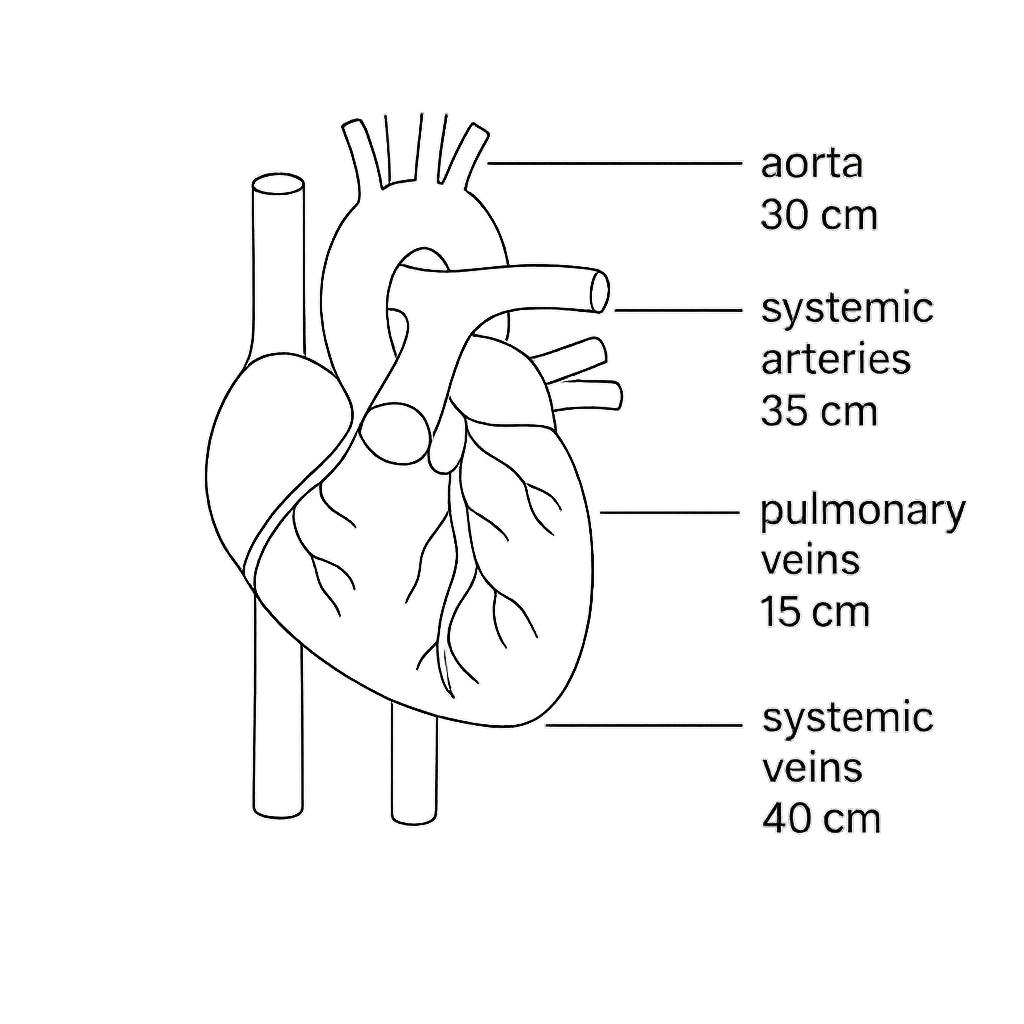
The diagram shows the lengths of major blood vessels in centimeters: aorta = 30 cm, systemic arteries = 35 cm, systemic veins = 40 cm, pulmonary artery = 15 cm, pulmonary veins = 15 cm. Assuming blood travels through each of these vessels once in a complete circuit, what is the total distance traveled by the blood in centimeters?
A. 150 cm
B. 130 cm
Correct C. 135 cm
D. 120 cm

Correct Answer: C

Want to see the full step-by-step solution? Unlock AI Explanation & Analytics
Question 20 View Details
A meal provides 25 g protein, 30 g carbohydrate, 10 g fat, and 5 g dietary fiber (non‑caloric). Protein and carbohydrate each yield \(4\ \text{kcal/g}\) and fat yields \(9\ \text{kcal/g}\). If the recommended daily energy intake is 2000 kcal, what percentage of the daily requirement does this meal supply?
A. 22.0 %
B. 13.5 %
Correct C. 15.5 %
D. 17.2 %

Correct Answer: C

Want to see the full step-by-step solution? Unlock AI Explanation & Analytics
Question 21 View Details
Three desert plant species exhibit different combinations of water‑saving adaptations. - Plant A possesses a thick waxy cuticle that reduces transpiration by \(40\%\) and a deep taproot that increases water uptake by \(20\%\). - Plant B has reduced leaf surface area decreasing water loss by \(30\%\) and performs CAM photosynthesis shifting stomatal opening to night, reducing water loss by \(25\%\). - Plant C exhibits all three adaptations (waxy cuticle, reduced leaf area, CAM) with the same percentage effects as above but no taproot. Assuming a baseline water loss of \(100\ \text{ml\ day}^{-1}\) for a plant without any adaptation, and that each percentage reduction applies to the water loss remaining after the previous adaptation has acted, which plant has the lowest net water loss per day?
A. Plant A and B
Correct B. Plant C
C. Plant B
D. Plant A

Correct Answer: B

Want to see the full step-by-step solution? Unlock AI Explanation & Analytics
Question 22 View Details
In a mammal the glomerular filtration rate (GFR) is \(120\ \text{ml\ min}^{-1}\). A solute X has a plasma concentration of \(50\ \text{mg\ dL}^{-1}\) and is freely filtered. Of the filtered load, \(80\%\) is reabsorbed in the proximal tubule. In the loop of Henle, \(10\%\) of the amount that reaches the loop is secreted into the tubular fluid. Finally, in the distal tubule \(5\%\) of the amount present is reabsorbed. What is the rate of excretion of X in \(\text{mg\ min}^{-1}\)?
Correct A. 12.5
B. 11.7
C. 13.2
D. 12.0

Correct Answer: A

Want to see the full step-by-step solution? Unlock AI Explanation & Analytics
Question 23 View Details
In a 28‑day menstrual cycle the plasma estrogen concentration rises linearly from \(20\ \text{pg\ mL}^{-1}\) on day 1 to a peak of \(200\ \text{pg\ mL}^{-1}\) on day 12 and then falls linearly back to \(20\ \text{pg\ mL}^{-1}\) on day 28. An LH surge is triggered when the estrogen level exceeds \(150\ \text{pg\ mL}^{-1}\) for at least 24 h. On which day does the LH surge begin?
Correct A. 9
B. 10
C. 12
D. 8

Correct Answer: A

Want to see the full step-by-step solution? Unlock AI Explanation & Analytics
Question 24 View Details
The style of a certain flowering plant is \(3.5\ \text{mm}\) long. A pollen tube grows initially at \(0.5\ \text{mm\ h}^{-1}\) but its growth rate accelerates by \(0.1\ \text{mm\ h}^{-2}\) each hour because of increasing calcium concentration. How many whole hours are required for the pollen tube to traverse the style and reach the ovary?
A. 6
B. 4
Correct C. 5
D. 8

Correct Answer: C

Want to see the full step-by-step solution? Unlock AI Explanation & Analytics
Question 25 View Details
A mountain goat lives at an altitude of \(3000\ \text{m}\) where the atmospheric pressure is \(70\ \text{kPa}\) (sea‑level pressure \(101.3\ \text{kPa}\)). The partial pressure of oxygen (\(P_{O_2}\)) is \(21\%\) of the atmospheric pressure. At sea level the goat's hemoglobin has a \(P_{50}\) of \(26\ \text{mmHg}\) and the Hill coefficient \(n = 2.5\). At altitude the goat shows two physiological adjustments: (i) ventilation increases to \(1.8\) times the sea‑level value, and (ii) the hemoglobin's affinity for O\(_2\) increases so that \(P_{50}\) falls to \(22\ \text{mmHg}\). Assuming arterial oxygen saturation (\(S_{aO_2}\)) is given by the Hill equation \[S_{aO_2}= \frac{P_{O_2}^{\,n}}{P_{50}^{\,n}+P_{O_2}^{\,n}}\] with \(n = 2.5\), and that arterial oxygen content is proportional to \(S_{aO_2}\), which of the two adjustments contributes more to the relative increase in arterial oxygen saturation compared with the sea‑level condition? Answer "ventilation" or "hemoglobin affinity".
A. both adjustments
B. ventilation
Correct C. hemoglobin affinity
D. neither adjustment

Correct Answer: C

Want to see the full step-by-step solution? Unlock AI Explanation & Analytics

Master the Exam!

You've seen a preview, but there are thousands more questions plus AI tutor to break down complex solutions.

Unlock Full Access Available for Android & Windows
Help others prepare! Share this practice hub:
Chat with Support