neco 2023 agricultural_science | Objective

Prepare for your exams with neco questions? Reviewing past/model questions is one of the most effective ways to guarantee a high score. This practice hub features authentic 2023 agricultural_science (Objective) questions designed to simulate the real exam environment.

Practice these randomly selected questions to test your readiness.

Question 1 View Details
A soil sample has a \( \text{pH}=5.2 \) and an electrical conductivity \( \text{EC}=0.8\ \text{dS/m} \). Classify the soil's acidity level and its salinity status.
A. Neutral; slightly saline
Correct B. Acidic; slightly saline
C. Alkaline; slightly saline
D. Acidic; non-saline

Correct Answer: B

Want to see the full step-by-step solution? Unlock AI Explanation & Analytics
Question 2 View Details
A farmer has 2 ha of land (\(20\,000\ \text{m}^2\)) and wants a total maize yield of 10 tonnes. Expected yield per plant is \(0.25\ \text{kg}\). If the rows are spaced \(0.75\ \text{m}\) apart, what should be the plant spacing (in metres) to meet the target?
Correct A. 0.67 m (approximately)
B. 0.80 m (approximately)
C. 0.75 m (approximately)
D. 0.55 m (approximately)

Correct Answer: A

Want to see the full step-by-step solution? Unlock AI Explanation & Analytics
Question 3 View Details
In a 5‑ha field a disease currently attacks 12\% of the area. Each percent of incidence reduces the yield by \(0.05\) tonne per ha. The crop sells for \(\text{N}150\) per tonne. A fungicide reduces the incidence by 70\% of the infected area but costs \(\text{N}200\) per ha. The disease‑free yield is 3 tonnes per ha. Should the farmer apply the fungicide?
A. Yes, because the fungicide cost is offset by the increased yield, giving a net profit of (N2000) compared to (N1800) without treatment.
B. Yes, because the net profit after treatment (N1900) is higher than the profit without treatment (N1800).
Correct C. No, because the net profit after treatment (N1115) is lower than the profit without treatment (N1800).
D. No, because the net profit after treatment (N1500) is lower than the profit without treatment (N1800).

Correct Answer: C

Want to see the full step-by-step solution? Unlock AI Explanation & Analytics
Question 4 View Details
A district has 12,000 smallholder farmers. Extension policy requires each agent to serve at most 250 farmers per year. An agent works 240 days annually and each farmer visit takes 2 days (including travel). Each agent receives a salary of \(\text{N}120,000\) per year and must attend two training workshops costing \(\text{N}15,000\) each. The district budget for extension is \(\text{N}1,200,000\). Determine the minimum number of agents needed to satisfy the farmer‑coverage requirement and whether this number can be afforded within the budget.
A. The minimum number of agents required is 100, and the budget allows exactly 100 agents, so the farmer‑coverage requirement can be met.
B. The minimum number of agents required is 100, but the budget only allows 12 agents, so the farmer‑coverage requirement cannot be met.
C. The minimum number of agents required is 48, but the budget only allows 8 agents, so the farmer‑coverage requirement cannot be met.
Correct D. The minimum number of agents required is 100, but the budget only allows 8 agents, so the farmer‑coverage requirement cannot be met.

Correct Answer: D

Want to see the full step-by-step solution? Unlock AI Explanation & Analytics
Question 5 View Details
A rabbit farm aims to produce 500 kg of meat in 6 months. Each rabbit gains \(30\) g per day and consumes \(120\) g of feed per day. Assuming a 10\% mortality rate, determine the number of rabbits that must be started with and the total amount of feed required for the whole period (in kg).
A. 112 rabbits initially; total feed required ≈ 2400 kg
B. 96 rabbits initially; total feed required ≈ 2100 kg
Correct C. 104 rabbits initially; total feed required ≈ 2246 kg
D. 108 rabbits initially; total feed required ≈ 2300 kg

Correct Answer: C

Want to see the full step-by-step solution? Unlock AI Explanation & Analytics
Question 6 View Details
A farmer has a rectangular field of \(15{,}000\ \text{m}^2\) (1.5 ha). A plough can be set to a working width of \(0.5\ \text{m}\) at a forward speed of \(5\ \text{km/h}\). If the width is increased to \(0.75\ \text{m}\) the speed drops by 20\% (i.e., to \(4\ \text{km/h}\)). The farmer wishes to finish ploughing the whole field in no more than \(6\) hours. Which setting should be chosen and what total distance will the plough travel under that setting?
A. 0.75 m; 24 km
B. 0.5 m; 20 km
C. 0.5 m; 30 km
Correct D. 0.75 m; 20 km

Correct Answer: D

Want to see the full step-by-step solution? Unlock AI Explanation & Analytics
Question 7 View Details
In a herd of \(200\) goats, the natural incidence of a certain disease is \(12\%\) among unvaccinated animals. A vaccine reduces the incidence by \(70\%\) relative to the unvaccinated level. If \(60\%\) of the goats are vaccinated, how many goats are expected to become diseased?
Correct A. 14
B. 7
C. 20
D. 15

Correct Answer: A

Want to see the full step-by-step solution? Unlock AI Explanation & Analytics
Question 8 View Details
State the process in the nitrogen cycle in which atmospheric nitrogen gas (\(N_2\)) is converted into ammonia (\(NH_3\)) by bacteria.
A. ammonification
Correct B. nitrogen fixation
C. nitrification
D. denitrification

Correct Answer: B

Want to see the full step-by-step solution? Unlock AI Explanation & Analytics
Question 9 View Details
A poultry farm holds \(5{,}000\) chickens. An outbreak of Newcastle disease would cause a mortality of \(8\%\) if no treatment is given. A medication reduces mortality by \(75\%\) of the untreated rate and costs ₦150 for every 100 chickens treated. If the farmer treats the entire flock, determine (a) the expected number of deaths after treatment, (b) the total cost of the medication, and (c) the number of lives saved compared with no treatment.
A. 100 deaths; ₦750,000; 300 lives saved
B. 200 deaths; ₦7,500; 200 lives saved
Correct C. 100 deaths; ₦7,500; 300 lives saved
D. 300 deaths; ₦7,500; 100 lives saved

Correct Answer: C

Want to see the full step-by-step solution? Unlock AI Explanation & Analytics
Question 10 View Details
A forest stand follows the logistic growth model\n\( V(t)=\dfrac{K}{1+ae^{-bt}} \)\nwhere \(K=200\ \text{m}^3\!\!/\text{ha}\) is the carrying capacity, \(b=0.25\ \text{yr}^{-1}\) and the constant \(a\) is fixed by the condition that at age \(t=5\) yr the stand volume is \(30\ \text{m}^3\!\!/\text{ha}\). The manager wants the rotation age \(T\) that maximizes the average annual increment\n\( \text{AAI}(T)=\dfrac{V(T)}{T}. \)\nFind the integer rotation age (in years) that gives the maximum AAI and give that maximum AAI value (to one decimal place).
A. 14 years; 8.5 m³\/ha per year
B. 17 years; 9.5 m³\/ha per year
Correct C. 16 years; 9.2 m³/ha per year
D. 15 years; 8.8 m³\/ha per year

Correct Answer: C

Want to see the full step-by-step solution? Unlock AI Explanation & Analytics
Question 11 View Details
A goat weighing 25 kg gains 150 g per day. Its maintenance energy requirement is 120 kJ per kg^{0.75} of metabolic weight per day. The energy needed for growth is 5.5 MJ per kg of weight gain. The feed offered contains 10 MJ of metabolizable energy per kg. Assuming the goat's daily energy requirement is the sum of maintenance and growth, calculate the amount of feed (in kg, to two decimal places) the goat must consume each day.
Correct A. 0.22 kg
B. 0.25 kg
C. 0.18 kg
D. 0.20 kg

Correct Answer: A

Want to see the full step-by-step solution? Unlock AI Explanation & Analytics
Question 12 View Details
A tilapia fishery follows the logistic Schaefer model. The carrying capacity of the lake is \(K = 5000\) tonnes and the intrinsic growth rate is \(r = 0.4\) yr^{-1}. Harvest follows \(H = qEB\) where catchability \(q = 0.0005\) tonne^{-1}\,effort^{-1} and effort \(E\) is measured in boat‑days per year. Management requires that the equilibrium biomass be at least 40 % of \(K\) and wishes to maximise the sustainable yield. Determine the optimal effort \(E^{*}\) (boat‑days yr^{-1}) and the corresponding sustainable annual yield (tonnes).
A. 350 boat‑days per year; 450 tonnes
B. 500 boat‑days per year; 600 tonnes
C. 450 boat‑days per year; 400 tonnes
Correct D. 400 boat‑days per year; 500 tonnes

Correct Answer: D

Want to see the full step-by-step solution? Unlock AI Explanation & Analytics
Question 13 View Details
A farmer plans to grow maize. Fixed costs are ₦150 000 per season and variable cost is ₦45 000 per hectare. Expected yield is 3.2 tonnes per hectare. The market price per tonne is uncertain: with probability 0.6 the price is ₦120 000, and with probability 0.4 it is ₦90 000. The farmer can choose to plant either 2 ha or 3 ha. For each option, compute the expected profit and the standard deviation of profit. Which planting area maximises expected profit, and what are its expected profit and risk (standard deviation)?
Correct A. 3 ha; expected profit ₦751,800; standard deviation ≈ ₦141,100
B. 2 ha; expected profit ₦451,200; standard deviation ≈ ₦94,100
C. 2 ha; expected profit ₦600,000; standard deviation ≈ ₦120,000
D. 3 ha; expected profit ₦720,000; standard deviation ≈ ₦150,000

Correct Answer: A

Want to see the full step-by-step solution? Unlock AI Explanation & Analytics
Question 14 View Details
A tilapia pond covers an area of 0.5 ha (5000 m\(^2\)) with an average depth of 1.2 m, holding 10 000 fish each weighing 250 g. At 28 °C each fish consumes 0.12 g O\(_2\) per hour. The pond loses dissolved oxygen to the atmosphere at a rate of 0.05 g O\(_2\) m\(^-2\) h\(^-1\). The water initially contains 4 mg O\(_2\) L\(^-1\) and must be maintained at a minimum of 5 mg L\(^-1\). An aerator supplies 2 g O\(_2\) per hour per kW of power. Determine the minimum aerator power (kW) required to keep the dissolved oxygen at or above 5 mg L\(^-1\).
A. 650 kW
Correct B. 725 kW
C. 800 kW
D. 950 kW

Correct Answer: B

Want to see the full step-by-step solution? Unlock AI Explanation & Analytics
Question 15 View Details
A tractor pulls a moldboard plough. The draft force required is given by \(D = a + b v^{2}\) where \(a = 1500\) N, \(b = 0.5\) N·s\(^2\) m\(^-2\) and \(v\) is the tractor speed in m s\(^-1\). The tractor moves at 4 km h\(^-1\) and the transmission efficiency is 85 %. Calculate the minimum engine power (kW) the tractor must have to maintain this speed while pulling the plough.
Correct A. 2.0 kW
B. 1.6 kW
C. 2.5 kW
D. 3.2 kW

Correct Answer: A

Want to see the full step-by-step solution? Unlock AI Explanation & Analytics
Question 16 View Details
In a herd of cattle, 4 were initially showing clinical signs of a contagious disease. After 20 days, the number of infected cattle increased to 48. Assuming the infection follows an exponential growth model \( N = N_0 e^{rt} \), where \( N_0 \) is the initial number infected, \( r \) is the daily infection rate and \( t \) is time in days, determine (a) the value of \( r \) (to three decimal places) and (b) the expected number of infected cattle after 30 days. Round the final number to the nearest whole animal.
A. r = 0.130, infected ≈ 180
Correct B. r = 0.124, infected ≈ 166
C. r = 0.115, infected ≈ 150
D. r = 0.124, infected ≈ 170

Correct Answer: B

Want to see the full step-by-step solution? Unlock AI Explanation & Analytics
Question 17 View Details
A batch of 500 kg fresh cassava chips has an initial moisture content of 60\% (wet basis). During drying, moisture is removed at a constant rate of 5 kg h\(^{-1}\) while the moisture content is above 30\%; once the moisture content reaches 30\% or lower, the removal rate halves to 2.5 kg h\(^{-1}\). Determine (a) the total drying time required to achieve a final moisture content of 20\% (wet basis) and (b) the final weight of the dried chips. Give the drying time to one decimal place (hours) and the final weight in kilograms.
A. 55.0 hours, 260 kg
Correct B. 57.1 hours, 250 kg
C. 48.3 hours, 260 kg
D. 62.5 hours, 240 kg

Correct Answer: B

Want to see the full step-by-step solution? Unlock AI Explanation & Analytics
Question 18 View Details
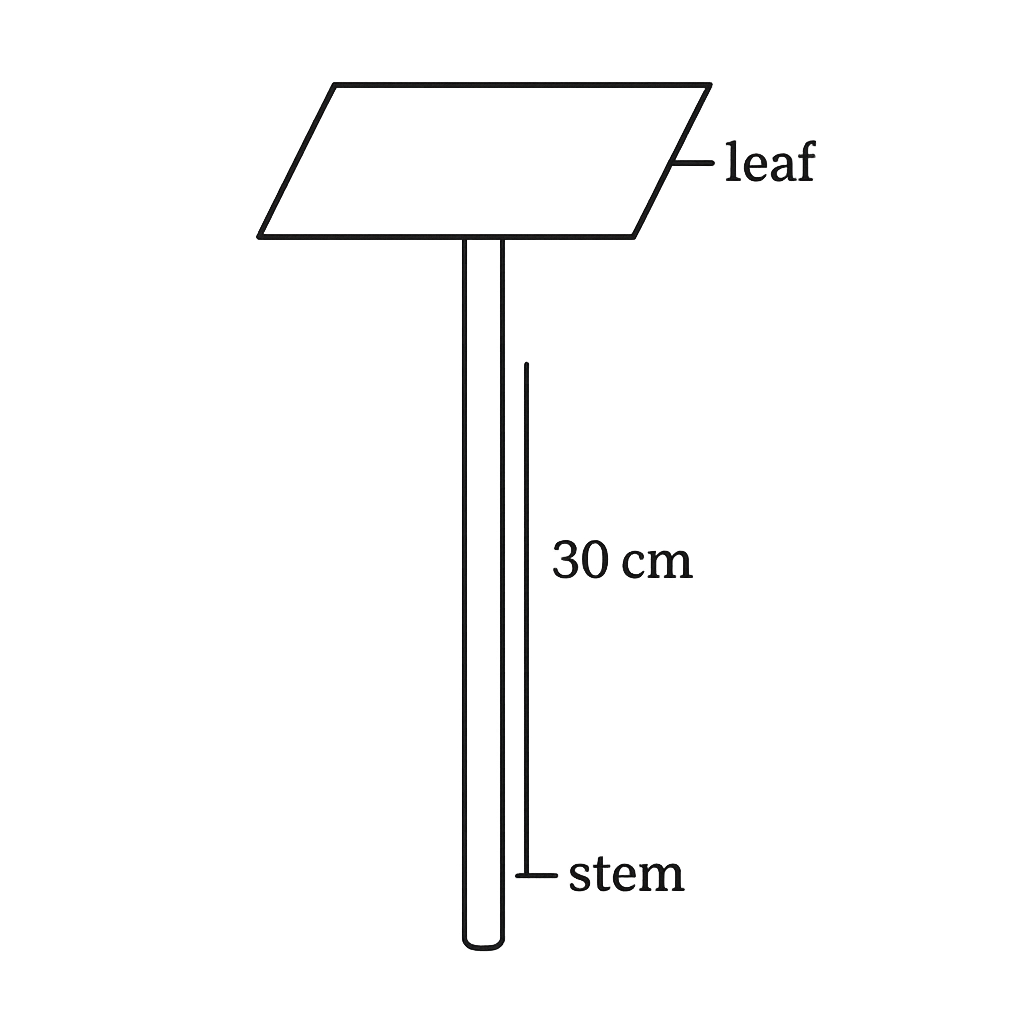
The diagram shows a plant with a rectangular leaf and a cylindrical stem. The leaf dimensions are 12 cm long and 5 cm wide; the stem is 30 cm tall with a diameter of 2 cm. Assuming the leaf is the only photosynthetic surface, calculate the percentage of the total above‑ground surface area (leaf area plus the lateral surface area of the stem) that is contributed by the leaf. Express your answer to one decimal place.
Correct A. 24.2
B. 30.4
C. 27.5
D. 21.0

Correct Answer: A

Want to see the full step-by-step solution? Unlock AI Explanation & Analytics
Question 19 View Details
A soil test indicates the following available nutrients per hectare: nitrogen (N) 20 kg, phosphorus (P) 10 kg, and potassium (K) 15 kg. The target maize yield is 8 t ha\(^{-1}\). The nutrient removal rates for maize are 20 kg N t\(^{-1}\), 5 kg P t\(^{-1}\), and 15 kg K t\(^{-1}\). Assuming that only 50 % of the applied fertilizer becomes available to the crop, calculate the amount of N, P and K (in kg ha\(^{-1}\)) that must be applied as fertilizer to meet the target yield.
A. N 320 kg, P 80 kg, K 240 kg per hectare
Correct B. N 280 kg, P 60 kg, K 210 kg per hectare
C. N 187 kg, P 40 kg, K 140 kg per hectare
D. N 140 kg, P 30 kg, K 105 kg per hectare

Correct Answer: B

Want to see the full step-by-step solution? Unlock AI Explanation & Analytics
Question 20 View Details
A tomato field has a planting density of 10 000 plants ha\(^{-1}\). Each plant normally yields 5 kg of tomatoes, sold at ₦200 kg\(^{-1}\). The whitefly pest reduces yield by 0.1 kg per pest per plant. A scouting survey records an average of 3 whiteflies per plant. A pesticide costs ₦150 ha\(^{-1}\) and reduces the pest population by 80 %. Should the farmer apply the pesticide, assuming the decision is based on whether the net economic benefit (avoided loss minus pesticide cost) is positive? Show all calculations.
Correct A. Yes, the pesticide should be applied (net benefit positive)
B. No, the pesticide should be applied (net benefit positive)
C. Yes, the pesticide should be applied (net benefit zero)
D. No, the pesticide should not be applied (net benefit negative)

Correct Answer: A

Want to see the full step-by-step solution? Unlock AI Explanation & Analytics
Question 21 View Details
In a 2 ha cassava field, the initial proportion of plants infected with mosaic virus is 5\%. The disease spreads each week according to the logistic‑type rule: the proportion of newly infected plants equals \(0.3\)\times I_t\times \(1 - I_t\), where I_t is the proportion infected at the start of the week. After the first two weeks the farmer applies a foliar spray that reduces the infection‑rate constant from \(0.3\) to \(0.18\). After week 3 he replaces 40\% of the remaining susceptible plants with a resistant variety that is completely immune. Assuming the spray remains effective, what is the proportion of infected plants at the end of week 4? Express your answer as a percentage to one decimal place.
A. 15.0\%
B. 12.3\%
Correct C. 10.5\%
D. 8.7\%

Correct Answer: C

Want to see the full step-by-step solution? Unlock AI Explanation & Analytics
Question 22 View Details
A farmer intends to apply 150\,kg of nitrogen per hectare to a soybean crop on 3\,ha. Base yield without fertilizer is 1.8\,t\,ha\textsuperscript{-1} and each additional 50\,kg\,N\,ha\textsuperscript{-1} increases yield by 0.12\,t\,ha\textsuperscript{-1} up to a maximum of 2.4\,t\,ha\textsuperscript{-1}. Fertiliser costs \u20A645\,kg\textsuperscript{-1}, but a government subsidy pays 20\% of this cost. The market price of soybeans is \u20A6250\,kg\textsuperscript{-1}. However, the price is price‑elastic: a 10\% increase in total national production leads to a 5\% decrease in price. Assume the farmer's extra production is the only change affecting the national supply, which is 100\,000\,t. What is the farmer's expected net profit per hectare after accounting for the subsidy and the price adjustment? Give your answer in \u20A5 to the nearest hundred.
A. \u20A5 500,000 per ha
B. \u20A5 480,000 per ha
C. \u20A5 560,000 per ha
Correct D. \u20A5 534,600 per ha

Correct Answer: D

Want to see the full step-by-step solution? Unlock AI Explanation & Analytics
Question 23 View Details
In a cotton field each bollworm larva causes a loss of 0.25\,kg of lint. The market price of lint is \u20A5150\,kg\textsuperscript{-1}. An insecticide application costs \u20A512,000\,ha\textsuperscript{-1} and kills 95\% of the larvae present. Using the economic injury level formula \(EIL = \dfrac{C}{V \times D \times K}\), where \(C\) is the control cost per hectare, \(V\) is the market value per kilogram, \(D\) is the loss per larva (kg), and \(K\) is the efficacy, calculate the threshold number of larvae per hectare at which the farmer should apply the insecticide. Round up to the nearest whole larva.
A. 350 larvae per ha
Correct B. 337 larvae per ha
C. 400 larvae per ha
D. 300 larvae per ha

Correct Answer: B

Want to see the full step-by-step solution? Unlock AI Explanation & Analytics
Question 24 View Details
A mixed farm has two enterprises.\n\nPoultry: 200 laying hens each produce 280 eggs per year. Eggs sell for \u20A512 each. Feed costs \u20A51,500 per hen per year and other variable costs are \u20A5300 per hen per year. Fixed overhead is \u20A530,000 per year and depreciation of the poultry house is \u20A515,000 per year.\n\nRice: 5\,ha are cultivated. Expected yield is 4\,t\,ha\textsuperscript{-1}. Rice sells for \u20A5180\,kg\textsuperscript{-1}. Variable production cost is \u20A525,000\,ha\textsuperscript{-1} and fixed cost is \u20A510,000\,ha\textsuperscript{-1}. Depreciation of the irrigation system is \u20A58,000 per year, allocated proportionally to the cultivated area.\n\nCompute the net profit for each enterprise and the overall net farm profit. Also state which enterprise is more profitable per unit (per hen versus per hectare). Give all monetary answers in \u20A5.
Correct A. Poultry profit: \u20A5 267,000 (\u20A5 1,335 per hen); Rice profit: \u20A5 3,417,000 (\u20A5 683,400 per ha); Overall profit: \u20A5 3,684,000; Rice enterprise is more profitable per unit.
B. Poultry profit: ₥ 250,000 (₥ 1,250 per hen); Rice profit: ₥ 3,300,000 (₥ 660,000 per ha); Overall profit: ₥ 3,550,000; Rice enterprise is more profitable per unit.
C. Poultry profit: ₥ 267,000 (₥ 1,335 per hen); Rice profit: ₥ 3,417,000 (₥ 683,400 per ha); Overall profit: ₥ 3,500,000; Rice enterprise is more profitable per unit.
D. Poultry profit: ₥ 267,000 (₥ 1,335 per hen); Rice profit: ₥ 3,417,000 (₥ 600,000 per ha); Overall profit: ₥ 3,684,000; Poultry enterprise is more profitable per unit.

Correct Answer: A

Want to see the full step-by-step solution? Unlock AI Explanation & Analytics
Question 25 View Details
An extension officer plans a 12‑month programme to promote integrated pest management for yam farmers in a district with 1,200 yam growers. The programme includes three activities:\n\n1. Radio broadcasts: cost \u20A5150,000 per month, each broadcast reaches 70\% of the farmers.\n2. Farmer field schools: cost \u20A5250,000 per session, each session is attended by 25 distinct farmers, with a maximum of 8 sessions per year.\n3. Printed pamphlets: cost \u20A530 per pamphlet, each pamphlet is given to one farmer and reaches 60\% of the farmers.\n\nThe total budget is \u20A52,500,000 for the year. The officer wants at least 90\% of the farmers (i.e., at least 1,080 farmers) to be reached by at least one activity, and the total number of farmer‑contact events (each broadcast counts as one contact per farmer reached, each field‑school session counts as one contact per attending farmer, each pamphlet counts as one contact) should be at least 1.5 times the number of farmers reached. Determine one feasible combination of (i) number of months of radio broadcasts, (ii) number of field‑school sessions, and (iii) number of pamphlets printed that satisfies the budget, coverage and contact‑frequency constraints. State the chosen numbers, the total cost, the total distinct farmers reached and the total contacts.
A. Radio months = 7, Field‑school sessions = 3, Pamphlets = 130; Total cost = \u20A51,880,000; Farmers reached = 1,090; Total contacts = 4,800.
B. Radio months = 6, Field‑school sessions = 4, Pamphlets = 200; Total cost = \u20A52,050,000; Farmers reached = 1,080; Total contacts = 6,000.
Correct C. Radio months = 6, Field‑school sessions = 4, Pamphlets = 140; Total cost = \u20A51,904,200; Farmers reached = 1,080; Total contacts = 5,280.
D. Radio months = 5, Field‑school sessions = 5, Pamphlets = 150; Total cost = \u20A51,950,000; Farmers reached = 1,050; Total contacts = 5,250.

Correct Answer: C

Want to see the full step-by-step solution? Unlock AI Explanation & Analytics

Master the Exam!

You've seen a preview, but there are thousands more questions plus AI tutor to break down complex solutions.

Unlock Full Access Available for Android & Windows
Help others prepare! Share this practice hub:
Chat with Support