neco 2023 agricultural_science | Essay

Prepare for your exams with neco questions? Reviewing past/model questions is one of the most effective ways to guarantee a high score. This practice hub features authentic 2023 agricultural_science (Essay) questions designed to simulate the real exam environment.

Practice these randomly selected questions to test your readiness.

Question 1 View Details
A farmer wishes to adopt ecological practices to make the farm more sustainable. Discuss the role of biodiversity in sustainable agriculture, addressing the following:
Question Parts
(a)
Explain how crop rotation can help regulate pest populations.
(b)
Describe the importance of pollinators for crop productivity.
(c)
Analyse the impact of habitat fragmentation on soil microbial diversity and its consequences for soil fertility.
Detailed Essay Solution & Marking Scheme Available

Get the step-by-step mathematical proofs, key points required by examiners, and a comprehensive breakdown from our AI Tutor.
Question 2 View Details
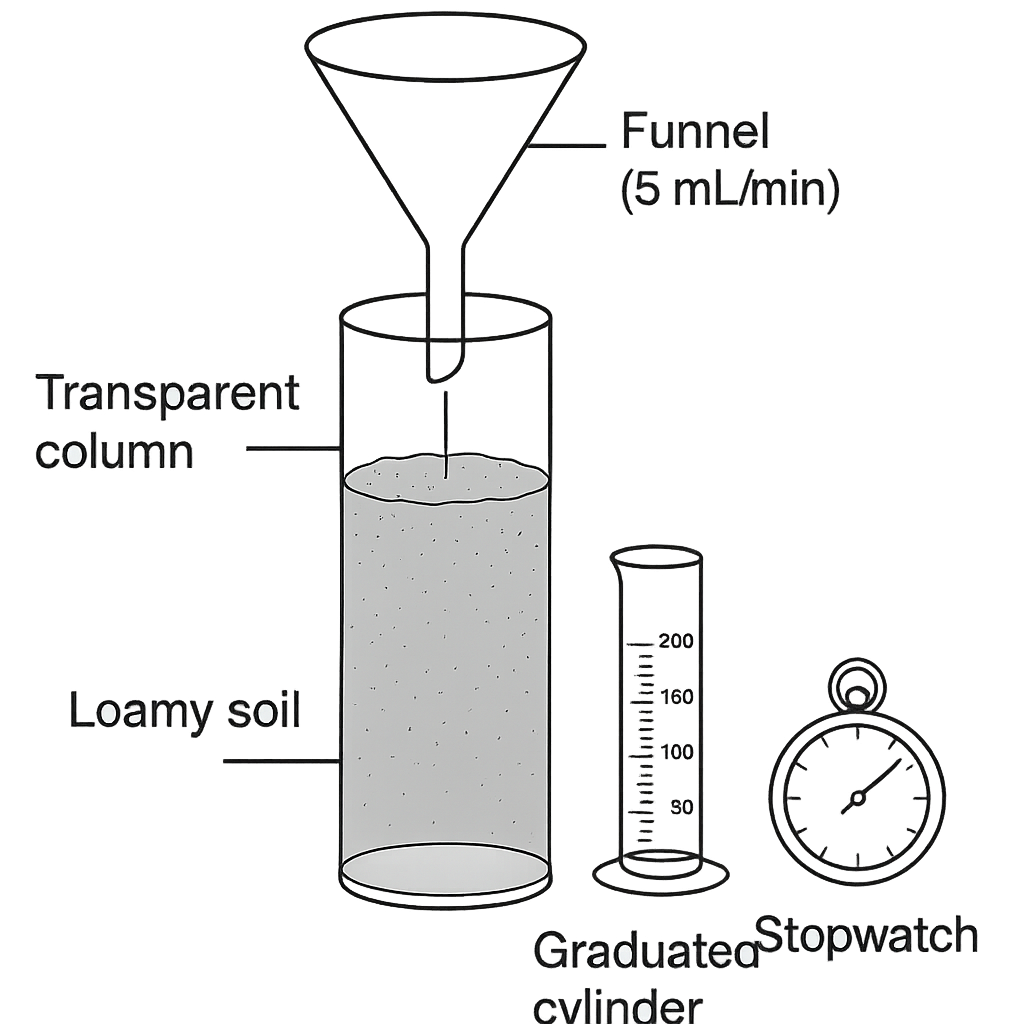
A soil scientist sets up a laboratory experiment to determine the infiltration rate of a loamy soil sample. The apparatus consists of a 30 cm high transparent column (inner diameter 10 cm) filled with the soil, a funnel delivering water at a constant rate of 5 mL per minute, and a graduated cylinder collecting the percolated water. The following observations were recorded: - After 10 minutes, 48 mL of water had been collected. - After 20 minutes, 95 mL of water had been collected. The bulk density of the soil is 1.4 g cm⁻³ and its field capacity is 0.35 cm³ cm⁻³. Answer the following:
Question Parts
(a)
Calculate the average infiltration rate (in mL min⁻¹) for the first 10‑minute interval and for the second 10‑minute interval. Comment on any change observed.
(b)
Using the column dimensions, estimate the amount of water (in grams) retained in the column when the soil is at field capacity.
(c)
Discuss two factors that could cause the infiltration rate observed in the laboratory to differ from the rate that would occur under field conditions.
Detailed Essay Solution & Marking Scheme Available

Get the step-by-step mathematical proofs, key points required by examiners, and a comprehensive breakdown from our AI Tutor.
Question 3 View Details
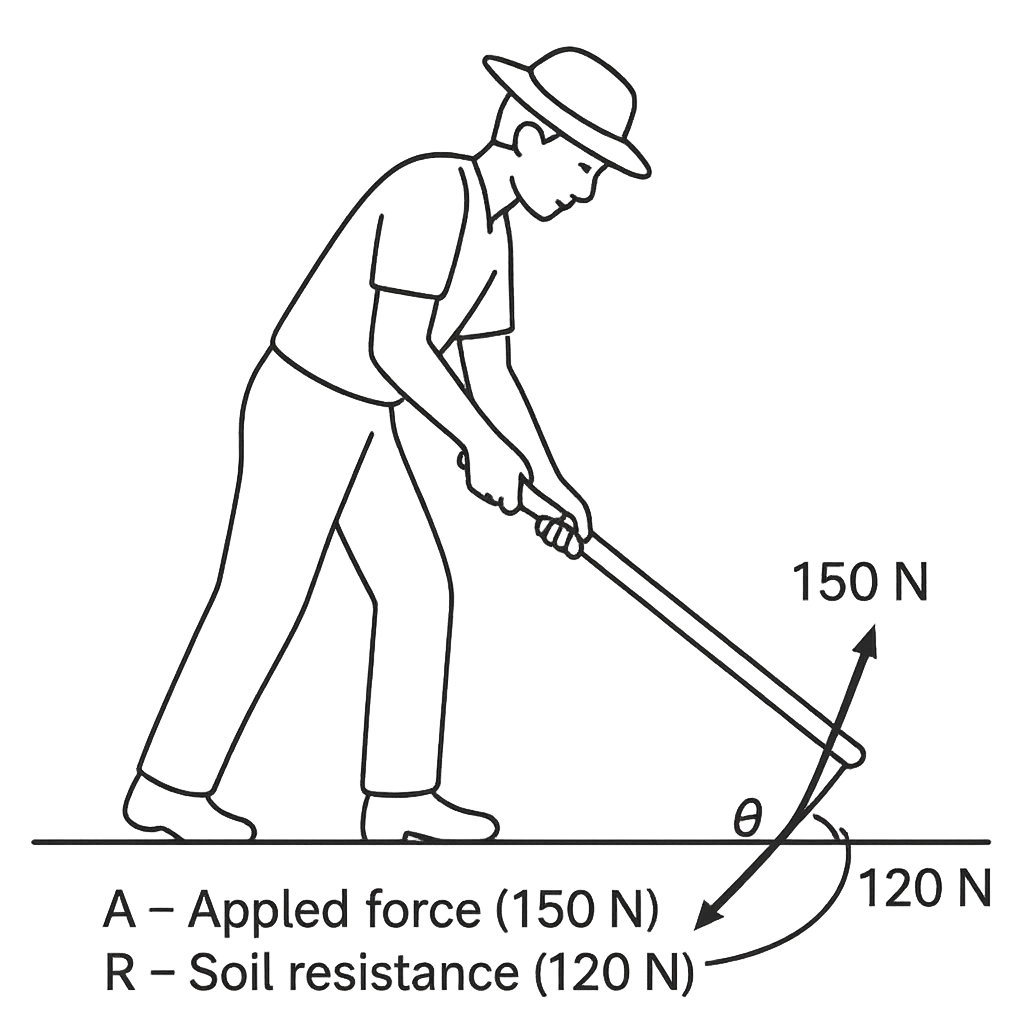
A practical demonstration of a hand hoe being used to till a small garden plot is shown in the diagram.
Question Parts
(a)
Identify three ergonomic features of the hand hoe that reduce farmer fatigue.
(b)
The farmer applies a constant force of 150 N at the handle making an angle of 30° with the horizontal to drive the hoe blade into the soil. If the blade moves a distance of 0.4 m per stroke, calculate the work done per stroke (in joules).
(c)
The soil offers a resistance of 120 N acting opposite to the direction of motion. Determine the net work done on the soil per stroke and state whether the soil is being displaced.
Detailed Essay Solution & Marking Scheme Available

Get the step-by-step mathematical proofs, key points required by examiners, and a comprehensive breakdown from our AI Tutor.

Question 4 View Details
A smallholder farmer is considering the adoption of a motorised two‑wheel tractor for his farm.
Question Parts
(a)
List three advantages of using a motorised two‑wheel tractor over animal‑drawn implements for smallholder farms.
(b)
The tractor has a rated power of 12 kW and a fuel consumption rate of 3.5 L per hour at full load. If the farmer plans to operate the tractor for 5 hours per week during the planting season, calculate the total fuel cost for a 12‑week season, given the price of diesel is ₦165 per litre.
(c)
The tractor’s engine efficiency is 25 %. Determine the useful mechanical energy (in megajoules) produced by the engine during the 5‑hour weekly operation.
(d)
Discuss two environmental impacts associated with the use of motorised tractors and suggest one mitigation measure for each impact.
Detailed Essay Solution & Marking Scheme Available

Get the step-by-step mathematical proofs, key points required by examiners, and a comprehensive breakdown from our AI Tutor.

Question 5 View Details
A mixed‑farming enterprise intends to implement a three‑year crop rotation of maize (Zea mays), soybean (Glycine max) and cassava (Manihot esculenta) on a total cultivated area of 10 ha.
Question Parts
(a)
Assuming average yields of 4.5 t ha⁻¹ for maize, 2.8 t ha⁻¹ for soybean and 15 t ha⁻¹ for cassava, calculate the total quantity of each crop produced over the three‑year rotation and the combined total production (in tonnes).
(b)
Soybean fixes atmospheric nitrogen at a rate of 50 kg N ha⁻¹ per year. Maize requires 150 kg N ha⁻¹ for optimal growth. Determine the amount of nitrogen that must be supplied to the maize crop each year after accounting for the nitrogen contributed by the preceding soybean crop. Express the required synthetic nitrogen fertilizer (in kg) for the maize field (5 ha).
(c)
Discuss at least three agronomic or economic advantages of practising this crop rotation in the given context.
Detailed Essay Solution & Marking Scheme Available

Get the step-by-step mathematical proofs, key points required by examiners, and a comprehensive breakdown from our AI Tutor.

Question 6 View Details
A smallholder dairy farm keeps 20 lactating Friesian cows. Each cow produces on average 20 L of milk per day. The farm feeds the cows with a ration containing 1.5 kg of concentrate (cost ₦1500 kg⁻¹) and 8 kg of roughage (cost ₦300 kg⁻¹) per cow per day. Milk is sold at ₦250 per litre.
Question Parts
(a)
Calculate the daily feed cost per cow and the total daily feed cost for the herd.
(b)
Determine the daily gross revenue from milk sales and the net profit per day after deducting feed costs only.
Detailed Essay Solution & Marking Scheme Available

Get the step-by-step mathematical proofs, key points required by examiners, and a comprehensive breakdown from our AI Tutor.

Question 7 View Details
A farmer cultivates 1 ha of maize. The potential yield without pest damage is 5 tonnes per hectare and the market price is ₦30,000 per tonne. Stem borer infestation reduces yield by 0.05 tonnes for each 1% increase in infestation. The cost of applying an appropriate insecticide is ₦12,000 per hectare. Using the Economic Injury Level (EIL) formula \(EIL = \dfrac{C}{V \times I}\) where C is the cost of control per hectare, V is the market price per tonne and I is the yield loss (tonne) per 1% infestation, answer the following:
Question Parts
(a)
Calculate the Economic Injury Level (percentage infestation) for the stem borer.
(b)
If a field inspection shows a stem‑borer infestation of 12%, state whether control is justified and give a brief justification.
(c)
List three cultural, two biological and two chemical control measures suitable for stem borer and early‑season aphids. For chemical control, mention one advantage and one disadvantage.
(d)
Explain two mechanisms by which stem‑borer populations can develop resistance to insecticides and suggest one management practice to delay resistance.
Detailed Essay Solution & Marking Scheme Available

Get the step-by-step mathematical proofs, key points required by examiners, and a comprehensive breakdown from our AI Tutor.

Question 8 View Details
A farmer grows tomatoes on 1 ha of land. The field shows symptoms of two diseases: - Early blight (caused by *Alternaria solani*) affecting the foliage. - Bacterial wilt (caused by *Ralstonia solanacearum*) causing wilting of stems. Data collected: - Potential yield without disease: 8 tonnes per hectare. - Market price: ₦35,000 per tonne. - Untreated disease reduces yield by 30%. - A survey of 20 randomly selected plants for early blight gave the following rating distribution (0 = no symptoms, 1 = 1–25% leaves affected, 2 = 26–50%, 3 = 51–75%, 4 = 76–100%): Rating 0: 2 plants, Rating 1: 6 plants, Rating 2: 8 plants, Rating 3: 3 plants, Rating 4: 1 plant. - The action threshold for early blight is a Disease Severity Index (DSI) of 25%. - Recommended fungicide concentration: 0.5% active ingredient, applied at 2 L per hectare. Answer the following:
Question Parts
(a)
Identify the causal agents of early blight and bacterial wilt and describe the three components of the disease triangle for each disease.
(b)
Calculate the Disease Severity Index (DSI) for early blight using the formula \(DSI = \dfrac{\sum (rating \times number\;of\;plants)}{(max\;rating \times total\;plants)} \times 100\).
(c)
Given the action threshold of 25% DSI, state whether control measures should be implemented for early blight.
Detailed Essay Solution & Marking Scheme Available

Get the step-by-step mathematical proofs, key points required by examiners, and a comprehensive breakdown from our AI Tutor.

Master the Exam!

You've seen a preview, but there are thousands more questions plus AI tutor to break down complex solutions.

Unlock Full Access Available for Android & Windows
Help others prepare! Share this practice hub:
Chat with Support