neco 2022 physics | Objective

Prepare for your exams with neco questions? Reviewing past/model questions is one of the most effective ways to guarantee a high score. This practice hub features authentic 2022 physics (Objective) questions designed to simulate the real exam environment.

Practice these randomly selected questions to test your readiness.

Question 1 View Details
From a distance‑time graph of a car the following data points are recorded: (0 s, 0 m), (2 s, 12 m), (5 s, 30 m) and (7 s, 38 m). (a) Assuming the segment between 2 s and 5 s is linear, determine the instantaneous speed of the car on that interval. (b) If each distance reading has an uncertainty of \(\pm0.2\) m and each time reading an uncertainty of \(\pm0.1\) s, calculate the absolute uncertainty in the speed obtained in part (a). Give your final answer as speed \(\pm\) uncertainty in \(\text{m s}^{-1}\).
A. 6.2 ± 0.3 m s^{-1}
Correct B. 6.0 ± 0.3 m s^{-1}
C. 5.5 ± 0.3 m s^{-1}
D. 6.0 ± 0.2 m s^{-1}

Correct Answer: B

Want to see the full step-by-step solution? Unlock AI Explanation & Analytics
Question 2 View Details
An acoustic source emits a tone of frequency \(f = 500\) Hz in air where the speed of sound is \(v = 340\) m s(^{-1}). The source moves directly towards a stationary observer with speed \(v_s = 30\) m s(^{-1}). At the same time the observer moves directly away from the source with speed \(v_o = 20\) m s(^{-1}). Determine the frequency heard by the observer. Give your answer to the nearest hertz.
Correct A. 516
B. 526
C. 506
D. 540

Correct Answer: A

Want to see the full step-by-step solution? Unlock AI Explanation & Analytics
Question 3 View Details
A rectangular coil of 40 turns has an area of \(A = 0.02\) m\(^2\). It rotates uniformly in a uniform magnetic field of magnitude \(B = 0.30\) T at a frequency of \(f = 50\) rev s(^{-1}). (a) Calculate the maximum (peak) emf induced in the coil. (b) If the coil's resistance is \(R_c = 10\) Ω, find the peak current. (c) An external resistor is to be added so that the peak current does not exceed \(0.20\) A. Determine the required resistance of this external resistor (to the nearest ohm).
A. 415
B. 389
Correct C. 367
D. 352

Correct Answer: C

Want to see the full step-by-step solution? Unlock AI Explanation & Analytics
Question 4 View Details
A proton (charge \(q = +1.6\times10^{-19}\) C) enters a region where a uniform electric field of magnitude \(E = 2.0\times10^{3}\) N C(^{-1}) points upward and a uniform magnetic field is perpendicular to the electric field. The proton's velocity is horizontal to the right with magnitude \(v = 2.0\times10^{6}\) m s(^{-1}). What magnitude of magnetic field \(B\) (in tesla) is required so that the proton travels through the region undeflected? State your answer in scientific notation to two significant figures.
A. 5.0e-4 T
B. 2.0e-3 T
Correct C. 1.0e-3 T
D. 1.0e-2 T

Correct Answer: C

Want to see the full step-by-step solution? Unlock AI Explanation & Analytics
Question 5 View Details
A ball is thrown vertically upward from ground level with an initial speed of \(20\) m s(^{-1}). Neglect air resistance and take \(g = 10\) m s(^{-2}) downward. What maximum height above the launch point does the ball reach? Give your answer in metres.
A. 40
B. 10
C. 25
Correct D. 20

Correct Answer: D

Want to see the full step-by-step solution? Unlock AI Explanation & Analytics
Question 6 View Details
A roller‑coaster car of mass \(500\ \text{kg}\) starts from rest at the top of a hill \(30\ \text{m}\) above the ground. It descends without friction and then immediately enters a vertical circular loop of radius \(10\ \text{m}\).\n\n(i) What is the minimum speed of the car at the top of the loop so that it remains in contact with the track?\n\n(ii) Assuming the car just reaches this minimum speed at the top of the loop, calculate the average mechanical power that a motor must supply to pull the car back to the top of the hill in \(20\ \text{s}\), neglecting all losses.
A. Minimum speed = 9.2 m\/s; Power ≈ 7.95 kW
B. Minimum speed = 11.0 m\/s; Power ≈ 10.5 kW
C. Minimum speed = 10.2 m\/s; Power ≈ 9.12 kW
Correct D. Minimum speed = 9.9 m/s; Power ≈ 8.58 kW

Correct Answer: D

Want to see the full step-by-step solution? Unlock AI Explanation & Analytics
Question 7 View Details
A compound pulley system is used to lift a load of mass \(200\ \text{kg}\). The arrangement gives a mechanical advantage of \(3\) and the overall efficiency is \(85\%\).\n\n(i) Determine the minimum force that the operator must apply to raise the load at constant speed.\n\n(ii) If the load is raised a vertical distance of \(5\ \text{m}\) in \(10\ \text{s}\), find the average power delivered by the operator.
Correct A. Force ≈ 7.69×10^2 N; Power ≈ 1.15×10^3 W
B. Force ≈ 7.00×10^2 N; Power ≈ 1.00×10^3 W
C. Force ≈ 6.53×10^2 N; Power ≈ 9.80×10^2 W
D. Force ≈ 8.00×10^2 N; Power ≈ 1.20×10^3 W

Correct Answer: A

Want to see the full step-by-step solution? Unlock AI Explanation & Analytics
Question 8 View Details
Three point charges are placed at the vertices of a right‑angled triangle: \(Q_{1}=+2\ \mu\text{C}\) at \(A(0,0)\), \(Q_{2}=-3\ \mu\text{C}\) at \(B(4\ \text{m},0)\) and \(Q_{3}=+4\ \mu\text{C}\) at \(C(0,3\ \text{m})\). Let \(P\) be the midpoint of the hypotenuse \(BC\).\n\n(i) Find the magnitude (in N·C\(^{-1}\)) and direction (angle measured clockwise from the positive \(x\)-axis) of the resultant electric field at \(P\).\n\n(ii) A test charge \(q=+1\ \mu\text{C}\) is moved slowly from \(P\) to the point \(D\) on the altitude from \(A\) to \(BC\) (coordinates \(D(1.44\ \text{m},1.92\ \text{m})\)). Calculate the work done by an external agent in this process.
A. E = 1.25×10^4 N\/C, 18.0° below +x; Work = 9.00×10^{-3} J
B. E = 9.80×10^3 N\/C, 30.0° below +x; Work = 7.10×10^{-3} J
Correct C. E = 1.12×10^4 N/C, 22.6° below +x; Work = 8.25×10^{-3} J
D. E = 1.05×10^4 N\/C, 25.4° below +x; Work = 8.80×10^{-3} J

Correct Answer: C

Want to see the full step-by-step solution? Unlock AI Explanation & Analytics
Question 9 View Details
A pure sample of the isotope \(^{238}\text{X}\) of mass \(2.0\ \text{g}\) decays by \(\alpha\) emission to \(^{234}\text{Y}\) with a half‑life of \(4.5\times10^{9}\ \text{yr}\). Each \(\alpha\) particle carries a kinetic energy of \(4.7\ \text{MeV}\).\n\n(i) Compute the activity of the sample in becquerels.\n\n(ii) Determine the power (in watts) released by the sample.\n\n(iii) The sample is placed in a shield that reduces the effective activity to \(1\%\) of its original value and absorbs \(60\%\) of the \(\alpha\) particles' energy. What is the net power after shielding?
A. Activity ≈ 1.2×10^4 Bq; Power ≈ 9.5×10^-9 W; Net power after shielding ≈ 3.8×10^-11 W
B. Activity ≈ 2.5×10^5 Bq; Power ≈ 1.9×10^-7 W; Net power after shielding ≈ 7.4×10^-10 W
C. Activity ≈ 3.6×10^4 Bq; Power ≈ 2.8×10^-8 W; Net power after shielding ≈ 1.1×10^-10 W
Correct D. Activity ≈ 2.5×10^4 Bq; Power ≈ 1.9×10^-8 W; Net power after shielding ≈ 7.4×10^-11 W

Correct Answer: D

Want to see the full step-by-step solution? Unlock AI Explanation & Analytics
Question 10 View Details
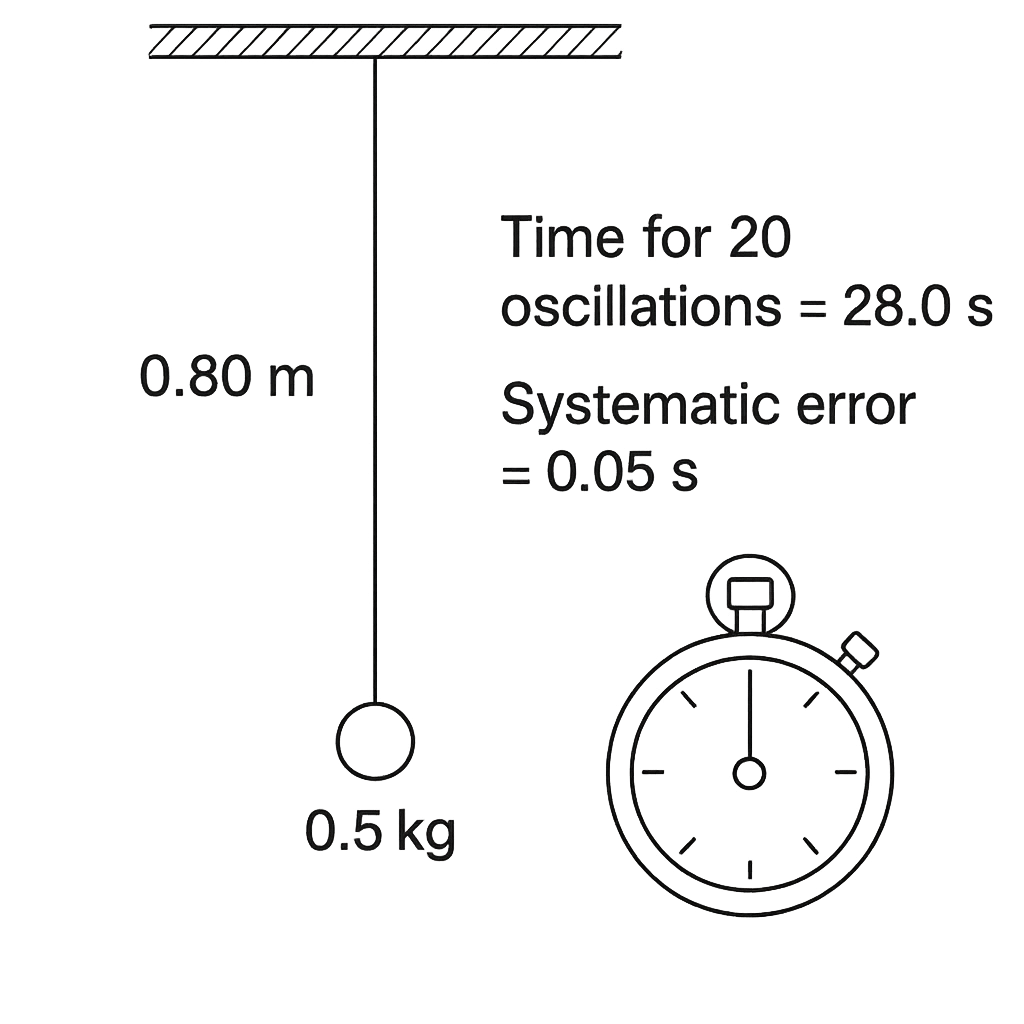
In the laboratory setup shown, a simple pendulum of length \(0.80\ \text{m}\) is suspended from a fixed support. The bob is displaced a small angle and released. A stopwatch is used to time the oscillations. The recorded time for \(20\) complete oscillations is \(28.0\ \text{s}\). The stopwatch gains \(0.05\ \text{s}\) per timing.\n\n(i) Calculate the theoretical period of the pendulum using \(g=9.8\ \text{m s}^{-2}\).\n\n(ii) Determine the corrected period of the pendulum based on the recorded time.
A. Theoretical period = 1.70 s; Corrected period = 1.50 s
B. Theoretical period = 1.85 s; Corrected period = 1.35 s
Correct C. Theoretical period = 1.79 s; Corrected period = 1.40 s
D. Theoretical period = 1.60 s; Corrected period = 1.45 s

Correct Answer: C

Want to see the full step-by-step solution? Unlock AI Explanation & Analytics
Question 11 View Details
A sample contains 2.0 g of isotope X (molar mass \(100\ \text{g·mol}^{-1}\), half‑life \(30\ \text{min}\)) and 3.0 g of isotope Y (molar mass \(150\ \text{g·mol}^{-1}\), half‑life \(2\ \text{h}\)). Both isotopes decay by emitting one particle per decay. At what time after the sample is prepared will the activity of X become one‑third of the activity of Y? Give your answer in minutes (nearest minute).
A. 165
Correct B. 143
C. 130
D. 150

Correct Answer: B

Want to see the full step-by-step solution? Unlock AI Explanation & Analytics
Question 12 View Details
The force-extension graph for a spring is given by the points (0\,cm,\,0\,N), (2\,cm,\,5\,N), (4\,cm,\,12\,N), (6\,cm,\,21\,N) and (8\,cm,\,32\,N). The first two points lie in the linear elastic region.\n\n(a) Determine the spring constant \(k\) from the linear region (in N·m\(^{-1}\)).\n\n(b) Using the trapezoidal rule between successive points, calculate the work done in stretching the spring from 0\,cm to 8\,cm. Give your answer in joules to two decimal places.
A. 1.20
Correct B. 1.08
C. 1.15
D. 0.96

Correct Answer: B

Want to see the full step-by-step solution? Unlock AI Explanation & Analytics
Question 13 View Details
In a pendulum experiment the length of the pendulum is measured with a meter rule (least count 1\,mm) as \(L = 1.000\ \text{m} \pm 0.001\ \text{m}\). The period is measured with a stopwatch (resolution 0.01\,s). Ten trials give an average period \(T = 2.01\ \text{s}\) with a standard deviation of \(0.02\ \text{s}\).\n\nUsing \(g = \dfrac{4\pi^{2}L}{T^{2}}\), calculate the value of \(g\) and its absolute uncertainty, expressing the result as \(g \pm \Delta g\) (to two significant figures). Also state the percentage uncertainty.
Correct A. 9.77 \pm 0.20 m·s^{-2}
B. 9.65 \pm 0.30 m·s^{-2}
C. 9.73 \pm 0.25 m·s^{-2}
D. 9.81 \pm 0.15 m·s^{-2}

Correct Answer: A

Want to see the full step-by-step solution? Unlock AI Explanation & Analytics
Question 14 View Details
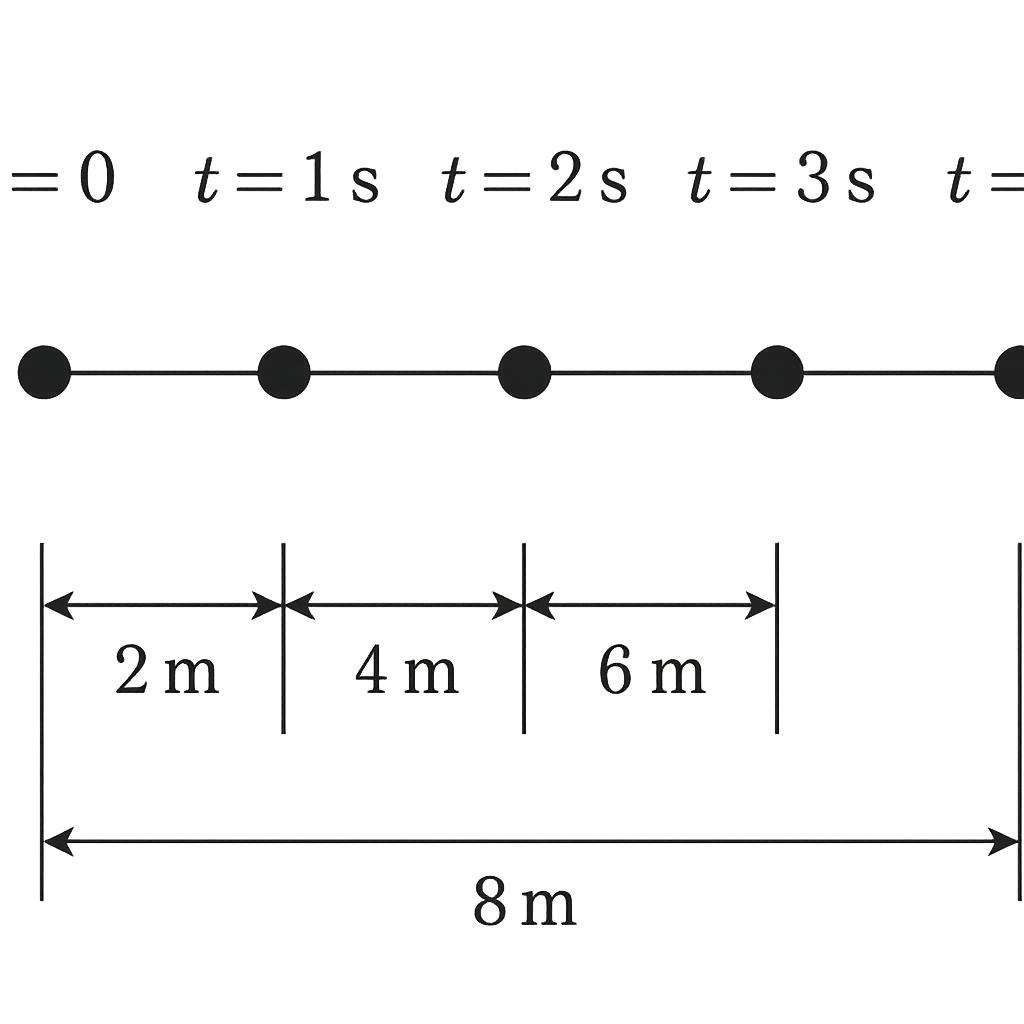
The motion diagram shows a particle moving in a straight line. The positions recorded at successive 1\,s intervals are separated by distances of 2\,m, 4\,m, 6\,m and 8\,m respectively. Assuming the particle moves with constant acceleration, determine the magnitude of the acceleration (in m·s\(^{-2}\)).
A. 4
Correct B. 2
C. 1
D. 3

Correct Answer: B

Want to see the full step-by-step solution? Unlock AI Explanation & Analytics
Question 15 View Details
A crate of weight \(800\ \text{N}\) is pulled up an inclined plane of length \(5.0\ \text{m}\) and height \(2.0\ \text{m}\) at constant speed by a force of magnitude \(500\ \text{N}\) applied parallel to the plane.\n\n(a) Calculate the coefficient of kinetic friction \(\mu_{k}\) between the crate and the plane.\n\n(b) Determine the mechanical efficiency of the inclined plane, defined as the ratio of useful output work (increase in gravitational potential energy) to the input work done by the applied force.
A. μ = 0.30, η = 70%
B. μ = 0.20, η = 55%
C. μ = 0.25, η = 75%
Correct D. μ = 0.25, η = 64%

Correct Answer: D

Want to see the full step-by-step solution? Unlock AI Explanation & Analytics
Question 16 View Details
A sealed container holds an ideal gas at an initial temperature of \(27^{\\circ}C\), pressure \(1.00\\,\\text{atm}\) and volume \(2.0\\,\\text{L}\). The gas is heated until the pressure rises to \(2.5\\,\\text{atm}\) while the volume expands to \(3.5\\,\\text{L}\). What is the final temperature of the gas in degrees Celsius? Give your answer to the nearest whole degree.
A. 950°C
B. 1150°C
Correct C. 1040°C
D. 870°C

Correct Answer: C

Want to see the full step-by-step solution? Unlock AI Explanation & Analytics
Question 17 View Details
In the force diagram shown, a block of mass \(10\\,\\text{kg}\) rests on a rough horizontal surface. A force of magnitude \(50\\,\\text{N}\) is applied at an angle of \(30^{\\circ}\) above the horizontal, pulling the block to the right. The coefficient of static friction between the block and the surface is unknown. Determine the minimum value of the coefficient of static friction \(\\mu_s\) that will keep the block at rest.
A. 0.45
Correct B. 0.59
C. 0.33
D. 0.71

Correct Answer: B

Want to see the full step-by-step solution? Unlock AI Explanation & Analytics
Question 18 View Details
A scuba diver descends to a depth where the absolute pressure is \(3.5\\,\\text{atm}\). At the surface, the diver's air tank contains air at a pressure of \(200\\,\\text{kPa}\) and a volume of \(12\\,\\text{L}\). Assuming the temperature of the air remains constant, what is the volume of the air in the tank at that depth? Give your answer in litres to two decimal places.
A. 6.86
B. 6.79
C. 6.71
Correct D. 6.77

Correct Answer: D

Want to see the full step-by-step solution? Unlock AI Explanation & Analytics
Question 19 View Details
A car travels \(150\\,\\text{km}\) in \(2\) hours \(15\) minutes. Calculate its average speed in metres per second, correct to one decimal place.
A. 19.2
B. 16.7
C. 18.0
Correct D. 18.5

Correct Answer: D

Want to see the full step-by-step solution? Unlock AI Explanation & Analytics
Question 20 View Details
Two quantities of water are mixed in an insulated container. \(200\\,\\text{g}\) of water at \(80^{\\circ}C\) is mixed with \(300\\,\\text{g}\) of water at \(20^{\\circ}C\). Assuming no heat loss to the surroundings and that the specific heat capacity of water is \(4.18\\,\\text{J g}^{-1}\\,\\text{K}^{-1}\), find the final equilibrium temperature of the mixture in degrees Celsius.
A. 48°C
B. 38°C
Correct C. 44°C
D. 42°C

Correct Answer: C

Want to see the full step-by-step solution? Unlock AI Explanation & Analytics
Question 21 View Details
An object (a candle) is placed 18 cm in front of a thin converging lens L1 of focal length \(12\ \text{cm}\). A second thin converging lens L2 is positioned 8 cm to the right of L1. The final image formed by the two‑lens system is located 20 cm to the right of L2 on a screen. Determine the focal length of L2 (in cm).
A. 50
Correct B. 70
C. 60
D. 80

Correct Answer: B

Want to see the full step-by-step solution? Unlock AI Explanation & Analytics
Question 22 View Details
A stationary source S1 emits sound of frequency \(500\ \text{Hz}\) in air where the speed of sound is \(340\ \text{m s}^{-1}\). An observer O moves directly towards S1 with speed \(10\ \text{m s}^{-1}\). At the same instant a second stationary source S2, located 30 m behind O, emits sound of frequency \(480\ \text{Hz}\). The source S2 moves away from O with speed \(5\ \text{m s}^{-1}\). Determine the beat frequency heard by O (in Hz, to one decimal place).
A. 45.5
Correct B. 55.6
C. 60.2
D. 50.0

Correct Answer: B

Want to see the full step-by-step solution? Unlock AI Explanation & Analytics
Question 23 View Details
A particle moves 5.0 m east and then 12.0 m north. Find the magnitude of its resultant displacement (in metres).
A. 15
Correct B. 13
C. 17
D. 7

Correct Answer: B

Want to see the full step-by-step solution? Unlock AI Explanation & Analytics
Question 24 View Details
A car travels at a constant speed of 60 km h\(^{-1}\) for 2.0 h and then at 80 km h\(^{-1}\) for 1.5 h. Calculate (a) the total distance travelled (in km) and (b) the average speed of the whole journey (in km h\(^{-1}\)).
A. 260 km, 74.3 km h^{-1}
B. 240 km, 70.0 km h^{-1}
C. 250 km, 71.4 km h^{-1}
Correct D. 240 km, 68.6 km h^{-1}

Correct Answer: D

Want to see the full step-by-step solution? Unlock AI Explanation & Analytics
Question 25 View Details
An electron in a hydrogen atom drops from the third to the first energy level, emitting a photon. The photon is absorbed by another hydrogen atom, exciting its electron from the ground state (n=1) to the third level (n=3). The excited electron then returns to the ground state via the intermediate level n=2, emitting a photon in the first step (n=3 \(\rightarrow\) n=2). Determine the wavelength of this photon in nanometres, correct to two decimal places.
Correct A. 656.61
B. 486.27
C. 434.05
D. 410.17

Correct Answer: A

Want to see the full step-by-step solution? Unlock AI Explanation & Analytics

Master the Exam!

You've seen a preview, but there are thousands more questions plus AI tutor to break down complex solutions.

Unlock Full Access Available for Android & Windows
Help others prepare! Share this practice hub:
Chat with Support