neco 2022 physics | Essay

Prepare for your exams with neco questions? Reviewing past/model questions is one of the most effective ways to guarantee a high score. This practice hub features authentic 2022 physics (Essay) questions designed to simulate the real exam environment.

Practice these randomly selected questions to test your readiness.
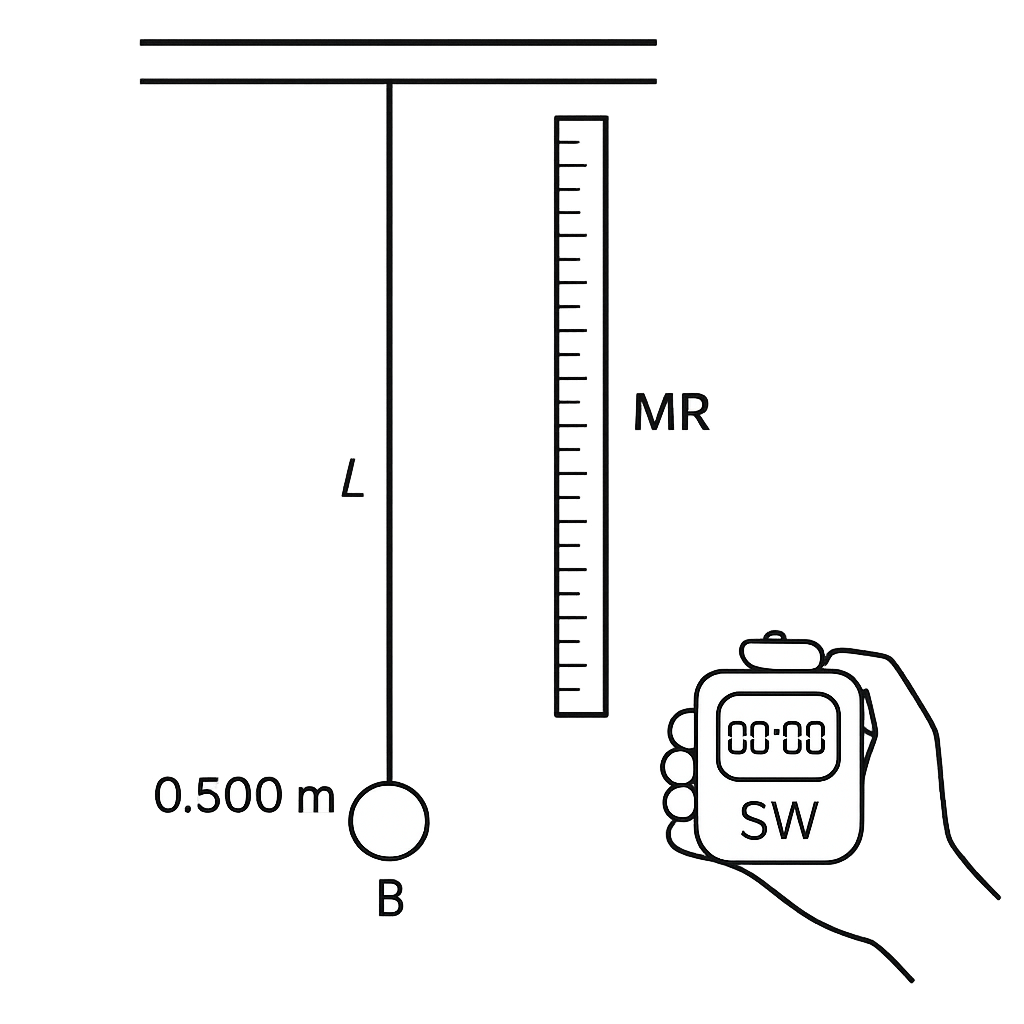
Question 1 View Details
In a physics laboratory, a simple pendulum is set up as shown in the diagram. The bob is a small spherical steel ball of mass 0.200 kg attached to a light inextensible string. The length of the string is measured from the point of suspension to the centre of the bob and recorded as 0.500 m using a meter rule. The period of the pendulum is measured by timing 20 complete oscillations with a digital stopwatch. The recorded time for 20 oscillations is 28.2 s. The ambient temperature is 22°C and the air density may be considered negligible.
Question Parts
(a)
Calculate the average period of one oscillation. Then, using the formula \(T = 2\pi\sqrt{\frac{L}{g}}\), determine the experimental value of the acceleration due to gravity \(g\). Show all steps.
(b)
Determine the percentage error of the experimental \(g\) value obtained in part (a) relative to the accepted value \(9.81\,\text{m\,s}^{-2}\).
(c)
Identify two possible sources of systematic error in this experiment and explain qualitatively how each would affect the calculated value of \(g\) (i.e., cause it to be higher or lower).
Detailed Essay Solution & Marking Scheme Available

Get the step-by-step mathematical proofs, key points required by examiners, and a comprehensive breakdown from our AI Tutor.
Question 2 View Details
A river flows due east at a uniform speed of 3.0 m·s⁻¹. A boat can travel at a speed of 5.0 m·s⁻¹ relative to the water. The river is 200 m wide.
Question Parts
(a)
If the boat heads directly north (perpendicular to the bank), determine the resultant velocity of the boat relative to the ground. Give both the magnitude (in m·s⁻¹) and the direction expressed as the angle east of north (to the nearest degree).
(b)
Using the heading in part (a), calculate the time required for the boat to reach the opposite bank.
(c)
To land directly opposite the starting point on the far bank, the boat must aim upstream at an angle \(\theta\) west of north. Determine the required heading angle \(\theta\) (to the nearest degree) and the time taken to cross the river under this heading.
(d)
Explain qualitatively how an increase in the river’s speed would affect (i) the required heading angle and (ii) the crossing time when the boat aims to land directly opposite its starting point.
Detailed Essay Solution & Marking Scheme Available

Get the step-by-step mathematical proofs, key points required by examiners, and a comprehensive breakdown from our AI Tutor.
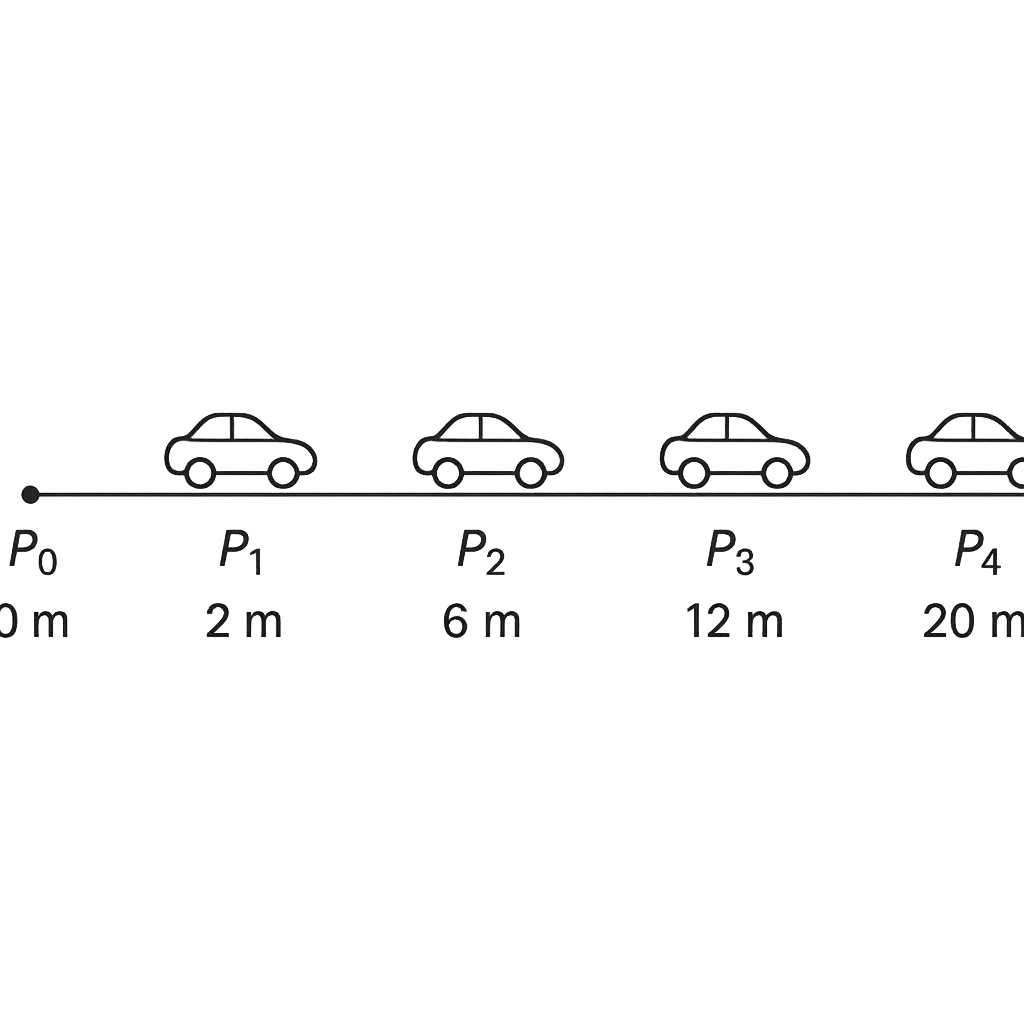
Question 3 View Details
A motion diagram shows a car moving in a straight line. The diagram marks the car's position at equal time intervals of 1 second. The positions are labelled P0, P1, P2, P3 and P4. The distances of these positions from the starting point are 0 m, 2 m, 6 m, 12 m and 20 m respectively.
Question Parts
(a)
Calculate the average velocity of the car between the initial position P0 and the final position P4.
(b)
Assuming the car started from rest and moved with constant acceleration, determine the magnitude of the acceleration.
(c)
Predict the distance of the car from the starting point after 6 seconds under the same constant acceleration.
Detailed Essay Solution & Marking Scheme Available

Get the step-by-step mathematical proofs, key points required by examiners, and a comprehensive breakdown from our AI Tutor.

Question 4 View Details
A 10 kg crate is pulled up a smooth inclined plane that makes an angle of 20° with the horizontal. The pulling force of magnitude 80 N is applied in a direction 30° above the horizontal. The coefficient of kinetic friction between the crate and the plane is 0.15.
Question Parts
(a)
Resolve the pulling force into components parallel and perpendicular to the plane and state their numerical values (to two decimal places).
(b)
Determine the normal reaction exerted by the plane on the crate.
(c)
Calculate the kinetic friction force acting on the crate.
(d)
Find the net force parallel to the plane, the resulting acceleration of the crate, and the work done by the pulling force after the crate has moved 5.0 m up the plane.
Detailed Essay Solution & Marking Scheme Available

Get the step-by-step mathematical proofs, key points required by examiners, and a comprehensive breakdown from our AI Tutor.

Question 5 View Details
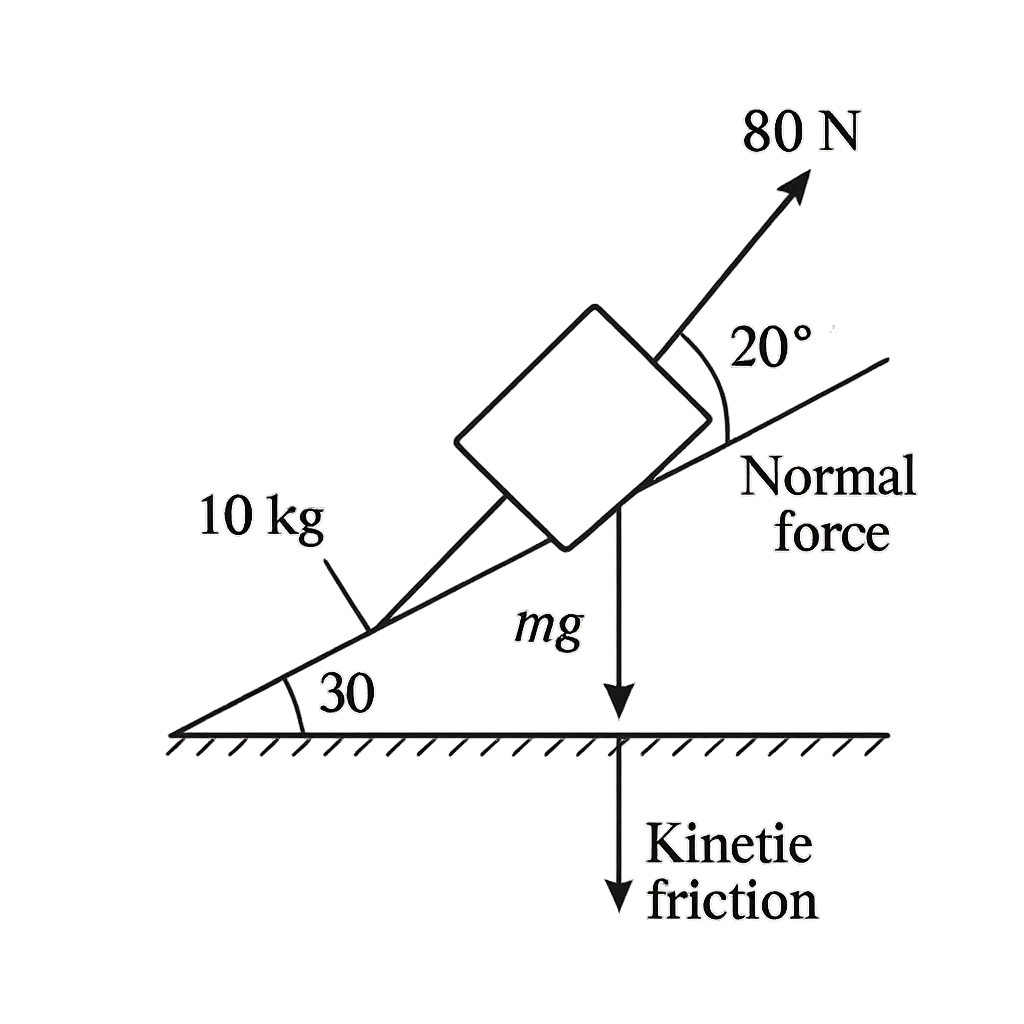
A block of mass 10 kg rests on a rough inclined plane that makes an angle of 30° with the horizontal. The coefficient of kinetic friction between the block and the plane is 0.20. The block is pulled up the plane to the top, a distance of 5.0 m, by a constant force of 80 N acting at an angle of 20° above the plane. The diagram of the situation is provided.
Question Parts
(a)
Calculate the work done by the applied force during the displacement.
(b)
Determine the work done against friction over the same displacement.
(c)
Find the net work done on the block.
(d)
If the block starts from rest, calculate its speed at the top of the incline.
Detailed Essay Solution & Marking Scheme Available

Get the step-by-step mathematical proofs, key points required by examiners, and a comprehensive breakdown from our AI Tutor.

Question 6 View Details
A wheel‑and‑axle system is used to lift a load. The wheel has a radius of 0.40 m and the axle a radius of 0.05 m. An effort of 30 N is applied tangentially to the rim of the wheel. The load attached to the axle is 200 N. Assume the rope does not slip on the wheel or axle.
Question Parts
(a)
For an ideal (frictionless) wheel‑and‑axle:
() Calculate the ideal mechanical advantage (IMA).
() Determine the theoretical load that could be lifted with the given effort.
(b)
In practice the upward force on the load is measured to be 150 N when the same 30 N effort is applied. Calculate the efficiency of the system and give two possible reasons for the loss of efficiency.
(c)
If the wheel radius is increased to 0.60 m while the axle radius remains 0.05 m and the effort stays 30 N, find the new IMA and the theoretical load. Comment briefly on how this change influences the effort required to lift a given load.
Detailed Essay Solution & Marking Scheme Available

Get the step-by-step mathematical proofs, key points required by examiners, and a comprehensive breakdown from our AI Tutor.

Question 7 View Details
A vertical piston-cylinder assembly contains 1.20 mol of an ideal gas at an initial pressure of 1.00 \times 10^5 Pa, a temperature of 300 K and a volume of 2.50 \times 10^{-2} \text{ m}^3. The piston is moved slowly so that the gas is compressed to a final volume of 1.80 \times 10^{-2} \text{ m}^3 while the temperature is raised uniformly to 420 K. The compression follows a polytropic process described by \(PV^{n}=\text{constant}\) with exponent \(n = 1.20\). The cylinder is made of steel whose ultimate tensile strength is 5.0 \times 10^8 \text{ Pa}.\
Question Parts
(a)
Calculate the final pressure of the gas after compression.
(b)
Determine the work done on the gas during this polytropic compression.
(c)
State whether the cylinder can safely contain the gas at the final pressure. Show all reasoning.
Detailed Essay Solution & Marking Scheme Available

Get the step-by-step mathematical proofs, key points required by examiners, and a comprehensive breakdown from our AI Tutor.

Question 8 View Details
A solid cylindrical rod of steel has a length of 0.500 m, a diameter of 20 mm and a density of 7850 kg·m⁻³. The coefficient of linear expansion of steel is \(\alpha = 1.2\times10^{-5}\ \text{K}^{-1}\) and its Young's modulus is \(E = 2.0\times10^{11}\ \text{Pa}\). The rod is fixed at both ends so that it cannot expand when heated. The yield strength of the steel is 250 MPa. The specific heat capacity of steel is 470 J·kg⁻¹·K⁻¹. The rod is placed in a water bath at 25°C and heated uniformly. The convective heat‑transfer coefficient between the rod surface and the water is \(h = 150\ \text{W·m}^{-2}\text{K}^{-1}\). Assume the water temperature remains constant at 25°C throughout the heating process.
Question Parts
(a)
Derive the expression for the thermal stress developed in the rod when its temperature is raised by \(\Delta T\) while the ends remain fixed.
(b)
Calculate the temperature increase \(\Delta T_{yield}\) that would cause the thermal stress to reach the yield strength of the steel.
(c)
Determine the amount of heat energy \(Q\) required to raise the temperature of the rod by \(\Delta T_{yield}\).
(d)
If the rod is heated only by convection from the water bath, estimate the time required to supply the heat \(Q\) calculated in part (c). Assume the entire lateral surface of the rod participates in convection and neglect heat loss from the ends.
Detailed Essay Solution & Marking Scheme Available

Get the step-by-step mathematical proofs, key points required by examiners, and a comprehensive breakdown from our AI Tutor.

Master the Exam!

You've seen a preview, but there are thousands more questions plus AI tutor to break down complex solutions.

Unlock Full Access Available for Android & Windows
Help others prepare! Share this practice hub:
Chat with Support