neco 2022 mathematics | Essay

Prepare for your exams with neco questions? Reviewing past/model questions is one of the most effective ways to guarantee a high score. This practice hub features authentic 2022 mathematics (Essay) questions designed to simulate the real exam environment.

Practice these randomly selected questions to test your readiness.

Question 1 View Details
A positive integer N leaves a remainder of 5 when divided by 7, a remainder of 2 when divided by 9 and a remainder of 8 when divided by 11. Determine the smallest such N.
Detailed Essay Solution & Marking Scheme Available

Get the step-by-step mathematical proofs, key points required by examiners, and a comprehensive breakdown from our AI Tutor.
Question 2 View Details
A solution contains 30% acid by volume. To increase the concentration to 45% without changing the total volume, a certain amount of the original solution is removed and replaced with pure acid. What fraction of the original solution must be removed and replaced? Express your answer as a simplified fraction and as a percentage (to one decimal place).
Detailed Essay Solution & Marking Scheme Available

Get the step-by-step mathematical proofs, key points required by examiners, and a comprehensive breakdown from our AI Tutor.
Question 3 View Details
A certain bacteria culture triples every 4 hours. Initially there are 500 bacteria.
Question Parts
(a)
Write an expression for the number of bacteria after \(t\) hours in terms of \(t\).
(b)
Determine, to the nearest hour, the time required for the culture to reach 40,500 bacteria.
(c)
Simplify the expression \(\dfrac{2^{3/2}\times 8^{1/3}}{\sqrt{32}}\) and give the result in its simplest form.
Detailed Essay Solution & Marking Scheme Available

Get the step-by-step mathematical proofs, key points required by examiners, and a comprehensive breakdown from our AI Tutor.

Question 4 View Details
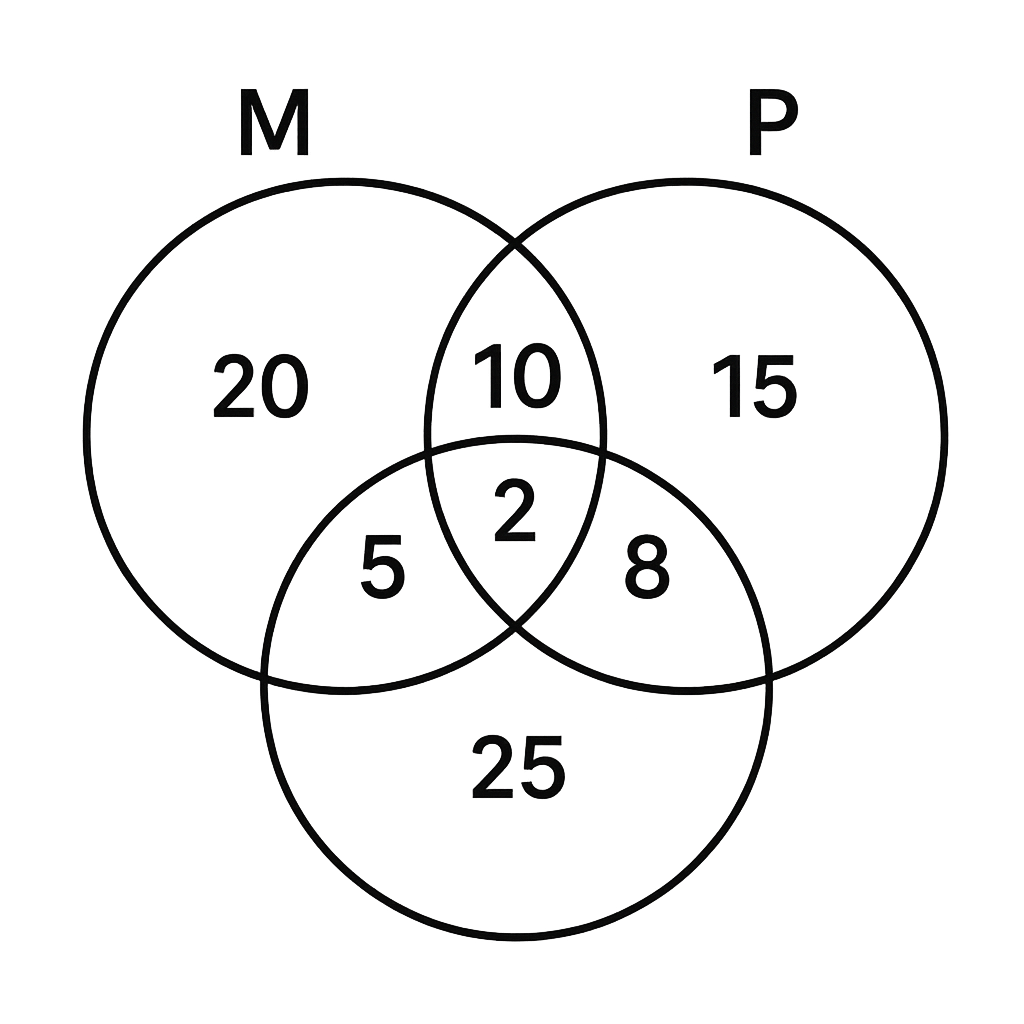
The Venn diagram below shows the number of senior secondary students who study Mathematics (M), Physics (P) and Chemistry (C).
Question Parts
(a)
How many students study only Mathematics?
(b)
How many students study at least two of the three subjects?
(c)
If the total number of students surveyed is 120, how many study none of the three subjects?
Detailed Essay Solution & Marking Scheme Available

Get the step-by-step mathematical proofs, key points required by examiners, and a comprehensive breakdown from our AI Tutor.

Question 5 View Details
A cubic polynomial is given by \(P(x)=3x^{3}-kx^{2}+12x-8\). It is known that \(P(x)\) is exactly divisible by \((x-2)\).\n\nAnswer the following:
Question Parts
(a)
Find the value of \(k\).
(b)
Factorise \(P(x)\) completely over the real numbers.
(c)
Using the factorisation obtained, determine the sum of the remaining two (possibly complex) roots of \(P(x)=0\).
Detailed Essay Solution & Marking Scheme Available

Get the step-by-step mathematical proofs, key points required by examiners, and a comprehensive breakdown from our AI Tutor.

Question 6 View Details
Solve the rational equation \(\dfrac{2x-5}{x+3}=\dfrac{x-1}{x-2}\). Then, for each solution obtained, evaluate the expression \(3x^{2}-5x+2\).
Question Parts
(a)
Find all real values of \(x\) that satisfy the equation.
Detailed Essay Solution & Marking Scheme Available

Get the step-by-step mathematical proofs, key points required by examiners, and a comprehensive breakdown from our AI Tutor.

Question 7 View Details
A company manufactures a product and its profit P (in thousands of naira) from selling x (in hundreds of units) is given by \(P(x) = -2x^{2} + 120x - 1000\).
Question Parts
(a)
Find the number of hundreds of units that will give the maximum profit.
(b)
State the maximum profit (in thousands of naira).
(c)
Determine the break‑even points, i.e. the values of x for which the profit is zero.
Detailed Essay Solution & Marking Scheme Available

Get the step-by-step mathematical proofs, key points required by examiners, and a comprehensive breakdown from our AI Tutor.

Question 8 View Details
A rectangular field is to be fenced using 100 metres of fencing. Let x metres be the length of the side parallel to the fence that will be used for a barn, leaving the remaining three sides to be fenced. The area A (in square metres) of the field is given by \(A = x(100-2x)\).
Question Parts
(a)
Form the inequality that expresses the condition that the area exceeds 1200 m\(^2\).
(b)
Solve the inequality to obtain the range of permissible values of x.
(c)
List all integer values of x (in metres) that satisfy the condition.
Detailed Essay Solution & Marking Scheme Available

Get the step-by-step mathematical proofs, key points required by examiners, and a comprehensive breakdown from our AI Tutor.

Question 9 View Details
The sum of the first three terms of a geometric progression (GP) is 21 and the sum of the first five terms is 93.
Question Parts
(a)
Find the common ratio \(r\) of the GP ( \(r \neq 1\) ).
(b)
Determine the first term \(a\) of the GP.
(c)
Calculate the sum of the first six terms of the GP.
Detailed Essay Solution & Marking Scheme Available

Get the step-by-step mathematical proofs, key points required by examiners, and a comprehensive breakdown from our AI Tutor.

Question 10 View Details
In a physics experiment the time \(T\) (in seconds) taken by a particle to travel a distance \(s\) (in metres) under a constant force \(F\) (in newtons) is directly proportional to the square root of the distance and inversely proportional to the cube root of the force.
Question Parts
(a)
Write the mathematical relationship between \(T\), \(s\) and \(F\) in the form \(T = k\,\frac{\sqrt{s}}{\sqrt[3]{F}}\), where \(k\) is the constant of proportionality.
(b)
When a force of \(8\) N is applied, the particle travels \(27\) m in \(6\) s. Determine the value of the constant \(k\).
(c)
Using the value of \(k\) found above, calculate the time required for the particle to travel \(125\) m when a force of \(27\) N is applied.
(d)
If the particle must travel \(125\) m in exactly \(4\) s, what magnitude of force \(F\) (in newtons) must be applied? Give your answer correct to two decimal places.
Detailed Essay Solution & Marking Scheme Available

Get the step-by-step mathematical proofs, key points required by examiners, and a comprehensive breakdown from our AI Tutor.

Question 11 View Details
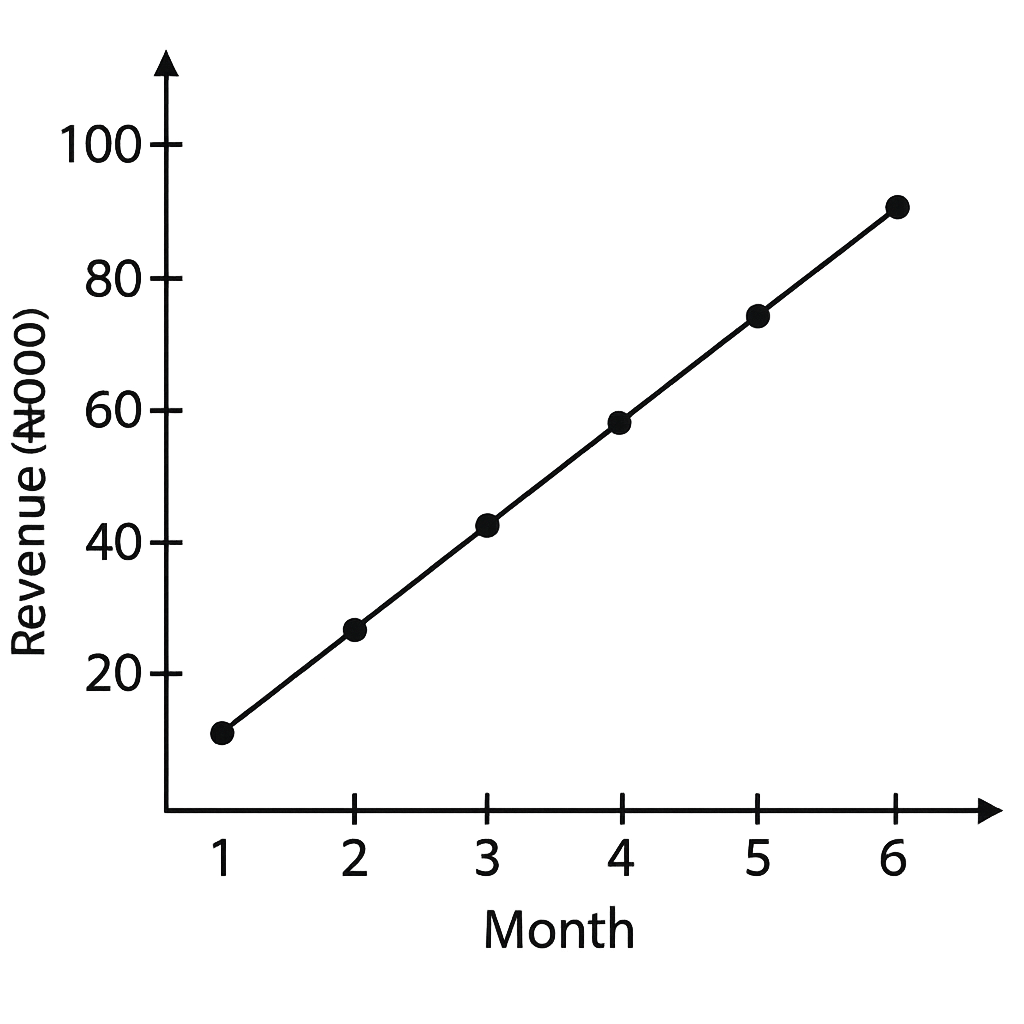
The graph below shows the monthly revenue (in thousands of naira) of a small business over six months.
Question Parts
(a)
Calculate the average rate of change of the revenue between month 2 and month 5. Express your answer in thousands of naira per month.
(b)
Assuming the revenue continues to increase linearly at the same rate as observed between month 4 and month 6, estimate the revenue for month 7.
(c)
Approximate the total revenue earned over the six months by using the trapezoidal rule on the graph. Give your answer to the nearest thousand naira.
(d)
From month 6 onward the business intends to increase its revenue by 20 % each month. (i) Write a general expression for the revenue in month \(n\) (where \(n\ge 6\)). (ii) Using this expression, calculate the expected revenue in month 9.
() Write the general expression for revenue in month \(n\).
() Calculate the revenue for month 9 using the expression.
Detailed Essay Solution & Marking Scheme Available

Get the step-by-step mathematical proofs, key points required by examiners, and a comprehensive breakdown from our AI Tutor.

Question 12 View Details
In the diagram, triangle ABC is shown. \(\angle A = 40^{\circ}\), \(\angle B = 70^{\circ}\) and side \(AB = 8\) cm.
Question Parts
(a)
Place point \(A\) at the origin \((0,0)\) and side \(AB\) on the positive \(x\)-axis. Determine the coordinates of point \(C\) (to two decimal places).
(b)
Using the coordinates found in part (a), calculate the length of the altitude from \(C\) to side \(AB\).
(c)
Find the area of triangle \(ABC\) using coordinate geometry and verify that it equals the area obtained from the formula \(\frac12 ab\sin C\).
Detailed Essay Solution & Marking Scheme Available

Get the step-by-step mathematical proofs, key points required by examiners, and a comprehensive breakdown from our AI Tutor.

Question 13 View Details
In triangle \(ABC\) the following are given: \(\angle A = 40^{\circ}\), \(\angle B = 70^{\circ}\) and side \(AB = 8\) cm. Point \(D\) lies on side \(BC\) such that \(BD:DC = 1:2\).
Question Parts
(a)
Find the length of side \(AC\).
(b)
Determine the length of side \(BC\) (give your answer to two decimal places).
(c)
Point \(D\) divides \(BC\) in the ratio \(BD:DC = 1:2\). Find:
() The length of \(AD\) (to two decimal places).
() The area of \(\triangle ABC\) (to two decimal places).
() The radius of the circumcircle of \(\triangle ABC\) (to two decimal places).
Detailed Essay Solution & Marking Scheme Available

Get the step-by-step mathematical proofs, key points required by examiners, and a comprehensive breakdown from our AI Tutor.

Master the Exam!

You've seen a preview, but there are thousands more questions plus AI tutor to break down complex solutions.

Unlock Full Access Available for Android & Windows
Help others prepare! Share this practice hub:
Chat with Support