neco 2022 biology | Essay

Prepare for your exams with neco questions? Reviewing past/model questions is one of the most effective ways to guarantee a high score. This practice hub features authentic 2022 biology (Essay) questions designed to simulate the real exam environment.

Practice these randomly selected questions to test your readiness.
Question 1 View Details
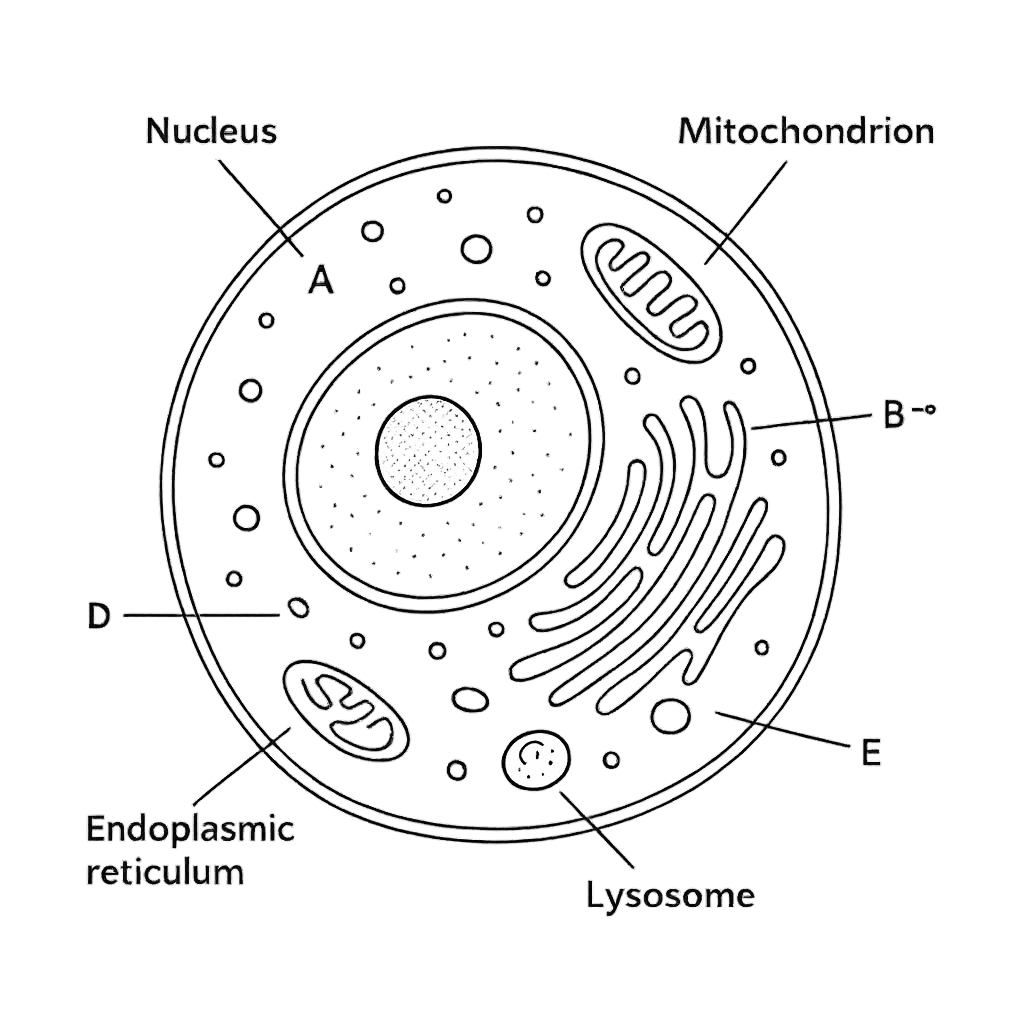
The diagram shows an animal cell with several labelled structures (A–G).
Question Parts
(a)
Identify the structures labelled A, B and C in the diagram.
(b)
State the primary function of each identified structure.
(c)
Explain how the selective permeability of the cell membrane contributes to cellular homeostasis.
Detailed Essay Solution & Marking Scheme Available

Get the step-by-step mathematical proofs, key points required by examiners, and a comprehensive breakdown from our AI Tutor.
Question 2 View Details
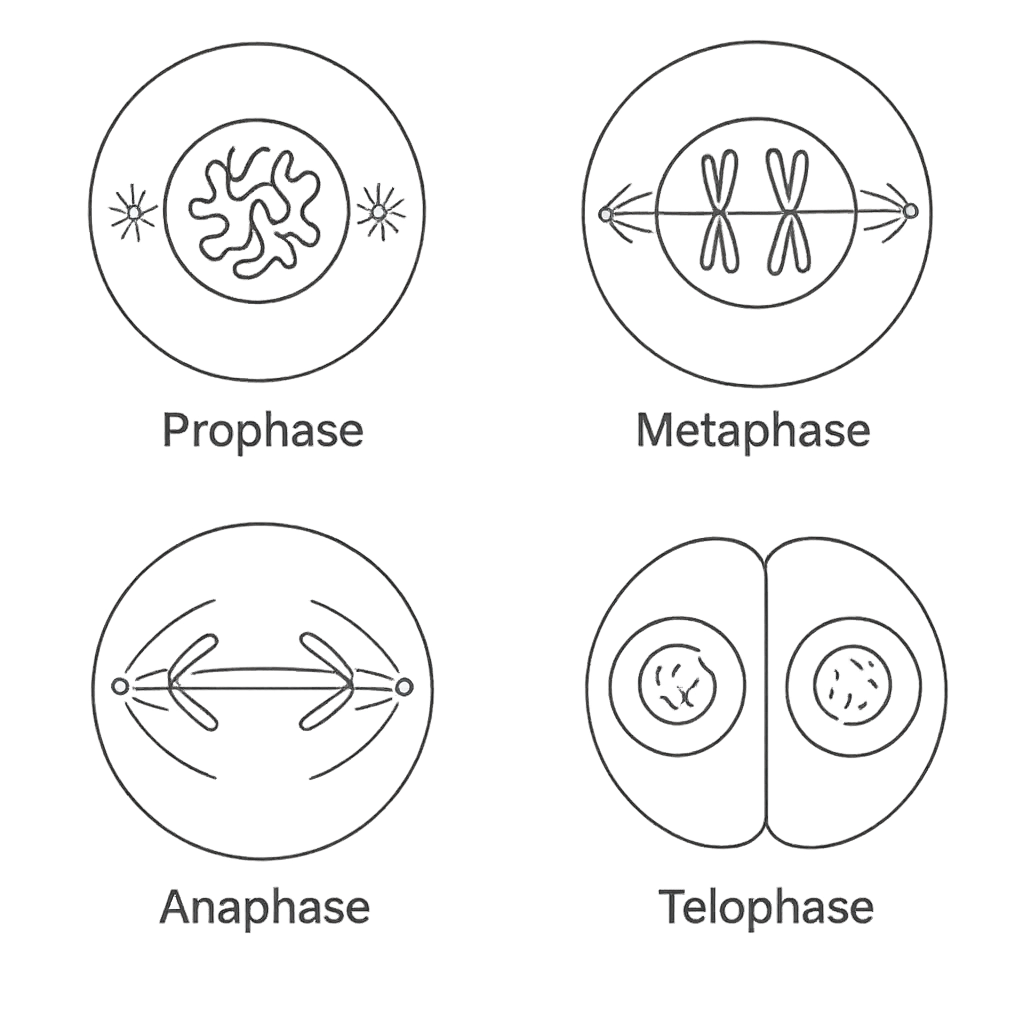
The illustration depicts a cell undergoing mitosis with four labelled stages (A–D).
Question Parts
(a)
List the stages of mitosis in the correct order, using the labels shown in the diagram.
(b)
State one key event that characterises each stage of mitosis.
() Prophase – ...
() Metaphase – ...
() Anaphase – ...
() Telophase – ...
(c)
Discuss why mitosis results in daughter cells that have the same chromosome number as the parent cell.
Detailed Essay Solution & Marking Scheme Available

Get the step-by-step mathematical proofs, key points required by examiners, and a comprehensive breakdown from our AI Tutor.
Question 3 View Details
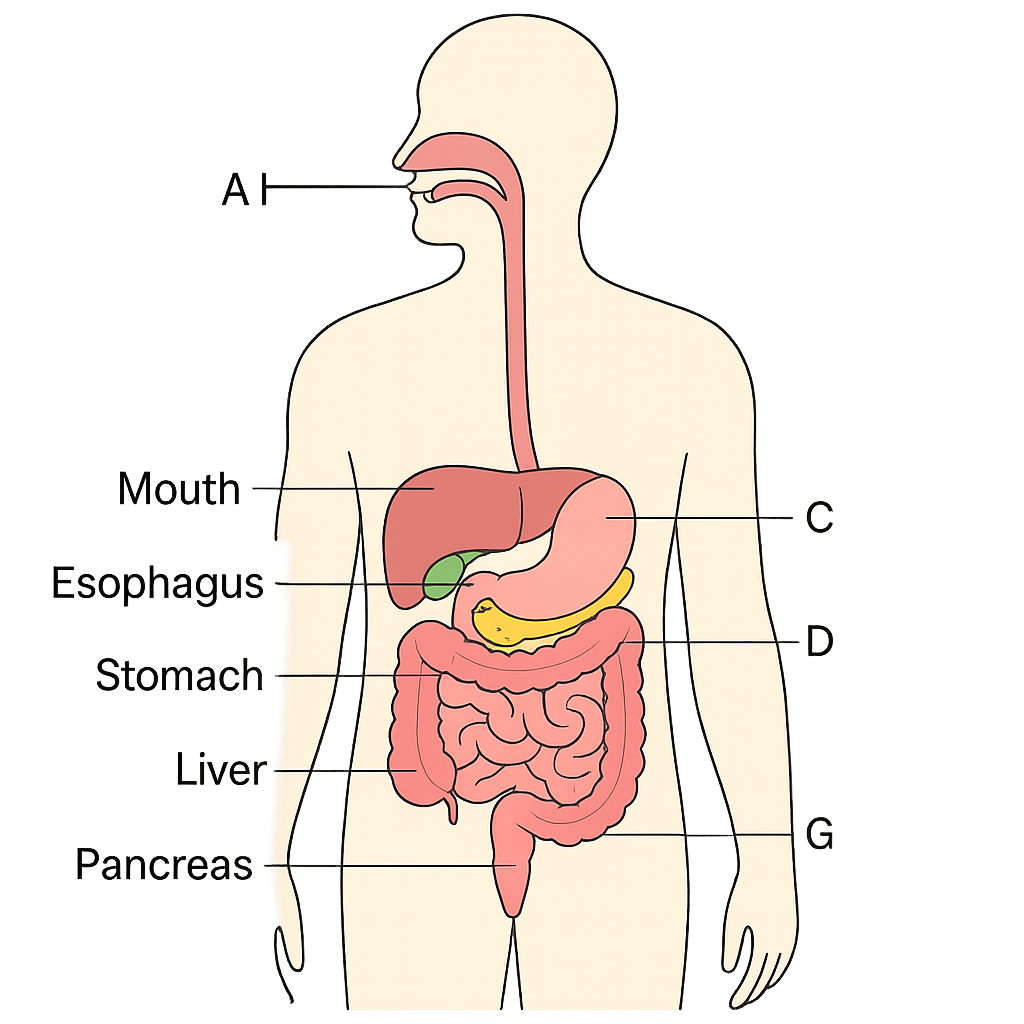
The diagram shows the human digestive system with its major organs labelled A–H.
Question Parts
(a)
Identify the organ labelled C and describe its role in both mechanical and chemical digestion.
(b)
Explain how the enzymes secreted by the organ labelled G (pancreas) aid digestion in the small intestine. Include at least three enzymes and the nutrients they act upon.
(c)
Discuss the importance of the organ labelled E in water absorption and formation of faeces. State two possible health problems that may arise if this organ is impaired.
(d)
Using the diagram, trace the pathway of a bolus of food from ingestion to elimination, naming each labelled organ it passes through and the main function performed at each stage.
Detailed Essay Solution & Marking Scheme Available

Get the step-by-step mathematical proofs, key points required by examiners, and a comprehensive breakdown from our AI Tutor.
Question 4 View Details
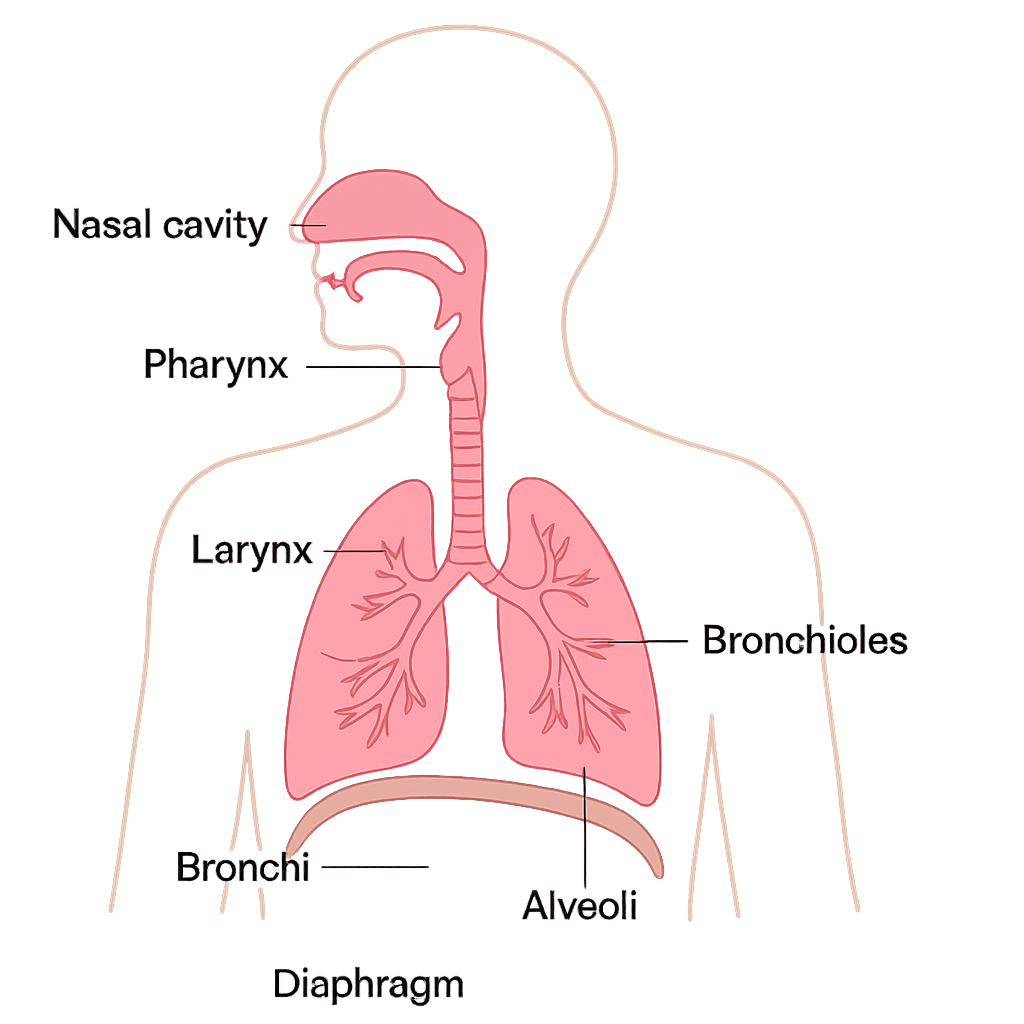
The labelled diagram shows the major structures of the human respiratory system.
Question Parts
(a)
Identify any three structures shown in the diagram and state one specific function of each.
(b)
Explain the process of external respiration, describing (i) the mechanical events that move air into the lungs and (ii) how oxygen and carbon dioxide are exchanged between the alveoli and the blood.
(c)
The following data are given for an adult at rest: - Diffusion coefficient for O₂ (D) = 2.0 × 10⁻⁵ cm²·s⁻¹ - Total alveolar surface area (A) = 70 000 cm² - Thickness of the alveolar‑capillary membrane (T) = 5.0 × 10⁻⁵ cm - Partial pressure difference for O₂ between alveolus and blood (ΔP) = 100 mmHg Using Fick’s law of diffusion (\(Rate = \frac{D \times A \times \Delta P}{T}\)), calculate the theoretical rate of O₂ diffusion (in cm³·s⁻¹). Then state whether this rate is sufficient to meet the average resting oxygen demand of 250 mL·min⁻¹. Show all steps and reasoning.
Detailed Essay Solution & Marking Scheme Available

Get the step-by-step mathematical proofs, key points required by examiners, and a comprehensive breakdown from our AI Tutor.
Question 5 View Details
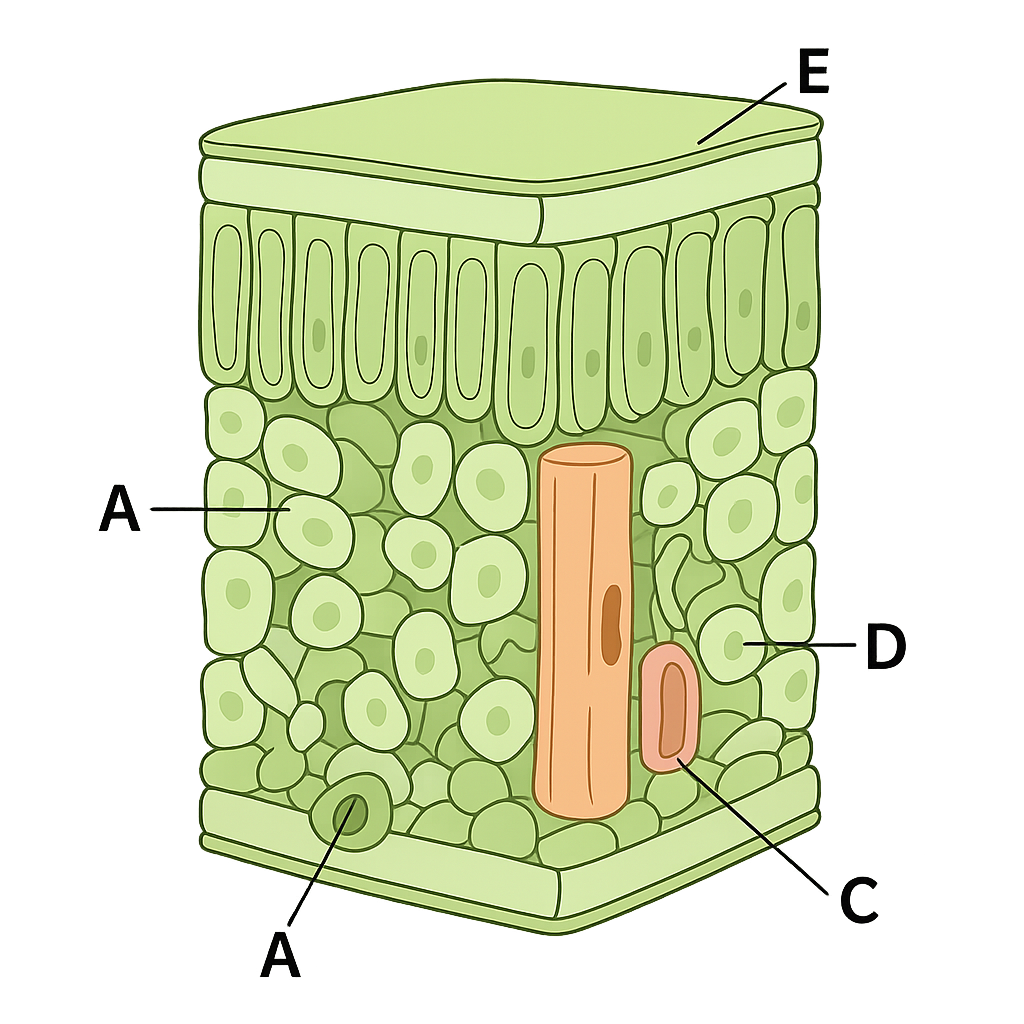
The diagram shows a cross‑section of a dicot leaf with several structures labelled.
Question Parts
(a)
Identify each labelled part (A, B, C, D, E) in the diagram and state its primary function related to transport in plants.
(b)
Using the labelled structures, describe the continuous pathway that water follows from the root to the site of evaporation in the leaf.
(c)
In a controlled experiment a leaf of area 25 cm² loses water at a rate of 0.45 mg cm⁻² h⁻¹ under the given conditions. Calculate the total mass of water lost from the leaf in 3 hours. Show all steps.
(d)
Discuss two environmental factors that could affect the rate of transpiration and explain how each factor influences the process.
Detailed Essay Solution & Marking Scheme Available

Get the step-by-step mathematical proofs, key points required by examiners, and a comprehensive breakdown from our AI Tutor.
Question 6 View Details
The human kidney plays a vital role in maintaining body‑fluid homeostasis.
Question Parts
(a)
Describe the structure of a nephron and state the function of each segment in the formation of urine.
(b)
Explain how antidiuretic hormone (ADH) influences water reabsorption in the collecting duct, including the cellular mechanism involved.
Detailed Essay Solution & Marking Scheme Available

Get the step-by-step mathematical proofs, key points required by examiners, and a comprehensive breakdown from our AI Tutor.

Question 7 View Details
A mountaineer ascends to an altitude of 4,500 metres where the ambient temperature is consistently below 5 °C. Despite the cold environment, his core body temperature remains near normal. Discuss the homeostatic mechanisms that enable the maintenance of core temperature in this situation.
Question Parts
(a)
Explain how negative feedback operates in the regulation of body temperature, identifying the key components of the control system.
(b)
Describe two physiological responses that the mountaineer’s body employs to conserve heat and generate additional heat.
(c)
Predict the changes that would occur in the mountaineer’s body if the hypothalamic set‑point were raised by 1 °C (as in a fever).
(d)
Propose a practical experiment to test whether prolonged exposure to cold (acclimatization) improves the mountaineer’s cold‑tolerance. Include the hypothesis, variables, method and the type of data to be recorded.
Detailed Essay Solution & Marking Scheme Available

Get the step-by-step mathematical proofs, key points required by examiners, and a comprehensive breakdown from our AI Tutor.

Question 8 View Details
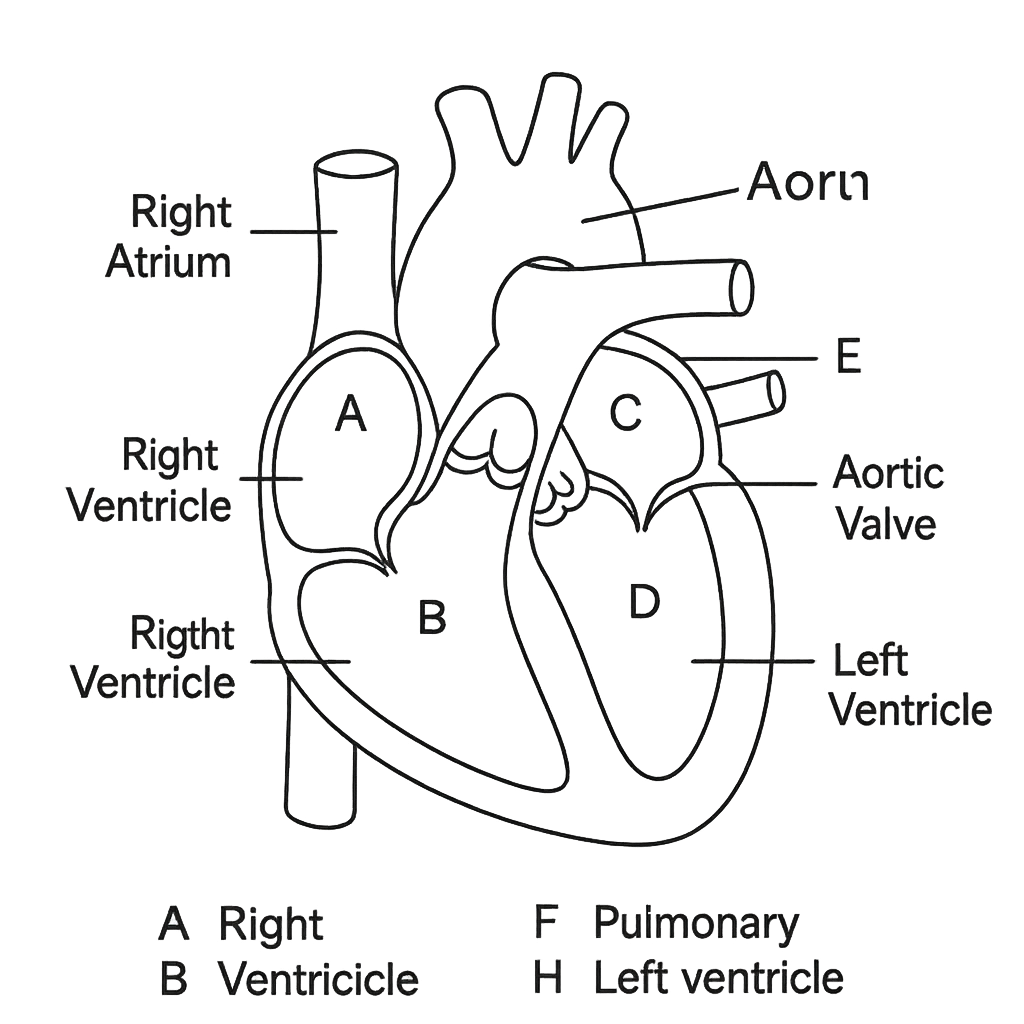
The diagram shows a labelled schematic of the human heart and the major blood vessels involved in systemic and pulmonary circulation.
Question Parts
(a)
Identify the structures labelled in the diagram:
() Right Atrium
() Right Ventricle
() Aortic Valve
() Pulmonary Trunk (Pulmonary Artery)
(b)
Describe the complete pathway of a drop of blood that enters the right atrium from the systemic circulation and returns to the left atrium, naming each chamber and vessel it passes through in the correct order.
(c)
Explain how the heart rate is increased during moderate exercise, mentioning the roles of the autonomic nervous system and any hormones involved.
(d)
A person’s resting heart rate is 70 beats per minute (bpm). During moderate exercise it rises to 115 bpm. Calculate the percentage increase in heart rate. Show your working.
Detailed Essay Solution & Marking Scheme Available

Get the step-by-step mathematical proofs, key points required by examiners, and a comprehensive breakdown from our AI Tutor.

Master the Exam!

You've seen a preview, but there are thousands more questions plus AI tutor to break down complex solutions.

Unlock Full Access Available for Android & Windows
Help others prepare! Share this practice hub:
Chat with Support