neco 2022 agricultural_science | Objective

Prepare for your exams with neco questions? Reviewing past/model questions is one of the most effective ways to guarantee a high score. This practice hub features authentic 2022 agricultural_science (Objective) questions designed to simulate the real exam environment.

Practice these randomly selected questions to test your readiness.

Question 1 View Details
The farmer plans to grow maize. Fixed costs are N30,000 and the variable cost is N12 per kg. If he sells in the open market the price is N20 per kg. A buyer offers a contract: if the farmer sells at least 2,500 kg, the price becomes N22 per kg for all the produce; otherwise the price remains N20. The profit can be expressed as \( \text{Profit}= (P - 12)Q - 30{,}000 \) where \(P\) is the selling price per kg and \(Q\) is the quantity produced (kg). Determine the minimum quantity of maize (in kg) the farmer must produce to earn at least N10,000 profit, and state which selling arrangement (contract or open market) should be chosen.
A. 4,000 kg (open market)
B. 5,000 kg (open market)
C. 3,500 kg (contract)
Correct D. 4,000 kg (contract)

Correct Answer: D

Want to see the full step-by-step solution? Unlock AI Explanation & Analytics
Question 2 View Details
A farmer has 1,200 mango trees. Initially 8\% of the trees are infected by a fungal disease. A fungicide application reduces the number of infected trees by 60\% of the current infected trees. Each application costs N150 per hectare, and each hectare contains 100 trees. After each application, 5\% of the remaining healthy trees become newly infected. The farmer can apply the fungicide at most two times. Assuming both applications are made, calculate the expected number of healthy trees after the second application (round to the nearest whole tree) and the total cost of the fungicide.
A. 1,104 healthy trees; total cost N3,600
B. 1,103 healthy trees; total cost N3,000
Correct C. 1,103 healthy trees; total cost N3,600
D. 1,098 healthy trees; total cost N3,600

Correct Answer: C

Want to see the full step-by-step solution? Unlock AI Explanation & Analytics
Question 3 View Details
An agricultural extension officer must schedule four training sessions (A, B, C, D) over two consecutive weeks (Monday to Friday each week). Each session occupies one half‑day slot. The constraints are: (i) Session A must be scheduled before session C; (ii) Sessions B and D cannot be on the same calendar day; (iii) No more than two sessions may be scheduled on any single day; (iv) In each week there must be at least one session on Crop Management (sessions A or B) and at least one session on Livestock Management (sessions C or D). How many distinct valid schedules are possible?
Correct A. 1,440
B. 1,200
C. 1,680
D. 1,560

Correct Answer: A

Want to see the full step-by-step solution? Unlock AI Explanation & Analytics
Question 4 View Details
A soil sample has a bulk density of 1.3\,g\,cm\(^{-3}\) and a porosity of 48\%. Assuming a particle density of 2.65\,g\,cm\(^{-3}\), field capacity (by weight) can be estimated as \( \text{FC}= \text{porosity}\times\left(1-\frac{\text{bulk density}}{\text{particle density}}\right) \). Calculate the field capacity as a percentage (to one decimal place).
Correct A. 24.5\%
B. 22.8\%
C. 26.3\%
D. 28.5\%

Correct Answer: A

Want to see the full step-by-step solution? Unlock AI Explanation & Analytics
Question 5 View Details
The draft force required to pull a plough through loamy soil is given by \( D = a + b v^{2} \) (newtons), where \( a = 150 \) N, \( b = 20 \) N·s\(^{2}\) m\(^{-2}\) and \( v \) is the tractor speed in metres per second. The tractor can deliver a maximum draw‑bar power of 12 kW. Determine the greatest speed (in m\,s\(^{-1}\)) at which the tractor can operate without exceeding the power limit. Give your answer to two decimal places.
A. 9.03
Correct B. 8.14
C. 7.92
D. 8.56

Correct Answer: B

Want to see the full step-by-step solution? Unlock AI Explanation & Analytics
Question 6 View Details
A farmer keeps \(120\) goats. Without vaccination a disease causes a \(5\%\) annual mortality. A vaccine costs ₦150 per goat and reduces mortality to \(0.5\%\). Each healthy goat is worth ₦30,000. Should the farmer vaccinate the whole herd? State the net monetary benefit (or loss) of vaccinating.
A. Yes, saves ₦120,000
B. No, loses ₦30,000
C. Yes, saves ₦150,000
Correct D. Yes, saves ₦144,000

Correct Answer: D

Want to see the full step-by-step solution? Unlock AI Explanation & Analytics
Question 7 View Details
An extension officer has a budget of ₦2,000,000 to organise training workshops for three crops: maize, cassava and soybean. Each workshop incurs a fixed cost of ₦200,000 plus a variable cost per attending farmer of ₦5,000 for maize, ₦4,000 for cassava and ₦6,000 for soybean. Each farmer can attend only one workshop. The officer must train at least 150 farmers in total and at least 40 % of the trainees must be soybean farmers. What is the maximum number of cassava farmers that can be trained while satisfying the budget and the other constraints?
A. 165
B. 180
Correct C. 173
D. 190

Correct Answer: C

Want to see the full step-by-step solution? Unlock AI Explanation & Analytics
Question 8 View Details
A maize field of 5 ha is being monitored for stem borer. The economic injury level (EIL) is given by \( \text{EIL} = \dfrac{C}{V \times D \times K} \) where \(C = ₦12{,}000\) per ha (cost of control), \(V = ₦30\) per kg (market value of maize), \(D = 0.02\) kg loss per insect, and \(K = 0.8\) (control efficacy). The farmer samples 200 plants and finds 3 insects per 10 plants. Assuming a planting density of 60 000 plants per ha, should control be applied? Answer "Yes" if the observed density exceeds the EIL (in insects per plant), otherwise answer "No".
A. Yes (apply)
Correct B. No
C. Yes
D. Yes, control needed

Correct Answer: B

Want to see the full step-by-step solution? Unlock AI Explanation & Analytics
Question 9 View Details
A dairy farmer is comparing two breeds of cows. Breed A produces 22 L of milk per day and consumes 25 kg of dry matter (DM) feed per day. Breed B produces 18 L of milk per day and consumes 20 kg DM per day. Feed costs ₦150 per kg DM and milk sells for ₦120 per litre. Which breed gives the higher net profit per cow per day? State the breed and the net profit (or loss) in naira.
A. Breed A (profit of ₦1110 per day)
B. Breed A (loss of ₦1110 per day)
C. Breed B (profit of ₦840 per day)
Correct D. Breed B (loss of ₦840 per day)

Correct Answer: D

Want to see the full step-by-step solution? Unlock AI Explanation & Analytics
Question 10 View Details
Soil in a field has a pH of 5.2. To raise the pH to 6.5, the lime requirement is 2.5 tonnes per hectare for each pH unit increase. How many tonnes of lime are required per hectare to achieve the target pH?
Correct A. 3.25 tonnes per ha
B. 3.3 tonnes per ha
C. 2.5 tonnes per ha
D. 3.75 tonnes per ha

Correct Answer: A

Want to see the full step-by-step solution? Unlock AI Explanation & Analytics
Question 11 View Details
A \(5\)-hectare farm has \(40\%\) of its area planted with soybeans that fix nitrogen at a rate of \(45\) kg N per hectare per year. Calculate the total amount of nitrogen fixed by the soybeans in one year.
A. 75
B. 180
Correct C. 90
D. 45

Correct Answer: C

Want to see the full step-by-step solution? Unlock AI Explanation & Analytics
Question 12 View Details
A farmer grows maize. Fixed costs are N30,000 per season. Variable cost is N6,000 per hectare. Expected yield is 4 tonnes per hectare and the selling price is N2,500 per tonne. Let \(x\) be the number of hectares planted. (a) What is the minimum area \(x\) (in hectares) required to break even? (b) How many hectares must be planted to achieve a profit of N20,000?
A. Break‑even: 7.0 ha; Profit target: 12.0 ha
Correct B. Break‑even: 7.5 ha; Profit target: 12.5 ha
C. Break‑even: 8.0 ha; Profit target: 13.0 ha
D. Break‑even: 6.0 ha; Profit target: 10.0 ha

Correct Answer: B

Want to see the full step-by-step solution? Unlock AI Explanation & Analytics
Question 13 View Details
A farmer harvests 2,000 kg of fresh cassava roots with an initial moisture content of 60 % (wet basis). The desired moisture content for storage is 20 % (wet basis). During drying the moisture content \(W\) (in %) follows \( W = W_{0} e^{-kt} \) where \(W_{0}=60\), \(k=0.15\ \text{day}^{-1}\) and \(t\) is the drying time in days. (a) Determine the number of days required to reach the target moisture content. (b) Calculate the final weight of the dried cassava at that moisture level. (c) If the dried cassava can be sold at N5 per kilogram, what is the gross revenue?
Correct A. a) 7.3 days (approx); b) 1,000 kg; c) N5,000
B. a) 5.2 days (approx); b) 800 kg; c) N4,000
C. a) 9.1 days (approx); b) 1,200 kg; c) N6,000
D. a) 6.0 days (approx); b) 950 kg; c) N4,750

Correct Answer: A

Want to see the full step-by-step solution? Unlock AI Explanation & Analytics
Question 14 View Details
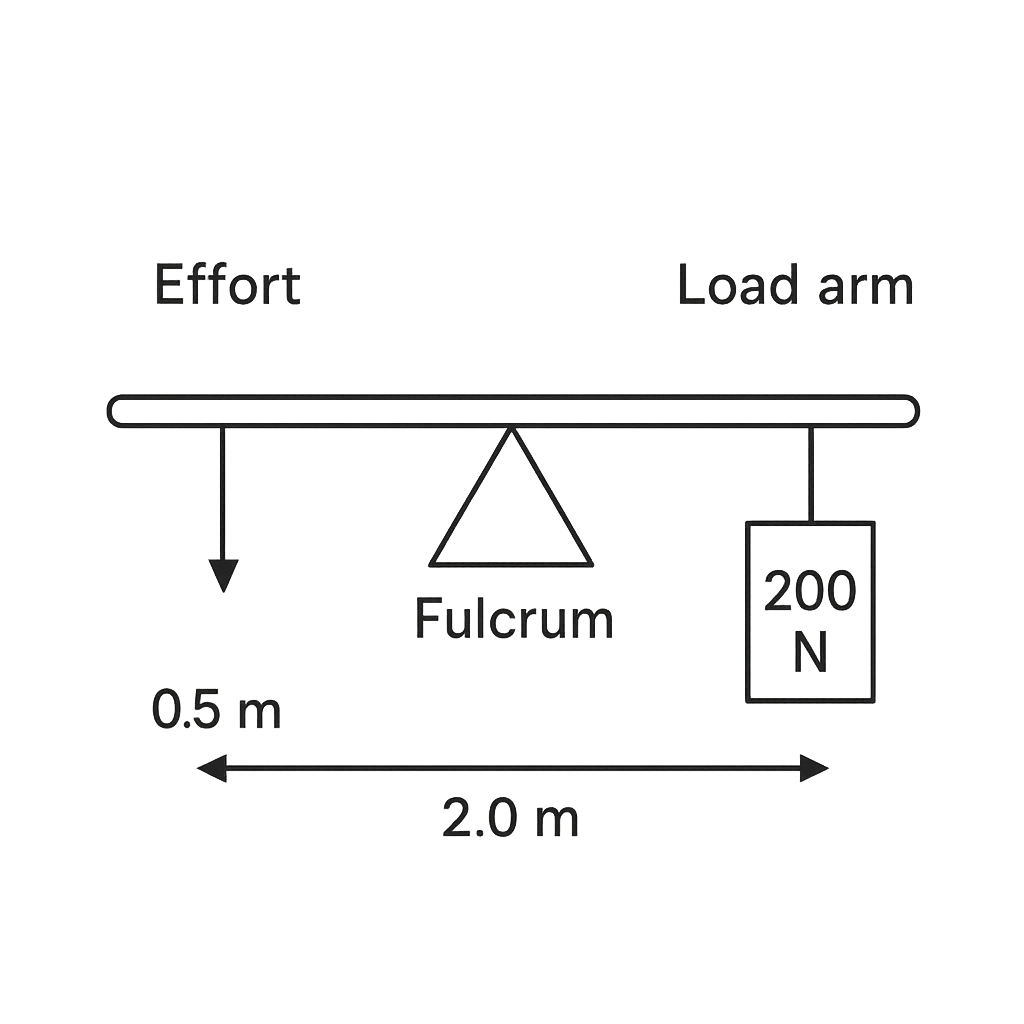
The diagram shows a simple lever used to lift a load. The distance from the fulcrum to the point where effort is applied (effort arm) is \(0.5\) m, and the distance from the fulcrum to the load (load arm) is \(2.0\) m. A load of \(200\) N hangs from the load end. Assuming an ideal frictionless lever, calculate the minimum effort force (in newtons) that must be applied at the effort end to keep the lever in equilibrium.
A. 1600
Correct B. 800
C. 400
D. 50

Correct Answer: B

Want to see the full step-by-step solution? Unlock AI Explanation & Analytics
Question 15 View Details
A dairy farm has \(40\) cows, each producing an average of \(22\) L of milk per day. Milk sells for N120 per litre. The farm incurs fixed costs of N150,000 per month and a variable cost of N30 per litre of milk produced. (a) Calculate the monthly profit. (b) The farmer wishes to increase the profit by 20 % by improving the average daily milk yield per cow (all other factors remain unchanged). What should be the new average daily milk yield per cow (in litres, to one decimal place)?
A. Monthly profit: N2,100,000; New yield: 26.1 L per cow
B. Monthly profit: N2,226,000; New yield: 25.5 L per cow
C. Monthly profit: N2,226,000; New yield: 27.0 L per cow
Correct D. Monthly profit: N2,226,000; New yield: 26.1 L per cow

Correct Answer: D

Want to see the full step-by-step solution? Unlock AI Explanation & Analytics
Question 16 View Details
A forest stand covers 100 ha and initially has 80 trees per hectare. Each tree has an average DBH of 30 cm and an average height of 15 m. Tree volume (in m³) can be estimated by \( V = 0.0001 \times DBH^{2} \times H \). The DBH of each tree increases by 0.5 cm each year. Every 5 years a harvest removes a constant proportion \(p\) of the standing volume. Assuming the height remains constant, what is the greatest whole‑number percentage of the standing volume that can be harvested every 5 years so that after 20 years the total standing volume is not less than the initial volume? Give your answer as a percent rounded to the nearest whole number.
A. 12
B. 20
C. 18
Correct D. 15

Correct Answer: D

Want to see the full step-by-step solution? Unlock AI Explanation & Analytics
Question 17 View Details
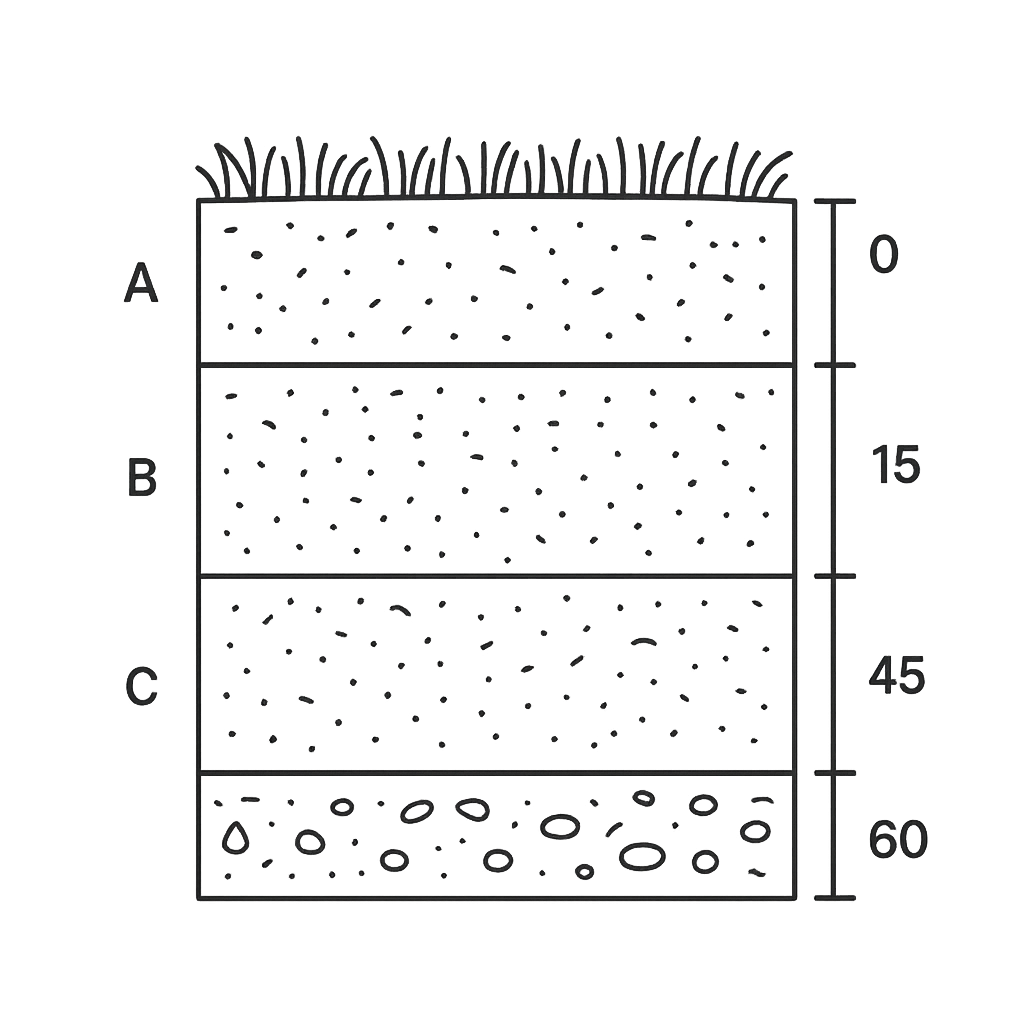
The diagram shows a soil profile with three horizons. Horizon A extends from the surface to a depth of 15 cm, horizon B from 15 cm to 45 cm, and horizon C from 45 cm to 60 cm. What is the thickness of horizon B in centimetres?
A. 45
B. 60
C. 15
Correct D. 30

Correct Answer: D

Want to see the full step-by-step solution? Unlock AI Explanation & Analytics
Question 18 View Details
A broiler chicken is reared from a starting weight of 0.5 kg to a market weight of 2.0 kg. Without a feed additive, the feed conversion ratio (FCR) is 1.8 kg feed per kg weight gain. With a feed additive, the FCR improves to 1.6 kg feed per kg gain, but the additive costs ₦500 per bird. Feed costs ₦200 per kilogram and the market price of live chicken is ₦800 per kilogram. Should the farmer use the feed additive to maximise profit per bird? Show the profit per bird for both scenarios and state the better option.
Correct A. No; profit without additive = ₦1060 per bird, profit with additive = ₦620 per bird.
B. No; profit without additive = ₦960 per bird, profit with additive = ₦620 per bird.
C. No; profit without additive = ₦1060 per bird, profit with additive = ₦720 per bird.
D. Yes; profit without additive = ₦960 per bird, profit with additive = ₦620 per bird.

Correct Answer: A

Want to see the full step-by-step solution? Unlock AI Explanation & Analytics
Question 19 View Details
A batch of 1000 kg fresh cassava chips contains 45 % moisture (wet basis). The chips must be dried to 12 % moisture (wet basis). The drying air enters the dryer at 30 °C and 40 % relative humidity and leaves at 45 °C and 20 % relative humidity. The air flow rate is 2 m³ s⁻¹, air density is 1.2 kg m⁻³, and the atmospheric pressure is 101.3 kPa. Saturation vapour pressures are 4.24 kPa at 30 °C and 9.59 kPa at 45 °C. Assuming all moisture removed is carried away by the air, estimate the drying time in hours, rounding to the nearest whole hour.
A. 34
Correct B. 31
C. 28
D. 38

Correct Answer: B

Want to see the full step-by-step solution? Unlock AI Explanation & Analytics
Question 20 View Details
In aerobic soils, which microbial process in the nitrogen cycle converts ammonium (\(NH_{4}^{+}\)) to nitrate (\(NO_{3}^{-}\))?
A. ammonification
B. nitrogen fixation
Correct C. nitrification
D. denitrification

Correct Answer: C

Want to see the full step-by-step solution? Unlock AI Explanation & Analytics
Question 21 View Details
A herd of 200 cattle is affected by disease X. The disease has a basic reproduction number \(R_0 = 2.5\) in a fully susceptible herd. A vaccination programme reduces the susceptibility of each vaccinated animal by 60 %. If 80 animals are vaccinated and there are initially 5 infected animals, what is the expected number of new infections after one generation of transmission? Give your answer as a decimal.
Correct A. 9.5
B. 7.5
C. 12.0
D. 15.0

Correct Answer: A

Want to see the full step-by-step solution? Unlock AI Explanation & Analytics
Question 22 View Details
The volume growth of a pine stand follows the logistic model \(V(t)=\frac{K}{1 + a e^{-b t}}\) where \(K = 5000\,\text{m}^3\) and \(b = 0.08\,\text{yr}^{-1}\). At planting (\(t=0\)) the stand volume is \(V_0 = 200\,\text{m}^3\). Determine the amount of timber (in cubic metres) that can be harvested now so that after 10 years the stand returns to its original volume of \(200\,\text{m}^3\).
Correct A. 224.5
B. 190.4
C. 250.2
D. 210.7

Correct Answer: A

Want to see the full step-by-step solution? Unlock AI Explanation & Analytics
Question 23 View Details
A lake fish species has a natural mortality rate \(M = 0.2\,\text{yr}^{-1}\) and its annual recruitment is given by \(R = 0.5\,B^{0.8}\) where \(B\) is the biomass in tonnes. The current biomass is \(B_0 = 1000\,\text{t}\). A constant annual harvest removes a proportion \(h\) of the biomass each year, so that \(B_{t+1}=B_t(1-h-M)+R_t\). Assuming the biomass remains constant from year to year, find the maximum sustainable harvest proportion \(h\) (as a percentage) that can be applied indefinitely.
A. 72.1%
B. 64.8%
C. 57.4%
Correct D. 67.4%

Correct Answer: D

Want to see the full step-by-step solution? Unlock AI Explanation & Analytics
Question 24 View Details
A farmer cultivates maize on 5\,ha. Fixed costs are ₦150,000 per season and variable costs are ₦30,000 per ha. Yield per ha (in tonnes) depends on the amount of nitrogen fertilizer applied (\(N\) kg ha\(^{-1}\)) according to \(Y = 2 + 0.07N - 0.0002N^{2}\). The market price of maize is ₦45,000 per tonne. Fertiliser costs ₦200 per kg N. If total revenue exceeds ₦500,000, a tax of 10 % is levied on the amount above ₦500,000. Determine the amount of nitrogen \(N\) (kg ha\(^{-1}\)) that maximises net profit and compute the maximum net profit (in ₦).
A. N = 140 kg\/ha, Net profit = ₦1,180,000
B. N = 150 kg\/ha, Net profit = ₦1,150,000
C. N = 180 kg\/ha, Net profit = ₦1,210,000
Correct D. N = 163 kg/ha, Net profit = ₦1,226,500

Correct Answer: D

Want to see the full step-by-step solution? Unlock AI Explanation & Analytics
Question 25 View Details
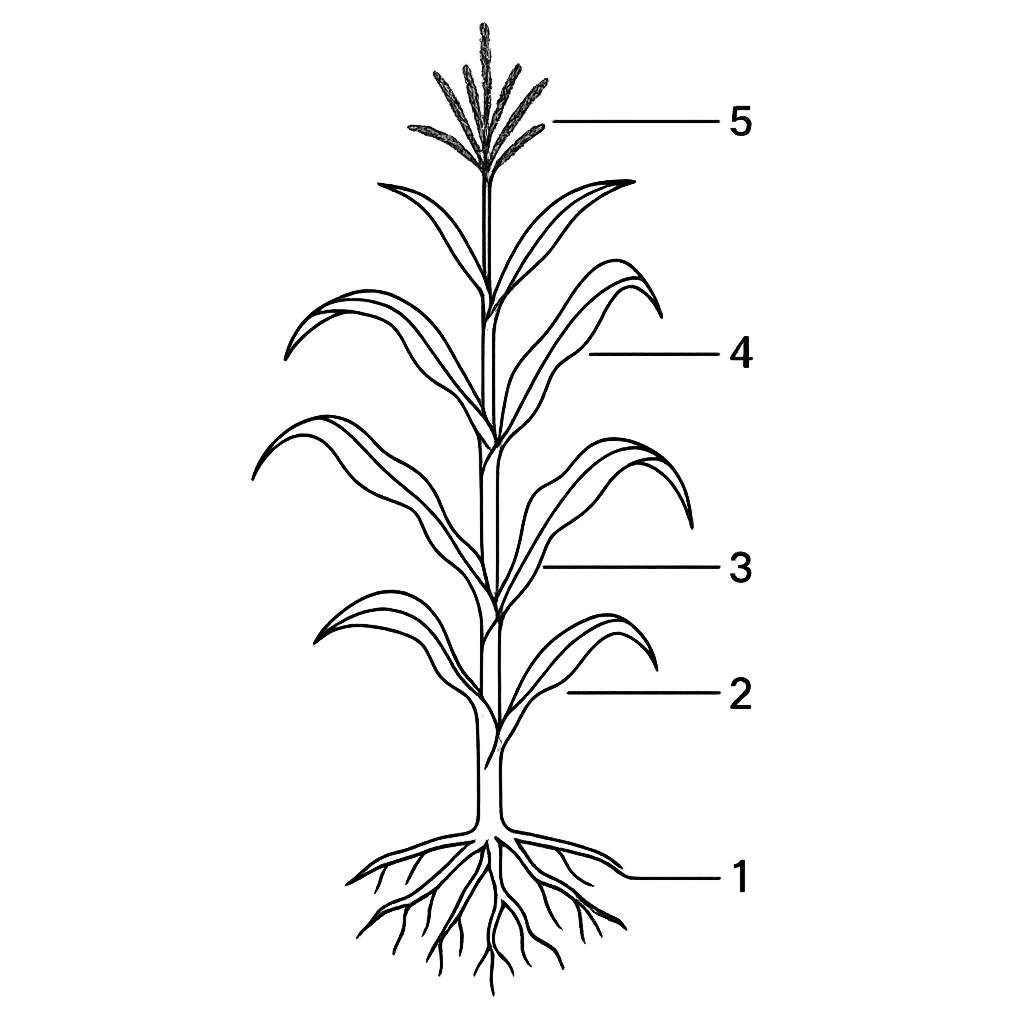
The diagram shows a mature maize plant with the six labelled parts: 1\,root system, 2\,stem, 3\,leaf blade, 4\,leaf sheath, 5\,tassel and 6\,ear. At maturity the total dry matter of the plant is 800\,g and, under normal conditions, it is distributed as follows: roots 15 %, stem 25 %, leaf blade 30 %, leaf sheath 10 %, tassel 5 % and ear 15 %. A disease reduces the leaf‑sheath dry matter by 40 % of its normal amount, and the lost dry matter is redistributed proportionally among the remaining parts. What is the new dry‑matter weight (in grams) of the ear?
A. 112.5 g
B. 133.2 g
C. 118.0 g
Correct D. 125.3 g

Correct Answer: D

Want to see the full step-by-step solution? Unlock AI Explanation & Analytics

Master the Exam!

You've seen a preview, but there are thousands more questions plus AI tutor to break down complex solutions.

Unlock Full Access Available for Android & Windows
Help others prepare! Share this practice hub:
Chat with Support