neco 2022 agricultural_science | Essay

Prepare for your exams with neco questions? Reviewing past/model questions is one of the most effective ways to guarantee a high score. This practice hub features authentic 2022 agricultural_science (Essay) questions designed to simulate the real exam environment.

Practice these randomly selected questions to test your readiness.

Question 1 View Details
A farmer intends to adopt sustainable agricultural practices on a mixed‑crop farm.
Question Parts
(a)
Define agricultural ecology and explain its relevance to sustainable farming.
(b)
Identify three major abiotic factors that influence crop productivity and discuss how each can be managed to enhance sustainability.
(c)
The farmer plans to integrate a leguminous cover crop into the rotation. Explain the ecological benefits of this practice, focusing on nitrogen fixation, soil structure, and biodiversity.
Detailed Essay Solution & Marking Scheme Available

Get the step-by-step mathematical proofs, key points required by examiners, and a comprehensive breakdown from our AI Tutor.
Question 2 View Details
A soil scientist conducts a laboratory experiment to compare the water infiltration rates of three soil textures: sand, loam and clay. The experimental apparatus is shown in the diagram.
Question Parts
(a)
The scientist records the time taken for 100 ml of water to pass through each soil column. Using the recorded times, calculate the infiltration rate (in ml min⁻¹) for sand, loam and clay.
(b)
Explain how soil texture influences the infiltration rates obtained, referring to pore size distribution and water‑holding capacity.
(c)
To improve infiltration in the clay sample, the scientist adds well‑decomposed organic matter. Predict qualitatively how the infiltration rate will change and justify your prediction.
Detailed Essay Solution & Marking Scheme Available

Get the step-by-step mathematical proofs, key points required by examiners, and a comprehensive breakdown from our AI Tutor.

Question 3 View Details
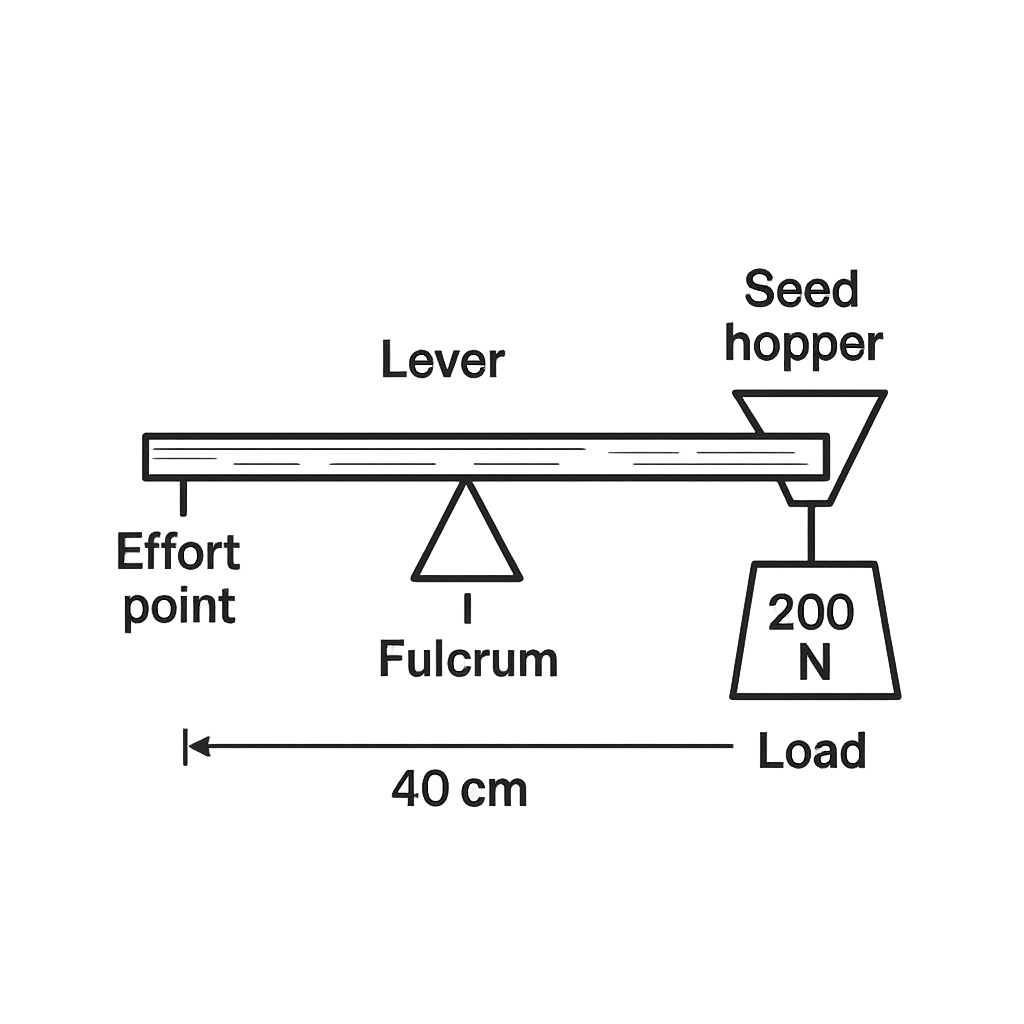
A simple lever is used in a farm seed‑planter to lift a seed hopper. The lever is a rigid wooden beam 120 cm long. A fulcrum is placed 40 cm from the left end of the beam. A load of 200 N is attached to the right end of the beam. The farmer applies the effort at the left end of the beam.
Question Parts
(a)
Determine the mechanical advantage (MA) of the lever.
(b)
If the farmer wants to lift the 200 N load, what is the minimum effort force that must be applied at the left end? (Assume an ideal lever with no friction.)
(c)
Discuss two advantages of using this lever‑based seed planter over manual hand sowing, focusing on labour efficiency and seed‑spacing uniformity.
Detailed Essay Solution & Marking Scheme Available

Get the step-by-step mathematical proofs, key points required by examiners, and a comprehensive breakdown from our AI Tutor.

Question 4 View Details
A smallholder farmer cultivates 5 hectares of mixed crops (maize and vegetables). He wishes to mechanise land preparation and planting to increase productivity.
Question Parts
(a)
Identify three farm machines that are suitable for land preparation on this farm. For each machine, describe its principle of operation, at least one advantage, and why it is appropriate for a smallholder.
(b)
Given the following purchase prices and useful lives, calculate the annual straight‑line depreciation for each machine and the total annual depreciation cost. Then determine the depreciation cost per hectare. - Two‑wheel tractor: ₦2,500,000, useful life 10 years, salvage value ₦0. - Power tiller: ₦350,000, useful life 5 years, salvage value ₦0. - Seed drill: ₦500,000, useful life 8 years, salvage value ₦0.
(c)
Identify and briefly discuss two non‑economic factors that may influence the farmer’s decision to adopt mechanisation on his farm.
Detailed Essay Solution & Marking Scheme Available

Get the step-by-step mathematical proofs, key points required by examiners, and a comprehensive breakdown from our AI Tutor.

Question 5 View Details
A farmer intends to grow maize and soybeans on a 5‑hectare farm using a mixed cropping system. The soil test indicates the following available nutrients per hectare: nitrogen (N) 30 kg, phosphorus as P₂O₅ 15 kg and potassium as K₂O 20 kg. The recommended nutrient requirements per hectare are: - Maize: N 120 kg, P₂O₅ 60 kg, K₂O 80 kg - Soybeans: N 50 kg (but only 30 % of this must be supplied from fertilizer because the remaining 70 % is obtained by biological N₂ fixation), P₂O₅ 40 kg, K₂O 50 kg The farmer plans to allocate 3 ha to maize and 2 ha to soybeans.
Question Parts
(a)
Determine the total amount of each nutrient (N, P₂O₅ and K₂O) that must be supplied as fertilizer for the whole farm.
(b)
If the farmer decides to use a blended NPK fertilizer that contains 20 % N, 10 % P₂O₅ and 15 % K₂O (by weight), calculate the quantity of this blended fertilizer required to meet the deficits calculated in part (a).
(c)
Discuss two agronomic advantages of using a mixed cropping system of maize and soybeans on this farm.
Detailed Essay Solution & Marking Scheme Available

Get the step-by-step mathematical proofs, key points required by examiners, and a comprehensive breakdown from our AI Tutor.

Question 6 View Details
A smallholder keeps a dairy herd of 20 lactating cows. The average daily milk yield per cow is 12 L. Each cow weighs about 450 kg and consumes 2.5 % of her body weight as dry matter (DM) per day. The herd is fed a total mixed ration (TMR) that consists of maize silage (35 % DM) and a concentrate mix (90 % DM). The silage contains 4 % crude protein (CP) on a DM basis, while the concentrate contains 18 % CP on a DM basis. Cows require 3.2 % CP of their total DM intake.
Question Parts
(a)
Calculate the total daily DM intake of the herd (in kg).
(b)
Determine the amount of concentrate (in kilograms of as‑fed feed) that must be fed daily to meet the cows’ CP requirement.
(c)
If the farmer wishes to increase the herd’s milk yield by 10 % without changing the total DM intake, suggest one nutritional strategy and briefly explain the scientific basis for its effectiveness.
Detailed Essay Solution & Marking Scheme Available

Get the step-by-step mathematical proofs, key points required by examiners, and a comprehensive breakdown from our AI Tutor.

Question 7 View Details
A farmer observed that on his 2.5 ha maize field, the leaves show characteristic "window‑pane" lesions and a white cottony mass on the undersides. He estimates that 15% of the leaf area is affected and that, if untreated, the yield loss would be about 0.8 t ha⁻¹. The recommended pesticide is Cypermethrin 10 % EC to be applied at 2.5 L ha⁻¹ for a spray volume of 400 L ha⁻¹. The pesticide label states that the maximum safe residue on maize is 0.05 mg kg⁻¹ and the pre‑harvest interval is 7 days. The farmer plans to harvest 30 days after application.
Question Parts
(a)
Identify the pest causing the symptoms and describe its life cycle briefly.
(b)
Calculate the total amount (in litres) of Cypermethrin 10 % EC required for the whole field.
(c)
Determine whether the recommended application rate complies with the maximum residue limit, assuming that each litre of the 10 % EC contains 100 g of active ingredient and that 1 g of active ingredient results in 0.2 mg kg⁻¹ residue in the grain at harvest. Show your calculation.
(d)
Recommend an integrated pest‑management (IPM) strategy for this pest, including at least three control measures, and justify each.
Detailed Essay Solution & Marking Scheme Available

Get the step-by-step mathematical proofs, key points required by examiners, and a comprehensive breakdown from our AI Tutor.

Question 8 View Details
A farmer's 3 ha tomato farm shows wilting of plants, yellowing of lower leaves and brown discoloration in the vascular tissue of stems. Laboratory analysis identifies the pathogen as Fusarium oxysporum f. sp. lycopersici. The disease incidence is 20 % of plants and each infected plant yields 30 % less than a healthy plant. The market price of tomatoes is ₦150 kg⁻¹. The farmer can apply a soil drench of carbendazim 12 % WP at 5 kg ha⁻¹, which reduces disease severity by 70 % but costs ₦2,500 per kg of product. The farmer wishes to know the economic benefit of applying the fungicide.
Question Parts
(a)
Explain the disease cycle of Fusarium wilt in tomatoes, highlighting the role of soil‑borne inoculum.
Detailed Essay Solution & Marking Scheme Available

Get the step-by-step mathematical proofs, key points required by examiners, and a comprehensive breakdown from our AI Tutor.

Master the Exam!

You've seen a preview, but there are thousands more questions plus AI tutor to break down complex solutions.

Unlock Full Access Available for Android & Windows
Help others prepare! Share this practice hub:
Chat with Support