neco 2021 physics | Objective

Prepare for your exams with neco questions? Reviewing past/model questions is one of the most effective ways to guarantee a high score. This practice hub features authentic 2021 physics (Objective) questions designed to simulate the real exam environment.

Practice these randomly selected questions to test your readiness.

Question 1 View Details
A block of mass \(5\ \text{kg}\) slides down a rough incline that is \(30^{\circ}\) to the horizontal and \(4\ \text{m}\) long. The coefficient of kinetic friction between the block and the plane is \(0.20\). The block starts from rest at the top of the incline. Determine the power supplied by the weight of the block at the instant it reaches the bottom of the incline. Give your answer in watts (W) to three significant figures.
A. 1.02\times10^{2}\ \text{W}
Correct B. 1.24\times10^{2}\ \text{W}
C. 1.36\times10^{2}\ \text{W}
D. 9.81\times10^{1}\ \text{W}

Correct Answer: B

Want to see the full step-by-step solution? Unlock AI Explanation & Analytics
Question 2 View Details
A car accelerates uniformly from rest to a speed of \(20\ \text{m s}^{-1}\) in \(5.0\ \text{s}\). Calculate the distance travelled by the car during this time interval. Give your answer in metres (m) to the nearest metre.
A. 55\\ \\text{m}
B. 45\\ \\text{m}
Correct C. 50\ \text{m}
D. 30\\ \\text{m}

Correct Answer: C

Want to see the full step-by-step solution? Unlock AI Explanation & Analytics
Question 3 View Details
A particle of mass \(5\ \text{kg}\) is acted upon by two forces. Force \(\vec{F}_{1}\) has magnitude \(12\ \text{N}\) and is directed \(30^{\circ}\) north of east. Force \(\vec{F}_{2}\) has unknown magnitude \(F\) and is directed \(60^{\circ}\) south of east. The resultant acceleration of the particle is directed exactly eastward. Determine the magnitude \(F\) in newtons (N).
Correct A. 6.9\ \text{N}
B. 12.0\\ \\text{N}
C. 8.4\\ \\text{N}
D. 5.2\\ \\text{N}

Correct Answer: A

Want to see the full step-by-step solution? Unlock AI Explanation & Analytics
Question 4 View Details
A block‑and‑tackle system consists of a fixed pulley and two movable pulleys, giving three rope segments that support the load. The load weight is \(600\ \text{N}\). While lifting the load at constant speed, the measured input force is \(210\ \text{N}\). (a) State the ideal mechanical advantage of the system. (b) Calculate the actual mechanical advantage. (c) Determine the efficiency of the system as a percentage, correct to one decimal place.
A. 88.3\%
B. 76.9\%
C. 102.5\%
Correct D. 95.2\%

Correct Answer: D

Want to see the full step-by-step solution? Unlock AI Explanation & Analytics
Question 5 View Details
A rectangular single‑turn loop of wire has length \(l = 0.50\ \text{m}\) and width \(w = 0.20\ \text{m}\). It rotates with a constant angular speed \(\omega = 50\ \text{rad s}^{-1}\) in a uniform magnetic field of magnitude \(B = 0.30\ \text{T}\), the axis of rotation being perpendicular to the field. The loop has a resistance of \(R = 2.0\ \Omega\). (a) Write the expression for the instantaneous induced emf in the loop and give its maximum value. (b) If the loop is connected to an external resistor \(R_{L}\), determine the value of \(R_{L}\) that will make the power delivered to \(R_{L}\) maximum. (c) Calculate this maximum power (in watts) delivered to the load resistor. Give your answer to two decimal places.
A. 0.35\\ \\text{W}
B. 0.22\\ \\text{W}
C. 0.30\\ \\text{W}
Correct D. 0.28\ \text{W}

Correct Answer: D

Want to see the full step-by-step solution? Unlock AI Explanation & Analytics
Question 6 View Details
A single rectangular coil of area \( A = 0.01\ \text{m}^2 \) and resistance \( R = 5\ \Omega \) rotates in a uniform magnetic field of magnitude \( B = 0.20\ \text{T} \). The coil starts from rest and rotates with a constant angular acceleration \( \alpha = 2\ \text{rad\ s}^{-2} \) about an axis perpendicular to the field. Determine (a) the magnitude of the induced emf at \( t = 3\ \text{s} \), (b) the instantaneous current at that instant, and (c) the total charge that has passed through the circuit from \( t = 0 \) to \( t = 3\ \text{s} \).
A. 5.0 mV, 1.1×10⁻⁴ A, 6.5×10⁻⁴ C
B. 5.2 mV, 1.0×10⁻⁴ A, 8.0×10⁻⁴ C
C. 4.5 mV, 9.0×10⁻⁴ A, 7.0×10⁻⁴ C
Correct D. 4.94 mV, 9.9×10⁻⁴ A, 7.6×10⁻⁴ C

Correct Answer: D

Want to see the full step-by-step solution? Unlock AI Explanation & Analytics
Question 7 View Details
An isolated sample initially contains \( N_{0}=1.0\times10^{20} \) atoms of a radioactive isotope A. Isotope A decays to isotope B by beta emission with a half‑life of \( 10\ \text{min} \); isotope B subsequently decays to a stable nucleus C by alpha emission with a half‑life of \( 5\ \text{min} \). Each decay of A releases \( 2.0\ \text{MeV} \) and each decay of B releases \( 1.5\ \text{MeV} \). Calculate the total energy released (in joules) after \( 30\ \text{min} \).
Correct A. 4.6×10⁷ J
B. 4.6×10⁶ J
C. 5.2×10⁷ J
D. 3.9×10⁷ J

Correct Answer: A

Want to see the full step-by-step solution? Unlock AI Explanation & Analytics
Question 8 View Details
A particle moves \(5.0\ \text{m}\) east and then \(12.0\ \text{m}\) north. (a) Find the magnitude and direction of the resultant displacement. (b) State whether the total distance travelled is a scalar or a vector quantity.
Correct A. 13.0 m, 67.4° north of east, scalar
B. 13.0 m, 45.0° north of east, scalar
C. 13.0 m, 67.4° north of east, vector
D. 15.0 m, 67.4° north of east, scalar

Correct Answer: A

Want to see the full step-by-step solution? Unlock AI Explanation & Analytics
Question 9 View Details
Three point charges are placed in the xy‑plane: \( Q_{1}=+2\ \mu\text{C} \) at the origin, \( Q_{2}=-3\ \mu\text{C} \) at \((0\ \text{m},\ 4\ \text{m})\), and \( Q_{3}=+4\ \mu\text{C} \) at \((3\ \text{m},\ 0\ \text{m})\). (a) Determine the magnitude (in N C\(^{-1}\)) and direction (angle measured counter‑clockwise from the +x‑axis) of the net electric field at point \( P(1\ \text{m},\ 1\ \text{m}) \). (b) A test charge \( q=+1\ \mu\text{C} \) is moved from \( P \) to point \( Q(2\ \text{m},\ 2\ \text{m}) \) along a straight line. Calculate the work done by an external agent in this movement.
A. 9.8×10³ N/C, 70°, 5.5×10⁻³ J
B. 1.10×10⁴ N/C, 85°, 6.8×10⁻³ J
Correct C. 1.22×10⁴ N/C, 94°, 7.5×10⁻³ J
D. 1.35×10⁴ N/C, 102°, 8.2×10⁻³ J

Correct Answer: C

Want to see the full step-by-step solution? Unlock AI Explanation & Analytics
Question 10 View Details
Vector \( \mathbf{A}=3\mathbf{i}+4\mathbf{j} \) and vector \( \mathbf{B}=5\mathbf{i}-2\mathbf{j} \). (a) Find the dot product \( \mathbf{A}\cdot\mathbf{B} \). (b) State whether the result is a scalar or a vector.
A. 11, scalar
B. 0, scalar
C. -7, scalar
Correct D. 7, scalar

Correct Answer: D

Want to see the full step-by-step solution? Unlock AI Explanation & Analytics
Question 11 View Details
Two point charges are placed on the same vertical line. A charge of \( +8\,\mu\text{C} \) is at the origin O and a charge of \( -2\,\mu\text{C} \) is at the point (0, 0.12\,m). At what distance from O along the line is the electric field zero? Give your answer in metres to two decimal places.
A. 0.10 m
B. 0.06 m
Correct C. 0.08 m
D. 0.14 m

Correct Answer: C

Want to see the full step-by-step solution? Unlock AI Explanation & Analytics
Question 12 View Details
A sealed container holds 0.020\,m\(^3\) of air at 1.0\,atm and 300\,K. The gas is heated at constant volume to 450\,K. Afterwards the piston is allowed to expand isothermally back to the original pressure of 1.0\,atm. Calculate the total work done by the gas during the isothermal expansion. Give your answer in kilojoules to two decimal places.
A. 0.98 kJ
B. 2.10 kJ
C. 1.45 kJ
Correct D. 1.23 kJ

Correct Answer: D

Want to see the full step-by-step solution? Unlock AI Explanation & Analytics
Question 13 View Details
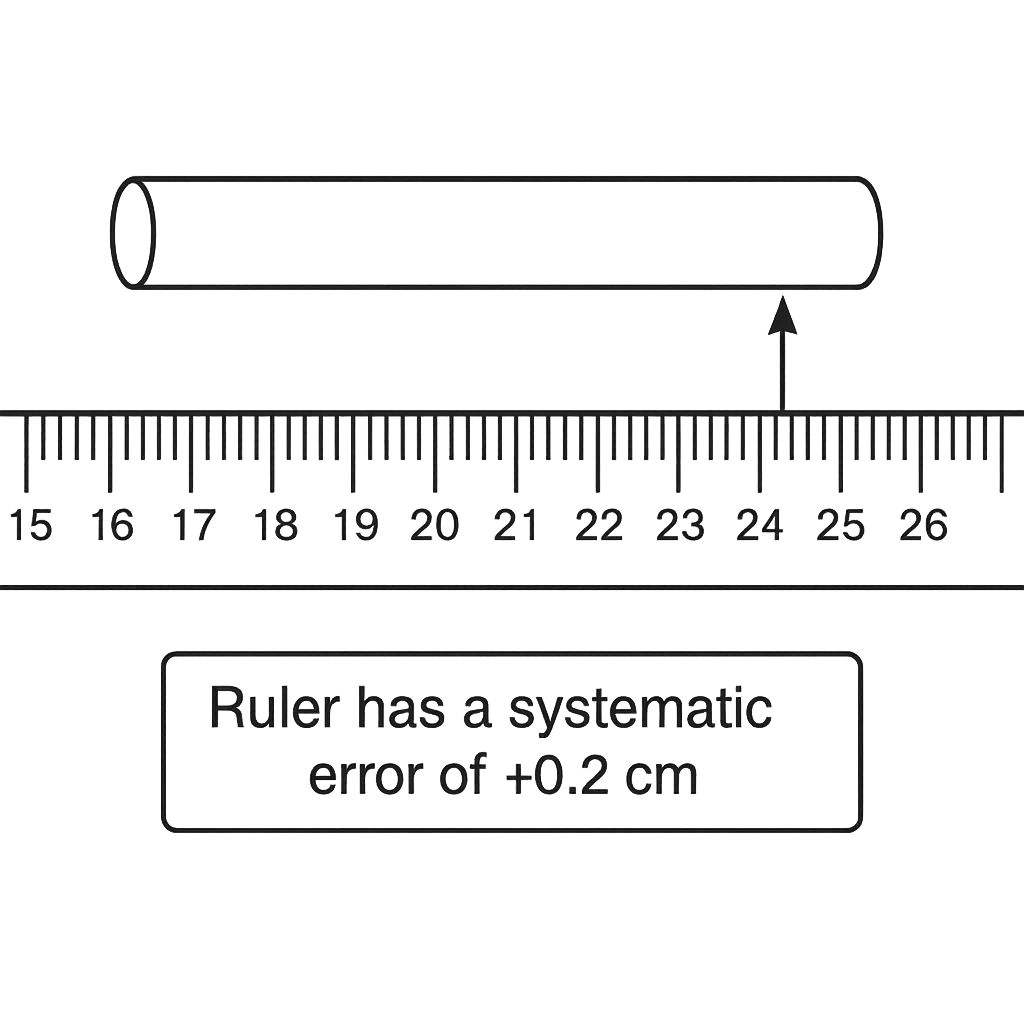
In the diagram, a student measures the length of a metal rod with a metre rule that reads 23.4\,cm. The rule has a systematic error of +0.2\,cm (its readings are always 0.2\,cm higher than the true length). What is the actual length of the rod?
Correct A. 23.2 cm
B. 23.6 cm
C. 23.4 cm
D. 23.0 cm

Correct Answer: A

Want to see the full step-by-step solution? Unlock AI Explanation & Analytics
Question 14 View Details
A rectangular tank 2.0\,m wide and 1.5\,m high is filled with water. A small hole of area \(2.0\times10^{-4}\,\text{m}^{2}\) is made at a depth \(h\) below the water surface. Water exits the hole and strikes a vertical plate placed 0.5\,m horizontally from the hole. If the force exerted on the plate by the jet is 150\,N, determine the depth \(h\) (in metres) of the hole. Use \(g=9.8\,\text{m s}^{-2}\) and \(\rho_{\text{water}}=1000\,\text{kg m}^{-3}\). Give your answer to two decimal places.
Correct A. 38.27 m
B. 27.50 m
C. 41.78 m
D. 32.14 m

Correct Answer: A

Want to see the full step-by-step solution? Unlock AI Explanation & Analytics
Question 15 View Details
A battery of emf \(E\) V and internal resistance \(r\) \(\Omega\) is connected to a parallel combination of a 4\,\Omega resistor and a 6\,\Omega resistor. The terminal voltage across the parallel network is 12\,V and the total current supplied by the battery is 5\,A. The total electrical power developed by the battery is 150\,W. Determine the emf \(E\) of the battery, its internal resistance \(r\), and the efficiency of the circuit (percentage of the power delivered to the external resistors).
Correct A. E = 30 V, r = 3.6 Ω, efficiency = 40%
B. E = 32 V, r = 3.2 Ω, efficiency = 42%
C. E = 30 V, r = 4.5 Ω, efficiency = 35%
D. E = 28 V, r = 4.0 Ω, efficiency = 38%

Correct Answer: A

Want to see the full step-by-step solution? Unlock AI Explanation & Analytics
Question 16 View Details
At a temperature of \(27^{\circ}\text{C}\), a pipe closed at one end resonates at frequencies \(210\,\text{Hz}\) and \(350\,\text{Hz}\), which correspond to successive resonant modes. Determine the length of the pipe in metres, giving your answer to two decimal places.
A. 1.36 m
B. 0.95 m
Correct C. 1.24 m
D. 1.10 m

Correct Answer: C

Want to see the full step-by-step solution? Unlock AI Explanation & Analytics
Question 17 View Details
A sealed \(2.00\,\text{L}\) container initially contains an ideal gas at \(1.00\,\text{atm}\) and \(27^{\circ}\text{C}\). The gas is heated at constant volume until the pressure rises to \(2.50\,\text{atm}\). It then expands isothermally at the final temperature until the pressure returns to \(1.00\,\text{atm}\). (a) Find the final volume of the gas after the isothermal expansion. (b) If the gas is monatomic with molar heat capacity at constant volume \(C_{V}=\tfrac{3}{2}R\), calculate the heat added during the constant‑volume heating step. Give your answer in joules to three significant figures.
A. Final volume = 5.50 L; Heat added = 4.00×10^2 J
B. Final volume = 4.00 L; Heat added = 3.60×10^2 J
C. Final volume = 6.00 L; Heat added = 5.00×10^2 J
Correct D. Final volume = 5.00 L; Heat added = 4.55×10^2 J

Correct Answer: D

Want to see the full step-by-step solution? Unlock AI Explanation & Analytics
Question 18 View Details
In a simple pendulum experiment the length of the string is measured with a meter rule as \(0.500\,\text{m}\) with a systematic uncertainty of \(\pm0.001\,\text{m}\). The period of the pendulum is timed ten times with a stopwatch, giving the values (in seconds): 2.01, 2.04, 2.00, 2.03, 2.02, 2.05, 2.01, 2.03, 2.02, 2.04. The reaction‑time uncertainty of the stopwatch is \(\pm0.02\,\text{s}\) (random).\n\n(a) Determine the best estimate of the acceleration due to gravity \(g\) and its combined standard uncertainty, assuming all uncertainties are independent.\n(b) Identify the dominant source of error and suggest one practical precaution to reduce it.
Correct A. g = 4.82 ± 0.04 m·s⁻²; dominant error = timing; precaution = use electronic/photogate timing
B. g = 4.82 ± 0.06 m·s⁻²; dominant error = reaction time; precaution = repeat timing many times
C. g = 4.90 ± 0.05 m·s⁻²; dominant error = length; precaution = use finer\/calibrated meter rule
D. g = 4.78 ± 0.04 m·s⁻²; dominant error = systematic; precaution = calibrate stopwatch

Correct Answer: A

Want to see the full step-by-step solution? Unlock AI Explanation & Analytics
Question 19 View Details
A string of length \(0.60\,\text{m}\) is fixed at both ends. Its fundamental frequency at an initial tension \(T\) is \(40\,\text{Hz}\). When the tension is increased by 20 % (the new tension is \(12\,\text{N}\)), the frequency of the third harmonic is measured to be \(132\,\text{Hz}\). Determine the linear mass density \(\mu\) of the string in \(\text{kg·m}^{-1}\) (give your answer to three significant figures).
A. 4.34×10⁻² kg·m⁻¹
Correct B. 4.34×10⁻³ kg·m⁻¹
C. 3.21×10⁻³ kg·m⁻¹
D. 5.12×10⁻³ kg·m⁻¹

Correct Answer: B

Want to see the full step-by-step solution? Unlock AI Explanation & Analytics
Question 20 View Details
A metal sphere initially at \(150^{\circ}\text{C}\) is placed in a room where the ambient temperature is \(25^{\circ}\text{C}\). After 5 minutes its temperature has fallen to \(95^{\circ}\text{C}\). Assuming Newton's law of cooling, \(T(t)=T_{\text{room}}+(T_0-T_{\text{room}})e^{-kt}\), determine the temperature of the sphere after 12 minutes. Give your answer to the nearest degree Celsius.
A. 48 °C
B. 71 °C
C. 62 °C
Correct D. 56 °C

Correct Answer: D

Want to see the full step-by-step solution? Unlock AI Explanation & Analytics
Question 21 View Details
An object is placed \(30\ \text{cm}\) in front of a converging lens L1 of focal length \(20\ \text{cm}\). A second converging lens L2 is positioned \(10\ \text{cm}\) to the right of L1. The final image formed by the combination is located \(40\ \text{cm}\) to the right of L2. Find the focal length of L2 in centimetres.
A. 300
Correct B. 200
C. 150
D. 250

Correct Answer: B

Want to see the full step-by-step solution? Unlock AI Explanation & Analytics
Question 22 View Details
A string is fixed at one end and free at the other. In its second harmonic the distance between two consecutive nodes is \(0.25\ \text{m}\) and the frequency of vibration is \(120\ \text{Hz}\). Determine the speed of the travelling wave on the string and the total length of the string.
A. 48 m/s, 0.3125 m
Correct B. 60 m/s, 0.375 m
C. 60 m/s, 0.5 m
D. 72 m/s, 0.45 m

Correct Answer: B

Want to see the full step-by-step solution? Unlock AI Explanation & Analytics
Question 23 View Details
A \(10\ \text{kg}\) block rests on a rough plane inclined at \(30^{\circ}\) to the horizontal. The coefficient of static friction between the block and the plane is \(0.25\). A horizontal force \(P\) is applied to the block, directed up the slope. Find the minimum magnitude of \(P\) (in newtons) required to start moving the block up the incline.
A. 115
Correct B. 95
C. 85
D. 105

Correct Answer: B

Want to see the full step-by-step solution? Unlock AI Explanation & Analytics
Question 24 View Details
Vector \(\mathbf{A}\) has magnitude \(5\ \text{m}\) and points east. Vector \(\mathbf{B}\) has magnitude \(12\ \text{m}\) and points \(30^{\circ}\) north of east. Determine the magnitude of the resultant vector \(\mathbf{R}=\mathbf{A}+\mathbf{B}\) and its direction measured north of east.
A. 15.0 m, 18° north of east
B. 13.0 m, 30° north of east
Correct C. 16.5 m, 21° north of east
D. 17.2 m, 24° north of east

Correct Answer: C

Want to see the full step-by-step solution? Unlock AI Explanation & Analytics
Question 25 View Details
A train moving towards a stationary observer at \(30\ \text{m\,s^{-1}}\) sounds its horn at a frequency of \(500\ \text{Hz}\). The speed of sound in air is \(340\ \text{m\,s^{-1}}\). A building located \(200\ \text{m}\) behind the train reflects the sound back to the observer. What frequency does the observer hear for the reflected sound?
A. 500
B. 430
C. 548
Correct D. 460

Correct Answer: D

Want to see the full step-by-step solution? Unlock AI Explanation & Analytics

Master the Exam!

You've seen a preview, but there are thousands more questions plus AI tutor to break down complex solutions.

Unlock Full Access Available for Android & Windows
Help others prepare! Share this practice hub:
Chat with Support