neco 2021 physics | Essay

Prepare for your exams with neco questions? Reviewing past/model questions is one of the most effective ways to guarantee a high score. This practice hub features authentic 2021 physics (Essay) questions designed to simulate the real exam environment.

Practice these randomly selected questions to test your readiness.
Question 1 View Details
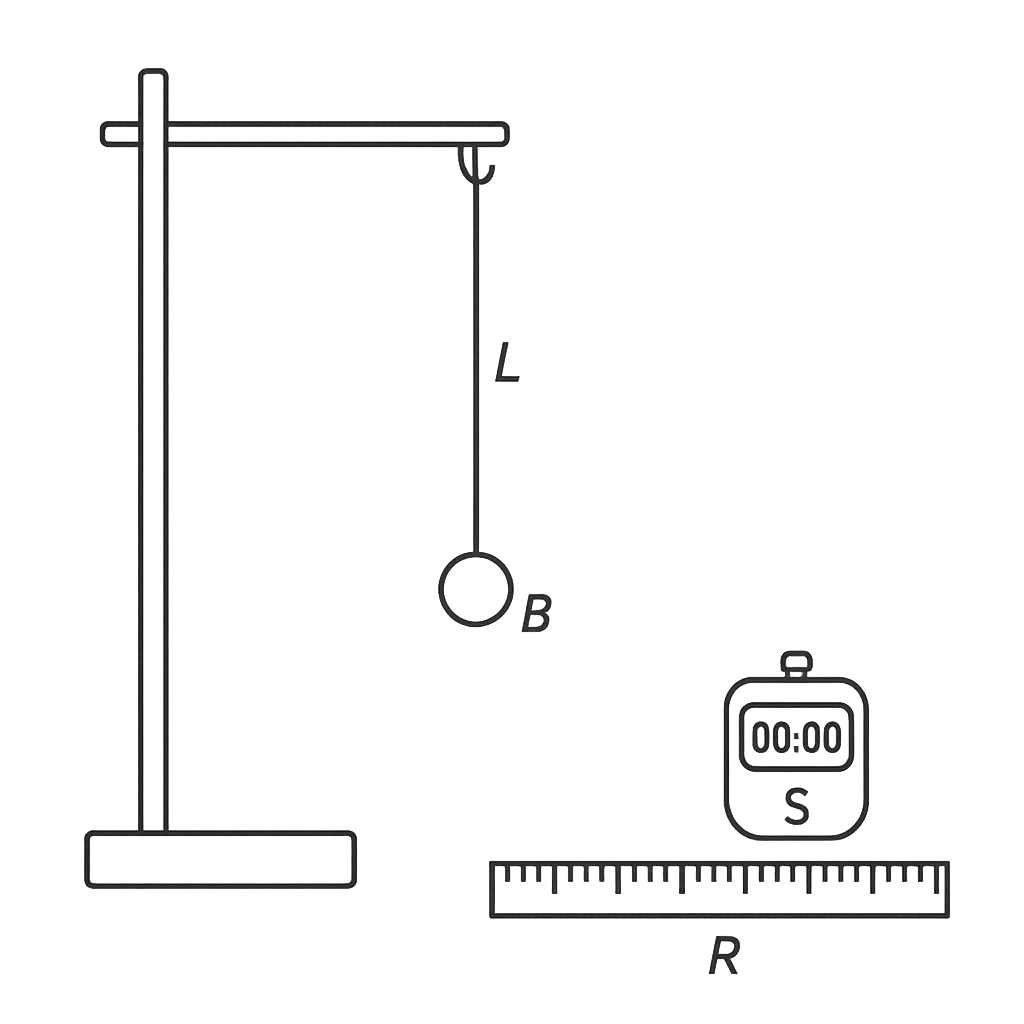
A physics laboratory is equipped for measuring the acceleration due to gravity (g) using a simple pendulum. The apparatus consists of a thin, non‑elastic string attached to a small spherical bob. The length of the string can be measured with a metre rule, and the period of oscillation is measured with a digital stopwatch. The diagram of the setup is provided.
Question Parts
(a)
Describe a reliable procedure for determining the effective length (L) of the pendulum. Include how you would avoid systematic errors associated with the point of suspension and the centre of mass of the bob.
(b)
Derive the theoretical expression for the period (T) of a simple pendulum for small amplitudes, starting from the definition of simple harmonic motion.
(c)
The length of the pendulum is measured as L = 0.500 m (to three significant figures). The stopwatch is used to time 20 complete oscillations, giving a total time of 28.40 s. Calculate the experimental value of g and state its percentage error relative to the accepted value of 9.800 m s⁻². Show all steps.
(d)
Identify two major sources of error in this experiment and suggest practical methods to reduce each of them.
Detailed Essay Solution & Marking Scheme Available

Get the step-by-step mathematical proofs, key points required by examiners, and a comprehensive breakdown from our AI Tutor.
Question 2 View Details
A boat can travel at a speed of 12.0 m s⁻¹ in still water. It attempts to cross a river that is 150 m wide. The river flows downstream at a uniform speed of 4.0 m s⁻¹. The captain decides to aim the boat at an angle θ upstream of the directly opposite bank in order to reach a point directly opposite the starting point.
Question Parts
(a)
Draw a vector diagram showing the velocity of the boat relative to water, the velocity of the water (river current), and the resultant velocity of the boat relative to the ground. Label all vectors and indicate the angle θ.
(b)
Derive an expression for the angle θ that the captain must maintain so that the resultant displacement is directly across the river (i.e., no downstream drift).
(c)
Using the expression from part (b), calculate the required angle θ (to the nearest degree) and the time taken to cross the river.
(d)
If the captain instead steers the boat directly towards the opposite bank (θ = 0°), determine the downstream displacement of the boat when it reaches the opposite bank. State the magnitude of the resultant ground speed and the total time taken for the crossing in this case.
Detailed Essay Solution & Marking Scheme Available

Get the step-by-step mathematical proofs, key points required by examiners, and a comprehensive breakdown from our AI Tutor.
Question 3 View Details
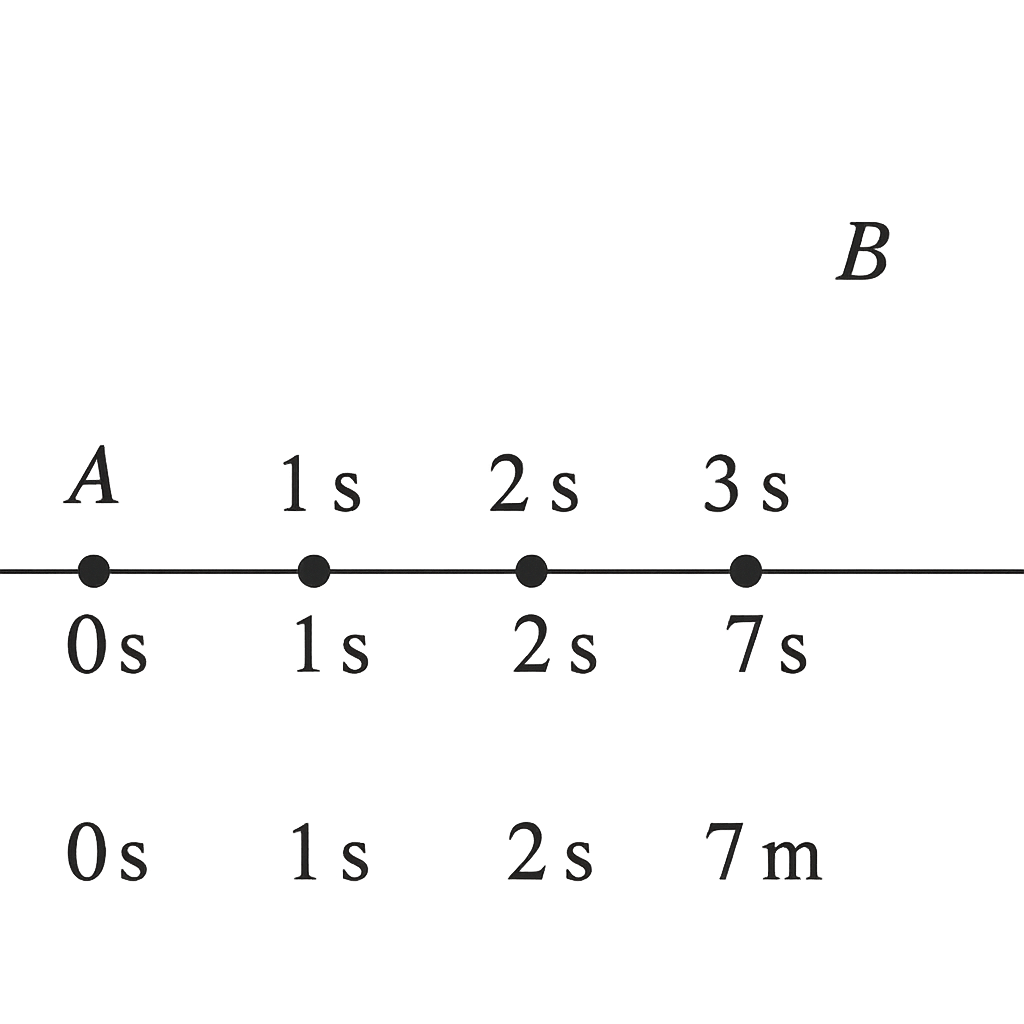
The motion diagram below shows the positions of two particles, A and B, moving in a straight line. The positions are recorded at equal time intervals of 1 second. The distances are measured from the common starting point O. Particle A: at t = 0 s, x = 0 m; t = 1 s, x = 2 m; t = 2 s, x = 5 m; t = 3 s, x = 9 m. Particle B: at t = 0 s, x = 0 m; t = 1 s, x = 3 m; t = 2 s, x = 7 m; t = 3 s, x = 12 m.
Question Parts
(a)
State whether the motion of each particle is uniformly accelerated. Justify your answer using the data in the diagram.
(b)
Determine the initial velocity (u) and the constant acceleration (a) of each particle. Give your answers in m s\(^{-1}\) and m s\(^{-2}\) respectively, correct to two decimal places where necessary.
(c)
Assuming the motions continue with the same constant accelerations found in part (b), at what time after the start will the separation between the two particles become 5 m?
Detailed Essay Solution & Marking Scheme Available

Get the step-by-step mathematical proofs, key points required by examiners, and a comprehensive breakdown from our AI Tutor.

Question 4 View Details
A 5.0 kg block rests on a rough horizontal floor. A force of magnitude 40 N is applied to the block at an angle of 30° above the horizontal, directed to the right. The block is also attached to a light rope that pulls horizontally to the left; the tension in the rope is T (unknown). The coefficient of static friction between the block and the floor is 0.40 and the coefficient of kinetic friction is 0.30. The force diagram shown in the illustration represents all the forces acting on the block: its weight (W) acting vertically downwards, the normal reaction (R) acting vertically upwards, the applied force (F) of 40 N at 30°, the tension (T) acting horizontally to the left, and the frictional force (f) opposing the motion. Using the information given and the diagram, answer the following questions.
Question Parts
(a)
Determine the magnitude of the normal reaction R on the block.
(b)
Calculate the maximum static friction force that can act on the block.
(c)
State whether the block will remain at rest, start moving, or move at constant speed. Justify your answer.
(d)
Assuming the rope is slack (T = 0), calculate the acceleration of the block once it starts moving.
(e)
Determine the magnitude of the tension T required in the rope to make the block move at constant speed (i.e., zero net horizontal force) once it is in motion.
Detailed Essay Solution & Marking Scheme Available

Get the step-by-step mathematical proofs, key points required by examiners, and a comprehensive breakdown from our AI Tutor.

Question 5 View Details
A 2.0 kg block is released from rest at the top of a smooth inclined plane that is 5.0 m high and makes an angle of 30° with the horizontal. The plane is rough, having a coefficient of kinetic friction μk = 0.20. The block slides down the plane and reaches the bottom in 4.0 s.
Question Parts
(a)
Calculate the length of the inclined plane.
(b)
Determine (i) the work done by gravity, (ii) the work done by friction, and (iii) the net work done on the block during its descent.
(c)
Using the net work, calculate the speed of the block at the bottom of the plane.
(d)
If the block takes 4.0 s to travel down the plane, find the average power developed during the motion.
Detailed Essay Solution & Marking Scheme Available

Get the step-by-step mathematical proofs, key points required by examiners, and a comprehensive breakdown from our AI Tutor.

Question 6 View Details
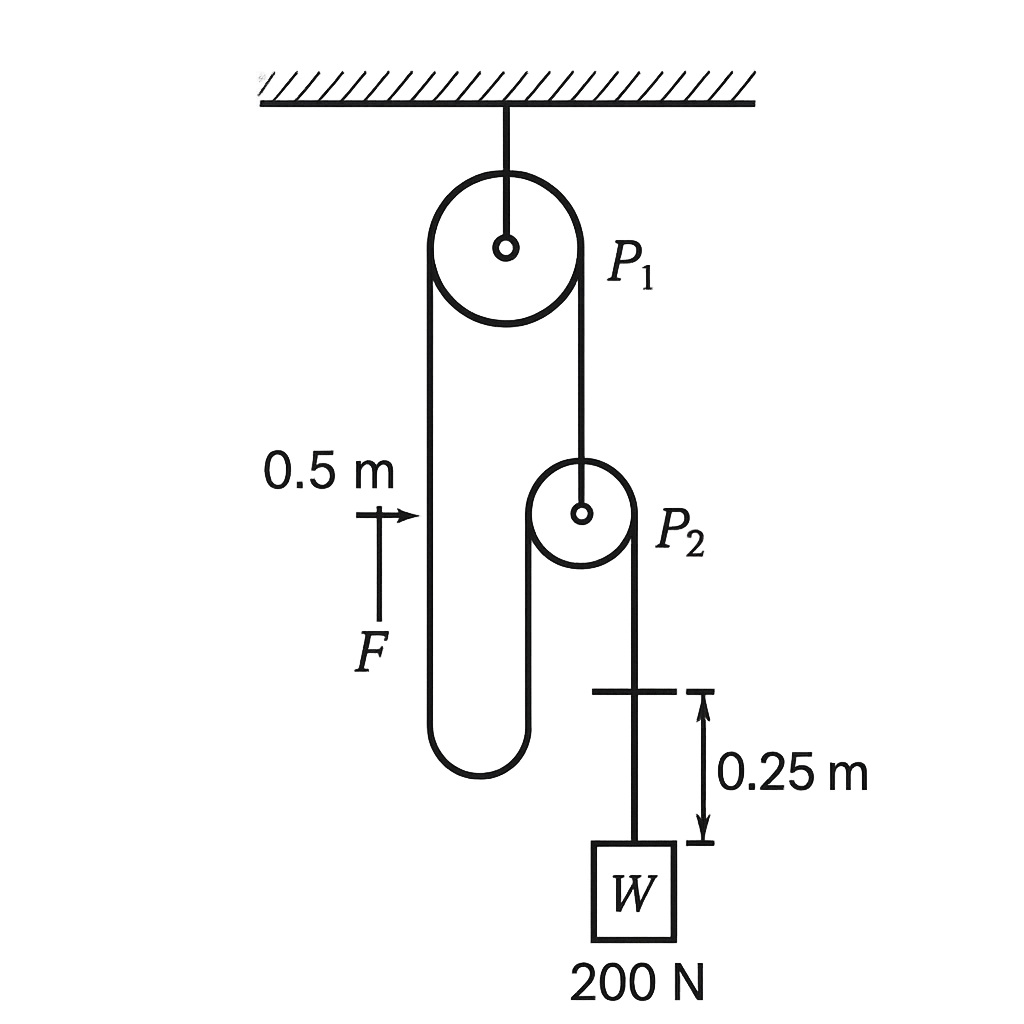
The diagram shows a compound pulley system consisting of a fixed pulley attached to the ceiling and a movable pulley attached to a load of 200 N. A single light rope passes over the fixed pulley, is attached to the movable pulley, and the free end is pulled vertically upward by a student with a force \(F\). The rope and pulleys are assumed massless and frictionless. The student pulls the rope a distance of 0.5 m, causing the load to rise.
Question Parts
(a)
Determine the ideal mechanical advantage (IMA) of the system.
(b)
If the student applies a pulling force of 120 N, calculate the actual mechanical advantage (AMA) and the efficiency of the system.
(c)
The student pulls the rope through a distance of 0.5 m. Calculate (i) the work done by the student (input work) and (ii) the work done in raising the load (output work). Comment on how these values relate to the efficiency found in part (b).
(d)
Briefly discuss two practical advantages of using such a compound pulley system when lifting heavy loads.
Detailed Essay Solution & Marking Scheme Available

Get the step-by-step mathematical proofs, key points required by examiners, and a comprehensive breakdown from our AI Tutor.

Question 7 View Details
A U‑tube manometer has mercury (density \(\rho_{Hg}=13600\,\text{kg m}^{-3}\)) in one arm and an unknown liquid of density \(\rho\) in the other arm. The mercury levels differ by \(8.0\,\text{cm}\) and the levels of the unknown liquid differ by \(12.0\,\text{cm}\). Atmospheric pressure is \(101.3\,\text{kPa}\). The manometer is connected to a piston that is placed at the bottom of a well 30.0 m deep, the well being open to the atmosphere at the surface. The piston has a circular cross‑section of area \(0.025\,\text{m}^{2}\).
Question Parts
(a)
Determine the density \(\rho\) of the unknown liquid.
(b)
Calculate the absolute pressure at the bottom of the well.
(c)
Find the magnitude of the force exerted on the piston at that depth.
Detailed Essay Solution & Marking Scheme Available

Get the step-by-step mathematical proofs, key points required by examiners, and a comprehensive breakdown from our AI Tutor.

Question 8 View Details
A uniform metal rod of length \(L=1.20\,\text{m}\) and cross‑sectional area \(A=2.0\times10^{-4}\,\text{m}^{2}\) is made of an alloy whose thermal conductivity is to be determined. One end of the rod is maintained at \(150^{\circ}\text{C}\) while the other end is kept at \(30^{\circ}\text{C}\). Under steady‑state conditions the rate of heat flow through the rod is \(45\,\text{W}\).
Question Parts
(a)
Calculate the thermal conductivity \(k\) of the alloy.
Detailed Essay Solution & Marking Scheme Available

Get the step-by-step mathematical proofs, key points required by examiners, and a comprehensive breakdown from our AI Tutor.

Master the Exam!

You've seen a preview, but there are thousands more questions plus AI tutor to break down complex solutions.

Unlock Full Access Available for Android & Windows
Help others prepare! Share this practice hub:
Chat with Support