neco 2021 biology | Objective

Prepare for your exams with neco questions? Reviewing past/model questions is one of the most effective ways to guarantee a high score. This practice hub features authentic 2021 biology (Objective) questions designed to simulate the real exam environment.

Practice these randomly selected questions to test your readiness.

Question 1 View Details
A batch fermenter is used to grow *Bacillus subtilis*. At 30 °C the specific growth rate is \( \mu = 0.45\ \text{h}^{-1} \) and the maintenance coefficient is \( m = 0.02\ \text{h}^{-1} \). When the temperature is raised to 37 °C, \( \mu \) increases by 20 % while \( m \) rises to \(0.03\ \text{h}^{-1}\). The culture starts with a biomass concentration of \(0.5\ \text{g\ L}^{-1}\). It is grown for 8 h at 30 °C and then the temperature is shifted to 37 °C for a further 4 h (total 12 h). Assuming exponential growth with net specific rate \( \mu_{\text{net}} = \mu - m \) in each phase, calculate the final biomass concentration (in g\,L\(^{-1}\)).
A. 87.3 g\/L
B. 226.3 g\/L
C. 135.2 g\/L
Correct D. 119.9 g/L

Correct Answer: D

Want to see the full step-by-step solution? Unlock AI Explanation & Analytics
Question 2 View Details
Two desert plants are compared for water‑loss adaptation. Plant\,A has a leaf area of \(0.02\ \text{m}^{2}\) per plant and a stomatal conductance of \(0.15\ \text{mol\ m}^{-2}\text{s}^{-1}\). Plant\,B has a leaf area of \(0.05\ \text{m}^{2}\) and a stomatal conductance of \(0.08\ \text{mol\ m}^{-2}\text{s}^{-1}\). The ambient vapor‑pressure deficit (VPD) is constant at \(2\ \text{kPa}\). Using the simplified transpiration equation \(E = g_{s}\,\text{VPD}\times0.1\) (which gives litres of water lost per second per square metre of leaf), calculate the total water loss per plant over a 24‑hour period for each plant and state which plant exhibits the more effective water‑conserving adaptation.
A. Plant A loses about 45 L per day and Plant B loses about 80 L per day; therefore Plant A has the more effective water‑conserving adaptation.
B. Plant A loses about 60 L per day and Plant B loses about 55 L per day; therefore Plant B has the more effective water‑conserving adaptation.
Correct C. Plant A loses about 52 L per day and Plant B loses about 69 L per day; therefore Plant A has the more effective water‑conserving adaptation.
D. Plant A loses about 52 L per day and Plant B loses about 69 L per day; therefore Plant B has the more effective water‑conserving adaptation.

Correct Answer: C

Want to see the full step-by-step solution? Unlock AI Explanation & Analytics
Question 3 View Details
A researcher investigates the effect of three fertilizer treatments (Control, Fertilizer\,X, Fertilizer\,Y) on the height of a crop using a randomized complete block design with three soil blocks. The recorded heights (cm) are:\n\nBlock\,1: Control\,12, X\,15, Y\,14\nBlock\,2: Control\,13, X\,18, Y\,16\nBlock\,3: Control\,11, X\,16, Y\,15\n\n(a) Ignoring the block effect, perform a one‑way ANOVA at the 5 % significance level to test whether fertilizer type influences plant height. State the calculated \(F\) value and the conclusion.\n(b) Briefly explain how ignoring the block factor could affect the reliability of the conclusion.
A. F ≈ 10.2 > F_{0.05,2,6}=5.14, so the effect of fertilizer is significant. Ignoring the block factor can decrease the within‑group variability, potentially inflating the apparent significance of the treatment effect.
Correct B. F ≈ 10.2 > F_{0.05,2,6}=5.14, so the effect of fertilizer is significant. Ignoring the block factor can increase the within‑group variability, potentially leading to a failure to detect a real treatment effect or to an inaccurate estimate of the treatment effect.
C. F ≈ 4.5 < F_{0.05,2,6}=5.14, so the effect of fertilizer is not significant. Ignoring the block factor can reduce the within‑group variability, potentially leading to an over‑estimation of treatment differences.
D. F ≈ 7.8 > F_{0.05,2,6}=5.14, so the effect of fertilizer is significant. Ignoring the block factor can increase the within‑group variability, potentially leading to a false indication of a treatment effect.

Correct Answer: B

Want to see the full step-by-step solution? Unlock AI Explanation & Analytics
Question 4 View Details
In the regulation of blood glucose, the rate of glucose entry from the digestive tract is constant at \(1.2\ \text{g\ min}^{-1}\). Insulin‑mediated cellular uptake follows Michaelis-Menten kinetics: uptake rate \(= \dfrac{V_{\max}\, G}{K_{m}+G}\), where \(G\) is the blood glucose concentration (g\,L\(^{-1}\)), \(V_{\max}=2.0\ \text{g\ min}^{-1}\) and \(K_{m}=5\ \text{g\ L}^{-1}\). Assuming steady‑state conditions where entry equals uptake, determine the steady‑state glucose concentration \(G\) (in g\,L\(^{-1}\)).
Correct A. 7.5 g/L
B. 10.0 g/L
C. 5.0 g/L
D. 2.4 g/L

Correct Answer: A

Want to see the full step-by-step solution? Unlock AI Explanation & Analytics
Question 5 View Details
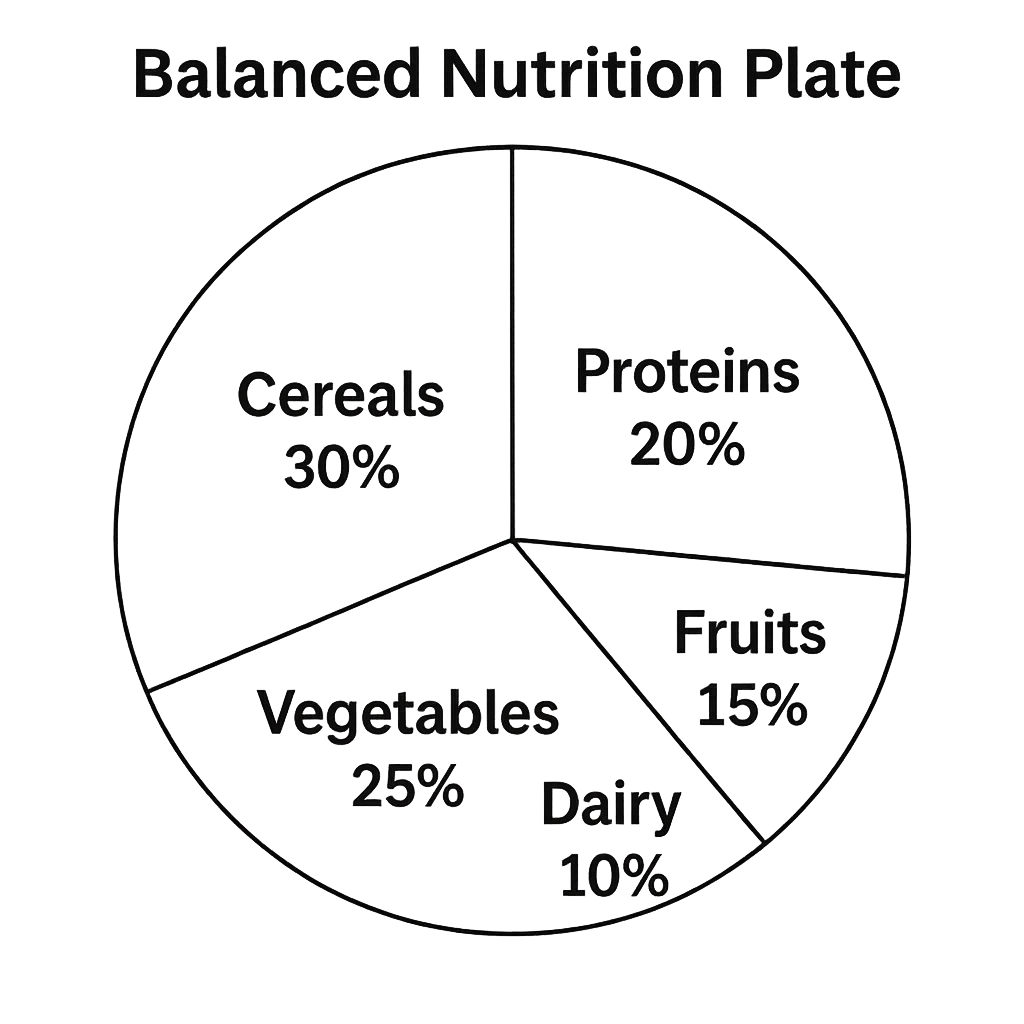
The diagram shows a balanced nutrition plate divided into five labelled sections: Cereals (30 %), Proteins (20 %), Vegetables (25 %), Fruits (15 %) and Dairy (10 %). Which food group in the diagram provides the greatest amount of protein per serving?
Correct A. Proteins
B. Vegetables
C. Cereals
D. Dairy

Correct Answer: A

Want to see the full step-by-step solution? Unlock AI Explanation & Analytics
Question 6 View Details
An unknown multicellular eukaryote exhibits the following characteristics: (i) cells with cellulose cell walls, (ii) chloroplasts containing chlorophyll a and b, (iii) alternation of generations, (iv) sporophyte produces spores in sporangia that are not enclosed, (v) the gametophyte stage is dominant, (vi) possesses vascular tissue with tracheids but does not produce seeds. Based on these traits, determine the taxonomic class to which the organism most likely belongs.
A. Lycopodiopsida
Correct B. Polypodiopsida
C. Magnoliopsida
D. Bryopsida

Correct Answer: B

Want to see the full step-by-step solution? Unlock AI Explanation & Analytics
Question 7 View Details
A leaf of area \(150\ \text{cm}^2\) loses water by transpiration at a rate of \(0.5\ \text{mg\,cm}^{-2}\,\text{h}^{-1}\) for 8 h during the day. Simultaneously, the root system of total area \(120\ \text{cm}^2\) absorbs water by root pressure at \(0.3\ \text{mg\,cm}^{-2}\,\text{h}^{-1}\) for the same period. Calculate the net water loss of the plant over the day in grams.
Correct A. 0.312
B. 0.336
C. 0.300
D. 0.288

Correct Answer: A

Want to see the full step-by-step solution? Unlock AI Explanation & Analytics
Question 8 View Details
A certain flowering plant produces on average \(250\) ovules per flower. The pollination success rate is \(68\%\). Of the fertilised ovules, \(85\%\) develop into viable seeds. If a single plant bears \(12\) flowers, how many viable seeds are expected from that plant?
Correct A. 1734
B. 1740
C. 1445
D. 1728

Correct Answer: A

Want to see the full step-by-step solution? Unlock AI Explanation & Analytics
Question 9 View Details
A specimen collected from a freshwater pond shows the following characteristics: (i) three pairs of legs, (ii) one pair of functional membranous wings and a second pair reduced to knob‑like structures that function as balance organs, (iii) mouthparts are of the sponging type, (iv) antennae are short with a bristle at the tip, (v) the abdomen is segmented with visible dorsal stripes. Based on these characteristics, identify the insect order to which the specimen belongs.
A. Coleoptera
Correct B. Diptera
C. Hemiptera
D. Lepidoptera

Correct Answer: B

Want to see the full step-by-step solution? Unlock AI Explanation & Analytics
Question 10 View Details
In a diagram of the human nephron, the structures are shown in the following order from the renal corpuscle to the point where urine enters the collecting duct: Bowman's capsule, glomerulus, proximal convoluted tubule, loop of Henle (descending limb), loop of Henle (ascending limb), distal convoluted tubule, collecting duct. However, the labels for the two limbs of the loop of Henle have been interchanged. Identify the two structures that are incorrectly labelled and provide the correct sequence of structures in the nephron.
Correct A. The descending limb and ascending limb are interchanged; correct order: Bowman's capsule, glomerulus, proximal convoluted tubule, descending limb, ascending limb, distal convoluted tubule, collecting duct
B. The proximal convoluted tubule and distal convoluted tubule are interchanged; correct order: Bowman's capsule, glomerulus, descending limb, ascending limb, proximal convoluted tubule, distal convoluted tubule, collecting duct
C. The glomerulus and Bowman's capsule are interchanged; correct order: glomerulus, Bowman's capsule, proximal convoluted tubule, descending limb, ascending limb, distal convoluted tubule, collecting duct
D. The descending limb and distal convoluted tubule are interchanged; correct order: Bowman's capsule, glomerulus, proximal convoluted tubule, distal convoluted tubule, ascending limb, descending limb, collecting duct

Correct Answer: A

Want to see the full step-by-step solution? Unlock AI Explanation & Analytics
Question 11 View Details
During meiosis, a diploid human somatic cell contains \(2n = 46\) chromosomes. From one such cell, how many haploid gametes are produced and how many chromosomes does each gamete contain?
A. 4 gametes; each contains 46 chromosomes
B. 2 gametes; each contains 23 chromosomes
Correct C. 4 gametes; each contains 23 chromosomes
D. 4 gametes; each contains 24 chromosomes

Correct Answer: C

Want to see the full step-by-step solution? Unlock AI Explanation & Analytics
Question 12 View Details
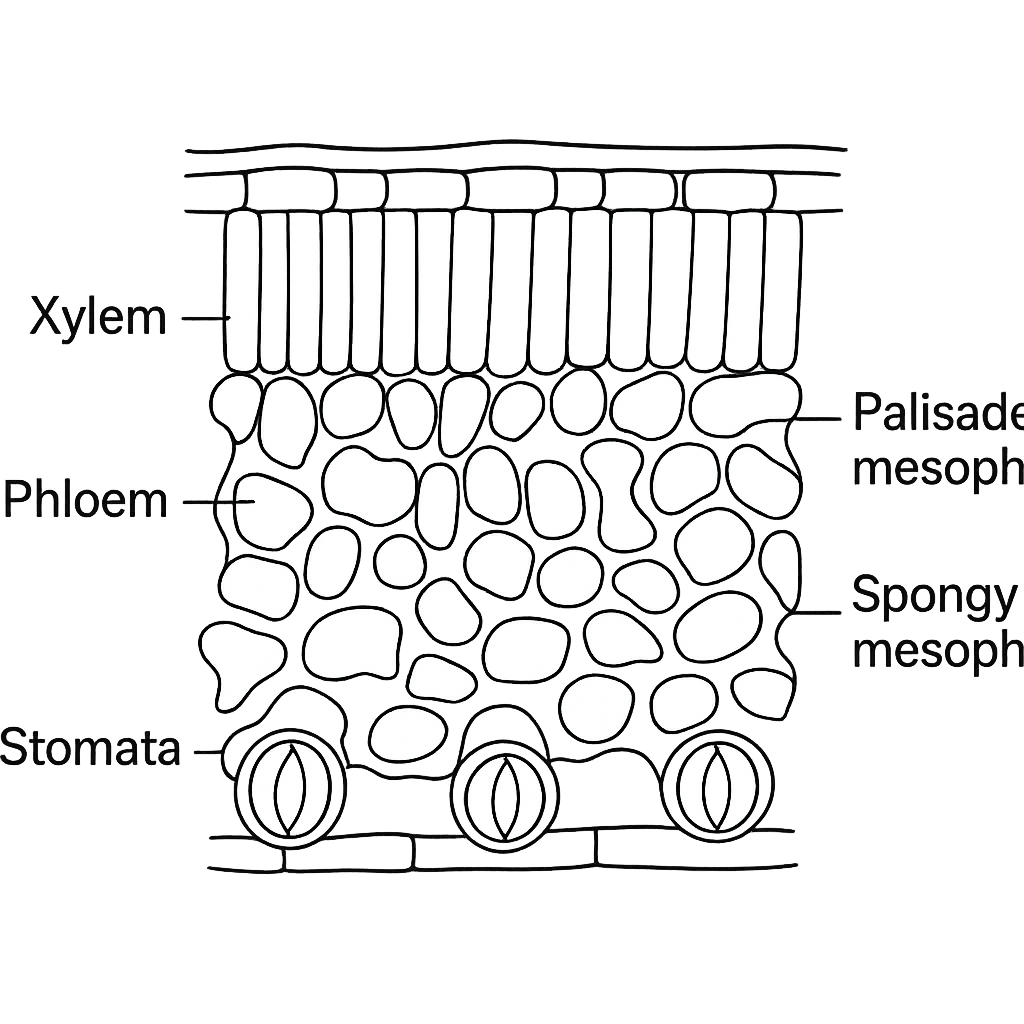
As described, a leaf diagram shows a cuticle thickness of \(5\,\mu\text{m}\), a palisade mesophyll thickness of \(30\,\mu\text{m}\) and a spongy mesophyll thickness of \(45\,\mu\text{m}\). The leaf area is \(2\ \text{cm}^2\). Assuming the thicknesses are uniform across the leaf, (a) calculate the total volume of mesophyll tissue (palisade + spongy) in cubic micrometres, and (b) indicate which mesophyll layer contributes more to gas exchange.
Correct A. Total mesophyll volume = 1.5×10^{10} µm³ (or 15 mm³); spongy mesophyll contributes more to gas exchange
B. Total mesophyll volume = 1.5×10^{9} µm³ (or 1.5 mm³); spongy mesophyll contributes more to gas exchange
C. Total mesophyll volume = 2.0×10^{10} µm³ (or 20 mm³); palisade mesophyll contributes more to gas exchange
D. Total mesophyll volume = 1.35×10^{10} µm³ (or 13.5 mm³); palisade mesophyll contributes more to gas exchange

Correct Answer: A

Want to see the full step-by-step solution? Unlock AI Explanation & Analytics
Question 13 View Details
In a grassland ecosystem the net primary productivity is \(8000\ \text{kJ m}^{-2}\text{ yr}^{-1}\). The area under consideration is \(2\ \text{ha}\). Herbivores convert \(10\%\) of the energy they obtain into their own biomass, and carnivores convert \(20\%\) of the energy they obtain from herbivores. Assuming the same \(20\%\) conversion efficiency for tertiary consumers feeding on carnivores, calculate the amount of energy (in kJ) available to tertiary consumers per year.
A. 64000 kJ
B. 1280000 kJ
Correct C. 640000 kJ
D. 320000 kJ

Correct Answer: C

Want to see the full step-by-step solution? Unlock AI Explanation & Analytics
Question 14 View Details
A human adult has a blood volume of \(5\ \text{L}\) with a haemoglobin concentration of \(150\ \text{g L}^{-1}\). Each gram of haemoglobin can bind \(1.34\ \text{mL}\) of \(\text{O}_2\) at STP. During moderate exercise, \(25\%\) of the oxygen bound to haemoglobin is extracted by the muscles. If the cardiac output is \(5\ \text{L min}^{-1}\), calculate the volume of \(\text{O}_2\) (in litres) delivered to the muscles each minute.
A. 0.5 L
B. 0.125 L
C. 0.75 L
Correct D. 0.25 L

Correct Answer: D

Want to see the full step-by-step solution? Unlock AI Explanation & Analytics
Question 15 View Details
The population of a fish species in a lake follows the discrete logistic model \(N_{t+1}=N_t + rN_t\left(1-\frac{N_t}{K}\right)\) with intrinsic growth rate \(r = 0.5\ \text{month}^{-1}\) and carrying capacity \(K = 2000\). If the initial population is \(N_0 = 500\), determine the population size after three months.
A. 1085
B. 1240
C. 1005
Correct D. 1161

Correct Answer: D

Want to see the full step-by-step solution? Unlock AI Explanation & Analytics
Question 16 View Details
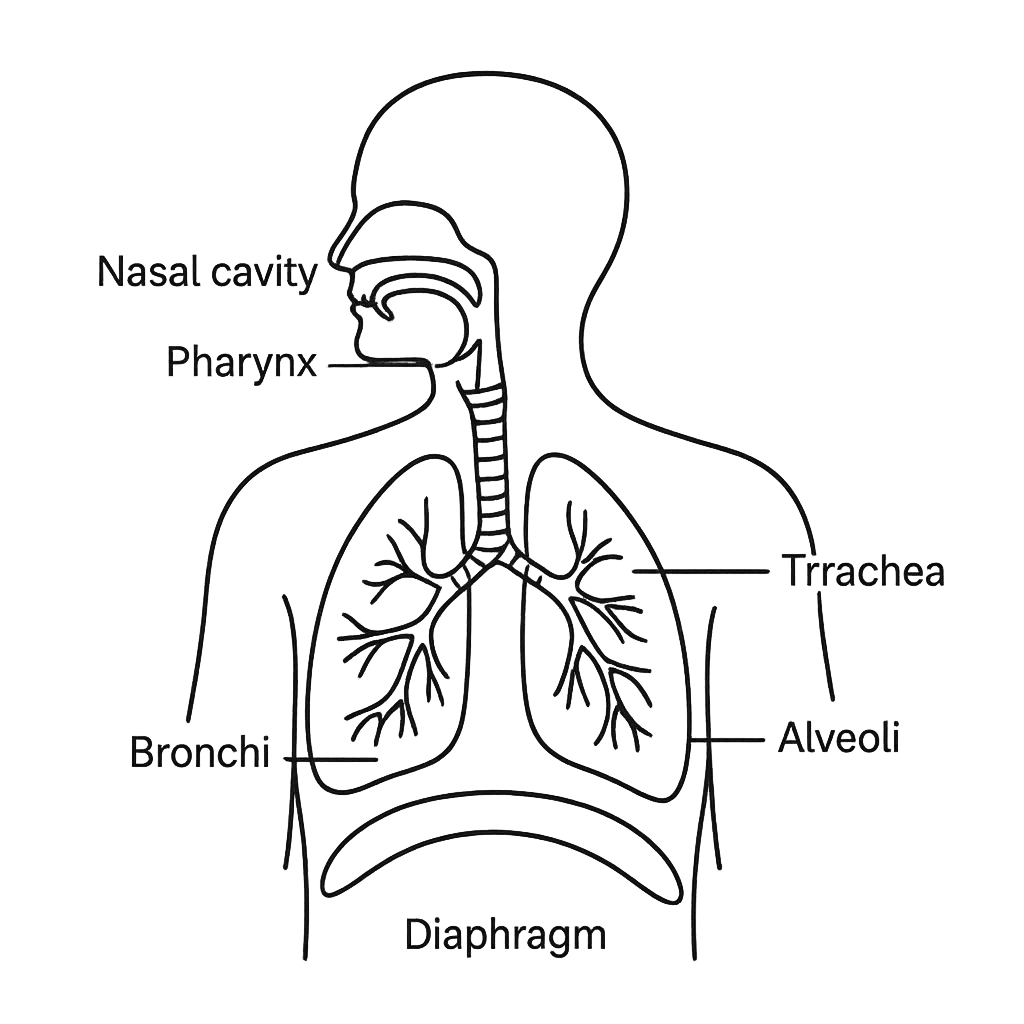
Using the labelled diagram of the human respiratory system, note that the alveolar partial pressure of oxygen ( \(P_{A\text{O2}}\) ) is 100 mmHg while atmospheric \(P_{O2}\) is 160 mmHg. If emphysema reduces the effective alveolar surface area by 30% but the diffusion gradient remains unchanged, estimate the percentage increase in breathing rate required to keep the total oxygen uptake unchanged, assuming oxygen uptake is directly proportional to surface area and ventilation rate.
A. 35%
B. 60%
Correct C. 43%
D. 50%

Correct Answer: C

Want to see the full step-by-step solution? Unlock AI Explanation & Analytics
Question 17 View Details
Consider a stretch reflex in which the sensory neuron length from the muscle spindle to the spinal cord is 0.5 m and the motor neuron length from the spinal cord to the muscle is 0.4 m. The conduction velocity of the sensory fibre is 80 m·s\(^{-1}\) and that of the motor fibre is 60 m·s\(^{-1}\). The synaptic delay at the spinal interneuron is 0.5 ms. Calculate the total reflex time from the onset of muscle stretch to the beginning of muscle contraction. Is this reflex time less than 15 ms, classifying it as a fast reflex? Answer "Yes" or "No".
Correct A. Yes
B. No (not a fast reflex)
C. No (reflex time exceeds 15 ms)
D. No

Correct Answer: A

Want to see the full step-by-step solution? Unlock AI Explanation & Analytics
Question 18 View Details
The glomerular filtration rate (GFR) is 120 mL·min\(^{-1}\). Plasma sodium concentration is 145 mmol·L\(^{-1}\). Ninety‑nine percent of the filtered Na\(^+\) is reabsorbed before the distal tubule, and the remaining 1% is excreted. (a) Calculate the amount of Na\(^+\) (in mmol) excreted per minute under normal conditions. (b) A diuretic increases Na\(^+\) excretion by 20% without changing GFR. Assuming that each mmol of Na\(^+\) excreted draws 1 mL of water, determine the change in blood volume (in mL) per minute caused by the diuretic.
A. -0.25
Correct B. -0.21
C. -0.20
D. -0.15

Correct Answer: B

Want to see the full step-by-step solution? Unlock AI Explanation & Analytics
Question 19 View Details
At an ambient temperature of 25\,\degree C, a resting adult loses heat by radiation at a rate of 150 kJ·h\(^{-1}\). Heat loss by radiation is proportional to the temperature difference between core body temperature (37\,\degree C) and ambient temperature. (a) Determine the proportionality constant \(k\) (in kJ·h\(^{-1}\)·\degree C\(^{-1}\)). (b) If the ambient temperature drops to 15\,\degree C, calculate the new rate of heat loss. (c) How much additional metabolic heat production (in kJ·h\(^{-1}\)) must be generated by shivering to maintain core temperature?
A. 150
B. 100
Correct C. 125
D. 135

Correct Answer: C

Want to see the full step-by-step solution? Unlock AI Explanation & Analytics
Question 20 View Details
In a large population the frequencies of the blood‑type alleles are: \(p_{i}=0.60\), \(p_{A}=0.25\) and \(p_{B}=0.15\). Assuming Hardy-Weinberg equilibrium, (a) calculate the expected phenotypic frequency of blood type AB. (b) If the observed frequency of type AB is 0.04, state whether the observed frequency is higher or lower than expected.
Correct A. lower
B. the same
C. higher
D. equal

Correct Answer: A

Want to see the full step-by-step solution? Unlock AI Explanation & Analytics
Question 21 View Details
Which vitamin deficiency is the primary cause of night blindness in humans?
A. Vitamin D
B. Vitamin C
C. Vitamin B
Correct D. Vitamin A

Correct Answer: D

Want to see the full step-by-step solution? Unlock AI Explanation & Analytics
Question 22 View Details
A balanced diet provides a total metabolic energy of \(2500\) kJ per day. Carbohydrates supply 55% of the energy, proteins 15%, and the remaining energy is supplied by fats. Given that the energy yields are \(17\) kJ per gram for carbohydrates and proteins, and \(37\) kJ per gram for fats, calculate the number of grams of each macronutrient (carbohydrate, protein, fat) that the diet contains.
A. Carbohydrate ≈ 70 g, Protein ≈ 30 g, Fat ≈ 25 g
Correct B. Carbohydrate ≈ 81 g, Protein ≈ 22 g, Fat ≈ 20 g
C. Carbohydrate ≈ 85 g, Protein ≈ 20 g, Fat ≈ 22 g
D. Carbohydrate ≈ 92 g, Protein ≈ 25 g, Fat ≈ 15 g

Correct Answer: B

Want to see the full step-by-step solution? Unlock AI Explanation & Analytics
Question 23 View Details
The glomerular filtration rate (GFR) in a healthy adult is about \(180\) mL min\(^{-1}\). If the plasma glucose concentration is \(12\) mmol L\(^{-1}\) and the renal threshold for glucose reabsorption is \(10\) mmol L\(^{-1}\), calculate the amount of glucose (in mmol) excreted in the urine per day, assuming that 99% of the filtered water and all glucose up to the threshold are reabsorbed.
Correct A. 518 mmol per day (approximately)
B. 52 mmol per day (approximately)
C. 3110 mmol per day (approximately)
D. 31 mmol per day (approximately)

Correct Answer: A

Want to see the full step-by-step solution? Unlock AI Explanation & Analytics
Question 24 View Details
At rest a person consumes \(250\) mL of \(\mathrm{O_2}\) per minute. During vigorous exercise the \(\mathrm{O_2}\) consumption rises to \(1.5\) L per minute. If the respiratory quotient (RQ) is \(0.8\) in both conditions, determine (a) the volume of \(\mathrm{CO_2}\) produced per minute at rest and during exercise, and (b) the total caloric expenditure per day assuming the person rests for 16 h and exercises for 2 h, using the conversion \(1\) L of \(\mathrm{O_2}\) ≈ \(5\) kcal.
A. Rest CO₂ ≈ 0.15 L min⁻¹; Exercise CO₂ ≈ 1.5 L min⁻¹; Total energy ≈ 2300 kcal per day
Correct B. Rest CO₂ ≈ 0.20 L min⁻¹; Exercise CO₂ ≈ 1.2 L min⁻¹; Total energy ≈ 2100 kcal per day
C. Rest CO₂ ≈ 0.25 L min⁻¹; Exercise CO₂ ≈ 1.0 L min⁻¹; Total energy ≈ 1900 kcal per day
D. Rest CO₂ ≈ 0.30 L min⁻¹; Exercise CO₂ ≈ 1.8 L min⁻¹; Total energy ≈ 2500 kcal per day

Correct Answer: B

Want to see the full step-by-step solution? Unlock AI Explanation & Analytics
Question 25 View Details
A simplified cladogram shows four species (A, B, C, D). The branch lengths (in million years) from the most recent common ancestor to each species are: A = 6 My, B = 8 My, C = 10 My, D = 12 My. The branch that joins the ancestor of A and B to the root is 4 My, and the branch that joins the ancestor of C and D to the root is also 4 My. Assuming a molecular clock, answer: (a) which pair of species shares the most recent common ancestor? (b) Estimate the time (in million years) since the divergence of that pair.
A. Species A and B; they diverged about 8 million years ago.
B. Species C and D; they diverged about 4 million years ago.
C. Species A and C; they diverged about 6 million years ago.
Correct D. Species A and B; they diverged about 4 million years ago.

Correct Answer: D

Want to see the full step-by-step solution? Unlock AI Explanation & Analytics

Master the Exam!

You've seen a preview, but there are thousands more questions plus AI tutor to break down complex solutions.

Unlock Full Access Available for Android & Windows
Help others prepare! Share this practice hub:
Chat with Support