neco 2021 agricultural_science | Objective

Prepare for your exams with neco questions? Reviewing past/model questions is one of the most effective ways to guarantee a high score. This practice hub features authentic 2021 agricultural_science (Objective) questions designed to simulate the real exam environment.

Practice these randomly selected questions to test your readiness.

Question 1 View Details
An agricultural extension programme has a total budget of ₦500,000. The cost to establish one demonstration farm includes land (₦30,000), seeds (₦20,000) and labour (₦30,000). Each demonstration farm influences five neighbouring farmers, each of whom pays a fee of ₦20,000 for the technology. The programme aims to (i) stay within the budget and (ii) generate at least ₦500,000 in total adoption fees. What is the maximum number of demonstration farms that can be established while satisfying both conditions?
A. 7
B. 5
Correct C. 6
D. 8

Correct Answer: C

Want to see the full step-by-step solution? Unlock AI Explanation & Analytics
Question 2 View Details
A soil sample has a porosity of \(45\%\) and a current volumetric water content of \(30\%\). What percentage of the pore space is still occupied by air?
A. 10
B. 25
Correct C. 15
D. 20

Correct Answer: C

Want to see the full step-by-step solution? Unlock AI Explanation & Analytics
Question 3 View Details
A fish population follows the logistic growth model \(\frac{dN}{dt}= rN\left(1-\frac{N}{K}\right)\) where the intrinsic rate \(r = 0.4\) year⁻¹ and the carrying capacity \(K = 200{,}000\) fish. A constant harvest \(H\) fish per year is applied. Determine the maximum constant harvest \(H_{\text{max}}\) that will allow the population to reach a non‑zero stable equilibrium, and state the equilibrium population size at that harvest.
A. H_{max}=15,000 fish per year; equilibrium population = 125,000 fish
B. H_{max}=25,000 fish per year; equilibrium population = 75,000 fish
Correct C. H_{max}=20,000 fish per year; equilibrium population = 100,000 fish
D. H_{max}=10,000 fish per year; equilibrium population = 150,000 fish

Correct Answer: C

Want to see the full step-by-step solution? Unlock AI Explanation & Analytics
Question 4 View Details
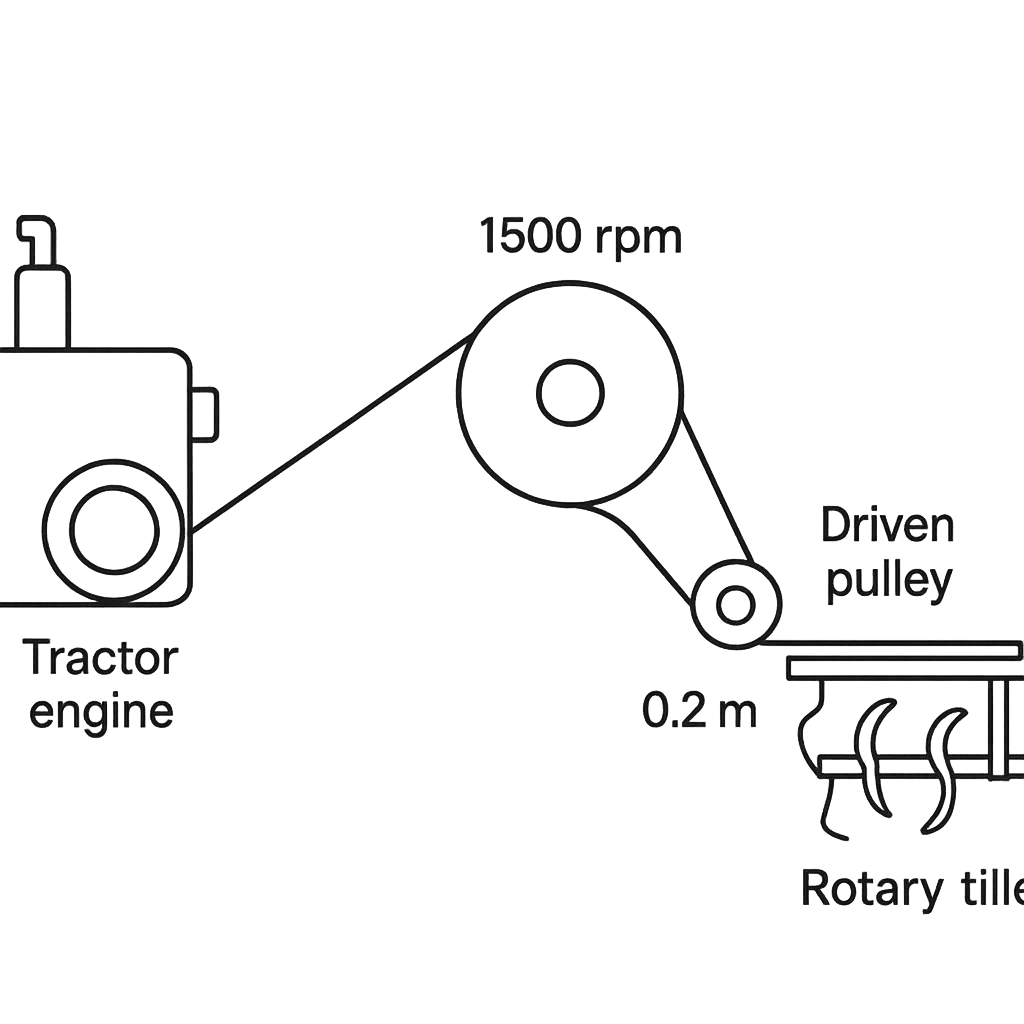
In the diagram, a tractor engine drives a belt that runs over two pulleys: the driver pulley attached to the engine has a diameter of \(0.5\) m and rotates at \(1500\) rpm. The driven pulley attached to the rotary tiller has a diameter of \(0.2\) m. Assuming no slip, (i) calculate the tiller rotational speed in rpm, and (ii) if the tiller requires a minimum speed of \(3500\) rpm to operate efficiently, decide whether an additional gear reduction is needed and, if so, compute the required gear ratio to achieve at least \(3500\) rpm.
A. 4500 rpm; no additional gear reduction needed
B. 3750 rpm; additional gear reduction needed
C. 3000 rpm; additional gear reduction needed
Correct D. 3750 rpm; no additional gear reduction needed

Correct Answer: D

Want to see the full step-by-step solution? Unlock AI Explanation & Analytics
Question 5 View Details
A cattle farm has 120 cattle. A disease has an incubation period of 10 days and each infected animal becomes infectious for 5 days before recovery. The farm plans a vaccination programme that reduces susceptibility by 80 % per vaccinated animal. To achieve herd immunity, at least 75 % effective immunity in the herd is required. Each vaccine dose protects one animal for the whole risk period and costs ₦2,500. Determine the minimum number of cattle that must be vaccinated and the total cost of the vaccination programme.
A. 115 cattle; total cost = ₦287,500
B. 110 cattle; total cost = ₦275,000
C. 108 cattle; total cost = ₦270,000
Correct D. 113 cattle; total cost = ₦282,500

Correct Answer: D

Want to see the full step-by-step solution? Unlock AI Explanation & Analytics
Question 6 View Details
A farmer is choosing between a manual plough and a motorised plough for a 2‑ha field. The manual plough costs \(\text{₦}5{,}000\), requires \(2\) hours to plough \(0.5\) ha, and has no fuel cost. The motorised plough costs \(\text{₦}30{,}000\), requires \(0.5\) hour to plough \(0.5\) ha, and consumes fuel at \(\text{₦}200\) per hour. Both ploughs are expected to be used for 5 years, during which the farmer will plough \(100\) ha each year. Assuming straight‑line amortisation over the total 500 ha, which plough results in the lower total cost for the 2‑ha field and by how much?
Correct A. Manual plough; ₦500 cheaper
B. Manual plough; ₦1,200 cheaper
C. Motorised plough; ₦300 cheaper
D. Motorised plough; ₦2,000 cheaper

Correct Answer: A

Want to see the full step-by-step solution? Unlock AI Explanation & Analytics
Question 7 View Details
A field contains 1500 kg of dry soil with a nitrogen content of 2 %. The farmer adds 30 kg of urea that is 46 % nitrogen by weight. After thorough mixing, what is the new percentage of nitrogen in the soil (to two decimal places)?
A. 3.12%
B. 2.45%
C. 2.70%
Correct D. 2.86%

Correct Answer: D

Want to see the full step-by-step solution? Unlock AI Explanation & Analytics
Question 8 View Details
A lake fish population follows the logistic model \(\frac{dP}{dt}=rP\left(1-\frac{P}{K}\right)\) with intrinsic growth rate \(r=0.4\) yr\(^{-1}\) and carrying capacity \(K=10{,}000\) fish. A constant harvest of \(H\) fish per year is planned. (a) What is the maximum sustainable harvest \(H_{\text{max}}\) that allows a non‑zero equilibrium? (b) If the manager wants the equilibrium population to be at least 4 000 fish, what is the largest integer harvest \(H\) (in fish per year) that satisfies this condition?
Correct A. 960
B. 800
C. 1000
D. 1120

Correct Answer: A

Want to see the full step-by-step solution? Unlock AI Explanation & Analytics
Question 9 View Details
A farmer grows maize with fixed costs of \(\text{₦}150{,}000\) per season and a variable cost of \(\text{₦}30{,}000\) per ton produced. The market price per ton is uncertain: with 60 % probability it will be \(\text{₦}55{,}000\) and with 40 % probability it will be \(\text{₦}45{,}000\). The farmer can plant either 5 tons (low‑risk) or 8 tons (high‑risk). If production exceeds market demand, the surplus is sold at 80 % of the prevailing market price. Market demand is 6 tons when the price is \(\text{₦}55{,}000\) and 7 tons when the price is \(\text{₦}45{,}000\). Which planting level maximises the farmer's expected profit, and what is that expected profit?
A. Plant 5 tons; expected profit ₦900
B. Plant 8 tons; expected profit ₦1,000
Correct C. Plant 8 tons; expected profit ₦1,200
D. Plant 5 tons; expected profit ₦1,200

Correct Answer: C

Want to see the full step-by-step solution? Unlock AI Explanation & Analytics
Question 10 View Details
A rabbit farm must supply 120 g of protein per rabbit per day. Two commercial feeds are available: Feed A contains 20 % protein and costs \(\text{₦}250\) per kg; Feed B contains 15 % protein and costs \(\text{₦}180\) per kg. Assuming the total amount of feed given to a rabbit is minimised while meeting the protein requirement exactly, determine the daily quantity (in kg) of each feed and the resulting daily feed cost per rabbit.
Correct A. 0.6 kg Feed A; cost ₦150 per day
B. 0.5 kg Feed A; cost ₦125 per day
C. 0.7 kg Feed A; cost ₦175 per day
D. 0.6 kg Feed B; cost ₦108 per day

Correct Answer: A

Want to see the full step-by-step solution? Unlock AI Explanation & Analytics
Question 11 View Details
A farmer plans to raise chickens to a market weight of \(2.0\) kg each. The chicks start at \(0.05\) kg. The feed conversion ratio (FCR) is \(1.8\) for weeks 1‑4, \(1.5\) for weeks 5‑8 and \(1.3\) for weeks 9‑12. Assuming the weight gain is linear over the 12 weeks, and the farmer has \(500\) kg of feed, what is the maximum number of chickens that can be raised to market weight? Give your answer as a whole number.
Correct A. 167
B. 160
C. 165
D. 170

Correct Answer: A

Want to see the full step-by-step solution? Unlock AI Explanation & Analytics
Question 12 View Details
A farmer harvests \(2\) tonnes of fresh cassava roots with an initial moisture content of \(60\%\) (wet basis). After peeling and slicing, the chips are dried in a solar dryer. The drying rate (kg water removed per hour per tonne of wet chips) is given by \(R = 30 - 0.5T\), where \(T\) is the temperature above \(30^{\circ}\)C. The dryer operates at \(45^{\circ}\)C for the first \(6\) h and then at \(35^{\circ}\)C thereafter. The target final moisture content is \(12\%\) (wet basis). Determine the total drying time (in hours, to one decimal place) required to reach the target moisture content.
A. 18.4
Correct B. 20.9
C. 22.7
D. 24.1

Correct Answer: B

Want to see the full step-by-step solution? Unlock AI Explanation & Analytics
Question 13 View Details
In a dairy herd the average milk yield is \(20\) L per day. The farmer selects the top \(20\%\) of cows for breeding; these cows produce on average \(30\%\) more milk than the herd average. With a heritability of \(0.4\) and a phenotypic standard deviation of \(4\) L, use the breeder's equation \(\Delta G = i \times h^{2} \times \sigma_{P}\) (where the selection intensity \(i\) for the top \(20\%\) is \(1.4\)) to estimate the expected increase in average herd yield in the next generation and state the new herd average (to two decimal places).
A. 21.84
Correct B. 22.24
C. 23.04
D. 22.64

Correct Answer: B

Want to see the full step-by-step solution? Unlock AI Explanation & Analytics
Question 14 View Details
A livestock disease has a basic reproduction number \(R_{0}=3.5\). A vaccine with \(85\%\) efficacy is available. To eradicate the disease the effective reproduction number must satisfy \(R_{e}=R_{0}(1-p\times e)<1\), where \(p\) is the proportion of the herd vaccinated and \(e\) is the vaccine efficacy (as a decimal). Calculate the minimum vaccination coverage \(p\) (as a percentage, to one decimal place) required.
Correct A. 84.0
B. 83.5
C. 90.0
D. 85.0

Correct Answer: A

Want to see the full step-by-step solution? Unlock AI Explanation & Analytics
Question 15 View Details
A farmer stores \(1.5\) tonnes of maize in a hermetic bag. The initial moisture content is \(13\%\) (wet basis). During storage the moisture content follows first‑order kinetics: \(\frac{dM}{dt} = -k\,(M-M_{eq})\), where \(M\) is moisture percentage, \(M_{eq}=12\%\) is the equilibrium moisture at the storage temperature, and \(k=0.05\) day⁻¹. Determine the moisture content after \(10\) days and state whether the grain meets the safe‑storage limit of \(\le 13\%\) moisture. Give the moisture content to two decimal places.
Correct A. 12.61
B. 13.12
C. 12.05
D. 11.98

Correct Answer: A

Want to see the full step-by-step solution? Unlock AI Explanation & Analytics
Question 16 View Details
A farmer monitors a 5‑ha maize field. He randomly samples 20 plants and rates disease severity on a scale of 0-5 (0 = no symptoms, 5 = severe). The sum of the severity scores is 48. The disease index (DI) is calculated as DI = ( \( \frac{\Sigma \text{severity scores}}{n \times 5} \times 100 \) ). The recommended fungicide application threshold is DI \( \ge \) 30 %. (a) Compute the DI and state whether the farmer should apply the fungicide. (b) Assuming the observed standard deviation of severity scores is 1.4, determine how many additional plants must be sampled so that the standard error of the mean severity does not exceed 0.2, using a 95 % confidence level (z = 1.96).
A. No, do not apply fungicide; 120 additional plants
B. No, do not apply fungicide; 169 additional plants
Correct C. Yes, apply fungicide; 169 additional plants
D. Yes, apply fungicide; 150 additional plants

Correct Answer: C

Want to see the full step-by-step solution? Unlock AI Explanation & Analytics
Question 17 View Details
An aphid population on a 2‑ha soybean field starts at 1 200 individuals and doubles every 3 days. The economic threshold (ET) is 8 000 aphids per ha. The insecticide costs ₦2 500 per ha, and each aphid above the ET causes a loss of ₦0.005. Assuming the farmer can apply the insecticide only at the end of a 3‑day interval, determine the latest day (counted from day 0) on which the farmer can apply the insecticide so that the total cost (control cost plus loss cost) is minimized.
A. 27
B. 21
Correct C. 24
D. 18

Correct Answer: C

Want to see the full step-by-step solution? Unlock AI Explanation & Analytics
Question 18 View Details
A farm ecosystem contains a total of 2 000 tonnes of carbon. If 60 % is stored in the soil, 25 % in vegetation and the remainder in livestock, how many tonnes of carbon are stored in the vegetation?
A. 600
B. 400
Correct C. 500
D. 300

Correct Answer: C

Want to see the full step-by-step solution? Unlock AI Explanation & Analytics
Question 19 View Details
A teak forest covers 100 ha. The initial standing volume is 150 m³ ha⁻¹ and the annual growth rate is 5 % of the current volume. The manager wishes to harvest a constant annual volume H (m³ ha⁻¹) each year for 20 years, while ensuring that after 20 years the standing volume is at least 120 m³ ha⁻¹ to maintain ecological function. Determine the maximum value of H (rounded to one decimal place) that satisfies this condition.
A. 9.2
Correct B. 8.4
C. 10.1
D. 7.9

Correct Answer: B

Want to see the full step-by-step solution? Unlock AI Explanation & Analytics
Question 20 View Details
A farmer can use two pesticides against a pest: pesticide A kills 90 % of the pest population on first use, but each consecutive use of A reduces its efficacy by 5 % absolute (e.g., 90 % → 85 % → 80 %). Pesticide B always kills 80 % and does not induce resistance. The farmer may apply only one pesticide per season and wants the average control efficacy over three consecutive seasons to be at least 85 %. (a) Propose a sequence of pesticide applications (e.g., A, B, A) that meets the requirement. (b) Compute the average efficacy of your proposed sequence.
Correct A. A, B, A; average efficacy 86.7 %
B. A, B, A; average efficacy 85.0 %
C. B, A, A; average efficacy 86.7 %
D. A, A, B; average efficacy 84.3 %

Correct Answer: A

Want to see the full step-by-step solution? Unlock AI Explanation & Analytics
Question 21 View Details
A mango orchard has \(2000\) trees. Initially \(5\%\) of the trees are infected with a fungal disease. Each month the disease spreads to \(30\%\) of the trees that are still healthy. After three months, how many trees are infected? Give your answer as an integer.
Correct A. 1348
B. 1350
C. 1400
D. 1338

Correct Answer: A

Want to see the full step-by-step solution? Unlock AI Explanation & Analytics
Question 22 View Details
A \(5\)-ha maize field is infested with stem‑borer larvae at a density of \(12\) larvae per square metre. A pesticide reduces the larval population by \(40\%\) immediately after application. However, each subsequent weekly application loses \(15\%\) of the previous efficacy (i.e., the percentage reduction is multiplied by \(0.85\) each week). If the farmer applies the pesticide once a week for three weeks, what is the expected total number of larvae remaining after the third application? Round to the nearest whole larva.
A. 168934
Correct B. 169114
C. 170112
D. 165800

Correct Answer: B

Want to see the full step-by-step solution? Unlock AI Explanation & Analytics
Question 23 View Details
A teak plantation covers \(120\) ha. The average annual volume growth is \(8\) m³ per ha. The forest currently has a standing volume of \(10,000\) m³. The manager intends to harvest the same amount of timber each year for ten years, but the harvest in any year must not exceed \(10\%\) of the standing volume at the start of that year. After ten years the standing volume must be at least \(9,000\) m³. (i) Determine the maximum constant annual harvest volume (in m³) that satisfies both conditions. (ii) Assuming each cubic metre of teak stores \(0.9\) tonnes of CO₂, calculate the total amount of carbon sequestered in the standing volume after ten years.
A. 950 m³ per year; 8,190 tonnes
B. 1,000 m³ per year; 9,000 tonnes
C. 1,100 m³ per year; 9,504 tonnes
Correct D. 1,000 m³ per year; 8,640 tonnes

Correct Answer: D

Want to see the full step-by-step solution? Unlock AI Explanation & Analytics
Question 24 View Details
A farmer plans to grow cassava on \(5\) ha. Expected yield is \(20\) tonnes per ha, giving a total production of \(100\) tonnes. Variable cost is \(₦45,000\) per tonne. Fixed costs are land rent \(₦150,000\), labor \(₦200,000\) and equipment depreciation \(₦80,000\). The farmer can sell cassava at a market price of \(P\) naira per tonne. If payment is made within 30 days the buyer receives a \(5\%\) discount on the total bill, and a sales tax of \(2\%\) is applied to the net amount after discount. What is the minimum market price \(P\) (in naira per tonne) that the farmer must set to achieve a net profit of at least \(₦500,000\) after discount and tax? Give your answer rounded up to the nearest naira.
A. 59000
B. 60000
C. 56000
Correct D. 58325

Correct Answer: D

Want to see the full step-by-step solution? Unlock AI Explanation & Analytics
Question 25 View Details
A soil test for a \(3\)-ha maize field shows nutrient deficiencies of nitrogen \(120\) kg ha⁻¹, phosphorus (as P₂O₅) \(60\) kg ha⁻¹ and potassium (as K₂O) \(80\) kg ha⁻¹. The farmer intends to use a compound fertilizer labelled 20‑10‑10 (percent by weight of N‑P₂O₅‑K₂O). (i) Determine the amount of this fertilizer (in kg) that should be applied per hectare to meet exactly the nitrogen requirement. (ii) Calculate the total cost for the whole 3‑ha field if the fertilizer costs \(₦45\) per kg. (iii) State whether any nutrient will be in excess or deficient after this application, and by how many kilograms per hectare.
Correct A. 600 kg/ha; ₦81,000; potassium deficiency of 20 kg/ha
B. 600 kg/ha; ₦81,000; phosphorus excess of 10 kg/ha
C. 500 kg/ha; ₦67,500; nitrogen deficiency of 20 kg/ha
D. 600 kg/ha; ₦81,000; potassium deficiency of 30 kg/ha

Correct Answer: A

Want to see the full step-by-step solution? Unlock AI Explanation & Analytics

Master the Exam!

You've seen a preview, but there are thousands more questions plus AI tutor to break down complex solutions.

Unlock Full Access Available for Android & Windows
Help others prepare! Share this practice hub:
Chat with Support