neco 2020 agricultural_science | Objective

Prepare for your exams with neco questions? Reviewing past/model questions is one of the most effective ways to guarantee a high score. This practice hub features authentic 2020 agricultural_science (Objective) questions designed to simulate the real exam environment.

Practice these randomly selected questions to test your readiness.

Question 1 View Details
The bulk density of a soil is \(1.4\ \text{g cm}^{-3}\). What is the mass of soil in kilograms per hectare for the top \(15\) cm layer?
A. 21000000 kg
B. 2150000 kg
C. 210000 kg
Correct D. 2100000 kg

Correct Answer: D

Want to see the full step-by-step solution? Unlock AI Explanation & Analytics
Question 2 View Details
A forest area of \(200\) ha is planted with species X at a spacing of \(3\) m \(\times\) \(3\) m. The volume growth of each tree is given by \(V = 0.05 t^{2}\) (m\(^3\)) where \(t\) is the age in years. The forest is managed on a \(30\)-year rotation.\n\n(a) Calculate the total timber volume (in m\(^3\)) that can be harvested at the end of the rotation.\n(b) Determine the average annual allowable cut (AAC) in m\(^3\) ha\(^{-1}\) yr\(^{-1}\).\n(c) If a \(10\)% loss occurs due to pests, what is the adjusted AAC?
A. 1200 m^3/ha/year
B. 1600 m^3/ha/year
Correct C. 1500 m^3/ha/year
D. 1800 m^3/ha/year

Correct Answer: C

Want to see the full step-by-step solution? Unlock AI Explanation & Analytics
Question 3 View Details
A tractor has an engine power of \(50\) kW and a transmission efficiency of \(85\)% . It is used to pull a 2‑bottom moldboard plough, each bottom having a width of \(0.25\) m. The soil draft per metre width is estimated by \(D = 0.1 (M+5) d v\) (kN m\(^{-1}\)), where \(M\) is the soil moisture percentage, \(d\) is the tillage depth in cm, and \(v\) is the forward speed in km h\(^{-1}\).\n\nIf the operation is carried out at a speed of \(5\) km h\(^{-1}\) in soil with \(12\)% moisture and a tillage depth of \(15\) cm, determine whether the tractor can maintain this speed without slipping.
A. No, the required power (35.0 kW) exceeds the available drawbar power (42.5 kW).
B. Yes, the required power (88.5 kW) is less than the available drawbar power (42.5 kW).
C. No, the required power (88.5 kW) exceeds the available drawbar power (55.0 kW).
Correct D. No, the required power (88.5 kW) exceeds the available drawbar power (42.5 kW).

Correct Answer: D

Want to see the full step-by-step solution? Unlock AI Explanation & Analytics
Question 4 View Details
Soil test results for a field are: available nitrogen \(20\) kg ha\(^{-1}\), phosphorus \(8\) kg ha\(^{-1}\) (as \(P_2O_5\)), and potassium \(15\) kg ha\(^{-1}\) (as \(K_2O\)). The target maize crop requires \(150\) kg ha\(^{-1}\) N, \(60\) kg ha\(^{-1}\) \(P_2O_5\), and \(80\) kg ha\(^{-1}\) \(K_2O\).\n\nFertiliser options are: urea (46% N), single superphosphate (20% \(P_2O_5\)), muriate of potash (60% \(K_2O\)), and a blended NPK fertiliser 20‑10‑15 (percent by weight).\n\nDetermine the amounts (kg ha\(^{-1}\)) of the blended NPK, urea, single superphosphate and muriate of potash that should be applied to meet the crop nutrient requirements exactly while minimising the total fertiliser applied.
Correct A. NPK 20-10-15: 433 kg/ha; Urea: 94 kg/ha; Single superphosphate: 43 kg/ha; Muriate of potash: 0 kg/ha
B. NPK 20-10-15: 420 kg/ha; Urea: 90 kg/ha; Single superphosphate: 40 kg/ha; Muriate of potash: 2 kg/ha
C. NPK 20-10-15: 450 kg/ha; Urea: 80 kg/ha; Single superphosphate: 30 kg/ha; Muriate of potash: 10 kg/ha
D. NPK 20-10-15: 400 kg/ha; Urea: 100 kg/ha; Single superphosphate: 50 kg/ha; Muriate of potash: 5 kg/ha

Correct Answer: A

Want to see the full step-by-step solution? Unlock AI Explanation & Analytics
Question 5 View Details
A farmer harvests \(10\) tonnes of fresh cassava roots with an initial moisture content of \(65\)% (wet basis). The roots must be dried to \(12\)% moisture for safe storage. The dryer removes moisture at a rate of \(0.8\) kg water per hour per tonne of fresh roots and operates \(8\) hours per day. The dryer consumes \(5\) kW of power and electricity costs \(\u20A6\)150 per kWh. \n\nCalculate (a) the total drying time in days, (b) the total energy cost, and (c) the net profit if the market price of dried cassava is \(\u20A6\)200 per kg and the farmer's production cost (excluding drying) is \(\u20A6\)500 per tonne of fresh roots. Assume no loss other than moisture removal.
A. Drying time ≈ 85 days; Energy cost ≈ \u20A6550,000; Net profit ≈ \u20A6240,000
B. Drying time ≈ 90 days; Energy cost ≈ \u20A6600,000; Net profit ≈ \u20A6220,000
C. Drying time ≈ 100 days; Energy cost ≈ \u20A6630,000; Net profit ≈ \u20A6210,000
Correct D. Drying time ≈ 95 days; Energy cost ≈ \u20A6565,000; Net profit ≈ \u20A6226,000

Correct Answer: D

Want to see the full step-by-step solution? Unlock AI Explanation & Analytics
Question 6 View Details
A tractor weighing 3500 kg pulls a plough of mass 800 kg up a 5 % incline at a constant speed of \(4\ \text{km h}^{-1}\). The rolling‑resistance coefficient for both tractor and plough is \(0.04\). The soil draft resistance is \(150\ \text{N kN}^{-1}\). Assuming a drivetrain efficiency of \(85\%\), calculate the minimum engine power required in kilowatts (kW).
Correct A. 6.5
B. 8.1
C. 5.9
D. 7.3

Correct Answer: A

Want to see the full step-by-step solution? Unlock AI Explanation & Analytics
Question 7 View Details
A farmer has 25 goats each weighing on average 45 kg that show signs of haemonchosis. The recommended treatment is ivermectin at a dose of \(200\ \mu\text{g kg}^{-1}\) body weight, supplied as a 1 % (w/v) solution (i.e., \(10\ \text{mg ml}^{-1}\)). Determine the total volume of the solution required to treat all the affected goats and the minimum number of 5 ml syringes needed (round up to whole syringes).
A. 22.5 ml, 4 syringes
B. 23 ml, 5 syringes
C. 20 ml, 4 syringes
Correct D. 22.5 ml, 5 syringes

Correct Answer: D

Want to see the full step-by-step solution? Unlock AI Explanation & Analytics
Question 8 View Details
A hand hoe has a handle length of \(1.2\ \text{m}\) and the distance from the pivot (where the blade meets the handle) to the cutting edge is \(0.15\ \text{m}\). To lift a soil clod weighing \(12\ \text{N}\), the farmer applies a force perpendicular to the handle at its end. (a) Calculate the minimum force the farmer must exert. (b) To reduce this effort by 30\% , the farmer plans to extend the handle by adding a brace, increasing the effort arm length while keeping the load arm unchanged. Determine the required effort‑arm length (in metres, to two decimal places) that will achieve exactly a 30\% reduction, and state the new required force.
A. Original force 1.5 N; required effort arm 1.50 m; new force 1.05 N
B. Original force 1.5 N; required effort arm 1.71 m; new force 0.90 N
C. Original force 1.8 N; required effort arm 1.71 m; new force 1.26 N
Correct D. Original force 1.5 N; required effort arm 1.71 m; new force 1.05 N

Correct Answer: D

Want to see the full step-by-step solution? Unlock AI Explanation & Analytics
Question 9 View Details
A \(2.5\)-ha maize field is infested with stem borer at a density of \(8\) larvae m\(^{-2}\). Two insecticides are available:\n\n- Insecticide A: application rate \(0.75\ \text{L ha}^{-1}\), cost ₦\(120\ \text{L}^{-1}\).\n- Insecticide B: application rate \(1.2\ \text{L ha}^{-1}\), cost ₦\(85\ \text{L}^{-1}\); it is only effective when pest density exceeds \(6\) larvae m\(^{-2}\).\n\nWhich insecticide should be used for this field, and what is the total cost (in ₦) of treating the whole field with the chosen product? Provide the answer in the form "Insecticide X, total cost ₦Y".
Correct A. Insecticide A, total cost ₦225
B. Insecticide A, total cost ₦240
C. Insecticide B, total cost ₦225
D. Insecticide B, total cost ₦255

Correct Answer: A

Want to see the full step-by-step solution? Unlock AI Explanation & Analytics
Question 10 View Details
A farmer harvests \(1.2\) tonnes (\(1200\ \text{kg}\)) of fresh cassava roots with an initial moisture content of \(60\%\) (wet basis). He intends to produce dried cassava chips with a final moisture content of \(12\%\) (wet basis). The solar dryer used has an average drying rate of \(0.45\ \text{kg water m}^{-2}\ \text{h}^{-1}\) and can be operated \(8\) h per day.\n\n(a) Calculate the total mass of water that must be removed.\n\n(b) If the dryer has a collector area of \(10\ \text{m}^{2}\), how many whole days are required to complete the drying? (Round up to the next whole day.)\n\n(c) What is the minimum collector area (in m², rounded up to the nearest whole square metre) needed to finish the drying in exactly \(3\) days?
A. (a) 600 kg, (b) 20 days, (c) 65 m²
B. (a) 720 kg, (b) 18 days, (c) 58 m²
Correct C. (a) 655 kg, (b) 19 days, (c) 61 m²
D. (a) 680 kg, (b) 19 days, (c) 70 m²

Correct Answer: C

Want to see the full step-by-step solution? Unlock AI Explanation & Analytics
Question 11 View Details
A farmer has a \(1\) ha earthen pond that can be used to raise either tilapia or catfish for a \(6\)-month production cycle. Tilapia grow to \(0.5\) kg per fish and sell for \(\text{₦}500\) per kg; their feed conversion ratio (FCR) is \(1.5\). Catfish grow to \(0.8\) kg per fish and sell for \(\text{₦}650\) per kg; their FCR is \(2.0\). The farmer has \(10\,000\) kg of feed available for the season and the pond can accommodate at most \(20\,000\) fish in total. Determine how many tilapia and how many catfish should be stocked to maximise total profit, and state the maximum profit (in naira).
A. 10,000 tilapia, 5,000 catfish; maximum profit = ₦5,250,000
B. 12,500 tilapia, 0 catfish; maximum profit = ₦3,125,000
Correct C. 13,333 tilapia, 0 catfish; maximum profit = ₦3,333,250
D. 0 tilapia, 12,500 catfish; maximum profit = ₦8,125,000

Correct Answer: C

Want to see the full step-by-step solution? Unlock AI Explanation & Analytics
Question 12 View Details
In a herd of \(200\) cattle, \(12\) were observed to have foot-and-mouth disease (FMD) during an outbreak, giving an incidence of \(6\%\). A vaccine that is \(85\%\) effective is now available. If the farmer vaccinates \(150\) cattle and leaves the remaining \(50\) unvaccinated, estimate the expected total number of FMD cases after a similar exposure, rounding to the nearest whole animal.
A. 2
B. 3
Correct C. 4
D. 5

Correct Answer: C

Want to see the full step-by-step solution? Unlock AI Explanation & Analytics
Question 13 View Details
A lake fish population follows the logistic growth model \(\frac{dN}{dt}=rN\left(1-\frac{N}{K}\right)\) with intrinsic growth rate \(r=0.4\)\,year\(^{-1}\) and carrying capacity \(K=80\,000\) fish. A manager wishes to harvest a constant number \(H\) of fish each year while keeping the population at equilibrium (i.e., \(\frac{dN}{dt}=0\)). Determine the maximum sustainable annual harvest \(H_{\max}\) and the corresponding equilibrium population size.
A. H_{max}=6,000 fish per year; equilibrium N=30,000 fish
Correct B. H_{max}=8,000 fish per year; equilibrium N=40,000 fish
C. H_{max}=12,000 fish per year; equilibrium N=20,000 fish
D. H_{max}=10,000 fish per year; equilibrium N=50,000 fish

Correct Answer: B

Want to see the full step-by-step solution? Unlock AI Explanation & Analytics
Question 14 View Details
A \(1.5\) ha earthen pond \(1.2\) m deep is stocked with \(10\,000\) tilapia, each weighing \(0.5\) kg. At \(28\)°C each kilogram of fish consumes \(0.2\) g of dissolved oxygen per hour. Natural photosynthesis in the pond supplies \(150\) g O₂ per hour. The pond volume is \(1.5\) ha × 1.2 m = \(18\,000\) m³ (i.e., \(18\,000\,000\) L). To keep dissolved oxygen above \(5\) mg L\(^{-1}\), determine the minimum aeration rate (in g O₂ per hour) that must be provided.
A. 900 g O₂ per hour
B. 700 g O₂ per hour
Correct C. 850 g O₂ per hour
D. 1000 g O₂ per hour

Correct Answer: C

Want to see the full step-by-step solution? Unlock AI Explanation & Analytics
Question 15 View Details
A tractor pulls a three‑share moldboard plough. The draft required for each share is \(1\,500\) N when the tractor moves at \(5\) km h\(^{-1}\). The transmission efficiency of the tractor is \(85\)% . Calculate the minimum engine power (in kW) that the tractor must develop to maintain this speed.
Correct A. 7.4 kW
B. 6.8 kW
C. 5.9 kW
D. 8.2 kW

Correct Answer: A

Want to see the full step-by-step solution? Unlock AI Explanation & Analytics
Question 16 View Details
A farmer produces maize. The market price per tonne is given by \( P = 60{,}000 - 2{,}000 Q \) where \(Q\) is the total quantity produced in tonnes. The farmer incurs a fixed cost of \(200{,}000\) Naira and a variable cost of \(10{,}000\) Naira per tonne produced. Determine the quantity \(Q\) (in tonnes) that maximizes profit and state the maximum profit (in Naira).
Correct A. 112500
B. 125000
C. 100000
D. 90000

Correct Answer: A

Want to see the full step-by-step solution? Unlock AI Explanation & Analytics
Question 17 View Details
In a 5‑hectare tomato field containing 1,200 plants, a survey finds 180 plants showing leaf‑spot symptoms, of which 30 % also exhibit wilting. (a) Calculate the disease incidence of leaf spot as a percentage. (b) Calculate the percentage of plants that show both leaf spot and wilting. (c) If a recommended fungicide costs \(250\) Naira per hectare and must be applied twice, compute the total cost for the whole field.
A. Incidence=18%; Both=5.4%; Total cost=3000 Naira
B. Incidence=15%; Both=6%; Total cost=2500 Naira
C. Incidence=12%; Both=3.6%; Total cost=1250 Naira
Correct D. Incidence=15%; Both=4.5%; Total cost=2500 Naira

Correct Answer: D

Want to see the full step-by-step solution? Unlock AI Explanation & Analytics
Question 18 View Details
A farmer has 8 ha of land to allocate between maize and cowpea. Expected yields are 3.5 t ha⁻¹ for maize and 1.2 t ha⁻¹ for cowpea. Market prices are \(40{,}000\) Naira per tonne for maize and \(60{,}000\) Naira per tonne for cowpea. The farmer wants a total revenue of at least \(900{,}000\) Naira. What is the minimum area (in hectares, to the nearest 0.1 ha) that must be planted with maize to meet the target?
A. 3.9
B. 6.0
Correct C. 4.8
D. 5.2

Correct Answer: C

Want to see the full step-by-step solution? Unlock AI Explanation & Analytics
Question 19 View Details
A dairy cow produces 25 L of milk per day while consuming 20 kg of dry‑matter feed, giving a feed conversion ratio (FCR) of milk (L) per kg DM. The farmer aims to increase milk yield by 20 % without changing feed intake. (a) What will be the new FCR? (b) Typical FCR values for dairy cows range from 1.2 to 1.5 L kg⁻¹. Is the required FCR realistic? Justify.
A. New FCR=1.2 L\/kg, which falls below the typical range and is therefore unrealistic.
B. New FCR=1.8 L\/kg, which exceeds the typical range and is not realistic.
C. New FCR=1.0 L\/kg, which is well within the typical range and thus realistic.
Correct D. New FCR=1.5 L/kg, which is at the upper limit of typical range and therefore marginally realistic.

Correct Answer: D

Want to see the full step-by-step solution? Unlock AI Explanation & Analytics
Question 20 View Details
An extension officer has a budget of \(250{,}000\) Naira to promote a new pest‑control technique to 200 smallholder farmers. Three dissemination methods are available: (1) Radio broadcast costing \(150{,}000\) Naira, reaching all farmers with an adoption probability of 0.4; (2) Group demonstration costing \(80{,}000\) Naira, reaching 60 % of the farmers with adoption probability 0.7; (3) Individual farm visits costing \(500\) Naira per farmer visited, with adoption probability 0.9. Determine the combination of methods that maximizes the expected number of adopters without exceeding the budget, and give that expected number.
Correct A. 156
B. 140
C. 150
D. 162

Correct Answer: A

Want to see the full step-by-step solution? Unlock AI Explanation & Analytics
Question 21 View Details
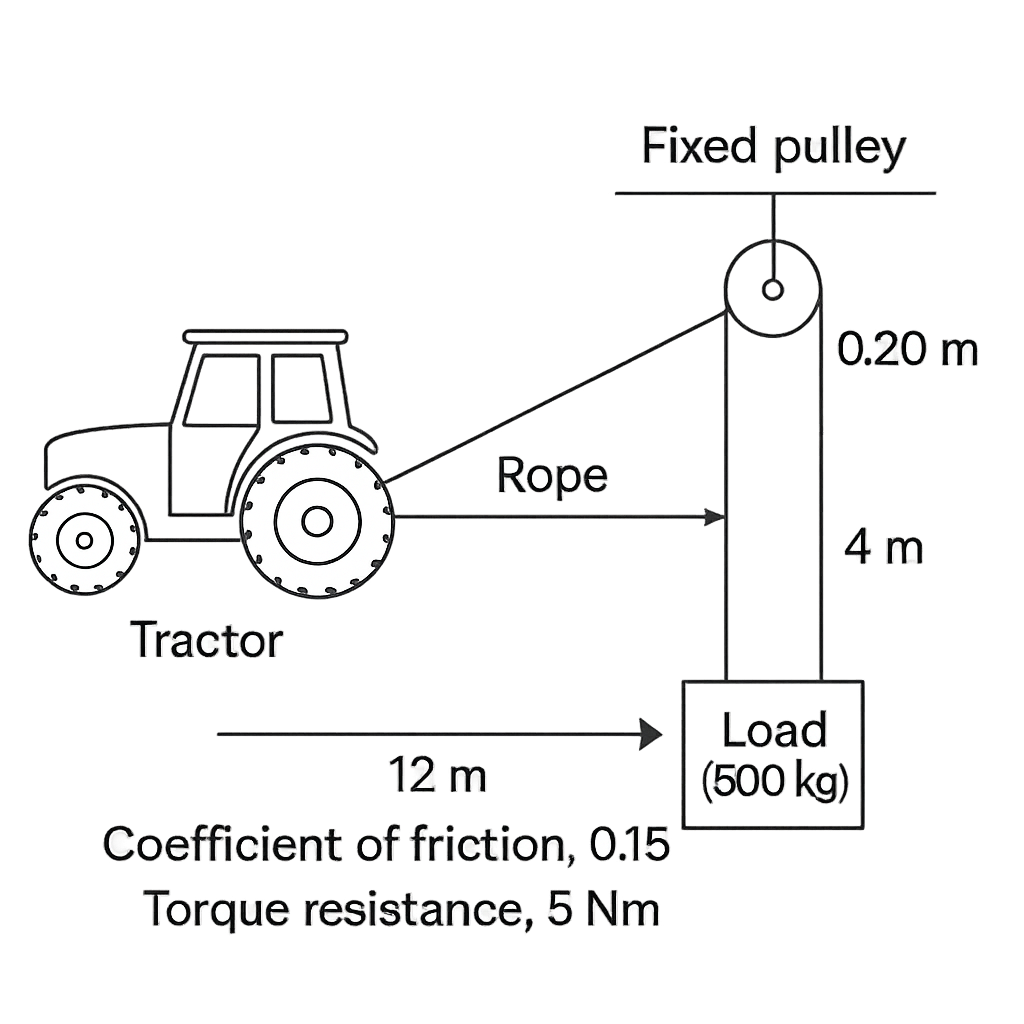
Refer to the diagram of a farm machinery setup where a tractor pulls a rope over a fixed pulley to lift a load. The load mass is \(500\\ \text{kg}\), the pulley radius is \(0.20\\ \text{m}\) and has a torque resistance of \(5\\ \text{Nm}\). The coefficient of friction between the rope and the pulley bearing is \(0.15\). Assuming the tractor pulls the rope at constant speed, calculate the minimum pulling force (in newtons) the tractor must exert to lift the load.
A. 5300 N
B. 5900 N
C. 5600 N
Correct D. 5660 N

Correct Answer: D

Want to see the full step-by-step solution? Unlock AI Explanation & Analytics
Question 22 View Details
In a field the total nitrogen input is \(120\\ \text{kg\,ha}^{-1}\). Leguminous crops contribute 25\% of this nitrogen by fixation. The remaining nitrogen is supplied by a synthetic fertilizer that contains 0.80\\ \text{kg}\ of nitrogen per kilogram of fertilizer. How many kilograms of synthetic fertilizer are required per hectare?
A. 72 kg
B. 120 kg
Correct C. 112.5 kg
D. 118.75 kg

Correct Answer: C

Want to see the full step-by-step solution? Unlock AI Explanation & Analytics
Question 23 View Details
A grain storage bin initially contains \(10{,}000\\ \text{kg}\) of maize with a moisture content of \(14\%\) (wet basis). The target moisture content is \(12\%\). The drying system removes moisture at a rate proportional to the difference between the current moisture content and the ambient moisture content of \(8\%\), with a proportionality constant of \(0.05\\ \text{day}^{-1}\). Assuming the moisture content follows the model \(M(t)=M_a+(M_0-M_a)e^{-kt}\), calculate the number of days required to reach the target moisture content. Give your answer to one decimal place.
Correct A. 8.1 days
B. 7.4 days
C. 9.0 days
D. 6.8 days

Correct Answer: A

Want to see the full step-by-step solution? Unlock AI Explanation & Analytics
Question 24 View Details
A soil sample has a cation exchange capacity (CEC) of \(20\\ \text{cmol}_c\\ \text{kg}^{-1}\). If the mass of the soil sample is \(2.5\\ \text{kg}\), what is the total charge in cmol\(_c\) that the soil can hold?
A. 45 cmolc
Correct B. 50 cmolc
C. 20 cmolc
D. 60 cmolc

Correct Answer: B

Want to see the full step-by-step solution? Unlock AI Explanation & Analytics
Question 25 View Details
A farmer intends to spray pesticide\,X on maize. The recommended dosage is \(2.5\\ \text{L}\) of pesticide per hectare, mixed with a spray volume of \(200\\ \text{L}\) of water per hectare. The farmer has a 500\\ \text{L}\ tank and needs to treat \(3.2\) ha. Determine (a) the total volume of pesticide required, (b) the amount of pesticide to add to each tank load, assuming the tank is filled to capacity for the first load and the remaining volume for the second load. Express the pesticide quantities in liters to two decimal places.
A. 7.50 L total; 5.00 L and 2.50 L for the first and second loads respectively
B. 8.00 L total; 6.00 L and 2.00 L for the first and second loads respectively
Correct C. 8.00 L total; 6.25 L and 1.75 L for the first and second loads respectively
D. 8.00 L total; 5.60 L and 2.40 L for the first and second loads respectively

Correct Answer: C

Want to see the full step-by-step solution? Unlock AI Explanation & Analytics

Master the Exam!

You've seen a preview, but there are thousands more questions plus AI tutor to break down complex solutions.

Unlock Full Access Available for Android & Windows
Help others prepare! Share this practice hub:
Chat with Support