neco 2020 agricultural_science | Essay

Prepare for your exams with neco questions? Reviewing past/model questions is one of the most effective ways to guarantee a high score. This practice hub features authentic 2020 agricultural_science (Essay) questions designed to simulate the real exam environment.

Practice these randomly selected questions to test your readiness.

Question 1 View Details
A farmer wishes to understand the ecological basis of his farm and how to improve its sustainability.
Question Parts
(a)
Define an agricultural ecosystem and list its three main biotic components.
(b)
Explain two ways in which monoculture can negatively affect (i) soil fertility and (ii) pest incidence on the farm.
(c)
Suggest three management practices that can enhance biodiversity on the farm and give a brief justification for each.
Detailed Essay Solution & Marking Scheme Available

Get the step-by-step mathematical proofs, key points required by examiners, and a comprehensive breakdown from our AI Tutor.
Question 2 View Details
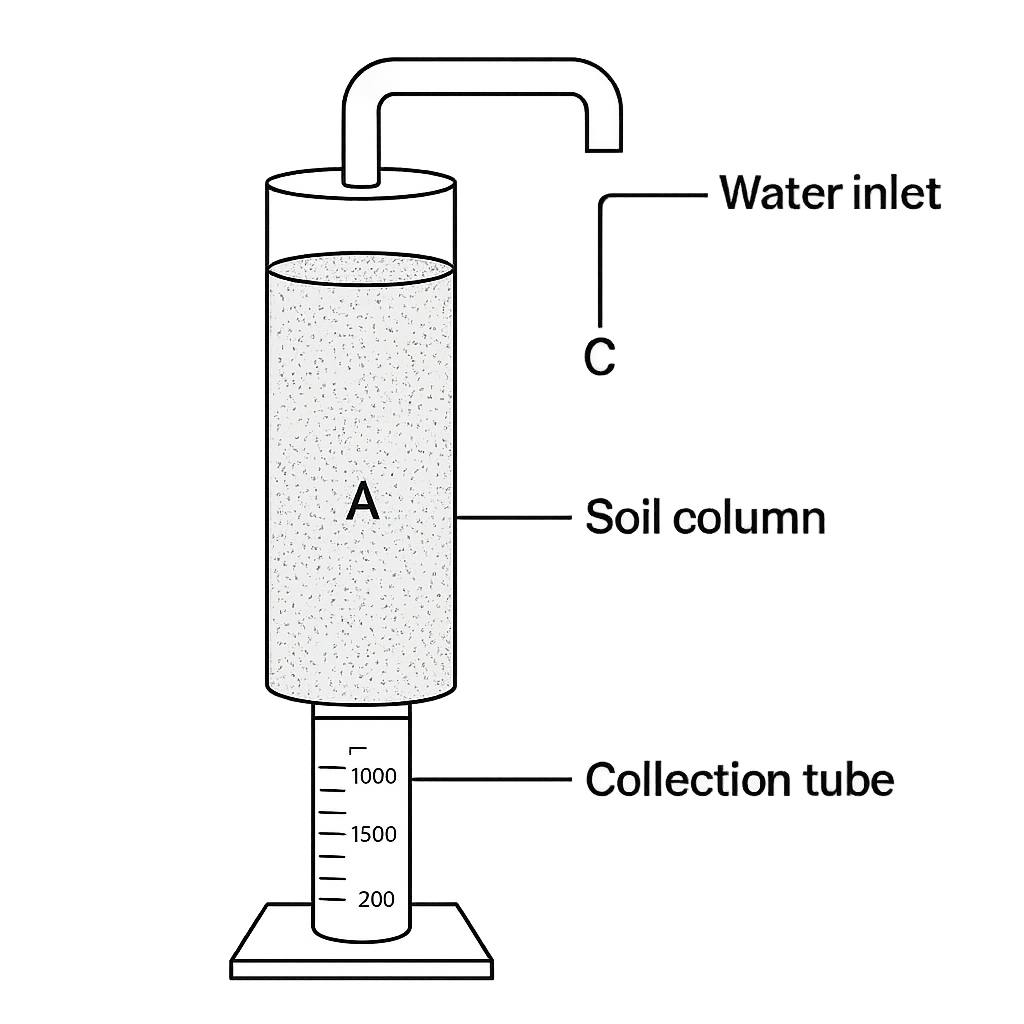
A soil‑water retention experiment is set up as shown in the illustration. The cylindrical column has an internal diameter of 10 cm and a height of 30 cm. The column is filled with a soil sample and fitted with a graduated collection tube at the base to record drained water. The procedure is: 1. Saturate the soil and allow free drainage until outflow stops – the volume of water collected is 1500 mL (field capacity). 2. After the soil dries to the permanent wilting point, add water until the column again reaches field capacity – the volume required is 200 mL. Using the data, determine: (a) The total volume of the soil column (in mL). (b) The volumetric water content at field capacity (expressed as a decimal to two places). (c) The volumetric water content at the permanent wilting point. (d) The available water holding capacity of the soil (difference between field capacity and wilting point, expressed as a decimal to two places).
Question Parts
(a)
Calculate the total volume of the soil column.
(b)
Determine the volumetric water content at field capacity.
(c)
Find the volumetric water content at the permanent wilting point.
(d)
Calculate the available water holding capacity (difference between field capacity and wilting point).
Detailed Essay Solution & Marking Scheme Available

Get the step-by-step mathematical proofs, key points required by examiners, and a comprehensive breakdown from our AI Tutor.
Question 3 View Details
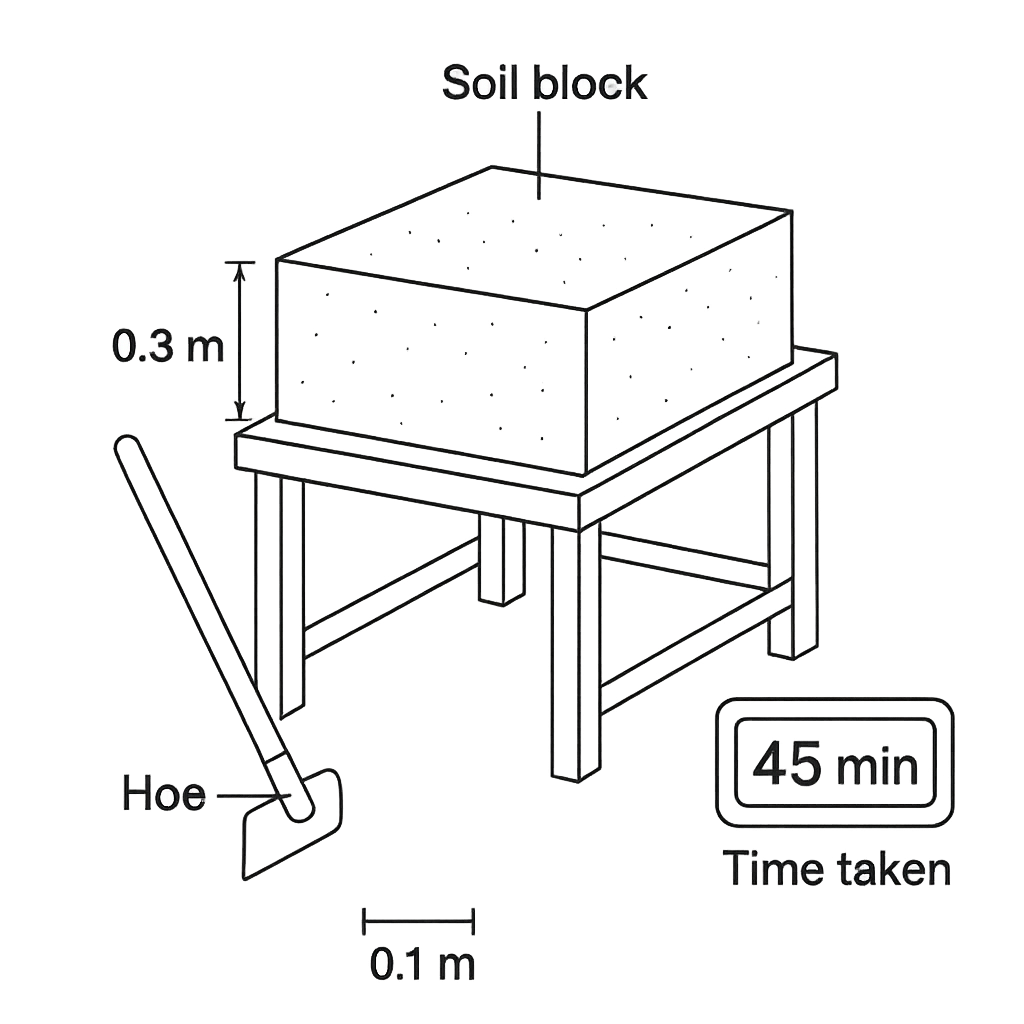
The illustration shows a practical setup for evaluating the efficiency of a manual hoe in breaking a compacted soil block. The soil block is rectangular, measuring 0.5 m in length, 0.3 m in width and 0.2 m in depth, and is supported by a wooden frame. The initial mass of the soil block (before tillage) is 120 kg. After tillage with the manual hoe, the bulk density of the soil reduces to 0.9 g cm⁻³ while the volume remains unchanged. The total time taken to till the whole block with the hoe is recorded as 45 minutes.
Question Parts
(a)
Calculate the mass of the soil after tillage using the given bulk density.
(b)
Determine the percentage reduction in soil mass as a result of the tillage operation.
(c)
If a motorised tiller works at 1.5 times the speed of the manual hoe, estimate the time required for the motorised tiller to till the same soil block to the same bulk‑density condition.
(d)
Discuss two agronomic benefits of reducing soil bulk density through tillage.
Detailed Essay Solution & Marking Scheme Available

Get the step-by-step mathematical proofs, key points required by examiners, and a comprehensive breakdown from our AI Tutor.

Question 4 View Details
A smallholder farmer is evaluating the purchase of a two‑stroke gasoline‑engine tractor for his 2‑ha vegetable farm. The tractor specifications are: rated power 12 kW at 2500 rpm, fuel consumption 3.5 L h⁻¹ at full load. The farmer intends to use the tractor for three operations with the following data: - Ploughing: drawbar pull 1.8 kN, ground speed 3 km h⁻¹. - Hauling a loaded trailer: drawbar pull 1.2 kN, ground speed 4 km h⁻¹. - Irrigation pump: hydraulic power requirement 4.5 kW, supplied via PTO at 540 rpm with 90 % mechanical efficiency. The cropping season lasts 20 weeks, with the tractor operating 6 hours per day, 5 days a week.
Question Parts
(a)
Calculate the tractive power (in kW) required for ploughing and for hauling. State which operation demands the greater power.
(b)
Determine the total fuel consumption for the entire season if the tractor operates at full load for 30 % of the total working hours and at 60 % load for the remaining time. Assume fuel consumption varies linearly with load.
(c)
A diesel‑engine alternative costs ₦250,000 more but consumes 15 % less fuel at the same load. Using a diesel price of ₦180 per litre, calculate the net fuel‑cost saving over the season and indicate after how many seasons the extra purchase cost would be recovered.
(d)
Explain two advantages of using a PTO‑driven irrigation pump on the tractor compared with a separate diesel pump.
Detailed Essay Solution & Marking Scheme Available

Get the step-by-step mathematical proofs, key points required by examiners, and a comprehensive breakdown from our AI Tutor.

Question 5 View Details
A farmer intends to implement a three‑year crop rotation on a 9‑hectare farm. The rotation will consist of maize (Year 1), cowpea (Year 2) and cassava (Year 3), each cultivated on 3 ha. Soil analysis of the field gave the following results: pH = 5.5, organic matter = 2 %, available nitrogen = 45 kg ha⁻¹, available phosphorus = 12 kg ha⁻¹ and available potassium = 90 kg ha⁻¹. The target soil pH for optimal maize production is 6.5. The recommended lime requirement for a sandy‑loam soil is 2.5 t ha⁻¹ for each unit increase in pH. Recommended fertilizer rates are: - Maize: 120 kg N, 60 kg P₂O₅ and 40 kg K₂O per hectare, - Cowpea: 30 kg N, 20 kg P₂O₅ and 15 kg K₂O per hectare, - Cassava: 50 kg N, 25 kg P₂O₅ and 30 kg K₂O per hectare. Expected yields after proper soil amendment are 4.5 t ha⁻¹ for maize, 1.8 t ha⁻¹ for cowpea and 12 t ha⁻¹ for cassava. Answer the following:
Question Parts
(a)
Determine the amount of agricultural lime required to raise the soil pH to the target level for the whole 9 ha farm.
(b)
Calculate the total quantity of N, P₂O₅ and K₂O fertilizer needed for the entire rotation (all three crops).
(c)
Discuss two agronomic advantages of the proposed crop rotation for soil fertility and pest management.
Detailed Essay Solution & Marking Scheme Available

Get the step-by-step mathematical proofs, key points required by examiners, and a comprehensive breakdown from our AI Tutor.

Question 6 View Details
A smallholder keeps 25 West African dwarf goats and 120 local chickens. The goats are reared for meat and are expected to gain an average of 2.5 kg per month over a 6‑month growth period. Their daily dry matter intake (DMI) is 3 % of body weight. The chickens are raised for eggs; each hen lays an average of 5 eggs per week and gains 30 g per week. Their DMI is 2 % of body weight. The cost of concentrate feed is ₦150 per kg, while the cost of roughage (crop residues) is ₦30 per kg. Market price for goat meat is ₦2 200 per kg and for eggs is ₦25 each. Answer the following:
Question Parts
(a)
Calculate the total quantity of feed (in kilograms) required for the goats and the chickens over the entire growth period.
(b)
Evaluate the economic viability of the enterprise by calculating total feed cost, total revenue from meat and eggs, and the net profit (or loss).
(c)
Suggest one practical feeding strategy that could improve feed conversion efficiency for either the goats or the chickens, and justify how it would reduce costs or increase output.
Detailed Essay Solution & Marking Scheme Available

Get the step-by-step mathematical proofs, key points required by examiners, and a comprehensive breakdown from our AI Tutor.

Question 7 View Details
A farmer in northern Nigeria cultivates 5 ha of maize. During the early vegetative stage, about 30% of the plants show small, white, cottony masses on the underside of the leaves. Laboratory observation indicates that the cottony material is the exuviae of a sap‑sucking insect. Each affected plant loses on average 0.8 kg of grain at harvest. The market price of maize is ₦150 per kilogram. The cost of applying an insecticide spray (including labour) is ₦12,000 per hectare. A healthy maize plant yields 0.5 kg of grain.
Question Parts
(a)
Identify the most likely pest responsible for the observed damage and justify your answer.
(b)
Outline the life‑cycle of the identified pest, highlighting the stage that causes the leaf damage.
(c)
Using the data provided, calculate the Economic Injury Level (EIL) in terms of the number of affected plants per hectare at which the cost of control equals the loss avoided.
(d)
Recommend an Integrated Pest Management (IPM) strategy for this pest. Mention at least three control measures and explain briefly how they complement each other.
Detailed Essay Solution & Marking Scheme Available

Get the step-by-step mathematical proofs, key points required by examiners, and a comprehensive breakdown from our AI Tutor.

Question 8 View Details
A smallholder in southwestern Nigeria cultivates 2 ha of tomato. Three weeks after planting, the leaves develop circular brown lesions surrounded by concentric yellow rings, and the fruit shows small water‑soaked spots that later become sunken lesions. Laboratory analysis confirms the presence of a fungus that produces conidia in a moist environment. If no control is applied, the disease is expected to cause a 25 % yield loss. The farmer can apply a fungicide at a cost of ₦8,000 per hectare, which reduces disease incidence by 80 %. The expected yield of the farm without disease is 10,000 kg of tomatoes per hectare.
Question Parts
(a)
Identify the disease and the causal organism.
(b)
Describe the disease cycle, emphasizing the environmental conditions that favour infection.
Detailed Essay Solution & Marking Scheme Available

Get the step-by-step mathematical proofs, key points required by examiners, and a comprehensive breakdown from our AI Tutor.

Master the Exam!

You've seen a preview, but there are thousands more questions plus AI tutor to break down complex solutions.

Unlock Full Access Available for Android & Windows
Help others prepare! Share this practice hub:
Chat with Support