neco 2019 physics | Objective

Prepare for your exams with neco questions? Reviewing past/model questions is one of the most effective ways to guarantee a high score. This practice hub features authentic 2019 physics (Objective) questions designed to simulate the real exam environment.

Practice these randomly selected questions to test your readiness.

Question 1 View Details
A 2.00 L container initially holds 0.500 mol of an ideal gas at \(25^{\circ}\text{C}\). The gas is heated until its pressure becomes three times the initial pressure. During heating, 0.050 mol of gas escapes. What is the final temperature of the gas in degrees Celsius? Give your answer to the nearest whole degree.
A. 650
Correct B. 720
C. 540
D. 780

Correct Answer: B

Want to see the full step-by-step solution? Unlock AI Explanation & Analytics
Question 2 View Details
A compound machine consists of a class‑2 lever (ideal mechanical advantage 2) with an efficiency of \(95\%\), a fixed pulley of efficiency \(90\%\) and a movable pulley of efficiency \(85\%\). The pulley arrangement gives an ideal mechanical advantage of 3. A load of \(500\,\text{N}\) is to be lifted. Determine the magnitude of the effort force that the operator must apply.
A. 100
Correct B. 115
C. 130
D. 120

Correct Answer: B

Want to see the full step-by-step solution? Unlock AI Explanation & Analytics
Question 3 View Details
Determine the dimensional formula of the quantity \(\frac{F\,t}{m}\), where \(F\) is force, \(t\) is time and \(m\) is mass.
A. [L^2 T^{-1}]
B. [M L T^{-2}]
C. [L T^{-2}]
Correct D. [L T^{-1}]

Correct Answer: D

Want to see the full step-by-step solution? Unlock AI Explanation & Analytics
Question 4 View Details
A block of mass \(5.0\,\text{kg}\) rests on a rough inclined plane that makes an angle of \(30^{\circ}\) with the horizontal. The coefficient of static friction between the block and the plane is \(0.25\). A horizontal force is applied to the block (parallel to the ground). Find the smallest magnitude of this horizontal force required to just start the block moving up the plane. Give your answer in newtons to the nearest newton.
A. 53
B. 42
C. 39
Correct D. 47

Correct Answer: D

Want to see the full step-by-step solution? Unlock AI Explanation & Analytics
Question 5 View Details
A string of length \(2.0\,\text{m}\) is fixed at both ends and vibrates in its fundamental mode with frequency \(120\,\text{Hz}\). When the tension in the string is increased by \(50\,\text{N}\), the frequency rises to \(150\,\text{Hz}\). Determine the original linear mass density of the string in \(\text{kg\,m}^{-1}\). Give your answer in scientific notation to two significant figures.
Correct A. 3.9e-4
B. 5.1e-4
C. 4.2e-4
D. 2.8e-4

Correct Answer: A

Want to see the full step-by-step solution? Unlock AI Explanation & Analytics
Question 6 View Details
A sealed rigid container of volume 5.0 L contains an ideal gas at \(27^{\circ}\text{C}\) and pressure \(P\). The gas is heated to \(127^{\circ}\text{C}\) and its pressure rises by 150 kPa. The container is then connected to an identical empty container and the valve is opened, allowing the gas to expand and fill both containers while the temperature is kept at \(127^{\circ}\text{C}\). What is the final pressure (in kPa) of the gas in each container after equilibrium is reached?
A. 350
Correct B. 300
C. 225
D. 450

Correct Answer: B

Want to see the full step-by-step solution? Unlock AI Explanation & Analytics
Question 7 View Details
A string 1.50 m long is fixed at both ends. Its fundamental frequency is 100 Hz. When the tension in the string is increased by 20 N, the frequency of the third harmonic becomes 450 Hz. Determine (a) the original tension \(T\) (in newtons) and (b) the linear mass density \(\mu\) (in kg m\(^{-1}\)).
Correct A. 16 N; 1.78×10^{-4} kg/m
B. 12 N; 1.50×10^{-4} kg\/m
C. 14 N; 2.10×10^{-4} kg\/m
D. 20 N; 2.00×10^{-4} kg\/m

Correct Answer: A

Want to see the full step-by-step solution? Unlock AI Explanation & Analytics
Question 8 View Details
A car travels 30 km east and then 40 km north. Find (a) the magnitude of the resultant displacement (in km) and (b) the direction of the resultant measured north of east (in degrees).
A. 30 km; 53.1° north of east
B. 70 km; 45° north of east
Correct C. 50 km; 53.1° north of east
D. 50 km; 45° north of east

Correct Answer: C

Want to see the full step-by-step solution? Unlock AI Explanation & Analytics
Question 9 View Details
The velocity-time graph of a particle moving in a straight line is described as follows: (i) from \(t = 0\) s to \(t = 2\) s, the velocity increases uniformly from 0 to 4.0 m s\(^{-1}\); (ii) from \(t = 2\) s to \(t = 5\) s, the velocity remains constant at 4.0 m s\(^{-1}\); (iii) from \(t = 5\) s to \(t = 7\) s, the velocity decreases uniformly to 0 m s\(^{-1}\). (a) Determine the total displacement of the particle over the 7 s interval (in metres). (b) Find the instantaneous acceleration at \(t = 1\) s and at \(t = 6\) s (in m s\(^{-2}\)). (c) Compute the average speed over the interval (in m s\(^{-1}\)). (d) If the particle has a mass of 0.8 kg, calculate the average kinetic energy over the interval (in joules, to two decimal places).
A. 22 m; 2.2 m\/s^2, -2.2 m\/s^2; 2.9 m\/s; 4.0 J
B. 24 m; 2 m\/s^2, -1.5 m\/s^2; 3.0 m\/s; 4.5 J
C. 18 m; 1.5 m\/s^2, -2.5 m\/s^2; 2.5 m\/s; 3.2 J
Correct D. 20 m; 2 m/s^2, -2 m/s^2; 2.86 m/s; 3.96 J

Correct Answer: D

Want to see the full step-by-step solution? Unlock AI Explanation & Analytics
Question 10 View Details
The motion diagram shows a particle moving along a straight line with its positions recorded at 1‑second intervals: at \(t = 0\) s the particle is at point A, at \(t = 1\) s at point B, at \(t = 2\) s at point C, and at \(t = 3\) s at point D. The distances between successive points are AB = 2 m, BC = 3 m, and CD = 4 m. Assuming the particle moves uniformly between each pair of successive points, determine the particle's average acceleration over the whole 3‑second interval (in m s\(^{-2}\)).
A. 0.50
B. 1.00
C. 0.33
Correct D. 0.67

Correct Answer: D

Want to see the full step-by-step solution? Unlock AI Explanation & Analytics
Question 11 View Details
An unstable isotope A has a half‑life of 30 min and isotope B has a half‑life of 2 h. Initially the sample contains unknown numbers of atoms N_A0 and N_B0. After 90 min the activity of isotope A has decreased to equal the activity of isotope B at that instant. Determine the ratio \(\frac{N_{B0}}{N_{A0}}\).
Correct A. 0.84
B. 0.42
C. 1.68
D. 0.24

Correct Answer: A

Want to see the full step-by-step solution? Unlock AI Explanation & Analytics
Question 12 View Details
A 5\,kg block starts from rest at the top of a 10\,m long incline that makes an angle of \(30^{\circ}\) with the horizontal. The coefficient of kinetic friction on the incline is \(\mu_{k}=0.20\). At the bottom the block compresses a horizontal spring of force constant \(k=800\,\text{N·m}^{-1}\). Find the maximum compression \(x\) of the spring.
Correct A. 0.63 m
B. 0.78 m
C. 0.55 m
D. 0.45 m

Correct Answer: A

Want to see the full step-by-step solution? Unlock AI Explanation & Analytics
Question 13 View Details
A He\(^{+}\) ion (hydrogen‑like, \(Z=2\)) in the excited state \(n=5\) decays to \(n=2\) and emits a photon. The photon strikes a metal surface whose work function is \(\phi =4.0\,\text{eV}\). (a) Calculate the maximum kinetic energy of the emitted electrons. (b) If the same photon undergoes Compton scattering from a free electron at a scattering angle of \(180^{\circ}\), determine the wavelength shift \(\Delta\lambda\).
A. K_{max}=7.00 eV; \\Delta\\lambda=0.00550 nm
B. K_{max}=8.10 eV; \\Delta\\lambda=0.00420 nm
Correct C. K_{max}=7.42 eV; \Delta\lambda=0.00486 nm
D. K_{max}=6.85 eV; \\Delta\\lambda=0.00512 nm

Correct Answer: C

Want to see the full step-by-step solution? Unlock AI Explanation & Analytics
Question 14 View Details
A rectangular coil of \(N=50\) turns, each side \(0.20\,\text{m}\) by \(0.10\,\text{m}\), rotates uniformly in a uniform magnetic field \(B=0.5\,\text{T}\). The axis of rotation is perpendicular to the field and passes through the centre of the coil. The coil rotates at \(60\) revolutions per second and is connected to a resistor of \(R=10\,\Omega\). (a) Find the maximum induced emf. (b) Compute the average power dissipated in the resistor. (c) Determine the mechanical torque required to keep the coil rotating at constant speed.
A. \varepsilon_{max}\approx210 V; P\approx2.1 kW; \tau\approx5.5 N·m
B. \varepsilon_{max}\approx175 V; P\approx1.5 kW; \tau\approx4.0 N·m
Correct C. \varepsilon_{max}\approx188 V; P\approx1.78 kW; \tau\approx4.7 N·m
D. \varepsilon_{max}\approx150 V; P\approx1.2 kW; \tau\approx3.8 N·m

Correct Answer: C

Want to see the full step-by-step solution? Unlock AI Explanation & Analytics
Question 15 View Details
A student measures the distance \(s\) (in metres) fallen by a small steel ball as a function of time \(t\) (in seconds) and obtains the data: (0,0), (0.5,1.2), (1.0,2.3), (1.5,3.1), (2.0,3.8), (2.5,4.3), (3.0,4.7). Assuming the motion follows \(s = \frac{v_{t}}{k}\bigl(1-e^{-k t}\bigr)\), where \(v_{t}\) is the terminal velocity and \(k\) a constant, (a) estimate \(v_{t}\) from the data, and (b) using \(v_{t}\) calculate the drag coefficient \(C_{d}\) given \(F_{d}=\frac{1}{2}C_{d}\rho A v^{2}\), with \(\rho=1.2\,\text{kg·m}^{-3}\), \(A=3.14\times10^{-4}\,\text{m}^{2}\), and the ball mass \(m=0.005\,\text{kg}\). Assume at terminal speed \(mg=F_{d}\).
Correct A. v_{t}\approx0.8 m·s^{-1}; C_{d}\approx4.1\times10^{2}
B. v_{t}\approx0.6 m·s^{-1}; C_{d}\approx3.2\times10^{2}
C. v_{t}\approx0.9 m·s^{-1}; C_{d}\approx2.5\times10^{2}
D. v_{t}\approx1.0 m·s^{-1}; C_{d}\approx5.0\times10^{2}

Correct Answer: A

Want to see the full step-by-step solution? Unlock AI Explanation & Analytics
Question 16 View Details
A rectangular conducting loop of width \(a = 0.20\ \text{m}\) and height \(b = 0.10\ \text{m}\) lies in a uniform magnetic field \(B = 0.5\ \text{T}\) directed into the page. The loop is pulled to the right at a constant speed \(v = 0.05\ \text{m s^{-1}}\) so that it leaves the field. At the instant when only half of the loop remains inside the field, determine the magnitude of the external force that must be applied to keep the motion at constant speed. (The resistance of the loop is \(R = 2\ \Omega\).)
A. 6.3e-4 N
Correct B. 6.3e-5 N
C. 5.3e-5 N
D. 6.0e-5 N

Correct Answer: B

Want to see the full step-by-step solution? Unlock AI Explanation & Analytics
Question 17 View Details
A block‑and‑tackle system consisting of one fixed pulley and one movable pulley is used to raise a load of \(200\ \text{N}\) through a vertical distance of \(0.50\ \text{m}\). The system operates with an overall mechanical efficiency of \(80\%\) and the load is raised in \(5.0\ \text{s}\). Determine the minimum power (in watts) that the operator must supply.
A. 40
B. 30
C. 20
Correct D. 25

Correct Answer: D

Want to see the full step-by-step solution? Unlock AI Explanation & Analytics
Question 18 View Details
A \(0.50\ \text{kg}\) metal block is heated to \(150^{\circ}\text{C}\) and then placed into a calorimeter containing \(200\ \text{g}\) of water at \(25^{\circ}\text{C}\). After thermal equilibrium the water temperature rises to \(30^{\circ}\text{C}\) and the metal block temperature falls to \(28^{\circ}\text{C}\). Assuming the calorimeter has negligible heat capacity and the specific heat capacity of water is \(4186\ \text{J kg}^{-1}\text{K}^{-1}\), calculate the specific heat capacity of the metal (in \(\text{J kg}^{-1}\text{K}^{-1}\)).
Correct A. 68.6
B. 70.0
C. 68.9
D. 69.8

Correct Answer: A

Want to see the full step-by-step solution? Unlock AI Explanation & Analytics
Question 19 View Details
An ideal gas is contained in a sealed vessel at an initial temperature of \(300\ \text{K}\) and pressure of \(1.0\ \text{atm}\). The gas is first compressed isothermally to \(60\%\) of its original volume and then heated at constant volume until the pressure reaches twice the initial pressure. Determine the final temperature of the gas in kelvin.
A. 390
B. 330
Correct C. 360
D. 420

Correct Answer: C

Want to see the full step-by-step solution? Unlock AI Explanation & Analytics
Question 20 View Details
A hydrogen atom makes a transition from the \(n = 5\) level to the \(n = 2\) level, emitting a photon. The photon is incident on a diffraction grating that has \(1.15 \times 10^{6}\) lines per metre. In the first‑order (\(m = 1\)) spectrum the maximum is observed at an angle of \(30^{\circ}\). (i) Find the wavelength of the photon in nanometres. (ii) Determine the energy of the photon in electron‑volts. (iii) Assuming the hydrogen atom was initially at rest and neglecting other forces, calculate the recoil speed of the atom after the emission (give the speed in \(\text{m s}^{-1}\) to two significant figures).
A. 425 nm, 2.75 eV, 0.78 m\/s
B. 440 nm, 2.80 eV, 0.85 m\/s
C. 430 nm, 2.90 eV, 0.95 m\/s
Correct D. 435 nm, 2.86 eV, 0.91 m/s

Correct Answer: D

Want to see the full step-by-step solution? Unlock AI Explanation & Analytics
Question 21 View Details
A speaker produces a sound intensity level of \(60\ \text{dB}\) at a point \(5\ \text{m}\) away. Assuming the sound spreads uniformly in all directions, what is the power output of the speaker in watts? Give your answer in scientific notation to two significant figures.
A. 4.0e-4
B. 1.2e-3
C. 2.5e-4
Correct D. 3.1e-4

Correct Answer: D

Want to see the full step-by-step solution? Unlock AI Explanation & Analytics
Question 22 View Details
Two converging lenses are placed 30 cm apart. The first lens has a focal length of \(10\ \text{cm}\) and the second lens a focal length of \(20\ \text{cm}\). An object is positioned 15 cm to the left of the first lens. Determine the distance of the final image from the second lens (positive if on the opposite side of the outgoing light) and state whether the image is real or virtual.
A. 12.5 cm, virtual
Correct B. 10.9 cm, real
C. 8.3 cm, real
D. 15.0 cm, virtual

Correct Answer: B

Want to see the full step-by-step solution? Unlock AI Explanation & Analytics
Question 23 View Details
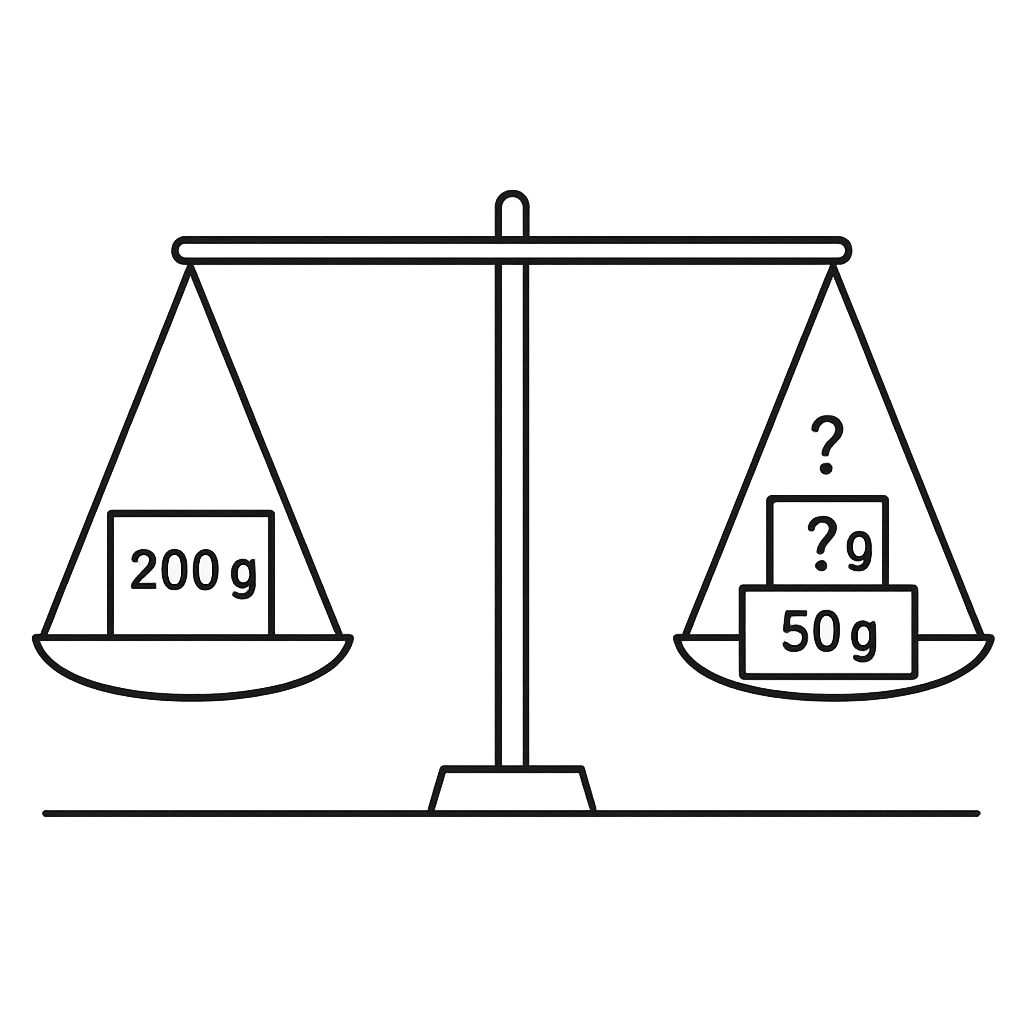
In the diagram of a simple balance scale, a known mass of \(200\ \text{g}\) is placed on the left pan. An unknown mass is placed on the right pan, and then a \(50\ \text{g}\) mass is added to the right pan until the scale balances. What is the value of the unknown mass (in grams)?
A. 100
B. 250
Correct C. 150
D. 200

Correct Answer: C

Want to see the full step-by-step solution? Unlock AI Explanation & Analytics
Question 24 View Details
Two fixed point charges, \(+2\ \mu\text{C}\) at point A and \(-3\ \mu\text{C}\) at point B, are 0.12 m apart. A third charge of \(+1\ \mu\text{C}\) is placed somewhere on the line AB such that the net electric field at its position is zero. (i) Find the distance of the \(+1\ \mu\text{C}\) charge from charge A. (ii) Calculate the electric potential at that point due to the two fixed charges. Give the distance in centimetres (to two significant figures) and the potential in volts (in scientific notation, two significant figures).
A. 5.4 cm, 7.5e4 V
B. 6.1 cm, -8.2e4 V
C. 4.8 cm, -6.8e4 V
Correct D. 5.4 cm, -7.5e4 V

Correct Answer: D

Want to see the full step-by-step solution? Unlock AI Explanation & Analytics
Question 25 View Details
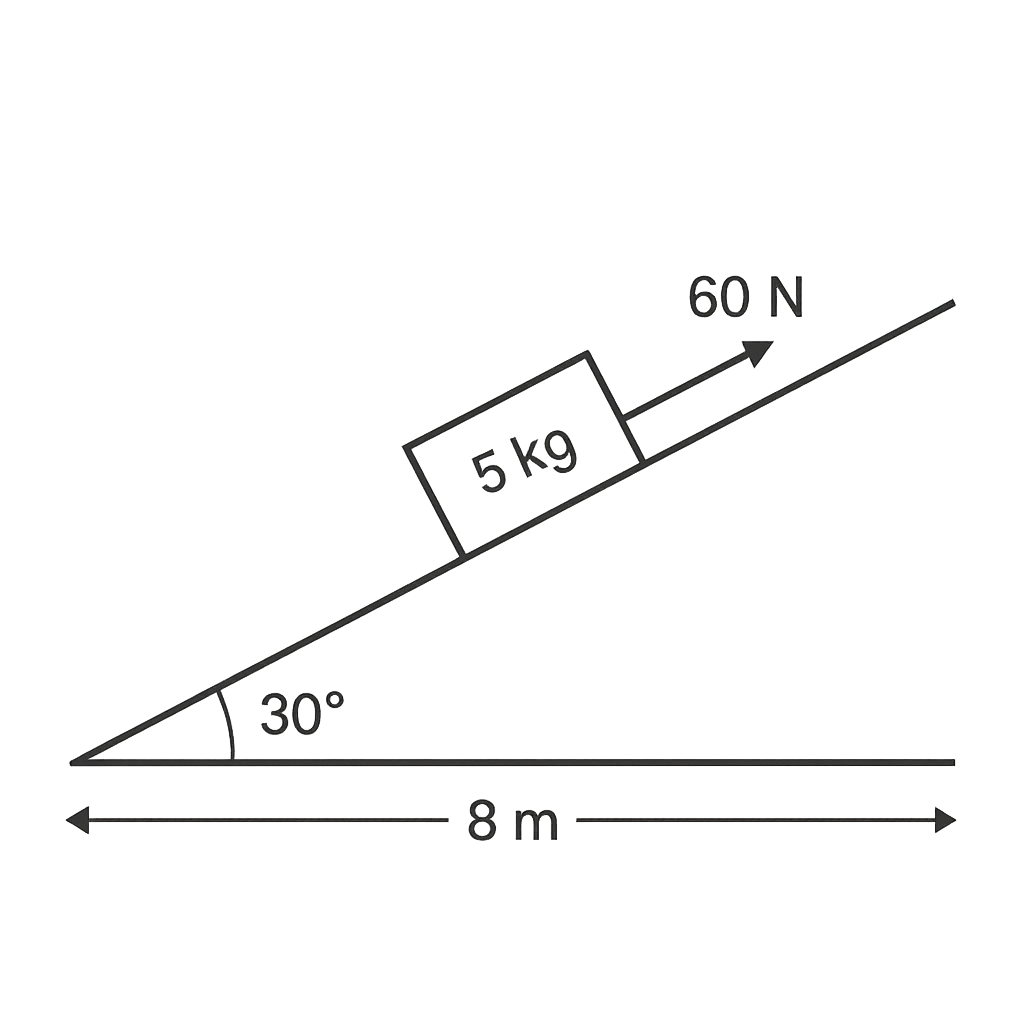
A 5.0 kg block is pulled up a frictionless incline that makes an angle of \(30^{\circ}\) with the horizontal by a constant force of \(60\ \text{N}\) acting parallel to the incline. The block moves 8.0 m along the incline in 4.0 s. (i) Calculate the work done by the pulling force. (ii) Determine the increase in the block's gravitational potential energy. (iii) Find the average power supplied by the pulling force.
Correct A. Work = 480 J, ΔU = 196 J, Power = 120 W
B. Work = 416 J, ΔU = 196 J, Power = 104 W
C. Work = 480 J, ΔU = 196 J, Power = 60 W
D. Work = 480 J, ΔU = 200 J, Power = 120 W

Correct Answer: A

Want to see the full step-by-step solution? Unlock AI Explanation & Analytics

Master the Exam!

You've seen a preview, but there are thousands more questions plus AI tutor to break down complex solutions.

Unlock Full Access Available for Android & Windows
Help others prepare! Share this practice hub:
Chat with Support