neco 2019 chemistry | Essay

Prepare for your exams with neco questions? Reviewing past/model questions is one of the most effective ways to guarantee a high score. This practice hub features authentic 2019 chemistry (Essay) questions designed to simulate the real exam environment.

Practice these randomly selected questions to test your readiness.
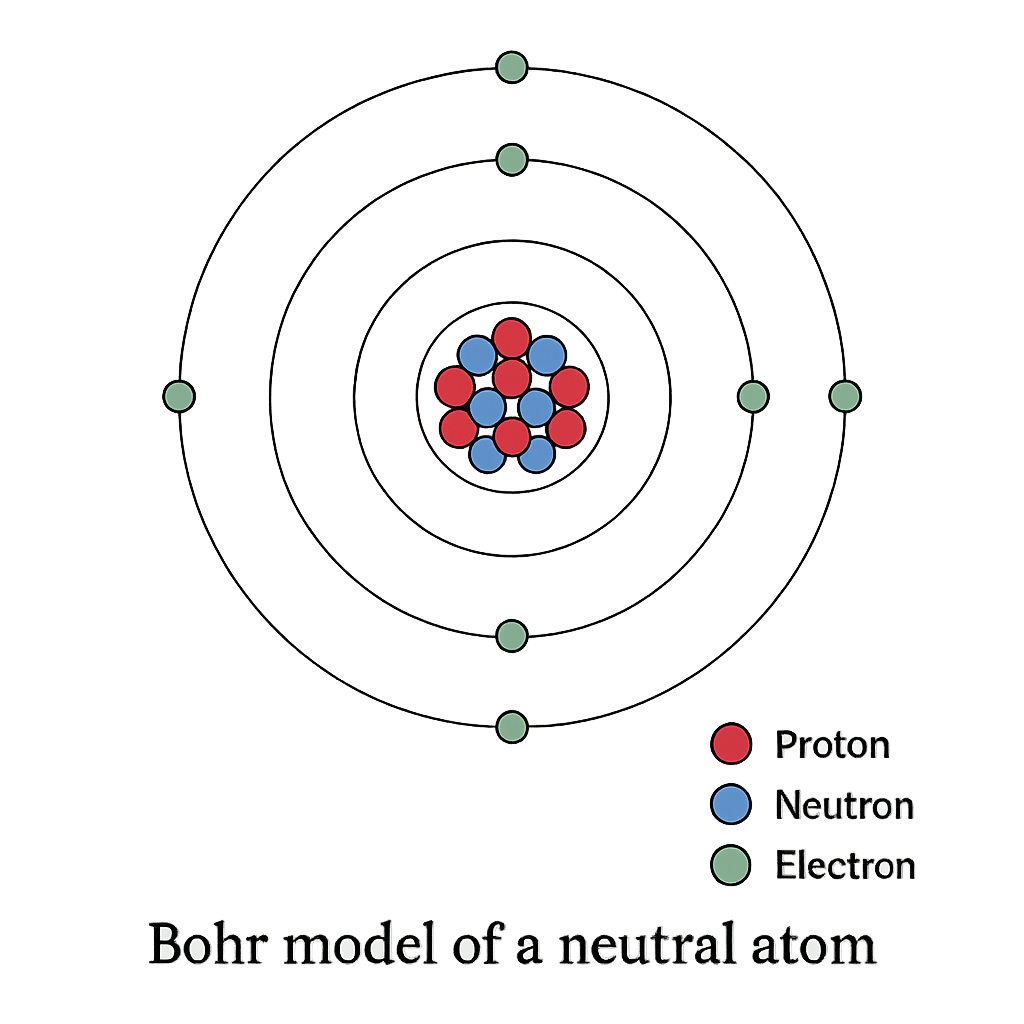
Question 1 View Details
The diagram shows a Bohr model of a neutral atom. The nucleus contains 15 protons and 16 neutrons. The electron shells are labelled K, L and M and contain 2, 8 and 5 electrons respectively.
Question Parts
(a)
Determine the atomic number (Z) and the mass number (A) of the element.
(b)
Identify the element and write its chemical symbol.
(c)
Write the ground‑state electron configuration of the element using the Aufbau principle. Include the noble‑gas shorthand notation.
(d)
If the atom loses electrons to attain the nearest noble‑gas configuration, write the symbol of the resulting ion and indicate its charge.
Detailed Essay Solution & Marking Scheme Available

Get the step-by-step mathematical proofs, key points required by examiners, and a comprehensive breakdown from our AI Tutor.
Question 2 View Details
The illustration presents the complete third period (period 3) of the periodic table, showing the elements Na, Mg, Al, Si, P, S, Cl and Ar with their atomic numbers, group numbers, first ionisation energies (kJ mol⁻¹) and atomic radii (pm).
Question Parts
(a)
State the group number for each of Na, Mg and Al and indicate the general type of element each belongs to (e.g., alkali metal, alkaline‑earth metal, metal).
(b)
Describe the trend in atomic radius from Na to Ar across the period and give a concise explanation for the observed pattern.
(c)
Using the ionisation energies given in the diagram, calculate the ratio of the first ionisation energy of Mg to that of Na. Give your answer to two decimal places.
(d)
When aluminium attains a noble‑gas configuration, what type of ion does it form and what is its symbol with charge?
Detailed Essay Solution & Marking Scheme Available

Get the step-by-step mathematical proofs, key points required by examiners, and a comprehensive breakdown from our AI Tutor.
Question 3 View Details
The table below gives the electronegativity values of selected elements and three compounds. Electronegativity (Pauling scale): Na = 0.9, Cl = 3.0, C = 2.5, O = 3.5, B = 2.0, F = 4.0. Compounds: (i) NaCl, (ii) CO2, (iii) BF3. Answer the following questions.
Question Parts
(a)
Using the electronegativity difference criterion, state the type of chemical bond (ionic, non‑polar covalent, polar covalent) present in each of the three compounds.
(b)
For the compound BF3:
() Draw the correct Lewis structure showing all valence electrons.
() Using VSEPR theory, predict the molecular geometry and give the approximate bond angle.
(c)
Explain, with reference to the type of bonding and structure, why the melting point of NaCl is much higher than that of CO2.
Detailed Essay Solution & Marking Scheme Available

Get the step-by-step mathematical proofs, key points required by examiners, and a comprehensive breakdown from our AI Tutor.

Question 4 View Details
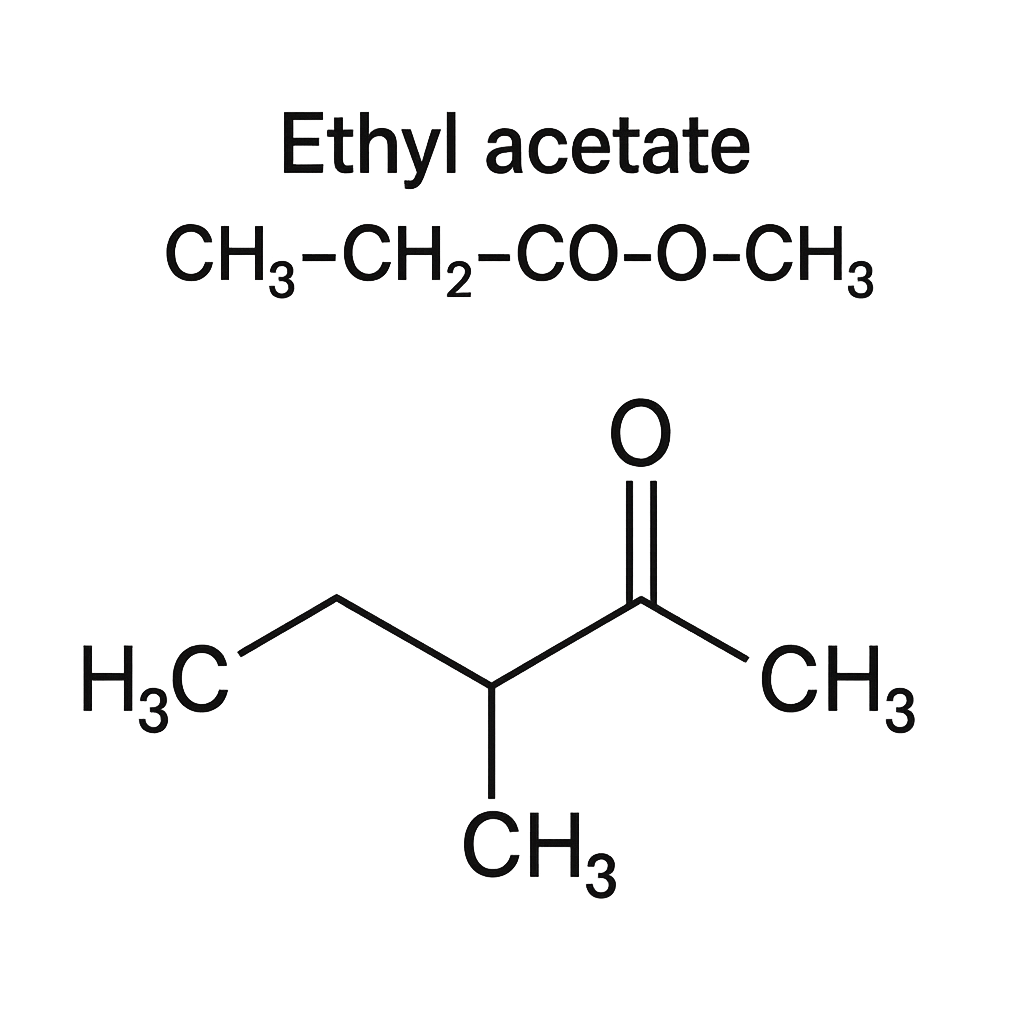
The diagram shows the structural formula of a colourless liquid organic compound commonly used as a solvent in laboratories.
Question Parts
(a)
Write the molecular formula of the compound shown in the diagram.
(b)
A 5.00 g sample of the compound is completely combusted in excess oxygen. Write the balanced combustion equation and calculate the mass of carbon dioxide produced.
(c)
From the same 5.00 g sample, calculate:
() Number of moles of the compound present in the sample.
() Mass of carbon contained in the sample.
() Percent by mass of hydrogen in the compound.
(d)
In a saponification reaction, 0.250 mol of the compound reacts with excess NaOH to give ethanol and sodium acetate. Calculate the mass of sodium acetate formed.
Detailed Essay Solution & Marking Scheme Available

Get the step-by-step mathematical proofs, key points required by examiners, and a comprehensive breakdown from our AI Tutor.

Question 5 View Details
A student carries out the reaction between magnesium metal and hydrochloric acid as shown below: Mg (s) + 2 HCl (aq) \rightarrow MgCl_2 (aq) + H_2 (g) The student weighs 10.0 g of Mg and measures 20.0 g of 37% (w/w) HCl solution. The density of the HCl solution is 1.19 g cm\(^{-3}\). After the reaction, the volume of hydrogen gas collected over water at 25\(^\circ\)C and 750 mmHg is measured to be 0.55 L. (The vapour pressure of water at 25\(^\circ\)C is 23.8 mmHg.) Answer the following: a) Identify the limiting reagent and show all calculations used to reach the conclusion. b) Calculate the theoretical mass of hydrogen gas that should be produced. c) Using the experimental data, determine the percent yield of hydrogen and the mass of excess magnesium remaining unreacted.
Question Parts
(a)
Identify the limiting reagent and show all calculations used to reach the conclusion.
(b)
Calculate the theoretical mass of hydrogen gas that should be produced.
(c)
Using the experimental data, determine the percent yield of hydrogen and the mass of excess magnesium remaining unreacted.
Detailed Essay Solution & Marking Scheme Available

Get the step-by-step mathematical proofs, key points required by examiners, and a comprehensive breakdown from our AI Tutor.

Question 6 View Details
A 5.0 g sample of a pure substance X is initially a solid at 25\(^\circ\)C. The substance has the following data: - Melting point: 150\(^\circ\)C, \(\Delta H_{fus}=60\) kJ kg\(^{-1}\) - Boiling point: 300\(^\circ\)C, \(\Delta H_{vap}=200\) kJ kg\(^{-1}\) - Specific heat capacities: \(c_{solid}=0.9\) J g\(^{-1}\)K\(^{-1}\), \(c_{liquid}=1.2\) J g\(^{-1}\)K\(^{-1}\), \(c_{gas}=0.7\) J g\(^{-1}\)K\(^{-1}\) The sample is heated uniformly until it reaches 350\(^\circ\)C. Calculate the total amount of heat energy (in kJ) required for the entire process. Show all steps and state any assumptions made.
Question Parts
(a)
Calculate the energy needed to raise the temperature of solid X from 25\(^\circ\)C to its melting point (150\(^\circ\)C).
(b)
Determine the heat required for the complete melting of the 5.0 g sample.
(c)
Calculate the energy needed to raise the temperature of liquid X from 150\(^\circ\)C to its boiling point (300\(^\circ\)C).
(d)
Determine the heat required for the complete vaporisation of the 5.0 g sample at 300\(^\circ\)C.
Detailed Essay Solution & Marking Scheme Available

Get the step-by-step mathematical proofs, key points required by examiners, and a comprehensive breakdown from our AI Tutor.

Question 7 View Details
A weak monoprotic acid, HA, is titrated with 0.100 M NaOH. The initial volume of the acid solution is 50.0 mL and its concentration is 0.100 M. At the half‑equivalence point the measured pH is 4.75. At the equivalence point the measured pH is 8.20. Using this information, answer the following:
Question Parts
(a)
Determine the acid dissociation constant (K_a) of HA.
(b)
Calculate the base dissociation constant (K_b) of the conjugate base A⁻.
(c)
Using the data above, calculate the pH of the solution at the equivalence point.
(d)
A 0.10 M aqueous solution of the salt NaA is prepared. Predict its pH and compare it qualitatively with the pH obtained at the equivalence point.
Detailed Essay Solution & Marking Scheme Available

Get the step-by-step mathematical proofs, key points required by examiners, and a comprehensive breakdown from our AI Tutor.

Question 8 View Details
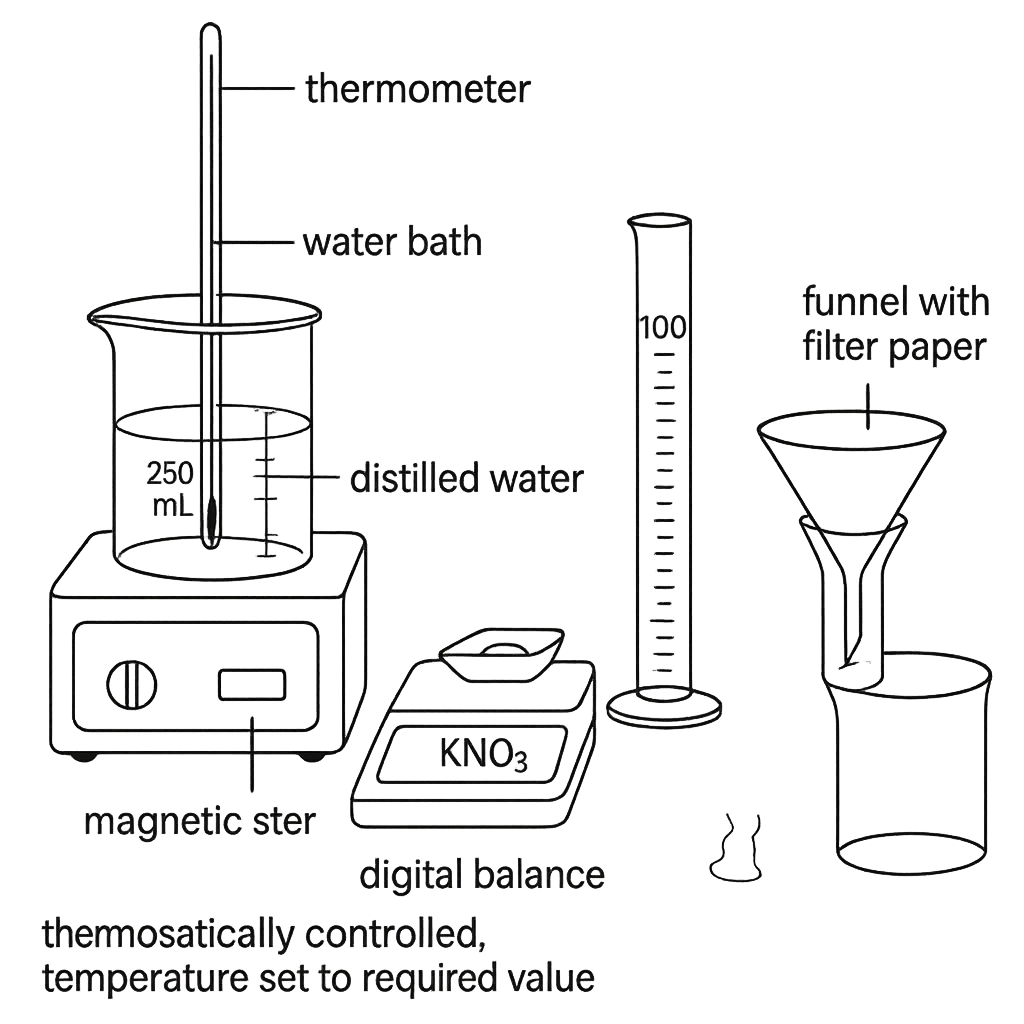
A student is investigating the solubility of potassium nitrate (KNO3) in water using the apparatus shown. The set‑up consists of a 250 mL beaker placed in a thermostatically controlled water bath, a thermometer, a magnetic stirrer, a digital balance, a funnel fitted with filter paper, and a graduated cylinder for measuring water volume. The student adds a known excess of solid KNO3 to 100.0 mL of distilled water, heats the mixture to a desired temperature, stirs until saturation, then quickly filters the hot solution to separate undissolved solid. The mass of the solid recovered on the filter paper is measured.
Question Parts
(a)
State the purpose of each component of the apparatus and explain the principle behind this method of determining solubility.
(b)
The experiment was carried out at two temperatures. (i) At 30 °C, 20.0 g of KNO3 was added to 100.0 mL of water and the solution was saturated. After filtration, 3.2 g of solid KNO3 was recovered. Calculate the solubility (g per 100 mL water) at 30 °C. (ii) At 60 °C, 40.0 g of KNO3 was added to 100.0 mL of water and the solution was saturated. After filtration, 5.6 g of solid KNO3 was recovered. Calculate the solubility (g per 100 mL water) at 60 °C.
(c)
Assuming that solubility varies linearly with temperature between 30 °C and 60 °C, estimate the mass of KNO3 required to prepare 250.0 mL of a saturated solution at 45 °C.
(d)
Identify two factors, other than temperature, that could affect the measured solubility in this experiment and suggest a modification to the experimental design to minimise each factor.
Detailed Essay Solution & Marking Scheme Available

Get the step-by-step mathematical proofs, key points required by examiners, and a comprehensive breakdown from our AI Tutor.

Master the Exam!

You've seen a preview, but there are thousands more questions plus AI tutor to break down complex solutions.

Unlock Full Access Available for Android & Windows
Help others prepare! Share this practice hub:
Chat with Support