neco 2019 agricultural_science | Objective

Prepare for your exams with neco questions? Reviewing past/model questions is one of the most effective ways to guarantee a high score. This practice hub features authentic 2019 agricultural_science (Objective) questions designed to simulate the real exam environment.

Practice these randomly selected questions to test your readiness.

Question 1 View Details
A farmer has a plough whose working width can be set to either \(0.5\) m or \(1.2\) m. The field size is \(5\) ha. For a \(1\) m wide plough the normal working rate is \(0.8\) ha per hour. The wider plough reduces the effective rate by \(20\%\) because of the heavier draft. Which plough width will finish the field sooner and by how many hours does it save work?
A. Use the \\ (1.2) m plough; it saves roughly \\ (4) hours compared with the \\ (0.5) m plough.
Correct B. Use the \(1.2\) m plough; it saves roughly \(6\) hours compared with the \(0.5\) m plough.
C. Use the \\ (0.5) m plough; it saves roughly \\ (4) hours compared with the \\ (1.2) m plough.
D. Use the \\ (0.5) m plough; it saves roughly \\ (6) hours compared with the \\ (1.2) m plough.

Correct Answer: B

Want to see the full step-by-step solution? Unlock AI Explanation & Analytics
Question 2 View Details
A farmer plans to grow maize. Fixed costs are \(\text{₦}150,000\) and variable cost is \(\text{₦}45,000\) per hectare. Expected yield is \(3.5\) t ha\(^{-1}\). The market price per tonne is expected to be \(\text{₦}120,000\), but there is a \(10\%\) chance that the price will fall to \(\text{₦}90,000\). The farmer can plant either \(2\) ha or \(4\) ha. Which planting area gives the higher expected profit and what is that expected profit?
A. Plant \\ (2\\) ha; expected profit is \\ (\\text{₦}579,000\\).
B. Plant \\ (4\\) ha; expected profit is \\ (\\text{₦}1,200,000\\).
C. Plant \\ (2\\) ha; expected profit is \\ (\\text{₦}1,308,000\\).
Correct D. Plant \(4\) ha; expected profit is \(\text{₦}1,308,000\).

Correct Answer: D

Want to see the full step-by-step solution? Unlock AI Explanation & Analytics
Question 3 View Details
A soil sample has a pH of \(5.2\). To raise the pH to \(6.5\), lime raises the pH by \(0.2\) units for every \(100\) kg applied per hectare. How many kilograms of lime are required per hectare?
A. \(500\) kg per hectare
B. \(700\) kg per hectare
Correct C. \(650\) kg per hectare
D. \(600\) kg per hectare

Correct Answer: C

Want to see the full step-by-step solution? Unlock AI Explanation & Analytics
Question 4 View Details
In a maize field \(12\%\) of the area is infested with stem borer. The economic injury threshold for chemical control is \(8\%\). A pesticide costs \(\text{₦}25,000\) per hectare and reduces infestation to \(2\%\). A biological control costs \(\text{₦}15,000\) per hectare and reduces infestation to \(5\%\). Loss of yield is estimated at \(\text{₦}120,000\) for each percent of area infested per hectare. Which control method minimises the total loss (control cost plus yield loss) per hectare?
A. Use the biological control; total loss is \\(\\text{₦}615,000\\) per hectare.
Correct B. Use the chemical pesticide; total loss is \(\text{₦}265,000\) per hectare.
C. Use the chemical pesticide; total loss is \\(\\text{₦}250,000\\) per hectare.
D. Do not apply any control; total loss is \\(\\text{₦}1,440,000\\) per hectare.

Correct Answer: B

Want to see the full step-by-step solution? Unlock AI Explanation & Analytics
Question 5 View Details
A teak stand of \(800\) trees has an average diameter at breast height (DBH) of \(30\) cm at age \(20\) years and an average height of \(12\) m. DBH increases at \(0.8\) cm per year and height increases linearly at \(0.6\) m per year. Tree volume (m³) is given by \( V = 0.0005 \times D^{2} \times H \) where \(D\) is DBH in cm and \(H\) is height in metres. After \(10\) years a selective harvest removes \(15\%\) of the trees. Calculate the total timber volume (in cubic metres) that will be available from the remaining stand after the \(10\)-year period.
Correct A. Approximately \(8,837\) m³ of timber will remain after the 10‑year period.
B. Approximately \\(9,500\\) m³ of timber will remain after the 10‑year period.
C. Approximately \\(10,100\\) m³ of timber will remain after the 10‑year period.
D. Approximately \\(7,200\\) m³ of timber will remain after the 10‑year period.

Correct Answer: A

Want to see the full step-by-step solution? Unlock AI Explanation & Analytics
Question 6 View Details
A farmer intends to raise 20 goats from 15 kg to 25 kg each in 90 days. The feed conversion ratio (FCR) is 5 kg feed per kg weight gain. Two feed ingredients are available: Ingredient A costs \(\text{₦}120\) per kg and contains 20 % protein; Ingredient B costs \(\text{₦}80\) per kg and contains 12 % protein. The diet must contain at least 15 % protein. What is the minimum total cost of feed required for the whole herd over the period?
A. 96000
B. 120000
C. 80000
Correct D. 95000

Correct Answer: D

Want to see the full step-by-step solution? Unlock AI Explanation & Analytics
Question 7 View Details
A farmer has 2 ha of maize that require 120 kg N, 60 kg P₂O₅ and 40 kg K₂O. Two fertilizer blends are available: Fertilizer X contains 30 % N, 10 % P₂O₅, 5 % K₂O and costs \(\text{₦}500\) per kg; Fertilizer Y contains 15 % N, 20 % P₂O₅, 10 % K₂O and costs \(\text{₦}450\) per kg. Using a combination of X and Y, meet or exceed all nutrient requirements at minimum total cost. How many kilograms of each fertilizer should be applied and what is the minimum cost?
A. 600 kg of X, 200 kg of Y, total cost 720000 Naira
Correct B. 800/3 kg of X, 800/3 kg of Y, total cost 760000/3 Naira
C. 800\/3 kg of X, 400 kg of Y, total cost 800000\/3 Naira
D. 400 kg of X, 400 kg of Y, total cost 760000 Naira

Correct Answer: B

Want to see the full step-by-step solution? Unlock AI Explanation & Analytics
Question 8 View Details
A farmer grows wheat on 1 ha. The yield potential is 4 t ha⁻¹ and the market price is \(\text{₦}150\) per kg. An insect pest reduces yield by 0.5 % for every 1 000 insects ha⁻¹. The current pest density is 12 000 insects ha⁻¹. An insecticide costs \(\text{₦}30,000\) per ha and reduces the pest population by 80 %. Should the farmer apply the insecticide? Show the Economic Injury Level (EIL) calculation and the decision.
A. Apply the insecticide (current density 12,000 > EIL 12,500)
B. Apply the insecticide (current density 12,000 < EIL 12,500)
Correct C. Do not apply the insecticide (current density 12,000 < EIL 12,500)
D. Do not apply the insecticide (current density 12,000 = EIL 12,500)

Correct Answer: C

Want to see the full step-by-step solution? Unlock AI Explanation & Analytics
Question 9 View Details
A soil sample measured a pH of 5.8. Classify the soil acidity and recommend one amendment to raise the pH toward neutral.
A. Alkaline; apply gypsum (calcium sulfate)
B. Acidic; apply fertilizer (ammonium nitrate)
C. Neutral; apply sulfur (elemental sulfur)
Correct D. Acidic; apply lime (calcium carbonate)

Correct Answer: D

Want to see the full step-by-step solution? Unlock AI Explanation & Analytics
Question 10 View Details
A rectangular earthen pond has a surface area of 2 ha (20 000 m²) and an average depth of 1.5 m, giving a water volume of 30 000 m³. A farmer wants to stock tilapia. Each fish gains 2 g per day and the culture period is 180 days. Feed conversion ratio (FCR) is 1.5 kg feed per kg weight gain. Feed costs \(\text{₦}200\) per kg, and market price of fish is \(\text{₦}500\) per kg. Fingerlings cost \(\text{₦}50\) each. Mortality increases linearly with stocking density D (fish m⁻³) as 5 % × D (i.e., mortality = 0.05D, no cap). Determine the maximum initial stocking density (fish m⁻³) that will still give the farmer a profit of at least \(\text{₦}1,000,000\). Show all steps.
A. Approximately 12.7 fish per m³ (about 380,000 fish total)
Correct B. Approximately 18.3 fish per m³ (about 555,000 fish total)
C. Approximately 15.2 fish per m³ (about 460,000 fish total)
D. Approximately 20.5 fish per m³ (about 620,000 fish total)

Correct Answer: B

Want to see the full step-by-step solution? Unlock AI Explanation & Analytics
Question 11 View Details
A farmer wants to prepare a 2.5 ha field of loamy soil using a motorised tiller. The work required to till one hectare of loamy soil is 15 MJ. The tiller operates at 80% mechanical efficiency. If the farmer wishes to finish the tillage in 5 hours, what is the minimum power rating (in kW) that the tiller must have? Round up to the nearest whole kilowatt.
A. 2
Correct B. 3
C. 4
D. 5

Correct Answer: B

Want to see the full step-by-step solution? Unlock AI Explanation & Analytics
Question 12 View Details
A legume crop fixes 45 kg of nitrogen per hectare each season. If a farmer cultivates 3.2 hectares of this legume, how many kilograms of nitrogen are fixed in total?
A. 135
B. 150
C. 120
Correct D. 144

Correct Answer: D

Want to see the full step-by-step solution? Unlock AI Explanation & Analytics
Question 13 View Details
Two combine harvesters are available. Harvester A harvests at 1.8 ha per hour and consumes 5 L of fuel per hour. Harvester B harvests at 2.2 ha per hour and consumes 5.5 L of fuel per hour. Fuel costs ₦120 per litre. A farmer has a 7 ha field and must finish the harvest within 4 hours. Which harvester will give the lower total fuel cost while meeting the time constraint?
Correct A. Harvester B
B. Both harvesters have the same fuel cost
C. Harvester A
D. Neither harvester can finish within 4 hours

Correct Answer: A

Want to see the full step-by-step solution? Unlock AI Explanation & Analytics
Question 14 View Details
A farmer applies 2 tonnes of agricultural lime per hectare, which raises the soil pH by 0.8 units (the soil buffer capacity is 0.4 pH units per tonne per hectare). If only 1.5 tonnes per hectare are applied, what will be the new soil pH assuming the initial pH was 5.5?
A. 5.9
B. 6.3
C. 6.7
Correct D. 6.1

Correct Answer: D

Want to see the full step-by-step solution? Unlock AI Explanation & Analytics
Question 15 View Details
In a 4‑ha wheat field there are 150,000 plants per hectare. A fungal disease currently infects 12% of the plants. Each infected plant causes a market loss of ₦0.15. A fungicide applied at 0.8 L per hectare costs ₦250 per litre and reduces disease incidence by 75%. Should the farmer apply the fungicide? (Answer "Yes" if it is economically advisable, otherwise "No").
Correct A. Yes
B. No
C. No (not advisable)
D. No (economically unwise)

Correct Answer: A

Want to see the full step-by-step solution? Unlock AI Explanation & Analytics
Question 16 View Details
A tractor engine delivers \(50\ \text{kW}\) at \(1800\ \text{rpm}\). The transmission has a gear ratio of \(4:1\) (engine to wheels) and the wheel radius is \(0.75\ \text{m}\). The plough requires a drawbar pull of \(12\ \text{kN}\) to operate at a speed of \(5\ \text{km/h}\). Assuming an overall drivetrain efficiency of \(85\%\), determine whether the tractor can maintain the required speed and pull. Also compute the fuel consumption per hour if the engine specific fuel consumption is \(210\ \text{g/kWh}\).
A. No, the tractor cannot provide the required drawbar pull. Maximum tractive force is about 2.5 kN (still below 12 kN). Fuel consumption is 12.0 kg per hour.
B. Yes, the tractor can provide the required drawbar pull. Maximum tractive force is about 13.5 kN, exceeding the 12 kN demand. Fuel consumption is 9.8 kg per hour.
Correct C. No, the tractor cannot provide the required drawbar pull. Maximum tractive force is about 1.20 kN (far below 12 kN). Fuel consumption is 10.5 kg per hour.
D. No, the tractor cannot provide the required drawbar pull. Maximum tractive force is about 1.20 kN (far below 12 kN). Fuel consumption is 8.4 kg per hour.

Correct Answer: C

Want to see the full step-by-step solution? Unlock AI Explanation & Analytics
Question 17 View Details
A forest stand has an initial timber volume of \(150\ \text{m}^3\) per hectare and grows at a constant annual rate of \(5\%\) of its current volume. A manager plans to harvest a fixed amount \(H\) (\(\text{m}^3\)/ha) at the end of each year for \(10\) consecutive years. The policy requires that after each harvest the remaining volume never falls below \(120\ \text{m}^3\)/ha. Determine the greatest possible value of \(H\) and the total volume harvested over the \(10\)-year period.
A. Maximum constant harvest H ≈ 9.0 m³/ha; total harvested over 10 years ≈ 90 m³/ha.
B. Maximum constant harvest H ≈ 8.75 m³/ha; total harvested over 10 years ≈ 87.5 m³/ha.
C. Maximum constant harvest H ≈ 10.5 m³/ha; total harvested over 10 years ≈ 105 m³/ha.
Correct D. Maximum constant harvest H ≈ 9.89 m³/ha; total harvested over 10 years ≈ 98.9 m³/ha.

Correct Answer: D

Want to see the full step-by-step solution? Unlock AI Explanation & Analytics
Question 18 View Details
A forest area of \(500\) ha is divided into five equal strata based on slope. Sample plots of \(0.1\) ha each are taken with the following results: - Stratum 1 (flat): 4 plots, mean volume \(120\ \text{m}^3\)/ha, variance \(400\). - Stratum 2 (gentle): 3 plots, mean \(150\ \text{m}^3\)/ha, variance \(625\). - Stratum 3 (moderate): 3 plots, mean \(180\ \text{m}^3\)/ha, variance \(900\). - Stratum 4 (steep): 2 plots, mean \(210\ \text{m}^3\)/ha, variance \(1225\). - Stratum 5 (very steep): 2 plots, mean \(240\ \text{m}^3\)/ha, variance \(1600\). Using stratified sampling, estimate the total timber volume for the whole forest and compute the 95 % confidence interval for the total volume. Use \(Z=1.96\).
Correct A. Estimated total volume = 90 000 m³; 95 % confidence interval ≈ (81 200 m³ , 98 800 m³).
B. Estimated total volume = 85 000 m³; 95 % confidence interval ≈ (76 200 m³ , 93 800 m³).
C. Estimated total volume = 92 000 m³; 95 % confidence interval ≈ (83 500 m³ , 100 500 m³).
D. Estimated total volume = 88 000 m³; 95 % confidence interval ≈ (79 300 m³ , 96 700 m³).

Correct Answer: A

Want to see the full step-by-step solution? Unlock AI Explanation & Analytics
Question 19 View Details
A farmer has a \(10\) ha maize field. The proportion of plants infected by a fungal disease after \(t\) weeks is modeled by \(I(t)=\frac{1}{1+e^{-0.5(t-4)}}\). A fungicide application instantly reduces the infected proportion by \(30\%\) of its current value and can be applied at most twice, at weeks 3 and 6. The yield loss at harvest (week 12) is \(0.05\) t/ha per 1 % increase in final disease incidence. Maize price is \(\text{₦}200\) per kg and the expected yield without disease is \(10{,}000\) kg/ha. Fungicide costs \(\text{₦}15{,}000\) per application. Determine the optimal spraying schedule (which weeks to spray) that minimizes the total cost (fungicide cost plus value of lost yield) and state the minimum total cost.
A. Spray at week 6 only; minimum total cost = ₦530 000.
B. Do not spray; minimum total cost = ₦560 000.
C. Spray at week 3 only; minimum total cost = ₦525 000.
Correct D. Spray at both weeks 3 and 6; minimum total cost = ₦511 000.

Correct Answer: D

Want to see the full step-by-step solution? Unlock AI Explanation & Analytics
Question 20 View Details
The market price (₦ per ton) for a cash crop is given by the linear demand function \(P = 200 - 0.5 Q\), where \(Q\) is the quantity produced (tons). The farmer's total cost function is \(C(Q) = 20{,}000 + 30 Q + 0.1 Q^{2}\). An alternative technology reduces the variable cost coefficient from 30 to 25 but requires a fixed investment of \(\text{₦}5{,}000\). Should the farmer adopt the technology to maximize profit? Compute the profit and the profit‑maximising output quantity with and without the technology.
A. Do not adopt the technology. Without it: optimal output ≈ 138 t, profit ≈ ‑₦9 000. With it: optimal output ≈ 144 t, profit ≈ ‑₦13 000.
B. Adopt the technology. Without it: optimal output ≈ 142 t, profit ≈ ‑₦7 500. With it: optimal output ≈ 146 t, profit ≈ ‑₦11 800.
C. Adopt the technology. Without it: optimal output ≈ 150 t, profit ≈ ‑₦6 500. With it: optimal output ≈ 155 t, profit ≈ ‑₦10 000.
Correct D. Do not adopt the technology. Without it: optimal output ≈ 142 t, profit ≈ ‑₦7 958. With it: optimal output ≈ 146 t, profit ≈ ‑₦12 233.

Correct Answer: D

Want to see the full step-by-step solution? Unlock AI Explanation & Analytics
Question 21 View Details
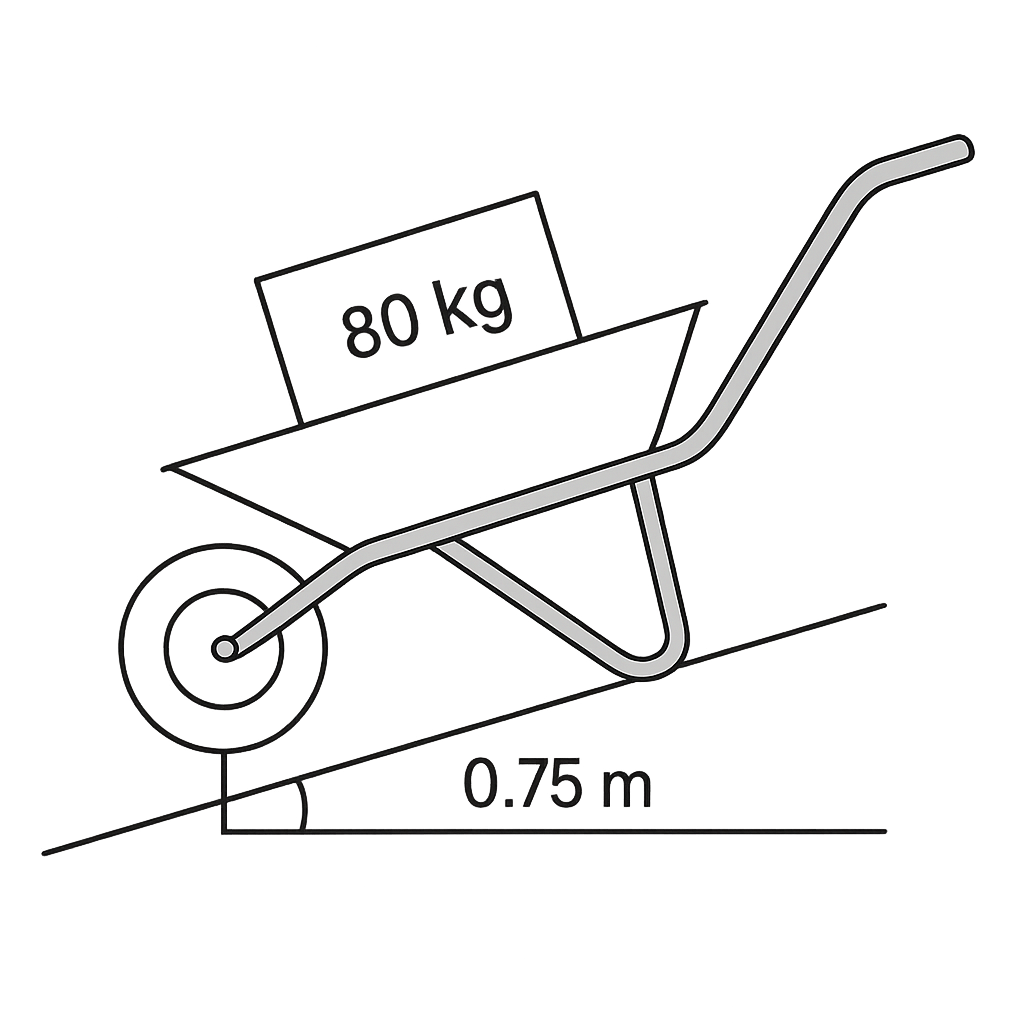
An illustration shows a wheelbarrow on a \\(5^{\\circ}\\) upward incline. The wheel has a radius of \\(0.35\\,\\text{m}\\) and the distance from the axle to the handles is \\(0.75\\,\\text{m}\\). The bucket contains a load of \\(80\\,\\text{kg}\\). Assuming the farmer pushes horizontally on the handles and the wheel rolls without slipping, what minimum horizontal force (in newtons) must the farmer apply to keep the wheelbarrow moving up the incline at constant speed? (Take \\(g = 9.8\\; \\text{m s}^{-2}\\).)
A. 28.5
Correct B. 31.9
C. 34.2
D. 36.0

Correct Answer: B

Want to see the full step-by-step solution? Unlock AI Explanation & Analytics
Question 22 View Details
Using the economic threshold formula \\(ET = \dfrac{C}{V \times L \times N \times E}\\), where \\(C\\) is the cost of control per hectare (₦), \\(V\\) is the market value per kilogram of crop (₦), \\(L\\) is the yield loss per pest per plant (kg), \\(N\\) is the number of plants per hectare, and \\(E\\) is the efficacy of the pesticide (as a fraction), determine the economic threshold (pests per plant) for a maize field where: control cost \\(C = 12{,}000\\) ₦ ha\\(^{-1}\\); market price \\(V = 150\\) ₦ kg\\(^{-1}\\); loss per pest per plant \\(L = 0.02\\) kg; plant density \\(N = 40{,}000\\) plants ha\\(^{-1}\\); and pesticide efficacy \\(E = 0.80\\).
A. 0.12
Correct B. 0.125
C. 0.13
D. 0.10

Correct Answer: B

Want to see the full step-by-step solution? Unlock AI Explanation & Analytics
Question 23 View Details
A herd of cattle shows fever, vesicular lesions on the mouth and feet, and loss of appetite. The most likely disease is ______. The recommended treatment is oxytetracycline at a dose of 10 mg kg\\(^{-1}\\) body weight. If a 450 kg animal is to be treated with an oxytetracycline solution containing 100 mg ml\\(^{-1}\\), what volume (in millilitres) of the solution should be administered to the animal?
A. Lumpy skin disease; 55 ml
Correct B. Foot-and-mouth disease; 45 ml
C. Bovine viral diarrhea; 40 ml
D. Rinderpest; 50 ml

Correct Answer: B

Want to see the full step-by-step solution? Unlock AI Explanation & Analytics
Question 24 View Details
A pesticide applied to a vegetable crop leaves an initial residue of 0.80 mg kg\\(^{-1}\\). The pesticide has a half‑life of 12 days. Assuming first‑order decay, calculate the residue level (in mg kg\\(^{-1}\\)) after 30 days. Round your answer to two decimal places.
A. 0.10
Correct B. 0.14
C. 0.18
D. 0.20

Correct Answer: B

Want to see the full step-by-step solution? Unlock AI Explanation & Analytics
Question 25 View Details
A farmer intends to raise a goat from a live weight of 15 kg to 30 kg. The expected average daily weight gain is 0.15 kg. The goats are fed a concentrate that they consume at 2.5 % of their body weight per day (as a proportion of the average body weight during the growth period). Calculate the total amount of concentrate (in kilograms) required for the entire growth period. Round your answer to one decimal place.
Correct A. 56.3
B. 58.1
C. 55.3
D. 53.7

Correct Answer: A

Want to see the full step-by-step solution? Unlock AI Explanation & Analytics

Master the Exam!

You've seen a preview, but there are thousands more questions plus AI tutor to break down complex solutions.

Unlock Full Access Available for Android & Windows
Help others prepare! Share this practice hub:
Chat with Support