neco 2019 agricultural_science | Essay

Prepare for your exams with neco questions? Reviewing past/model questions is one of the most effective ways to guarantee a high score. This practice hub features authentic 2019 agricultural_science (Essay) questions designed to simulate the real exam environment.

Practice these randomly selected questions to test your readiness.

Question 1 View Details
Biodiversity plays a crucial role in the productivity and sustainability of agricultural ecosystems.
Question Parts
(a)
Define biodiversity in the context of an agricultural ecosystem.
(b)
Explain two ways in which loss of biodiversity can adversely affect crop yield.
(c)
Suggest three practical management practices a farmer can adopt to conserve biodiversity on a mixed‑cropping farm and briefly explain how each practice contributes to conservation.
Detailed Essay Solution & Marking Scheme Available

Get the step-by-step mathematical proofs, key points required by examiners, and a comprehensive breakdown from our AI Tutor.
Question 2 View Details
A student is carrying out a laboratory experiment to determine the field capacity of a soil sample using the gravimetric method. The experimental arrangement is shown in the diagram.
Question Parts
(a)
Describe, in order, the steps the student must follow to obtain the field capacity of the soil using this set‑up.
(b)
The dry weight of the soil sample is 250 g. After saturation and 30 minutes drainage, the weight of the soil‑water mixture is 420 g. Calculate the field capacity of the soil as a percentage.
(c)
Explain why knowing the field capacity of a soil is important for planning irrigation on a farm.
Detailed Essay Solution & Marking Scheme Available

Get the step-by-step mathematical proofs, key points required by examiners, and a comprehensive breakdown from our AI Tutor.

Question 3 View Details
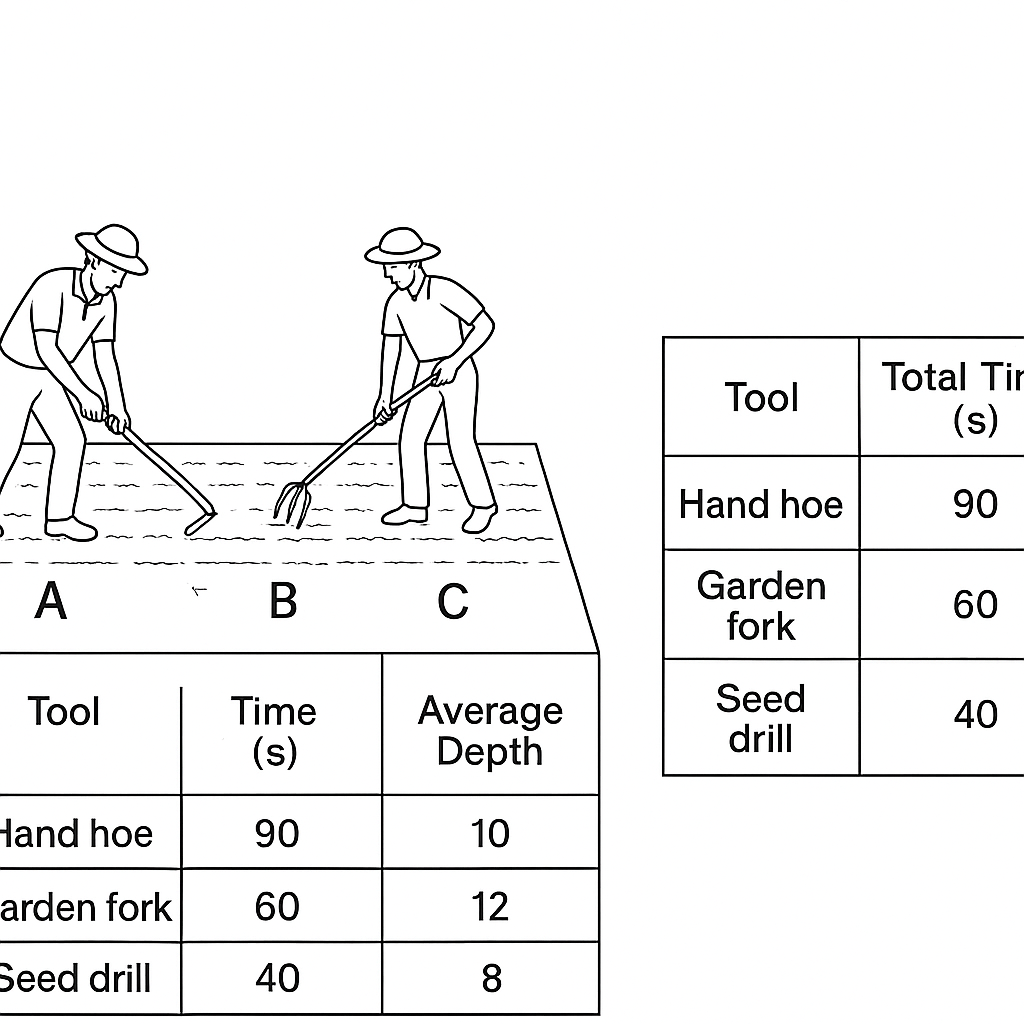
A farmer is demonstrating the use of three farm tools in a field experiment: a hand hoe, a garden fork, and a seed drill. The experimental plot is a rectangle 10 m long and 6 m wide, divided into three equal sections (A, B and C). Each section is assigned to one tool as shown in the diagram. The farmer records the total time taken to till the whole section at full working depth and the average depth of soil turned (in cm) for each tool. The recorded data are:
Question Parts
(a)
Calculate the average time (in seconds) taken to till one square metre with each tool.
(b)
Identify which tool is the most time‑efficient for soil preparation.
(c)
Discuss two advantages of using the seed drill over the hand hoe and garden fork with respect to soil conservation and seed placement.
Detailed Essay Solution & Marking Scheme Available

Get the step-by-step mathematical proofs, key points required by examiners, and a comprehensive breakdown from our AI Tutor.

Question 4 View Details
A smallholder farmer is evaluating the purchase of a 25‑horsepower (hp) tractor to replace manual labour for land preparation. The tractor consumes 4 L of diesel per hour when operating at full load. Each planting season the farmer must prepare 5 ha of land, requiring 0.5 hour of tractor operation per hectare at full load. Diesel costs ₦150 per litre. Manual labour for land preparation costs ₦2 500 per hectare. The tractor is priced at ₦1 200 000 and is expected to have a useful life of 8 years with no salvage value. The farmer intends to use the tractor for four planting seasons each year.
Question Parts
(a)
Calculate the total cost of diesel fuel required for land preparation in one planting season.
(b)
Determine the total cost of land preparation per season when using the tractor, including fuel and depreciation. (Assume straight‑line depreciation.)
(c)
Compare the total seasonal cost of land preparation using the tractor with the cost of manual labour and state which method is more economical.
(d)
Explain two non‑economic benefits of employing the tractor for land preparation.
Detailed Essay Solution & Marking Scheme Available

Get the step-by-step mathematical proofs, key points required by examiners, and a comprehensive breakdown from our AI Tutor.

Question 5 View Details
A farmer cultivates maize on a well‑drained loamy soil. The current practice is a plant spacing of 75 cm between rows and 25 cm within rows, with no nitrogen fertilizer applied. The average yield obtained under this practice is 2.5 tonnes per hectare. The farmer is considering the following changes: - Reduce the within‑row spacing to 20 cm while keeping the row spacing at 75 cm. - Apply 120 kg of nitrogen fertilizer per hectare. Research indicates that for maize each additional 10 kg N ha⁻¹ increases yield by 0.15 t ha⁻¹ (up to a maximum response of 0.9 t ha⁻¹) and that reducing the within‑row spacing from 25 cm to 20 cm increases yield by 0.20 t ha⁻¹. Using this information, answer the questions below.
Question Parts
(a)
Calculate the number of maize plants per hectare under the current spacing (75 cm × 25 cm) and under the proposed spacing (75 cm × 20 cm).
(b)
Determine the expected maize yield (in tonnes per hectare) after applying the 120 kg N ha⁻¹ and adopting the new spacing. Show your calculations.
(c)
Discuss two agronomic advantages and two possible disadvantages of adopting the new spacing and nitrogen application.
Detailed Essay Solution & Marking Scheme Available

Get the step-by-step mathematical proofs, key points required by examiners, and a comprehensive breakdown from our AI Tutor.

Question 6 View Details
A small dairy farm keeps 20 lactating cows. Each cow currently produces 20 litres of milk per day. The daily ration consists of 5 kg of grass (roughage) at ₦30 per kg and 0.5 kg of concentrate at ₦250 per kg. The farmer plans to increase milk production by 10 % by adding an extra 0.2 kg of concentrate per cow each day. Using this information, answer the following:
Question Parts
(a)
Calculate the total daily feed cost for the herd under the present feeding regime.
(b)
Determine the additional feed cost incurred by the extra 0.2 kg concentrate per cow and the new total daily feed cost after the change.
(c)
Compute the cost of milk production (in ₦ per litre) before and after the feed increase. State the percentage change in cost per litre.
(d)
Briefly discuss two nutritional considerations that must be addressed when increasing concentrate supplementation in lactating cows.
Detailed Essay Solution & Marking Scheme Available

Get the step-by-step mathematical proofs, key points required by examiners, and a comprehensive breakdown from our AI Tutor.

Question 7 View Details
A farmer in northern Nigeria cultivates maize on a 5‑hectare field. The major pest observed is the stem borer (Busseola fusca). The farmer wishes to adopt an integrated pest management (IPM) approach that combines cultural, chemical and biological tactics.
Question Parts
(a)
Identify the life‑cycle stage(s) of Busseola fusca that cause the greatest damage to maize and explain why they are the most harmful.
(b)
The farmer intends to use a threshold‑based chemical control. The economic injury level (EIL) for stem borer is 5 % of plants infested. Each infested plant reduces yield by 0.2 kg per hectare. The market price of maize is ₦150 per kilogram and the cost of applying the recommended insecticide is ₦12 000 per hectare. Calculate the economic threshold (ET) – the percentage of plants infested at which the farmer should spray.
(c)
Propose two cultural control methods that can be incorporated into the farmer’s IPM programme and explain how each method reduces stem‑borer incidence.
(d)
Discuss the advantages and disadvantages of using Bt‑maize varieties as a biological control option for stem borer in this setting.
Detailed Essay Solution & Marking Scheme Available

Get the step-by-step mathematical proofs, key points required by examiners, and a comprehensive breakdown from our AI Tutor.

Question 8 View Details
A farmer observes wilting, yellowing of leaves and stunted growth in a 3‑hectare tomato field. Laboratory analysis confirms the disease is Fusarium wilt caused by Fusarium oxysporum f.sp. lycopersici. The farmer seeks an effective management plan.
Question Parts
(a)
Describe the mode of infection of Fusarium oxysporum in tomato plants and list the typical symptoms that develop.
(b)
Historical data show that when disease incidence is 30 % the average yield loss is 25 % of the potential yield. Assuming a linear relationship between incidence and loss, estimate the expected yield loss if disease incidence rises to 45 %.
(c)
Propose an integrated disease‑management strategy that includes at least three control measures (cultural, chemical, biological or resistant varieties). For each measure, explain the principle behind it and how it reduces Fusarium wilt.
Detailed Essay Solution & Marking Scheme Available

Get the step-by-step mathematical proofs, key points required by examiners, and a comprehensive breakdown from our AI Tutor.

Master the Exam!

You've seen a preview, but there are thousands more questions plus AI tutor to break down complex solutions.

Unlock Full Access Available for Android & Windows
Help others prepare! Share this practice hub:
Chat with Support