neco 2018 geography | Objective

Prepare for your exams with neco questions? Reviewing past/model questions is one of the most effective ways to guarantee a high score. This practice hub features authentic 2018 geography (Objective) questions designed to simulate the real exam environment.

Practice these randomly selected questions to test your readiness.

Question 1 View Details
Nigeria's natural vegetation is distributed as follows: Rainforest 10 %, Savanna 45 %, Sudanian 30 %, Sahel 12 %, and Mangrove 3 %. A development project will convert 15 % of the Savanna area and 5 % of the Sudanian area into farmland. Assuming no other changes, what percentage of the country's total land area will remain covered by natural vegetation after the project?
A. 88.25 %
Correct B. 91.75 %
C. 92.75 %
D. 90.75 %

Correct Answer: B

Want to see the full step-by-step solution? Unlock AI Explanation & Analytics
Question 2 View Details
A map of Nigeria uses a scale of 1 cm : 5 km. The straight‑line distance between Lagos and Ibadan on the map measures 8.4 cm. What is the actual distance between the two cities in kilometres?
A. 45 km
B. 40 km
C. 38 km
Correct D. 42 km

Correct Answer: D

Want to see the full step-by-step solution? Unlock AI Explanation & Analytics
Question 3 View Details
The average annual rainfall in a region is 1200 mm. Climate‑change projections indicate a 12 % increase in rainfall over the next decade. The region's drainage system can safely convey up to 1300 mm of rainfall per year without flooding. A flood‑mitigation scheme can be activated only if the projected rainfall exceeds 1250 mm; when activated it reduces the effective rainfall by 5 %. Determine whether the region will be at risk of flooding in ten years, and state the effective rainfall after mitigation (if any) and the amount by which it is below or above the drainage capacity.
A. No flooding risk; effective rainfall = 1254 mm, which is 46 mm below the drainage capacity
B. Flooding risk; effective rainfall = 1344 mm, which is 44 mm above the drainage capacity
C. Flooding risk; effective rainfall = 1411.2 mm, which is 111.2 mm above the drainage capacity
Correct D. No flooding risk; effective rainfall = 1276.8 mm, which is 23.2 mm below the drainage capacity

Correct Answer: D

Want to see the full step-by-step solution? Unlock AI Explanation & Analytics
Question 4 View Details
A soil test shows pH 5.2, organic matter 2.5 % and a cation‑exchange capacity (CEC) of 12 cmolc kg⁻¹. At this pH, phosphorus availability is 70 % of the optimum, while potassium availability is 85 % of the optimum. The farmer plans to apply lime, which will raise the pH to 6.5, increase the CEC by 20 % and raise phosphorus availability by 15 % of its current value; potassium availability will remain unchanged. After liming, which nutrient (phosphorus or potassium) will be the most limiting relative to its optimum level?
A. Potassium
B. Neither nutrient is limiting
C. Both nutrients are equally limiting
Correct D. Phosphorus

Correct Answer: D

Want to see the full step-by-step solution? Unlock AI Explanation & Analytics
Question 5 View Details
A rectangular field 200 m long and 120 m wide is drained by parallel tile drains spaced 30 m apart. The soil hydraulic conductivity is \(K = 2.5 \times 10^{-5}\) m s\(^{-1}\) and the height of the water table above the drain level is 0.8 m. Using the simplified Hooghoudt equation for steady‑state drainage \( q = \frac{8 K D H^{2}}{L^{2}} \) where \(q\) is the discharge per metre of drain (m³ s\(^{-1}\) m\(^{-1}\)), \(D\) is the drain spacing (m), \(H\) is the water‑table height (m) and \(L\) is the field length (m), calculate the total volume of water drained in one day (in cubic metres). Give your answer rounded to the nearest whole number.
Correct A. 7 m³
B. 6 m³
C. 8 m³
D. 12 m³

Correct Answer: A

Want to see the full step-by-step solution? Unlock AI Explanation & Analytics
Question 6 View Details
A map has a scale of 1 cm : 5 km. The distance between Town A and Town B on the map measures \(3.2\) cm. Using this information, calculate the real distance in kilometres and the time, in minutes, it would take to travel this distance by car travelling at an average speed of \(80\) km/h.
A. 16 km; 15 minutes
Correct B. 16 km; 12 minutes
C. 19.2 km; 14 minutes
D. 12.8 km; 10 minutes

Correct Answer: B

Want to see the full step-by-step solution? Unlock AI Explanation & Analytics
Question 7 View Details
A catchment area of 25 km\(^{2}\) has a total stream length of 40 km. During a storm, 80 mm of rain falls uniformly over the catchment in 2 hours, and 30% of the rainfall infiltrates the soil. \(a\) Calculate the drainage density of the catchment (in km km\(^{-1}\)). \(b\) Determine the average discharge (in m\(^{3}\) s\(^{-1}\)) of the runoff during the storm.
A. 1.2 km km^{-1}; 160.0 m^3\/s
B. 1.6 km km^{-1}; 150.0 m^3\/s
C. 2.0 km km^{-1}; 194.4 m^3\/s
Correct D. 1.6 km km^{-1}; 194.4 m^3/s

Correct Answer: D

Want to see the full step-by-step solution? Unlock AI Explanation & Analytics
Question 8 View Details
A soil sample is classified as loam with a sand:silt:clay ratio of 20:40:40. The field capacity is \(0.30\) m\(^{3}\) m\(^{-3}\) and the wilting point is \(0.15\) m\(^{3}\) m\(^{-3}\). The root zone depth is \(0.6\) m and the current volumetric moisture content is \(0.20\) m\(^{3}\) m\(^{-3}\). Calculate the volume of water (in cubic metres) required per hectare to raise the soil moisture to field capacity.
A. 900
Correct B. 600
C. 300
D. 1200

Correct Answer: B

Want to see the full step-by-step solution? Unlock AI Explanation & Analytics
Question 9 View Details
A town had a population of 1,200,000 at the beginning of 2020. The annual natural increase rate (births minus deaths) is 2.5% and the town experiences a net migration loss of 5,000 persons each year. Assuming these rates remain constant, what will be the projected population at the beginning of 2025?
A. 1,325,000
Correct B. 1,331,409
C. 1,357,690
D. 1,352,690

Correct Answer: B

Want to see the full step-by-step solution? Unlock AI Explanation & Analytics
Question 10 View Details
A farmer has 10 ha of land to allocate between maize and cassava. Maize yields 3.5 t ha\(^{-1}\) and sells for \(\text{\u20A6}120\) per kg; its variable cost is \(\text{\u20A6}30,000\) per ha. Cassava yields 20 t ha\(^{-1}\) and sells for \(\text{\u20A6}25\) per kg; its variable cost is \(\text{\u20A6}15,000\) per ha. The farmer must allocate at least 3 ha to cassava but cannot allocate more than 6 ha to cassava. He wants to achieve a total profit of at least \(\text{\u20A6}2,000,000\) while minimizing total variable cost. Determine the optimal allocation of land (ha) to maize and to cassava.
A. Maize: 7 ha; Cassava: 3 ha
Correct B. Maize: 4 ha; Cassava: 6 ha
C. Maize: 6 ha; Cassava: 4 ha
D. Maize: 5 ha; Cassava: 5 ha

Correct Answer: B

Want to see the full step-by-step solution? Unlock AI Explanation & Analytics
Question 11 View Details
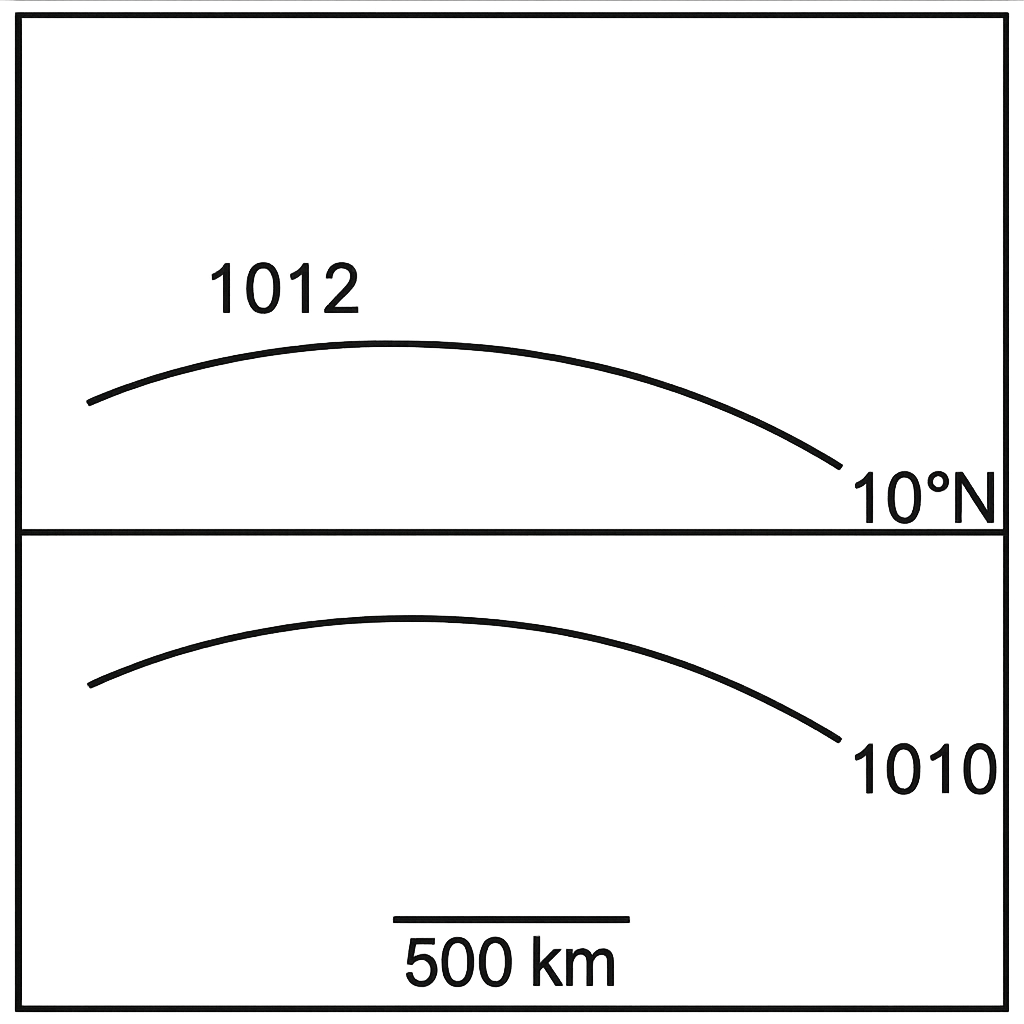
A weather map shows two isobars: 1012 hPa at a western point and 1010 hPa at an eastern point 500 km apart, located at latitude 10°N. Assuming air density \(\rho = 1.2\,\text{kg m}^{-3}\) and using the geostrophic wind approximation, calculate the approximate wind speed in metres per second and state its general direction (northward, southward, eastward or westward).
Correct A. Approximately \(13.2\) m s\(^{-1}\) directed southward.
B. Approximately \\(14.5\\) m s\(^{-1}\) directed northward.
C. Approximately \\(13.2\\) m s\(^{-1}\) directed eastward.
D. Approximately \\(12.0\\) m s\(^{-1}\) directed southward.

Correct Answer: A

Want to see the full step-by-step solution? Unlock AI Explanation & Analytics
Question 12 View Details
A river descends from an elevation of 800 m to 200 m over a total length of 150 km. The upper 60 km of the river has a gradient that is twice the gradient of the lower 90 km. Determine the average gradient (in metres per kilometre) of the upper and lower reaches respectively.
A. Upper gradient \(\approx 4.28\) m km\(^{-1}\); lower gradient \(\approx 2.14\) m km\(^{-1}\).
B. Upper gradient \(\approx 5.71\) m km\(^{-1}\); lower gradient \(\approx 1.43\) m km\(^{-1}\).
C. Upper gradient \(\approx 8.57\) m km\(^{-1}\); lower gradient \(\approx 2.86\) m km\(^{-1}\).
Correct D. Upper gradient \(\approx 5.71\) m km\(^{-1}\); lower gradient \(\approx 2.86\) m km\(^{-1}\).

Correct Answer: D

Want to see the full step-by-step solution? Unlock AI Explanation & Analytics
Question 13 View Details
A specialized hospital serves surrounding villages according to the utility function \(U = 80 - 15\log_{10} d\), where \(d\) is the distance in kilometres from the village to the hospital. A village will use the hospital only if \(U \ge 50\). The villages are uniformly distributed with a density of 0.02 villages per square kilometre. Determine the maximum distance (in km) from which a village will use the hospital and estimate the total number of villages that can be served.
Correct A. Maximum distance 100 km; about 628 villages are served.
B. Maximum distance 80 km; about 500 villages are served.
C. Maximum distance 90 km; about 560 villages are served.
D. Maximum distance 120 km; about 800 villages are served.

Correct Answer: A

Want to see the full step-by-step solution? Unlock AI Explanation & Analytics
Question 14 View Details
A town had a population of 150,000 in the year 2000. From 2000 to 2010 the annual growth rate was 2.5 %. From 2010 onward the growth rate decreased linearly by 0.1 % each year until it reached 1.5 % in 2020, after which it remained constant at 1.5 %. In which year will the population first exceed 250,000?
A. 2023
B. 2026
Correct C. 2024
D. 2025

Correct Answer: C

Want to see the full step-by-step solution? Unlock AI Explanation & Analytics
Question 15 View Details
A state has a total population of 5 million, of which 60 % live in urban areas. The capital city contains 1.2 million people, and the remaining urban population is distributed equally among three secondary towns. What is the population of each secondary town?
A. 500,000
Correct B. 600,000
C. 700,000
D. 800,000

Correct Answer: B

Want to see the full step-by-step solution? Unlock AI Explanation & Analytics
Question 16 View Details
A textile manufacturer is evaluating two possible sites for a new factory. Site A: fixed annual cost ₦2,000,000; variable production cost ₦150 per unit; distance to raw‑material source 40 km (transport cost ₦5 per km per unit); distance to market 60 km (transport cost ₦8 per km per unit). Site B: fixed annual cost ₦1,500,000; variable production cost ₦180 per unit; distance to raw‑material source 20 km (same transport cost); distance to market 90 km (same transport cost). Assuming each unit requires one unit of raw material, let \(Q\) denote the annual number of units produced. (a) Derive the total annual cost functions for Site A and Site B in terms of \(Q\). (b) Find the break‑even production quantity at which the two total‑cost functions are equal (round to the nearest whole unit). (c) If the factory plans to produce 3,500 units per year, state which site yields the lower total cost.
A. Break‑even quantity ≈ 2,500 units; for 3,500 units Site B is cheaper.
Correct B. Break‑even quantity ≈ 2,941 units; for 3,500 units Site A is cheaper.
C. Break‑even quantity ≈ 2,941 units; for 3,500 units Site B is cheaper.
D. Break‑even quantity ≈ 3,200 units; for 3,500 units Site B is cheaper.

Correct Answer: B

Want to see the full step-by-step solution? Unlock AI Explanation & Analytics
Question 17 View Details
An area experiences an average annual rainfall of 1,200 mm with a standard deviation of 150 mm. The probability of a landslide in a given year is modelled as \(P(L)=0.02\,(R/1000)\), where \(R\) is the rainfall (mm) for that year, provided the average slope exceeds 15°. The area's average slope is 18°. The probability of a flood is \(P(F)=0.03\,(R/1200)\).\n\nAssuming rainfall equals the long‑term mean (1,200 mm) and that landslide and flood events are independent:\n\n1. Compute the original probabilities \(P(L)\) and \(P(F)\).\n2. Determine the probability that at least one of the two hazards occurs in a year.\n\nA mitigation programme reduces the landslide probability by 30 % and the flood probability by 20 %. Re‑calculate the combined probability after mitigation.
A. Original combined probability ≈ 5.10 %; after mitigation ≈ 3.90 %
B. Original combined probability ≈ 5.80 %; after mitigation ≈ 4.20 %
Correct C. Original combined probability ≈ 5.33 %; after mitigation ≈ 4.04 %.
D. Original combined probability ≈ 6.00 %; after mitigation ≈ 4.50 %

Correct Answer: C

Want to see the full step-by-step solution? Unlock AI Explanation & Analytics
Question 18 View Details
An open rectangular drainage channel has a uniform slope of 0.0015 and Manning's roughness coefficient \(n=0.015\). The depth of flow is fixed at 1.2 m. The required discharge is 12 m³ s\(^{-1}\).\n\nDetermine the minimum channel width \(b\) (in metres, to two decimal places) that will convey the required discharge.
A. 5.10 m (approximately)
B. 4.20 m (approximately)
Correct C. 4.55 m (approximately)
D. 3.85 m (approximately)

Correct Answer: C

Want to see the full step-by-step solution? Unlock AI Explanation & Analytics
Question 19 View Details
A town had a population of 45,000 in 2015. It experienced an average annual natural increase of 2.4 % and a net in‑migration of 1.2 % per year. From 2020 onward, a new industrial zone is expected to attract an additional 0.8 % net migration each year. Assuming these rates remain constant, calculate:\n\n(a) the projected population in 2025;\n\n(b) the percentage increase of the 2025 population relative to 2015 (to one decimal place).
A. Projected population ≈ 61,500; increase ≈ 36.7 %.
B. Projected population ≈ 70,800; increase ≈ 57.3 %.
C. Projected population ≈ 63,200; increase ≈ 40.5 %.
Correct D. Projected population ≈ 66,600; increase ≈ 48.0 %.

Correct Answer: D

Want to see the full step-by-step solution? Unlock AI Explanation & Analytics
Question 20 View Details
Two climatic zones lie within the same region. Zone X (lowland) - monthly mean temperatures (°C): 28, 28, 27, 26, 25, 24, 24, 24, 25, 26, 27, 28. Monthly rainfall (mm): 120, 110, 130, 150, 200, 250, 300, 280, 220, 180, 150, 130. Zone Y (highland) - monthly mean temperatures (°C): 22, 22, 21, 20, 19, 17, 17, 17, 19, 20, 21, 22. Monthly rainfall (mm): 80, 70, 90, 110, 150, 200, 250, 240, 180, 130, 100, 90. For each zone: 1. Compute the annual mean temperature and total annual rainfall. 2. Classify the climate using the Köppen system (choose among Af, Am, Aw, Cfa, Cfb, Cwa, Dfb, etc.). Cocoa cultivation requires a mean temperature between 21 °C and 27 °C and annual rainfall exceeding 1,500 mm. Indicate which zone is more suitable for cocoa production.
Correct A. Zone X: mean 26 °C, rainfall 2,220 mm, climate Af, suitable for cocoa. Zone Y: mean ≈19.8 °C, rainfall 1,690 mm, climate Cfb, not suitable for cocoa.
B. Zone X: mean 26 °C, rainfall 1,690 mm, climate Af, suitable for cocoa. Zone Y: mean ≈19.8 °C, rainfall 2,220 mm, climate Cfb, not suitable for cocoa.
C. Zone X: mean 26 °C, rainfall 2,220 mm, climate Cfa, suitable for cocoa. Zone Y: mean ≈19.8 °C, rainfall 1,690 mm, climate Cfb, not suitable for cocoa.
D. Zone X: mean 26 °C, rainfall 2,220 mm, climate Af, not suitable for cocoa. Zone Y: mean ≈19.8 °C, rainfall 1,690 mm, climate Cfb, suitable for cocoa.

Correct Answer: A

Want to see the full step-by-step solution? Unlock AI Explanation & Analytics
Question 21 View Details
If a region receives an annual rainfall of \\(1500\\) mm and a mean temperature of \\(26^{\\circ}C\\). During a 3‑month dry season the actual evapotranspiration exceeds precipitation by \\(200\\) mm each month. Determine the major vegetation type that best fits the region using the following criteria: - Rainforest: rainfall > 2000 mm, temperature > 24°C - Savanna: rainfall 900-1500 mm, temperature 22-28°C - Sudanian savanna: rainfall 600-900 mm, temperature 20-26°C
Correct A. Savanna
B. Sudanian savanna
C. Desert
D. Rainforest

Correct Answer: A

Want to see the full step-by-step solution? Unlock AI Explanation & Analytics
Question 22 View Details
A river originates at an elevation of \\(800\\) m and enters the sea at \\(200\\) m above sea level after flowing \\(120\\) km. Its average discharge is \\(150\\) m\\(^3\\) s\\(^{-1}\\). Classify the river stage using the following criteria: - Youthful: gradient > 5 m/km and discharge < 200 m\\(^3\\) s\\(^{-1}\\) - Mature: gradient 1-5 m/km and discharge 200-500 m\\(^3\\) s\\(^{-1}\\) - Old: gradient < 1 m/km and discharge > 500 m\\(^3\\) s\\(^{-1}\\)
A. Old
Correct B. Youthful
C. Transitional
D. Mature

Correct Answer: B

Want to see the full step-by-step solution? Unlock AI Explanation & Analytics
Question 23 View Details
In a 10 km\\(^2\\) forest plot the following numbers of individuals were recorded for four tree species: Species A - 120, Species B - 80, Species C - 50, Species D - 30. Using Simpson's Diversity Index \\(D = \\frac{\\sum n_i (n_i-1)}{N(N-1)}\\) where \\(N\\) is the total number of individuals, determine the diversity level according to these guidelines: D < 0.2 - high diversity; 0.2 ≤ D ≤ 0.5 - moderate diversity; D > 0.5 - low diversity.
A. low
B. very low
Correct C. moderate
D. high

Correct Answer: C

Want to see the full step-by-step solution? Unlock AI Explanation & Analytics
Question 24 View Details
A map has a scale of 1 cm : 5 km. The distance between Town X and Town Y on the map measures 7.4 cm. What is the actual distance between the towns in kilometres?
A. 35 km
B. 40 km
C. 29.6 km
Correct D. 37 km

Correct Answer: D

Want to see the full step-by-step solution? Unlock AI Explanation & Analytics
Question 25 View Details
Monthly rainfall (mm) for a location is: Jan 120, Feb 110, Mar 90, Apr 80, May 70, Jun 60, Jul 50, Aug 40, Sep 30, Oct 20, Nov 10, Dec 5. Using the simplified classification: - Desert (BWh): annual rainfall < 500 mm - Semi‑arid (BSh): 500 mm ≤ annual rainfall < 1000 mm - Others: ≥ 1000 mm Determine the climate type of the location.
A. Cfa
Correct B. BSh
C. BWh
D. Af

Correct Answer: B

Want to see the full step-by-step solution? Unlock AI Explanation & Analytics

Master the Exam!

You've seen a preview, but there are thousands more questions plus AI tutor to break down complex solutions.

Unlock Full Access Available for Android & Windows
Help others prepare! Share this practice hub:
Chat with Support