neco 2018 chemistry | Essay

Prepare for your exams with neco questions? Reviewing past/model questions is one of the most effective ways to guarantee a high score. This practice hub features authentic 2018 chemistry (Essay) questions designed to simulate the real exam environment.

Practice these randomly selected questions to test your readiness.
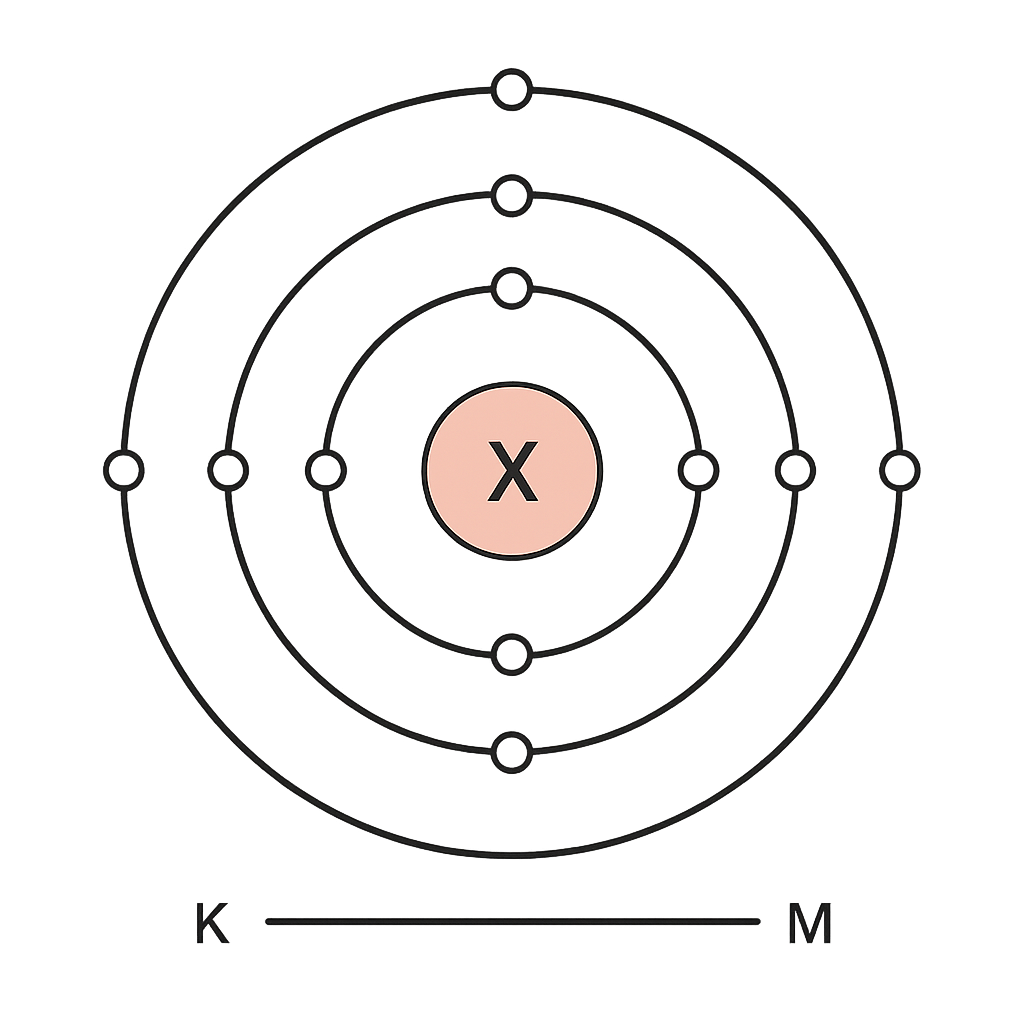
Question 1 View Details
The diagram shows the Bohr model of an unknown element X. The nucleus is labelled X and the electron shells contain the following numbers of electrons: K‑shell 2, L‑shell 8, M‑shell 5. No electrons are shown in higher shells.
Question Parts
(a)
Determine the atomic number (Z) of element X and write the symbol of the element (including mass number) if the most abundant isotope of X contains 16 neutrons.
(b)
Write the ground‑state electron configuration of element X using orbital notation (showing the distribution of electrons in s and p subshells).
(c)
Predict the most common ion formed by element X in its compounds and give the formula of the oxide formed with oxygen.
Detailed Essay Solution & Marking Scheme Available

Get the step-by-step mathematical proofs, key points required by examiners, and a comprehensive breakdown from our AI Tutor.
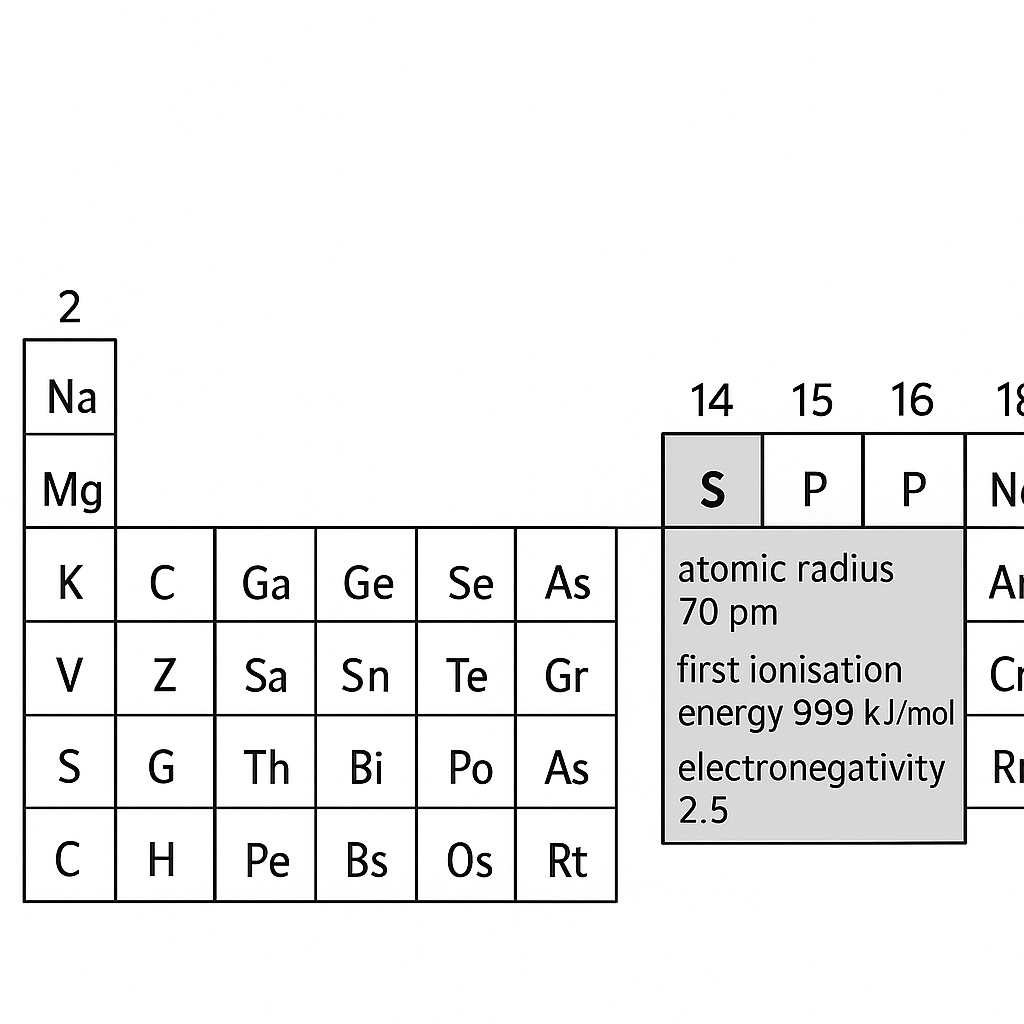
Question 2 View Details
The diagram shows a portion of the periodic table highlighting periods 2 and 3 and groups 1, 2, 13, 14, 15, 16 and 18. The element Y is placed in period 3, group 16. The data given for Y are: atomic radius = 70 pm, first ionisation energy = 999 kJ·mol⁻¹, electronegativity (Pauling) = 2.5. For the element in the same period but group 2 (element Z) the atomic radius is 150 pm and its first ionisation energy is 738 kJ·mol⁻¹.
Question Parts
(a)
Identify element Y by its chemical symbol and name.
(b)
Explain why the atomic radius of Y is smaller than that of Z even though both are in the same period.
(c)
Write the chemical formula of the most stable oxide formed by element Y and state the oxidation state of Y in that oxide.
(d)
Calculate the percentage decrease in atomic radius from element Z to element Y. Show your working.
Detailed Essay Solution & Marking Scheme Available

Get the step-by-step mathematical proofs, key points required by examiners, and a comprehensive breakdown from our AI Tutor.

Question 3 View Details
A compound X is formed between a metal M and a non‑metal N. The metal M has an atomic radius of 160 pm, a first ionisation energy of 735 kJ mol⁻¹ and a sublimation enthalpy of 100 kJ mol⁻¹. The non‑metal N has an electronegativity of 3.0, a first electron affinity of –150 kJ mol⁻¹, a second electron affinity of –200 kJ mol⁻¹ and a bond dissociation energy for N₂ of 495 kJ mol⁻¹. The lattice energy of the ionic solid X is –3500 kJ mol⁻¹. The compound is known to be ionic.
Question Parts
(a)
Write the electron configurations of the neutral atoms M and N, and of the ions M⁺ and N⁻ that are present in X.
(b)
Using the data given, calculate the standard enthalpy change (ΔH⁰_f) for the formation of one mole of X from its elements in their standard states, employing a Born‑Haber cycle.
(c)
Explain, with reference to the data, why the formation of X is thermodynamically favourable despite the relatively high first ionisation energy of M.
Detailed Essay Solution & Marking Scheme Available

Get the step-by-step mathematical proofs, key points required by examiners, and a comprehensive breakdown from our AI Tutor.

Question 4 View Details
The diagram shows the structural formula of a carbohydrate molecule. The carbon atoms are labelled C1 to C6 and the oxygen atoms are labelled O1 to O6. All hydrogen atoms are attached to the carbon or oxygen atoms as indicated in the diagram. Using the information from the diagram, answer the following:
Question Parts
(a)
Determine the empirical formula of the compound.
(b)
The experimentally determined molar mass of the compound is 180 g mol⁻¹. Using the empirical formula obtained in part (a), deduce the molecular formula of the compound.
(c)
A 2.70 g sample of the compound is dissolved in water. Calculate the number of moles of the compound present in the sample.
(d)
Based on the molecular formula, calculate the mass of carbon, hydrogen and oxygen respectively present in the 2.70 g sample.
Detailed Essay Solution & Marking Scheme Available

Get the step-by-step mathematical proofs, key points required by examiners, and a comprehensive breakdown from our AI Tutor.

Question 5 View Details
The diagram shows the structural formula of an organic compound X which contains only carbon, hydrogen and oxygen atoms. The compound reacts with aqueous sodium hydroxide (NaOH) according to the equation: X + NaOH → Y + Z. In the reaction, Y is a sodium salt and Z is an alcohol. Given that 2.00 g of X reacts with 5.00 g of NaOH (excess) and 1.80 g of Y is obtained, answer the following:
Question Parts
(a)
Write the molecular formula of X.
(b)
State the functional group(s) present in X.
(c)
Calculate the theoretical mass of Y that could be obtained from the given amount of X.
(d)
Determine the percent yield of Y.
(e)
Explain, with reference to the functional group(s), why NaOH reacts with X to give Y and Z.
Detailed Essay Solution & Marking Scheme Available

Get the step-by-step mathematical proofs, key points required by examiners, and a comprehensive breakdown from our AI Tutor.

Question 6 View Details
A 2.00 g sample of a pure substance is heated from –20 °C to 120 °C. The substance has a melting point of 0 °C and a boiling point of 80 °C. Its molar mass is 40.0 g mol⁻¹. The specific heat capacities are: solid = 1.0 J g⁻¹ K⁻¹, liquid = 2.0 J g⁻¹ K⁻¹, gas = 0.8 J g⁻¹ K⁻¹. The enthalpy of fusion is 6.0 kJ mol⁻¹ and the enthalpy of vaporisation is 30.0 kJ mol⁻¹. Determine:
Question Parts
(a)
The total amount of heat (in joules) required to raise the sample from –20 °C to 120 °C, taking into account all phase changes.
(b)
If the sample is heated at a constant rate of 5.0 J s⁻¹, the time (in minutes and seconds) required for the sample to become completely vapourised.
(c)
The temperature at which the sample is completely vapourised.
Detailed Essay Solution & Marking Scheme Available

Get the step-by-step mathematical proofs, key points required by examiners, and a comprehensive breakdown from our AI Tutor.

Question 7 View Details
A 0.250 mol dm\(^{-3}\) solution of the weak acid HA (\(K_{a}=1.2\times10^{-5}\)) is mixed with its sodium salt NaA to prepare 250 cm\(^{3}\) of a buffer solution. The solution is subsequently titrated with 0.100 mol dm\(^{-3}\) NaOH. Answer the following questions.
Question Parts
(a)
Calculate the pH of the buffer before any NaOH is added. (Assume the ratio [A\(^{-}\)]/[HA] = 1.5.)
(b)
After adding 10.0 cm\(^{3}\) of the NaOH solution, calculate the new pH of the buffer.
(c)
How many millilitres of the 0.100 mol dm\(^{-3}\) NaOH solution are required to raise the pH of the original buffer by 0.50 units?
(d)
Explain, with reference to the common‑ion effect, why the buffer resists large changes in pH when small amounts of strong acid or base are added.
Detailed Essay Solution & Marking Scheme Available

Get the step-by-step mathematical proofs, key points required by examiners, and a comprehensive breakdown from our AI Tutor.

Question 8 View Details
Silver chloride (AgCl) is a sparingly soluble salt with a solubility product \(K_{sp}=1.8\times10^{-10}\) at 25 °C. The following situations are considered:
Question Parts
(a)
Calculate the molar solubility of AgCl in pure water.
(b)
If the solution already contains 0.010 mol dm⁻³ NaCl, determine the new solubility of AgCl.
(c)
Ammonia forms the complex ion \([Ag(NH_{3})_{2}]^{+}\) with a cumulative formation constant \(\beta_{2}=1.6\times10^{7}\). Assuming the solution contains 0.10 mol dm⁻³ NH₃ and that the only silver species present are Ag⁺ and the complex, calculate the solubility of AgCl in this solution.
Detailed Essay Solution & Marking Scheme Available

Get the step-by-step mathematical proofs, key points required by examiners, and a comprehensive breakdown from our AI Tutor.

Master the Exam!

You've seen a preview, but there are thousands more questions plus AI tutor to break down complex solutions.

Unlock Full Access Available for Android & Windows
Help others prepare! Share this practice hub:
Chat with Support