neco 2018 agricultural_science | Objective

Prepare for your exams with neco questions? Reviewing past/model questions is one of the most effective ways to guarantee a high score. This practice hub features authentic 2018 agricultural_science (Objective) questions designed to simulate the real exam environment.

Practice these randomly selected questions to test your readiness.

Question 1 View Details
If a forest area of 10 ha is planted with 2000 seedlings per ha of species X. The initial DBH is 2 cm and height 0.5 m. Each year the trees increase in DBH by 2.5 cm and height by 0.6 m. After 5 years, 85% of the seedlings survive and a thinning removes 30% of the surviving trees. The remaining trees continue to grow until age 20 years (i.e., 15 more years). The merchantable volume per tree at age 20 is estimated by \(V = 0.0001 d^{2} h\) cubic metres, where \(d\) is the DBH in cm and \(h\) is the height in metres. Calculate the total merchantable volume from the whole forest at age 20.
A. 38900 cubic metres
B. 42500 cubic metres
Correct C. 40222 cubic metres
D. 36198 cubic metres

Correct Answer: C

Want to see the full step-by-step solution? Unlock AI Explanation & Analytics
Question 2 View Details
A farmer produces maize with fixed costs of \(\text{₦}150,000\) per season. The variable cost is \(\text{₦}18,000\) per tonne and the expected yield is 10 tonnes. The market price is \(\text{₦}45,000\) per tonne. The government offers a subsidy equal to 20% of the market price for each tonne sold, but the subsidy is paid only if the farmer's profit before subsidy exceeds \(\text{₦}100,000\). The farmer is considering a new high‑yield variety that raises the expected yield by 25% but increases the variable cost by \(\text{₦}5,000\) per tonne. Should the farmer adopt the new variety, assuming the market price remains unchanged and the subsidy condition is evaluated after adoption?
Correct A. Yes, the farmer should adopt the new variety because the profit after subsidy rises to ₦237,500, which is higher than the ₦210,000 profit with the current variety.
B. Yes, the farmer should adopt the new variety because the profit after subsidy rises to ₦225,000, which is higher than the ₦210,000 profit with the current variety.
C. Yes, the farmer should adopt the new variety because the profit after subsidy rises to ₦240,000, which is higher than the ₦210,000 profit with the current variety.
D. No, the farmer should not adopt the new variety because the profit after subsidy falls to ₦195,000, which is lower than the ₦210,000 profit with the current variety.

Correct Answer: A

Want to see the full step-by-step solution? Unlock AI Explanation & Analytics
Question 3 View Details
In a field of 200 plants, 30 show symptoms of a leaf‑spot disease. Of the symptomatic plants, 80% have lesions covering less than 10% of leaf area, while 20% have lesions covering more than 30% of leaf area. The disease is caused by a fungus that requires a minimum leaf‑wetness period of 6 hours for infection. Weather records indicate an average leaf‑wetness duration of 5 hours, but irrigation adds 2 hours of wetness to 40% of the field. Determine (a) the disease incidence in the field, (b) the proportion of the field that is at risk of infection because the leaf‑wetness requirement is met, and (c) give an integrated management recommendation that includes cultural, chemical and resistant‑variety measures.
A. (a) 18 % incidence; (b) 25 % of the field is at risk; (c) Implement mulching, apply a seed treatment fungicide, and use genetically modified resistant lines.
B. (a) 20 % incidence; (b) 30 % of the field is at risk; (c) Use crop rotation, apply a systemic fungicide after symptoms appear, and select tolerant varieties.
C. (a) 12 % incidence; (b) 50 % of the field is at risk; (c) Increase canopy airflow, apply a curative fungicide mid‑season, and plant early‑maturing cultivars.
Correct D. (a) 15 % incidence; (b) 40 % of the field is at risk; (c) Use improved drainage and irrigation scheduling, apply a protectant fungicide at the start of wet periods, and plant resistant varieties.

Correct Answer: D

Want to see the full step-by-step solution? Unlock AI Explanation & Analytics
Question 4 View Details
A soil sample has a pH of 5.2. The farmer wants to raise the pH to 6.5 using agricultural lime (CaCO₃). For this soil type, each 100 kg of lime per hectare raises the pH by 0.1 unit. How many kilograms of lime are required per hectare?
A. 130 kg per hectare
Correct B. 1300 kg per hectare
C. 1500 kg per hectare
D. 1000 kg per hectare

Correct Answer: B

Want to see the full step-by-step solution? Unlock AI Explanation & Analytics
Question 5 View Details
A farm has 120 labour‑days available each month. Two activities are required: planting, which needs 3 labour‑days per hectare, and weeding, which needs 2 labour‑days per hectare. The farm has 30 hectares of land. Profit from a planted hectare is \(\text{₦}50,000\) provided the hectare is weeded at least once; otherwise the profit from that hectare falls to \(\text{₦}30,000\). Determine the optimal number of hectares to plant and weed in order to maximise monthly profit, and state the maximum profit achievable.
A. Plant and weed 25 hectares; maximum profit = ₦1,250,000
Correct B. Plant and weed 24 hectares; maximum profit = ₦1,200,000
C. Plant and weed 24 hectares; maximum profit = ₦1,150,000
D. Plant and weed 20 hectares; maximum profit = ₦1,000,000

Correct Answer: B

Want to see the full step-by-step solution? Unlock AI Explanation & Analytics
Question 6 View Details
A farmer plans to cultivate maize on a variable area of land (in hectares). Fixed costs for the season are ₦150,000. Variable cost is ₦30,000 per hectare. Expected yield is 4 tonnes per hectare. The market price is ₦45,000 per tonne, but if total production exceeds 18 tonnes the price falls by 10%, becoming \(0.9 \times 45{,}000 = 40{,}500\) naira per tonne. Determine the minimum area (to two decimal places) that must be cultivated to obtain a profit of at least \(200{,}000\) naira.
A. 3.00 ha
Correct B. 2.34 ha
C. 2.20 ha
D. 2.50 ha

Correct Answer: B

Want to see the full step-by-step solution? Unlock AI Explanation & Analytics
Question 7 View Details
In a mixed‑farming system the total nitrogen input is \(120\) kg ha\(^{-1}\). Biological nitrogen fixation supplies 60 % of the total, mineral fertilizer supplies 25 %, and the remainder comes from organic manure. Calculate the amount of nitrogen supplied by the organic manure (in kg ha\(^{-1}\)).
A. 12 kg ha⁻¹
B. 30 kg ha⁻¹
Correct C. 18 kg ha⁻¹
D. 24 kg ha⁻¹

Correct Answer: C

Want to see the full step-by-step solution? Unlock AI Explanation & Analytics
Question 8 View Details
A tomato farmer monitors the pest *Tuta absoluta*. The economic injury level (EIL) is given by \(\text{EIL}=\dfrac{C}{V\times I}\), where \(C\) is the cost of control per hectare (₦12,000), \(V\) is the market value per kilogram of tomatoes (₦250), and \(I\) is the injury per pest per kilogram yield loss (0.02 kg per pest). The farmer estimates that each pest causes a loss of 0.02 kg per kilogram of yield. The current pest density is 5 pests per plant and there are 10,000 plants per hectare. Should the farmer apply control measures? Answer "Yes" if control is justified, otherwise "No".
A. Not necessary
B. Maybe
C. No
Correct D. Yes

Correct Answer: D

Want to see the full step-by-step solution? Unlock AI Explanation & Analytics
Question 9 View Details
A soil sample contains 30 % sand, 45 % silt and 25 % clay (by weight). According to the USDA soil‑texture triangle, what is the textural class of this soil?
A. Clay loam
B. Sandy loam
Correct C. Silty loam
D. Silty clay loam

Correct Answer: C

Want to see the full step-by-step solution? Unlock AI Explanation & Analytics
Question 10 View Details
A batch of cassava roots weighs 500 kg (wet basis) and has an initial moisture content of 70 % (wet basis). The desired final moisture content for safe storage is 15 % (wet basis). The drying follows the model \(M_t = M_e + (M_0 - M_e) e^{-kt}\), where \(M_t\) is the moisture content at time \(t\) (hours), \(M_0\) is the initial moisture content, \(M_e\) is the equilibrium moisture content (assumed 12 % wet basis), and \(k = 0.25\) h\(^{-1}\). Calculate the minimum drying time required to reach the target moisture content of 15 % (wet basis). Give your answer in hours, rounded to one decimal place.
Correct A. 11.8 h
B. 10.3 h
C. 9.9 h
D. 13.5 h

Correct Answer: A

Want to see the full step-by-step solution? Unlock AI Explanation & Analytics
Question 11 View Details
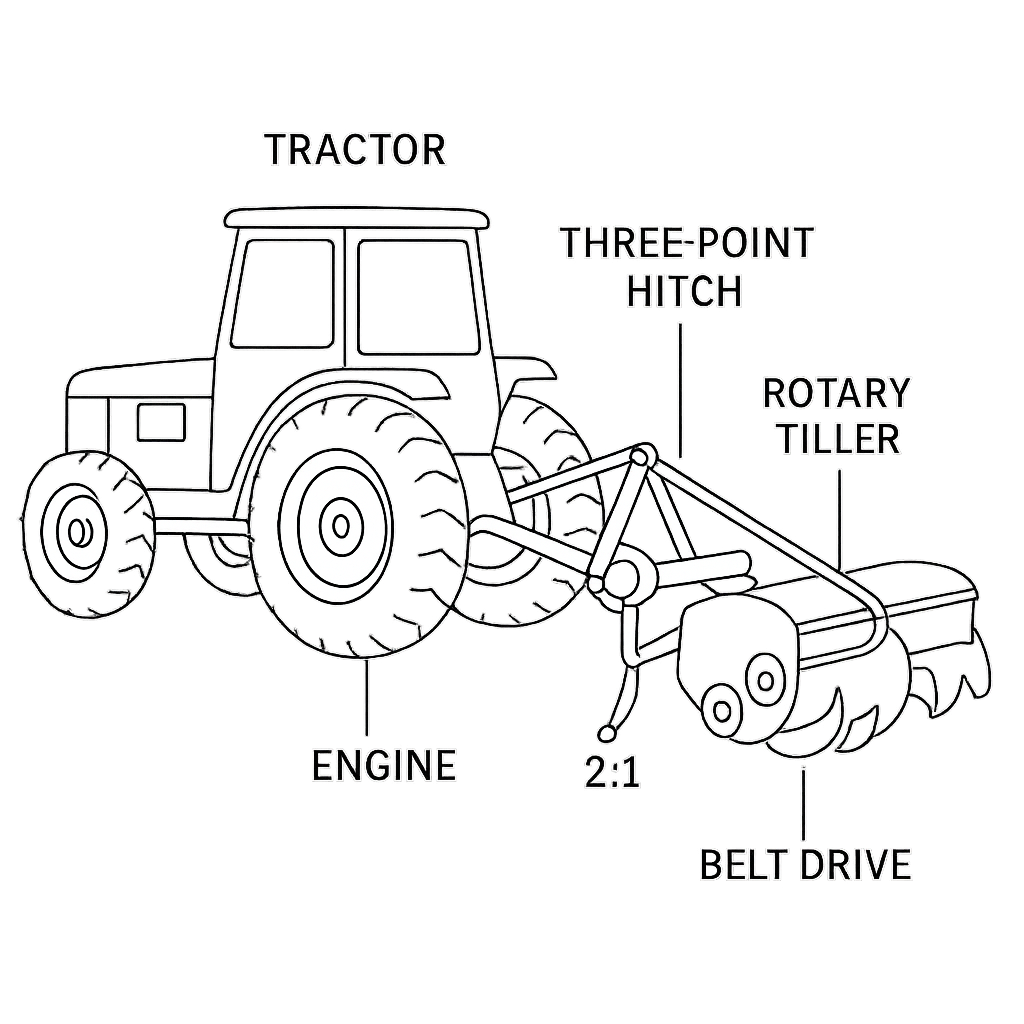
The diagram shows a tractor driving a rotary tiller through a belt drive. The tractor engine runs at 1500 rpm. The gear ratio from engine to belt is \(2:1\) (engine : belt). The belt to drum ratio is \(3:2\) (belt : drum). The tiller drum has a radius of 0.20 m and a working width of 0.50 m. Assuming continuous operation and no overlap, calculate the theoretical field capacity in hectares per hour, rounded to two decimal places.
A. 2.12 ha\/h
B. 2.45 ha\/h
C. 1.70 ha\/h
Correct D. 1.88 ha/h

Correct Answer: D

Want to see the full step-by-step solution? Unlock AI Explanation & Analytics
Question 12 View Details
A farmer has 5 ha of maize. Without control, disease X reduces the yield by 15 %. A fungicide costs \(12,000\) ₦ per hectare and reduces disease incidence by 80 %. The market price of maize is \(30\) ₦ per kg and the expected yield without disease is 3,000 kg per hectare. Should the farmer apply the fungicide? State the decision and the net profit difference per hectare (in ₦).
A. Yes; profit is higher by 800 ₦ per ha
Correct B. No; profit is lower by 1,200 ₦ per ha
C. No; profit is lower by 2,400 ₦ per ha
D. Yes; profit is higher by 1,500 ₦ per ha

Correct Answer: B

Want to see the full step-by-step solution? Unlock AI Explanation & Analytics
Question 13 View Details
A dairy cow produces 25 L of milk per day and consumes 22 kg of dry‑matter total mixed ration (TMR) per day. The TMR contains 16 % crude protein and provides 2.8 Mcal of metabolizable energy per kilogram. (i) Calculate the feed conversion efficiency (FCE) in kg milk per Mcal. (ii) Determine whether the cow meets the recommended minimum FCE of 0.9 kg Mcal⁻¹ and the crude protein requirement of 6 kg per day (assume 1 L milk ≈ 1 kg).
A. FCE = 0.41 kg Mcal⁻¹ (below 0.9); CP intake = 3.52 kg (below 6 kg) - diet meets requirements
Correct B. FCE = 0.41 kg Mcal⁻¹ (below 0.9); CP intake = 3.52 kg (below 6 kg) - diet is inadequate
C. FCE = 0.41 kg Mcal⁻¹ (below 0.9); CP intake = 4.80 kg (below 6 kg) - diet is inadequate
D. FCE = 0.55 kg Mcal⁻¹ (below 0.9); CP intake = 3.52 kg (below 6 kg) - diet is inadequate

Correct Answer: B

Want to see the full step-by-step solution? Unlock AI Explanation & Analytics
Question 14 View Details
A farmer uses a class‑1 lever to lift a 120 kg sack of grain. The fulcrum is placed 0.25 m from the load and 0.75 m from the effort point. (i) What is the minimum effort force required (in newtons) assuming no friction? (ii) If the farmer can apply at most 200 N, what is the maximum load (in kilograms) that can be lifted with this lever?
Correct A. Minimum effort = 392 N; maximum liftable load ≈ 61 kg
B. Minimum effort = 300 N; maximum liftable load ≈ 45 kg
C. Minimum effort = 350 N; maximum liftable load ≈ 55 kg
D. Minimum effort = 480 N; maximum liftable load ≈ 75 kg

Correct Answer: A

Want to see the full step-by-step solution? Unlock AI Explanation & Analytics
Question 15 View Details
A farmer grows cassava with fixed costs of \(150,000\) ₦ per season and variable costs of \(45,000\) ₦ per hectare. Expected yield is 12 tonnes per hectare. The market price is \(12,000\) ₦ per tonne, but for each hectare above 5 ha the price falls by 5 % per extra hectare (price = \(12,000\) ₦ × (1 - 0.05 × (H - 5)) for H > 5). The farmer can cultivate up to 10 ha. Determine the number of hectares that maximizes profit and state the maximum profit (in ₦).
Correct A. 9 hectares; maximum profit = 481,800 ₦
B. 7 hectares; maximum profit = 442,200 ₦
C. 8 hectares; maximum profit = 469,200 ₦
D. 10 hectares; maximum profit = 480,000 ₦

Correct Answer: A

Want to see the full step-by-step solution? Unlock AI Explanation & Analytics
Question 16 View Details
On a 12‑ha farm a 4‑year crop rotation of maize and soybean is planned. Maize yields 3.5 t ha\(^{-1}\) and removes 150 kg N ha\(^{-1}\) each year. Soybean yields 2.8 t ha\(^{-1}\) and fixes 45 kg N ha\(^{-1}\) (i.e., net nitrogen removal is -45 kg N ha\(^{-1}\)). To avoid soil nitrogen depletion the average annual nitrogen removal must not exceed 120 kg N ha\(^{-1}\). Determine how many years in the 4‑year cycle should be allocated to maize and how many to soybean so that the nitrogen constraint is satisfied while the total grain yield over the cycle is maximised.
Correct A. Maize 3 years, Soybean 1 year
B. Maize 1 year, Soybean 3 years
C. Maize 4 years, Soybean 0 years
D. Maize 2 years, Soybean 2 years

Correct Answer: A

Want to see the full step-by-step solution? Unlock AI Explanation & Analytics
Question 17 View Details
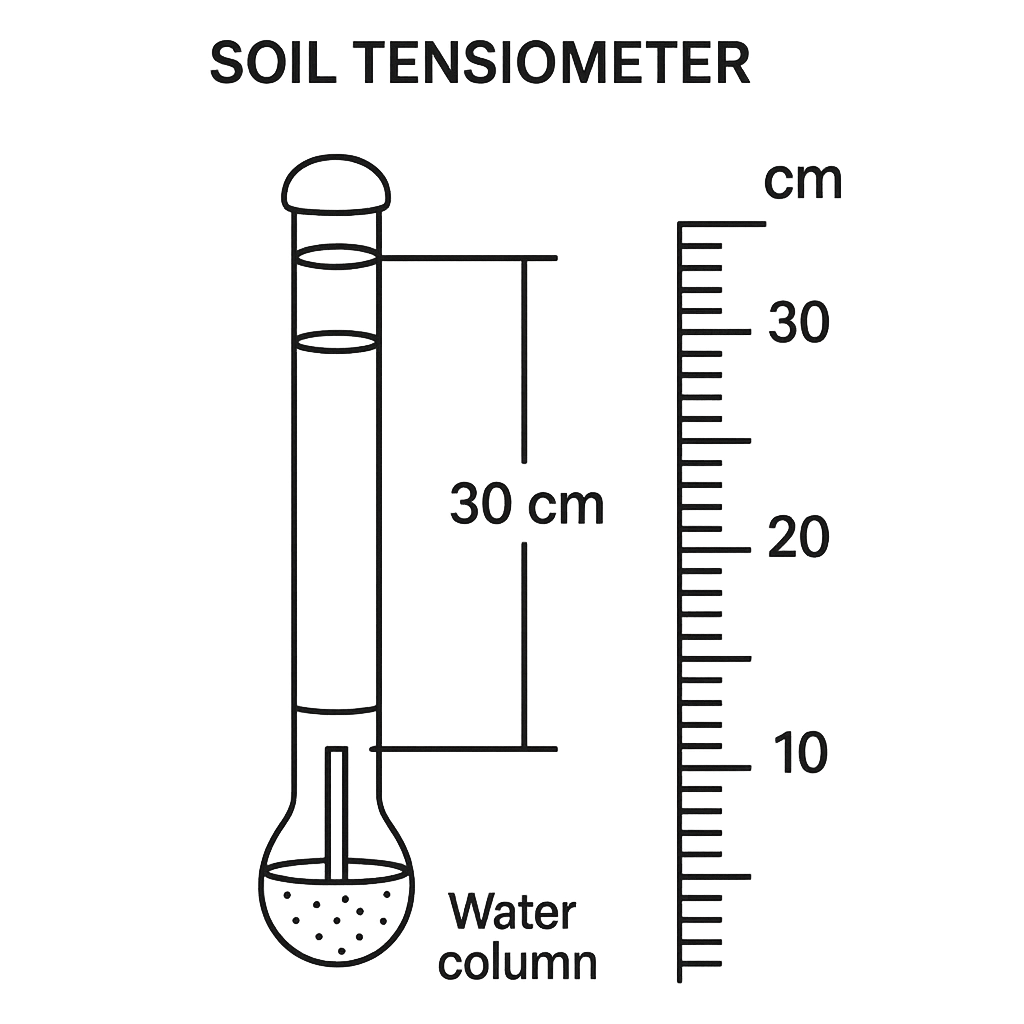
A tensiometer is set up in a soil profile as shown in the diagram. The water column inside the tensiometer rises to a height of 30 cm. Given that 1 cm of water column corresponds to 0.098 kPa of soil water potential, calculate the soil water potential in kPa indicated by the tensiometer.
A. 3.00 kPa
B. 2.70 kPa
Correct C. 2.94 kPa
D. 0.098 kPa

Correct Answer: C

Want to see the full step-by-step solution? Unlock AI Explanation & Analytics
Question 18 View Details
Cassava chips have an initial moisture content of 45 % (wet basis). They must be dried to a final moisture content of 12 % (wet basis) before storage. In a solar dryer operating at 45 °C the drying rate follows the empirical law \( \frac{dM}{dt}= -k\,(M-M_e) \) where \(M\) is the moisture content (% wb), \(M_e =10\%\) is the equilibrium moisture content at this temperature, and \(k =0.8\ \text{h}^{-1}\). Assuming the moisture content changes continuously according to this law, calculate the drying time (in hours) required to reach the target moisture content.
A. ≈ 5.1 h
B. ≈ 4.2 h
Correct C. ≈ 3.6 h
D. ≈ 2.9 h

Correct Answer: C

Want to see the full step-by-step solution? Unlock AI Explanation & Analytics
Question 19 View Details
A mixed forest covering 100 ha has an average tree height of 20 m and an average DBH (diameter at breast height) of 30 cm. The volume of a single tree (in m\(^3\)) can be estimated by \( V = 0.00005\, D^{2}\, H \) where \(D\) is in cm and \(H\) in metres. There are 500 trees per hectare. The stand's annual growth factor is 2.5 % of the standing volume, and the management plan permits harvesting at most 1.5 % of the standing volume each year to ensure sustainability. Determine the maximum annual timber volume (in m\(^3\)) that may be harvested from the whole forest.
A. 540 m³ per year
B. 720 m³ per year
C. 630 m³ per year
Correct D. 675 m³ per year

Correct Answer: D

Want to see the full step-by-step solution? Unlock AI Explanation & Analytics
Question 20 View Details
A farmer invests ₦200,000 in fixed capital (housing, equipment) to start a broiler operation. The variable cost per bird is ₦1,200 (feed, medication). Each bird sells for ₦2,500 after a 6‑week growth period. The farmer plans to raise 1,000 birds per production cycle and to run four cycles per year. There is a 5 % probability that a disease outbreak occurs in a cycle, causing a 30 % loss of birds; the surviving birds are then sold at only 80 % of the normal price because of market saturation. Assuming the expected values, (a) compute the expected annual profit, and (b) state whether the fixed‑cost investment is recovered within three years.
Correct A. Expected annual profit = ₦4,980,000; the investment is recovered in the first year (hence within three years).
B. Expected annual profit = ₦4,980,000; the investment is recovered in the third year (hence within three years).
C. Expected annual profit = ₦5,200,000; the investment is recovered in the first year (hence within three years).
D. Expected annual profit = ₦4,500,000; the investment is recovered in the second year (hence within three years).

Correct Answer: A

Want to see the full step-by-step solution? Unlock AI Explanation & Analytics
Question 21 View Details
An agricultural extension service incurs a fixed annual cost of \(\text{₦}150{,}000\) and a variable cost of \(\text{₦}500\) per farmer trained. Each farmer who adopts the recommended technology gains an increase in net farm income of \(\text{₦}12{,}000\) per year. (a) Determine the minimum whole number of farmers that must adopt the technology for the extension programme to break even. (b) If the actual number of adopting farmers is 30\% higher than this break‑even number, estimate the total net benefit to the community after covering the extension costs. Express your answer in \(\text{₦}\).
A. ₦45,500
B. ₦80,000
Correct C. ₦57,000
D. ₦68,500

Correct Answer: C

Want to see the full step-by-step solution? Unlock AI Explanation & Analytics
Question 22 View Details
A tractor has a rated engine power of \(45\) kW and a transmission efficiency of \(85\%\). It must pull a plough that requires a constant drawbar pull of \(12\) kN up a \(5\%\) slope. (a) Determine the maximum speed (in m/s) the tractor can maintain under these conditions. (b) If the tractor operates at that speed for \(4\) hours, how many litres of diesel are consumed? Assume diesel has an energy density of \(36\) MJ/L and the engine thermal efficiency is \(30\%\). Give your answer to two decimal places.
A. 55.00
B. 45.00
C. 48.00
Correct D. 51.00

Correct Answer: D

Want to see the full step-by-step solution? Unlock AI Explanation & Analytics
Question 23 View Details
During an outbreak of Newcastle disease on a poultry farm, the number of infected birds rose from \(10\) to \(40\) over a period of \(6\) days. The disease has a latent period of \(2\) days and an infectious period of \(4\) days. (a) Assuming exponential growth, estimate the basic reproduction number \(R_{0}\) using the approximation \(R_{0}\approx 1 + r\,T_{g}\), where \(r\) is the exponential growth rate and \(T_{g}\) (the generation time) equals latent period plus half the infectious period. (b) What minimum proportion of the flock must be immunised with a perfect vaccine to prevent a further epidemic? Express your answer as a percentage rounded to the nearest whole number.
A. 60%
B. 55%
C. 42%
Correct D. 48%

Correct Answer: D

Want to see the full step-by-step solution? Unlock AI Explanation & Analytics
Question 24 View Details
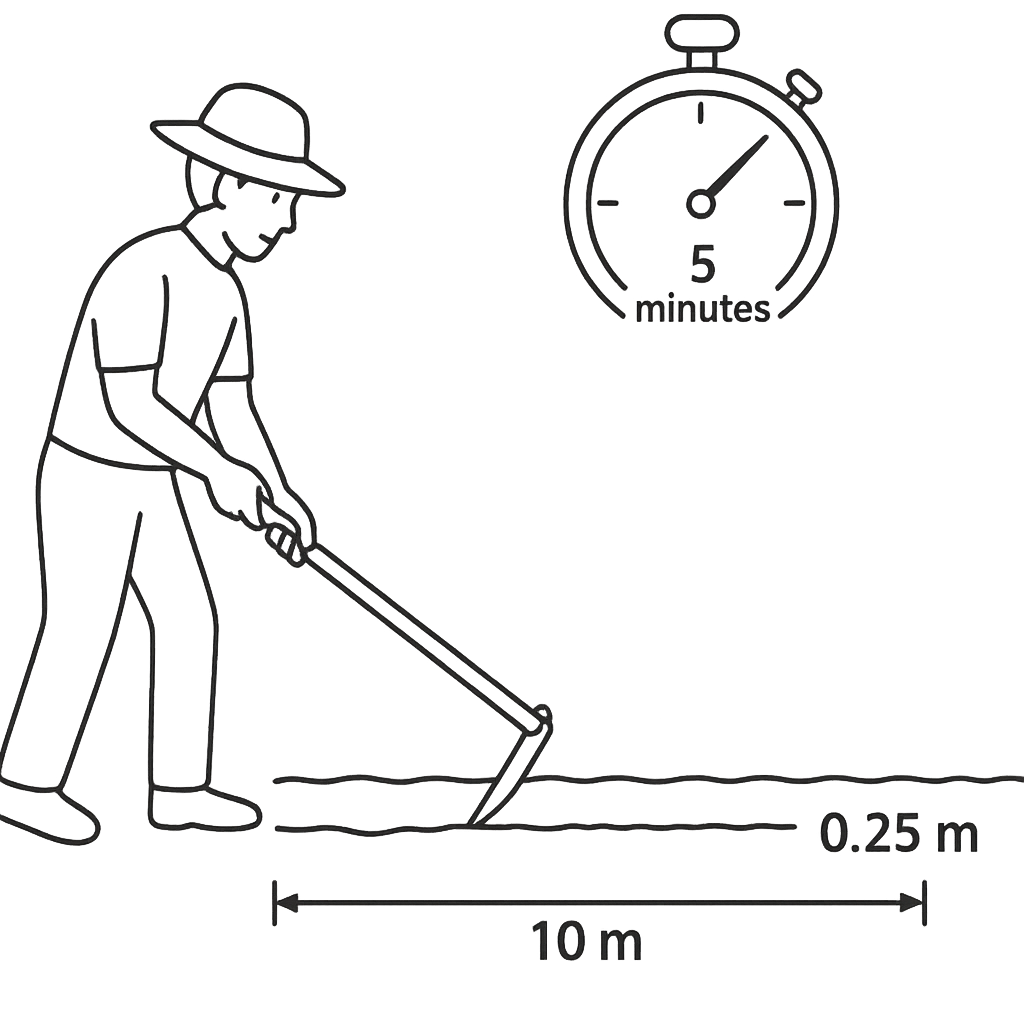
The diagram shows a farmer using a hand hoe to till a straight furrow that is \(10\) m long. A stopwatch indicates that the furrow is completed in \(5\) minutes. The furrow width is \(0.25\) m. (a) Assuming the farmer works continuously for \(8\) hours, estimate the total area (in m²) that can be tilled. (b) To increase the total tilled area by \(20\)% without changing the tool, what average speed (in m/min) must the farmer maintain? Give your answer to two decimal places.
A. 2.00
B. 2.24
C. 2.62
Correct D. 2.42

Correct Answer: D

Want to see the full step-by-step solution? Unlock AI Explanation & Analytics
Question 25 View Details
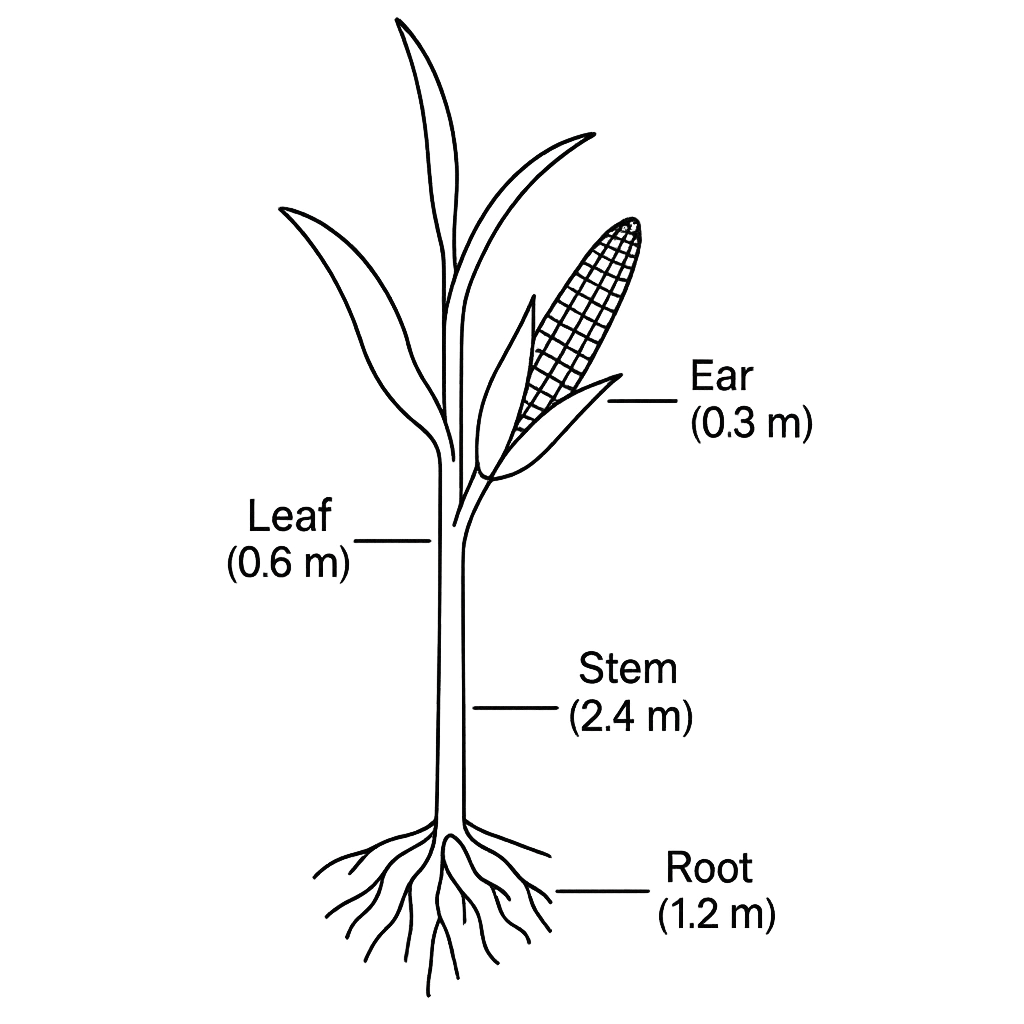
The diagram depicts a mature maize plant with the following labelled organ lengths: stem \(2.4\) m, leaf \(0.6\) m, ear \(0.3\) m, and root \(1.2\) m. The cross‑sectional area of the stem is twice that of each of the other organs (leaf, ear, root), which all have the same area. Assuming dry‑matter accumulation is proportional to the product of length and cross‑sectional area for each organ, calculate the percentage of the plant's total dry matter that is contained in the stem. Round your answer to the nearest whole percent.
Correct A. 70%
B. 55%
C. 80%
D. 60%

Correct Answer: A

Want to see the full step-by-step solution? Unlock AI Explanation & Analytics

Master the Exam!

You've seen a preview, but there are thousands more questions plus AI tutor to break down complex solutions.

Unlock Full Access Available for Android & Windows
Help others prepare! Share this practice hub:
Chat with Support