neco 2018 agricultural_science | Essay

Prepare for your exams with neco questions? Reviewing past/model questions is one of the most effective ways to guarantee a high score. This practice hub features authentic 2018 agricultural_science (Essay) questions designed to simulate the real exam environment.

Practice these randomly selected questions to test your readiness.

Question 1 View Details
Biodiversity is a key component of a sustainable agricultural ecosystem. Discuss its importance by addressing the following points:
Question Parts
(a)
Explain how biodiversity contributes to natural pest regulation.
(b)
Describe the role of soil microorganisms in nutrient cycling and soil fertility.
(c)
Analyse the impact of monoculture on ecosystem stability and long‑term productivity.
Detailed Essay Solution & Marking Scheme Available

Get the step-by-step mathematical proofs, key points required by examiners, and a comprehensive breakdown from our AI Tutor.
Question 2 View Details
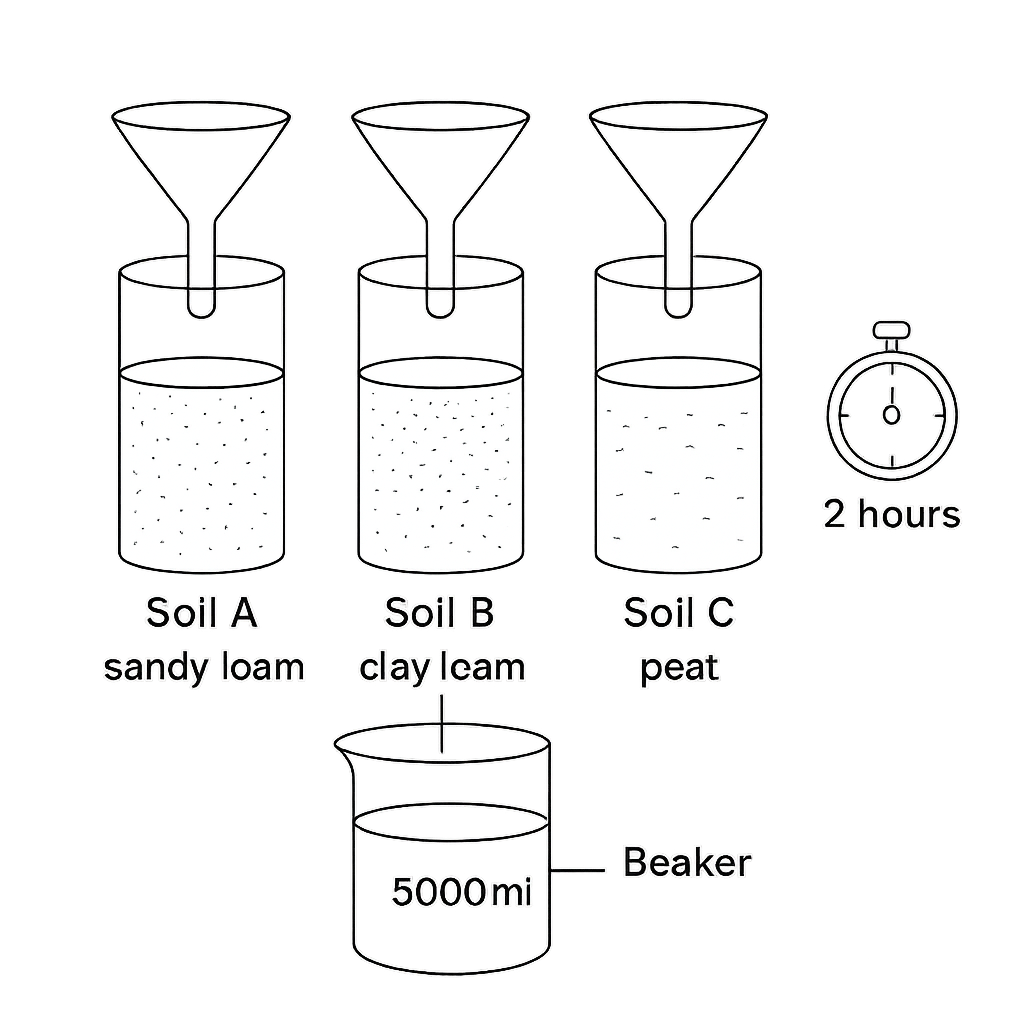
A soil scientist is investigating the water‑retention characteristics of three soil types: sandy loam (Soil A), clay loam (Soil B) and peat (Soil C). The experimental arrangement is shown in the illustration. Each soil column is 30 cm high with a cross‑sectional area of 100 cm². After saturation, the columns are allowed to drain freely for 2 hours and the volume of water collected in the drainage beaker is recorded as follows: Soil A – 1800 cm³, Soil B – 1200 cm³, Soil C – 600 cm³.
Question Parts
(a)
Calculate the field capacity (percentage of water retained) for each soil type.
(b)
Identify which soil has the highest water‑holding capacity and explain the reason based on its texture.
(c)
If the wilting point is 50 % of the field capacity, determine the volume of water remaining in each column at the wilting point.
(d)
Discuss two practical implications of these results for irrigation scheduling on a farm that grows a mixed crop of maize and vegetables.
Detailed Essay Solution & Marking Scheme Available

Get the step-by-step mathematical proofs, key points required by examiners, and a comprehensive breakdown from our AI Tutor.
Question 3 View Details
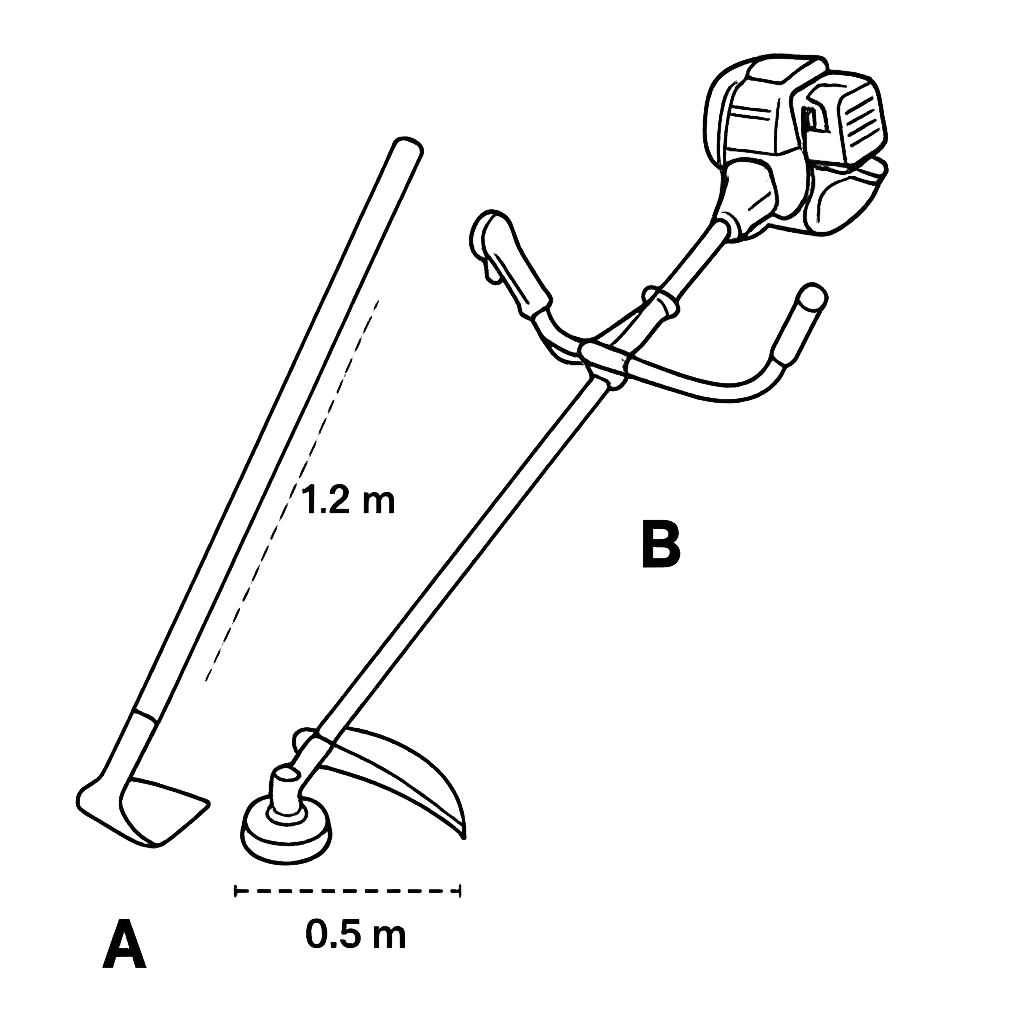
A farmer intends to clear a 0.5 ha field of weeds. Two options are available:\n\n1. A hand hoe with a handle length of 1.2 m and a blade width of 0.25 m. The farmer can clear 0.05 ha per hour using the hoe.\n2. A motorised brush cutter with a cutting width of 0.5 m and a fuel consumption of 0.8 L per hour. The farmer can clear 0.12 ha per hour with the cutter.\nThe farmer works 6 hours per day. Using the diagram of the two tools, answer the following:
Question Parts
(a)
Calculate the total amount of fuel (in litres) required for the brush cutter to clear the whole 0.5 ha field.
(b)
State the area cleared per litre of fuel by the brush cutter.
(c)
Calculate the total number of days required to clear the field with each tool, assuming the farmer works 6 hours each day.
(d)
Based on the calculations, discuss two advantages and two disadvantages of using the brush cutter instead of the hand hoe for this task.
Detailed Essay Solution & Marking Scheme Available

Get the step-by-step mathematical proofs, key points required by examiners, and a comprehensive breakdown from our AI Tutor.

Question 4 View Details
A farmer owns a 30 kW tractor fitted with a 3‑point hitch. The tractor is used to pull a disc harrow that has a working width of 2.4 m. The tractor moves forward at a speed of 5 km/h. The field to be cultivated measures 12 ha. Assume an overall field efficiency of 0.80.
Question Parts
(a)
Calculate the field capacity of the disc harrow in hectares per hour.
(b)
Determine the total time (in hours) required to cultivate the whole 12 ha field at the calculated capacity.
(c)
If the forward speed is increased to 6 km/h (all other factors unchanged), recalculate the field capacity and the total time required. Comment on the effect of the speed change.
(d)
List two routine maintenance practices that help keep the tractor operating at optimum performance.
Detailed Essay Solution & Marking Scheme Available

Get the step-by-step mathematical proofs, key points required by examiners, and a comprehensive breakdown from our AI Tutor.

Question 5 View Details
A farmer has 2 hectares of land on which he intends to practice mixed cropping of maize and cowpea. Soil test results show that the soil currently contains 60 kg of available nitrogen (N), 20 kg of available phosphorus (P) and 30 kg of available potassium (K) per hectare. The recommended fertilizer applications per hectare are: - Maize: 120 kg N, 60 kg P₂O₅, 40 kg K₂O - Cowpea: 30 kg N (to be supplied by biological fixation), 20 kg P₂O₅, 20 kg K₂O The farmer will allocate 1.2 ha to maize and 0.8 ha to cowpea. Seed rates are 25 kg ha⁻¹ for maize and 10 kg ha⁻¹ for cowpea. Market prices are ₦150 per kg of maize and ₦200 per kg of cowpea. Fertilizer costs are ₦30 per kg of N, ₦25 per kg of P₂O₅ and ₦20 per kg of K₂O. Expected yields are 4 t ha⁻¹ for maize and 1.5 t ha⁻¹ for cowpea. No other costs are considered.
Question Parts
(a)
Determine the total amount of each fertilizer nutrient (N, P₂O₅, K₂O) required for the whole farm.
(b)
Calculate the total cost of the fertilizer required for the farm.
(c)
Compute the gross income from the harvest and the net profit after deducting the fertilizer cost.
Detailed Essay Solution & Marking Scheme Available

Get the step-by-step mathematical proofs, key points required by examiners, and a comprehensive breakdown from our AI Tutor.

Question 6 View Details
A smallholder keeps four lactating dairy cows. Each cow produces 20 litres of milk per day and has an average body weight of 450 kg. The daily dry‑matter intake (DMI) per cow is 12 kg and the ration is composed of 60 % maize silage (dry‑matter 35 % with metabolizable energy (ME) 10 MJ kg⁻¹ DM) and 40 % concentrate (dry‑matter 90 % with ME 13 MJ kg⁻¹ DM). Maintenance energy requirement for a cow is 0.56 MJ kg⁻¹ BW⁰·⁷⁵ per day. Energy needed for milk synthesis is 3.14 MJ per litre of milk.
Question Parts
(a)
Calculate the total metabolizable energy (ME) supplied by the ration per cow per day (in MJ).
(b)
Determine whether the ration meets the combined energy requirement for maintenance and milk production. Show all calculations.
(c)
If the ration were found to be deficient by 5 MJ per cow per day, propose a new concentrate proportion (as a percentage of the total DM) that would exactly meet the energy requirement, keeping the silage component unchanged. Show the calculation used to obtain the new proportion.
Detailed Essay Solution & Marking Scheme Available

Get the step-by-step mathematical proofs, key points required by examiners, and a comprehensive breakdown from our AI Tutor.

Question 7 View Details
A cassava farmer in the Niger Delta region reports an increasing presence of a pest that causes leaf wilting and stunted growth. The pest is known to reproduce rapidly and can cause severe yield loss if not controlled. The farmer currently observes a pest density of 800 individuals per hectare. Data provided: - Cost of applying the recommended pesticide per hectare (C): ₦5,000 - Efficacy of the pesticide (proportion of damage prevented, K): 0.8 - Market value of cassava per tonne (Vₜ): ₦200,000 - Expected yield of cassava per hectare (Y): 10 tonnes - Each 1,000 pests per hectare cause a 0.5% yield loss (D = 0.005 per 1,000 pests) Using the Economic Injury Level (EIL) formula \(\frac{C}{V \times D \times K}\) where V is the market value per hectare, answer the following:
Question Parts
(a)
Identify two major pests of cassava in Nigeria and briefly describe the life cycle of each.
(b)
Calculate the Economic Injury Level (EIL) for the pest described, using the data supplied. Show all steps.
(c)
Based on the current pest density (800 pests per ha) and the EIL you have calculated, recommend whether the farmer should apply the pesticide. Justify your recommendation.
(d)
Outline an Integrated Pest Management (IPM) programme for this cassava pest, covering cultural, biological, mechanical and chemical control measures.
Detailed Essay Solution & Marking Scheme Available

Get the step-by-step mathematical proofs, key points required by examiners, and a comprehensive breakdown from our AI Tutor.

Question 8 View Details
A smallholder farmer in Oyo State observes that many of his tomato plants show wilted leaves, brown lesions on stems and a characteristic "target" spot on fruits. A field survey of 100 plants gave the following disease ratings on a 0–5 scale: Rating 0: 10 plants Rating 1: 15 plants Rating 2: 20 plants Rating 3: 30 plants Rating 4: 15 plants Rating 5: 10 plants Additional data: - Expected yield of tomatoes per hectare = 20 tonnes - Market price = ₦150,000 per tonne - Each 1% increase in disease severity index (DS%) results in a 0.8% yield loss. - A fungicide application costs ₦30,000 per hectare and reduces disease severity by 60%. Using the disease severity index formula \(DS\% = \frac{\sum (rating \times number\ of\ plants)}{total\ plants \times maximum\ rating} \times 100\), answer the following:
Question Parts
(a)
Identify the most probable disease affecting the tomatoes and name the causal pathogen.
Detailed Essay Solution & Marking Scheme Available

Get the step-by-step mathematical proofs, key points required by examiners, and a comprehensive breakdown from our AI Tutor.

Master the Exam!

You've seen a preview, but there are thousands more questions plus AI tutor to break down complex solutions.

Unlock Full Access Available for Android & Windows
Help others prepare! Share this practice hub:
Chat with Support