neco 2017 physics | Objective

Prepare for your exams with neco questions? Reviewing past/model questions is one of the most effective ways to guarantee a high score. This practice hub features authentic 2017 physics (Objective) questions designed to simulate the real exam environment.

Practice these randomly selected questions to test your readiness.

Question 1 View Details
A 4.0 kg block rests on a smooth inclined plane that makes an angle of \(20^{\circ}\) with the horizontal. The plane is accelerated horizontally to the right with a constant acceleration of \(2.0\ \text{m s}^{-2}\). The block does not slide relative to the plane. Determine the minimum coefficient of static friction \(\mu_s\) between the block and the plane required to keep the block at rest relative to the plane.
A. 0.61
B. 0.70
Correct C. 0.53
D. 0.45

Correct Answer: C

Want to see the full step-by-step solution? Unlock AI Explanation & Analytics
Question 2 View Details
A tube closed at one end has a total length of \(1.00\ \text{m}\) at \(20^{\circ}\text{C}\). The speed of sound in air varies with temperature as \(v = 331 + 0.6T\) (m\,s\(^{-1}\)), where \(T\) is in degrees Celsius. The tube is filled with water to a height \(h\) from the closed end, leaving an air column of length \(L_{\text{air}} = 1.00 - h\). The air column resonates at its fundamental frequency of \(256\ \text{Hz}\). Find the water height \(h\) (in metres) in the tube.
A. 0.585
Correct B. 0.665
C. 0.600
D. 0.735

Correct Answer: B

Want to see the full step-by-step solution? Unlock AI Explanation & Analytics
Question 3 View Details
A sealed vertical cylinder contains \(2.0\ \text{mol}\) of an ideal gas at \(300\ \text{K}\) and pressure \(1.0\times10^{5}\ \text{Pa}\). A frictionless piston of mass \(5.0\ \text{kg}\) and cross‑sectional area \(0.010\ \text{m}^{2}\) rests on the gas. The external atmospheric pressure is \(1.0\times10^{5}\ \text{Pa}\). The system is heated until the piston rises \(0.10\ \text{m}\). Assuming the gas temperature is uniform, determine the final temperature of the gas (in kelvin, to three significant figures).
Correct A. 306
B. 350
C. 300
D. 312

Correct Answer: A

Want to see the full step-by-step solution? Unlock AI Explanation & Analytics
Question 4 View Details
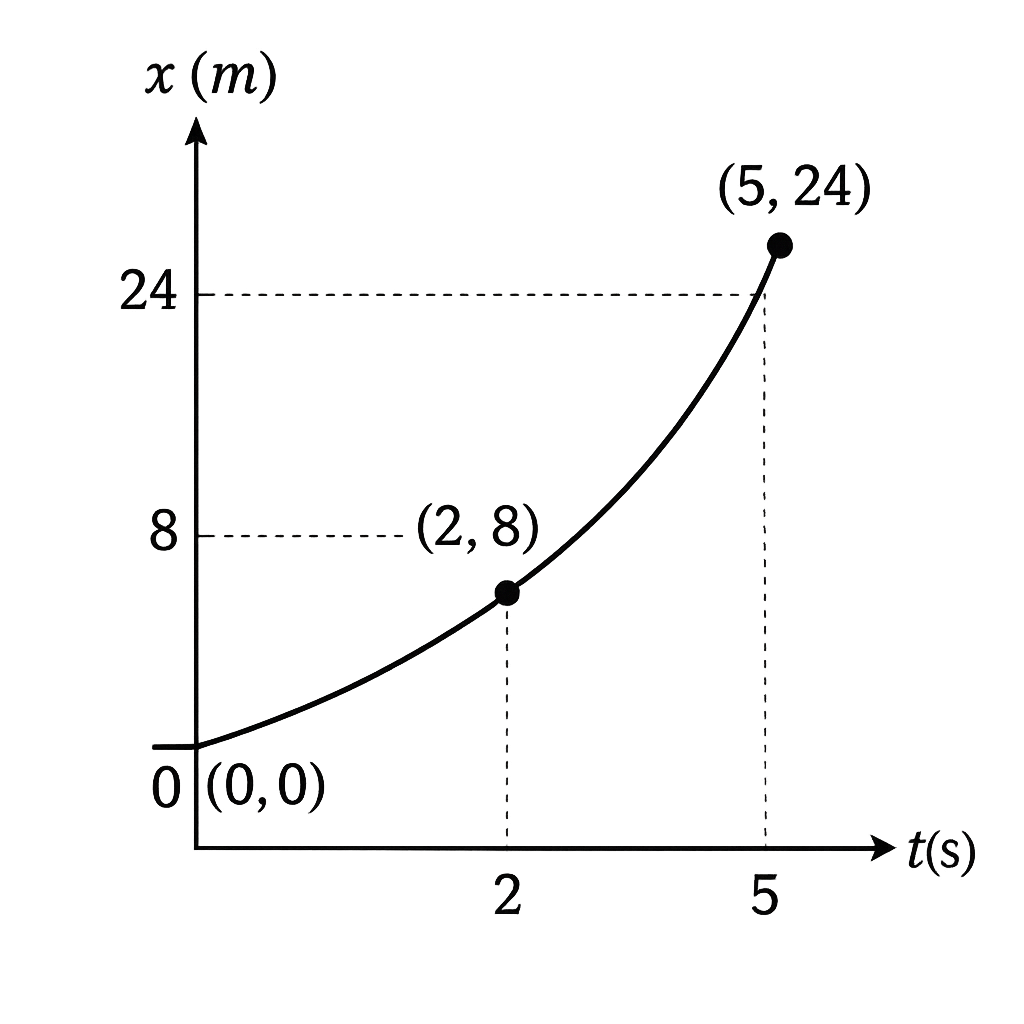
The motion diagram shows a particle moving along a straight line. The particle is at the origin at \(t = 0\ \text{s}\). At \(t = 2\ \text{s}\) its position is \(8\ \text{m}\), and at \(t = 5\ \text{s}\) its position is \(24\ \text{m}\). Assuming the particle moves with constant acceleration, calculate its instantaneous velocity at \(t = 2\ \text{s}\) (in \(\text{m s}^{-1}\), to two decimal places).
A. 4.03
B. 3.53
C. 5.33
Correct D. 4.53

Correct Answer: D

Want to see the full step-by-step solution? Unlock AI Explanation & Analytics
Question 5 View Details
A \(200\ \text{g}\) block of ice at \(-10^{\circ}\text{C}\) is placed in \(500\ \text{g}\) of water at \(30^{\circ}\text{C}\) in an insulated container. The specific heat capacities are \(c_{\text{ice}} = 2.1\ \text{J g}^{-1}\text{K}^{-1}\) and \(c_{\text{water}} = 4.18\ \text{J g}^{-1}\text{K}^{-1}\). The latent heat of fusion of ice is \(L_f = 334\ \text{J g}^{-1}\). Determine the final temperature of the system and the mass of ice that melts (in grams, to three significant figures).
A. -5°C, 200 g
B. 0°C, 150 g
Correct C. 0°C, 175 g
D. 5°C, 175 g

Correct Answer: C

Want to see the full step-by-step solution? Unlock AI Explanation & Analytics
Question 6 View Details
A battery with internal resistance \(r\) is connected in series with a resistor \(R_{1}=4\,\Omega\). This series combination is then connected across a parallel network consisting of a resistor \(R_{2}=6\,\Omega\) and an unknown resistor \(R_{3}\). The total current drawn from the battery is \(3\,\text{A}\), the power dissipated in \(R_{2}\) is \(9\,\text{W}\), and the total electrical power supplied by the battery is \(60\,\text{W}\). Determine the value of the internal resistance \(r\) (in \(\Omega\)) and the resistance \(R_{3}\) (in \(\Omega\)).
A. r \\approx 0.40\\,\\Omega, \\; R_{3} \\approx 2.80\\,\\Omega
B. r \\approx 0.30\\,\\Omega, \\; R_{3} \\approx 5.00\\,\\Omega
C. r \\approx 0.15\\,\\Omega, \\; R_{3} \\approx 3.50\\,\\Omega
Correct D. r \approx 0.22\,\Omega, \; R_{3} \approx 4.14\,\Omega

Correct Answer: D

Want to see the full step-by-step solution? Unlock AI Explanation & Analytics
Question 7 View Details
A source of sound moves directly towards a stationary observer with a speed of \(30\,\text{m s}^{-1}\). The speed of sound in air is \(340\,\text{m s}^{-1}\). The source emits a sound of unknown frequency \(f_{s}\). At the same time the observer hears a second source at rest that emits a frequency of \(520\,\text{Hz}\). The observer reports a beat frequency of \(10\,\text{Hz}\) between the two sounds. Determine the frequency \(f_{s}\) emitted by the moving source (in Hz, to the nearest hertz).
A. 475\\,\\text{Hz}
B. 492\\,\\text{Hz}
Correct C. 483\,\text{Hz}
D. 500\\,\\text{Hz}

Correct Answer: C

Want to see the full step-by-step solution? Unlock AI Explanation & Analytics
Question 8 View Details
A particle moves 5\,m east and then 12\,m north. Find the magnitude of the resultant displacement (in metres) and its direction measured north of east (in degrees, to one decimal place).
A. 13\\,\\text{m}, \\; 45.0^{\\circ}\\text{ north of east}
Correct B. 13\,\text{m}, \; 67.4^{\circ}\text{ north of east}
C. 12\\,\\text{m}, \\; 67.4^{\\circ}\\text{ north of east}
D. 13.5\\,\\text{m}, \\; 70.0^{\\circ}\\text{ north of east}

Correct Answer: B

Want to see the full step-by-step solution? Unlock AI Explanation & Analytics
Question 9 View Details
A string of length \(1.2\,\text{m}\) is fixed at both ends. When the tension in the string is \(80\,\text{N}\) it vibrates in its fundamental mode with a frequency of \(100\,\text{Hz}\). The linear mass density of the string is uniform. If the tension is increased to \(180\,\text{N}\), what is the new fundamental frequency (in Hz, to the nearest whole number)?
A. 225\\,\\text{Hz}
B. 165\\,\\text{Hz}
Correct C. 150\,\text{Hz}
D. 140\\,\\text{Hz}

Correct Answer: C

Want to see the full step-by-step solution? Unlock AI Explanation & Analytics
Question 10 View Details
A block of mass \(5\,\text{kg}\) slides down a frictionless incline that is \(8\,\text{m}\) higher than the horizontal ground. At the bottom of the incline the block reaches a horizontal rough surface with a coefficient of kinetic friction \(\mu_{k}=0.20\). The block comes to rest after travelling a distance \(d\) on the rough surface. Assuming \(g=9.8\,\text{m s}^{-2}\), determine the value of \(d\) (in metres, to the nearest metre).
A. 45\\,\\text{m}
B. 30\\,\\text{m}
C. 35\\,\\text{m}
Correct D. 40\,\text{m}

Correct Answer: D

Want to see the full step-by-step solution? Unlock AI Explanation & Analytics
Question 11 View Details
A point charge +5 \(\mu\)C is fixed at the origin. A point charge -10 \(\mu\)C is placed on the positive x‑axis at \(x = 0.12\) m. (i) Determine the position on the x‑axis where the electric potential is zero. (ii) Calculate the magnitude of the electric field at that point.
A. x = 0.08 m; E = 2.11×10^7 N\/C
B. x = 0.03 m; E = 5.00×10^7 N\/C
Correct C. x = 0.04 m; E = 4.22×10^7 N/C
D. x = 0.06 m; E = 3.00×10^7 N\/C

Correct Answer: C

Want to see the full step-by-step solution? Unlock AI Explanation & Analytics
Question 12 View Details
A sealed source contains \(2.0\times10^{20}\) atoms of isotope A (α emitter, half‑life \(30\) min, energy per decay \(5.0\) MeV) and the same number of isotope B (β emitter, half‑life \(2\) h, energy per decay \(1.2\) MeV). The source is left undisturbed for \(3\) h. (i) Calculate the total energy (in joules) released during this period, assuming that only \(80\%\) of the β‑particle energy is absorbed in the source. (ii) Determine the activity (in becquerels) of isotope B at the end of \(3\) h.
Correct A. Total energy ≈ 1.78×10^8 J; Activity of B ≈ 6.8×10^15 Bq
B. Total energy ≈ 1.2×10^8 J; Activity of B ≈ 5.0×10^15 Bq
C. Total energy ≈ 1.78×10^7 J; Activity of B ≈ 6.8×10^14 Bq
D. Total energy ≈ 2.3×10^8 J; Activity of B ≈ 8.5×10^15 Bq

Correct Answer: A

Want to see the full step-by-step solution? Unlock AI Explanation & Analytics
Question 13 View Details
A mass is measured as \(2.50\) g using a balance with a least count of \(0.01\) g. Express the mass in kilograms, showing the correct number of significant figures.
A. 2.50×10^{-4} kg
B. 2.5×10^{-3} kg
C. 2.50×10^{-2} kg
Correct D. 2.50×10^{-3} kg

Correct Answer: D

Want to see the full step-by-step solution? Unlock AI Explanation & Analytics
Question 14 View Details
A converging lens forms a real image of a candle placed \(30\) cm from the lens. The image is inverted and \(10\) cm tall, while the object is \(3\) cm tall. (i) Determine the focal length of the lens (in cm). (ii) Find its optical power in diopters.
Correct A. f ≈ 23.1 cm; Power ≈ 4.33 D
B. f ≈ 15.0 cm; Power ≈ 6.67 D
C. f ≈ 30.0 cm; Power ≈ 3.33 D
D. f ≈ 20.0 cm; Power ≈ 5.00 D

Correct Answer: A

Want to see the full step-by-step solution? Unlock AI Explanation & Analytics
Question 15 View Details
A car accelerates uniformly from rest to \(20\) m s⁻¹ in \(5\) s. Find the distance covered during this time.
A. 62.5 m
Correct B. 50 m
C. 100 m
D. 25 m

Correct Answer: B

Want to see the full step-by-step solution? Unlock AI Explanation & Analytics
Question 16 View Details
An isotope X (atomic mass 238 u) decays by alpha emission, releasing 5.00\,MeV per decay. A 2.00\,g sample of X has a half‑life of \(4.5\times10^{8}\)\,years. (i) How long will it take for the sample to reduce to one‑eighth of its original mass? (ii) How much total energy in joules will be released during this period? (Use \(1\ \text{eV}=1.602\times10^{-19}\ \text{J}\).)
A. 1.35×10^8 years, 3.55×10^8 J
B. 2.70×10^9 years, 7.10×10^9 J
Correct C. 1.35×10^9 years, 3.55×10^9 J
D. 1.35×10^9 years, 5.33×10^9 J

Correct Answer: C

Want to see the full step-by-step solution? Unlock AI Explanation & Analytics
Question 17 View Details
A particle of mass \(0.50\)\,kg moves along a straight line. Its velocity‑time graph is described as follows: from \(t=0\)\,s to \(t=4\)\,s the velocity increases uniformly from \(2.0\)\,m\,s⁻¹ to \(6.0\)\,m\,s⁻¹; from \(t=4\)\,s to \(t=8\)\,s the velocity remains constant at \(6.0\)\,m\,s⁻¹. (i) Determine the total distance travelled between \(t=0\) and \(t=8\)\,s. (ii) Find the magnitude of the particle's average acceleration over the whole 8‑s interval. (iii) Calculate the increase in the particle's kinetic energy during the motion.
A. 48 m, 0.75 m\/s², 10.0 J
B. 32 m, 0.25 m\/s², 6.0 J
Correct C. 40 m, 0.50 m/s², 8.0 J
D. 44 m, 1.00 m\/s², 12.0 J

Correct Answer: C

Want to see the full step-by-step solution? Unlock AI Explanation & Analytics
Question 18 View Details
A string fixed at both ends has a linear mass density of \(0.025\)\,kg\,m⁻¹ and is under a tension of \(120\)\,N. When the string is forced to vibrate at a frequency of \(120\)\,Hz, a standing wave with three complete loops is observed. (i) Determine the speed of the transverse wave on the string. (ii) Find the length of the string. (iii) What is the frequency of the second harmonic of this string?
Correct A. 69.3 m/s, 0.866 m, 80.0 Hz
B. 71.2 m/s, 0.900 m, 80.0 Hz
C. 69.3 m/s, 0.866 m, 85.0 Hz
D. 65.0 m/s, 0.800 m, 75.0 Hz

Correct Answer: A

Want to see the full step-by-step solution? Unlock AI Explanation & Analytics
Question 19 View Details
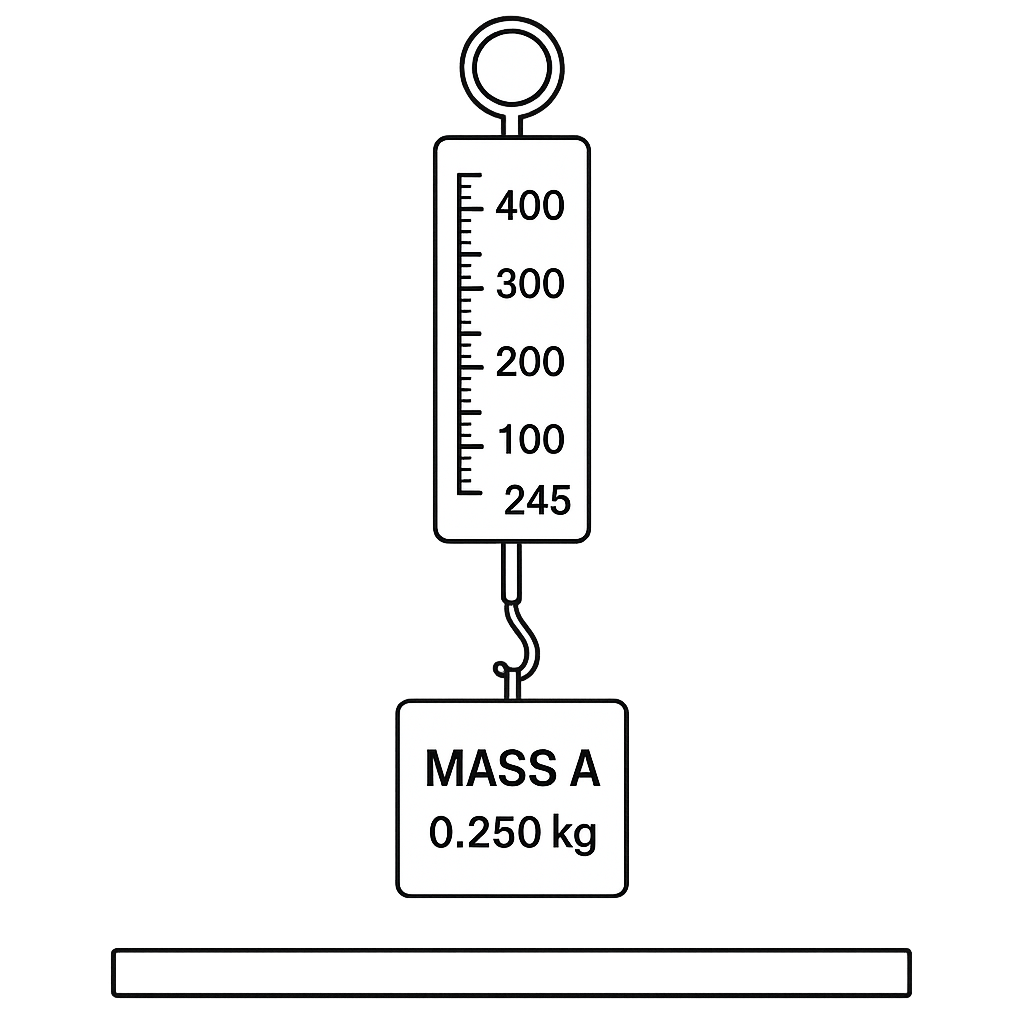
In the laboratory setup shown, a spring balance is used to weigh an unknown mass \(A\). The balance scale is calibrated in grams. When mass \(A\) is hung, the pointer indicates a reading of \(245\)\,g. (i) Convert this reading to newtons (use \(g=9.8\)\,m\,s⁻²). (ii) The true mass of \(A\) is \(0.250\)\,kg. Determine the percentage error in the balance reading.
A. 2.401 N, 2.0% high
B. 2.450 N, 2.0% low
C. 2.401 N, 1.5% low
Correct D. 2.401 N, 2.0% low

Correct Answer: D

Want to see the full step-by-step solution? Unlock AI Explanation & Analytics
Question 20 View Details
A car starts from rest and accelerates uniformly to a speed of \(20\)\,m\,s⁻¹ in \(5\)\,s. It then travels at this constant speed for \(10\)\,s before decelerating uniformly to rest in \(4\)\,s. (i) Calculate the total distance covered during the whole motion. (ii) Determine the average speed of the car over the entire journey.
Correct A. 290 m, 15.3 m/s
B. 310 m, 15.5 m\/s
C. 280 m, 14.0 m\/s
D. 250 m, 13.2 m\/s

Correct Answer: A

Want to see the full step-by-step solution? Unlock AI Explanation & Analytics
Question 21 View Details
If a block of mass 5.0 kg rests on a rough inclined plane that makes an angle of \(30^{\circ}\) with the horizontal. The coefficient of static friction is 0.25. A horizontal force \(F\) is applied to push the block up the incline. Determine the minimum magnitude of \(F\) required to start moving the block up the incline. Give your answer in newtons (N) to two significant figures.
Correct A. 47 N
B. 28 N
C. 55 N
D. 41 N

Correct Answer: A

Want to see the full step-by-step solution? Unlock AI Explanation & Analytics
Question 22 View Details
Two point charges are fixed in the xy‑plane. Charge \(q_{1}=+8\,\mu\text{C}\) is at the origin \((0,0)\). Charge \(q_{2}=-2\,\mu\text{C}\) is at \((0.12\,\text{m},0)\). Determine the magnitude of the net electric field at point \(P\) with coordinates \((0.12\,\text{m},0.09\,\text{m})\). Also give the direction of the net field measured as the angle below the positive x‑axis. Give the magnitude in \(\text{N·C}^{-1}\) to three significant figures and the angle in degrees to one decimal place.
Correct A. 2.57×10^{6} N·C^{-1}, 6.7° below the positive x‑axis
B. 2.57×10^{6} N·C^{-1}, 6.7° above the positive x‑axis
C. 2.57×10^{6} N·C^{-1}, 12.5° below the positive x‑axis
D. 2.31×10^{6} N·C^{-1}, 8.2° below the positive x‑axis

Correct Answer: A

Want to see the full step-by-step solution? Unlock AI Explanation & Analytics
Question 23 View Details
A sealed gas container of volume 5.0\,L contains an ideal gas at 300\,K and pressure 1.00\times10^{5}\,Pa. The container is connected to a U‑tube manometer filled with mercury (density 13\,600\,kg·m^{-3}). The mercury column shows a height difference of 0.075\,m, indicating the gas pressure is higher than atmospheric. The atmospheric pressure is 1.01\times10^{5}\,Pa and remains unchanged. The gas is heated to 350\,K while the volume stays constant. Find the new height difference shown by the manometer (in metres, to three decimal places).
A. 0.089 m
Correct B. 0.214 m
C. 0.156 m
D. 0.267 m

Correct Answer: B

Want to see the full step-by-step solution? Unlock AI Explanation & Analytics
Question 24 View Details
A 150\,g piece of aluminum (specific heat 0.900\,J·g^{-1}·K^{-1}) at 80\,°C is placed into 250\,g of water (specific heat 4.18\,J·g^{-1}·K^{-1}) at 20\,°C inside an insulated container. During the 10‑minute process the container loses heat to the surroundings at a constant rate of 12\,J·min^{-1}. Assuming thermal equilibrium is reached after the 10\,minutes, determine the final temperature of the mixture (in \(^\circ\)C, to two decimal places).
A. 28.53 °C
B. 30.00 °C
Correct C. 26.78 °C
D. 24.19 °C

Correct Answer: C

Want to see the full step-by-step solution? Unlock AI Explanation & Analytics
Question 25 View Details
A source emits sound of frequency \(f_{s}=500\,\text{Hz}\) in air where the speed of sound is \(v=340\,\text{m·s^{-1}}\). The source moves towards a stationary observer at \(30\,\text{m·s^{-1}}\) for 5\,s and then stops. Immediately after the source stops, the observer starts moving away from the source at \(20\,\text{m·s^{-1}}\). Assuming the observer receives the wavefronts that were emitted while the source was moving, find the frequency heard by the observer during the second interval (after the source has stopped). Give your answer in hertz to the nearest whole number.
A. 540 Hz
B. 508 Hz
C. 523 Hz
Correct D. 516 Hz

Correct Answer: D

Want to see the full step-by-step solution? Unlock AI Explanation & Analytics

Master the Exam!

You've seen a preview, but there are thousands more questions plus AI tutor to break down complex solutions.

Unlock Full Access Available for Android & Windows
Help others prepare! Share this practice hub:
Chat with Support