neco 2017 physics | Essay

Prepare for your exams with neco questions? Reviewing past/model questions is one of the most effective ways to guarantee a high score. This practice hub features authentic 2017 physics (Essay) questions designed to simulate the real exam environment.

Practice these randomly selected questions to test your readiness.
Question 1 View Details
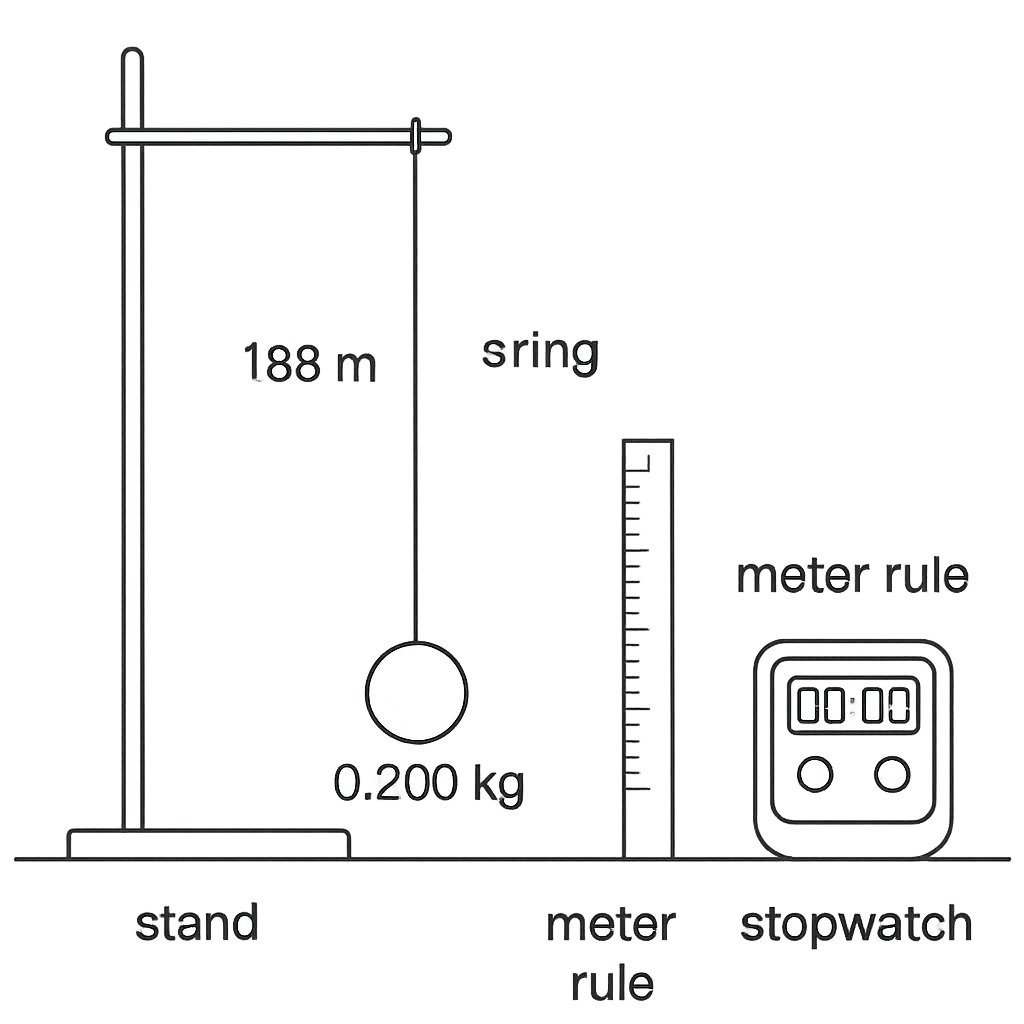
A simple pendulum is set up as shown in the diagram. The length of the string from the point of suspension to the centre of mass of the bob is measured as 0.85 m with an uncertainty of \(\pm 0.01 \text{ m}\). The mass of the bob is 0.200 kg. The period of oscillation is measured using a stopwatch by timing 20 complete oscillations. Three trials give total times of 40.2 s, 40.5 s and 40.1 s respectively.
Question Parts
(a)
Calculate the mean period of the pendulum and the standard uncertainty in the period.
(b)
Using the mean period, determine the experimental value of the acceleration due to gravity \(g\). State the formula used and any assumptions made.
(c)
Discuss two possible sources of systematic error in this experiment and explain qualitatively how each would affect the calculated value of \(g\).
(d)
If the length of the pendulum were increased by 10\%, predict the new period using the relationship between period and length.
Detailed Essay Solution & Marking Scheme Available

Get the step-by-step mathematical proofs, key points required by examiners, and a comprehensive breakdown from our AI Tutor.
Question 2 View Details
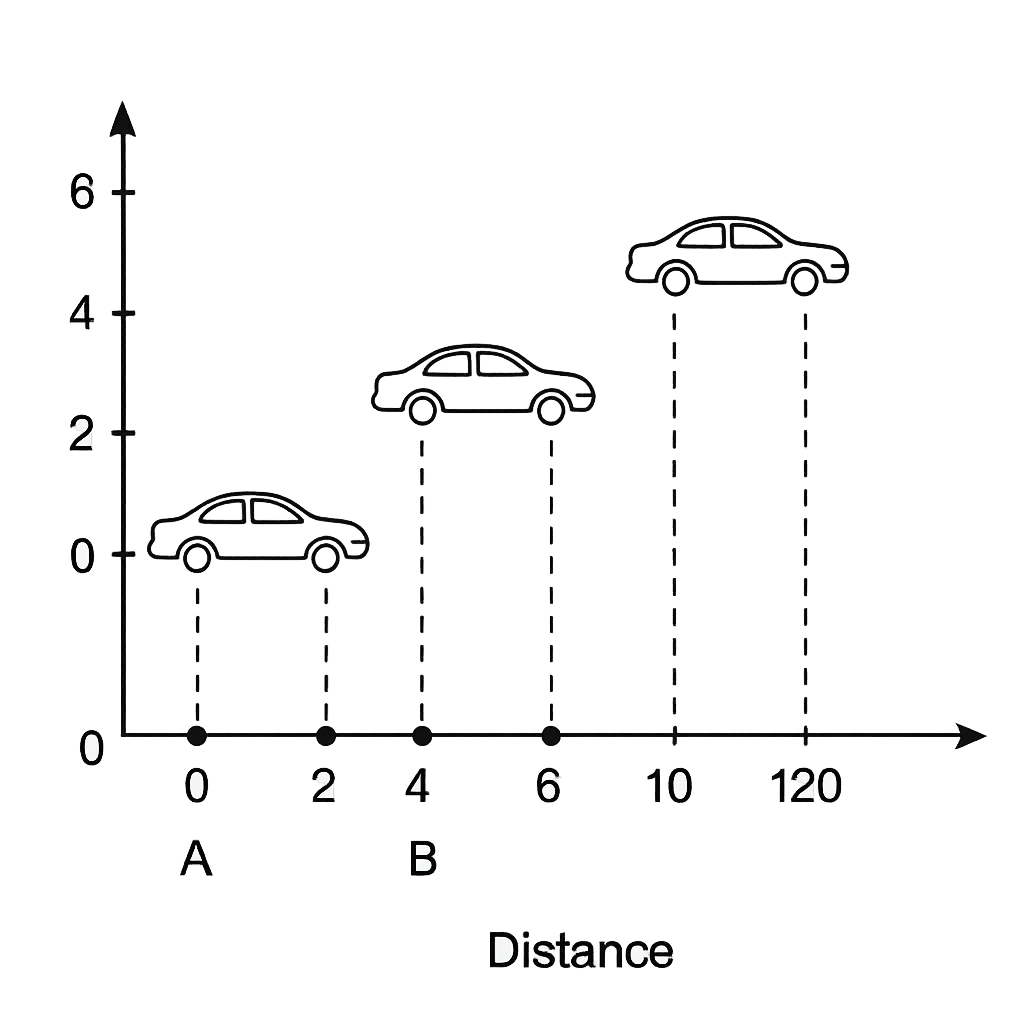
The motion diagram (see the diagram) shows the positions of two cars, Car A and Car B, on a straight, level road at successive 2‑second intervals.
Question Parts
(a)
State the speed of Car A and the speed of Car B as indicated by the diagram.
(b)
Using the speeds found in part (a), determine the relative speed of Car A with respect to Car B.
(c)
Assume Car A started from rest and accelerated uniformly to reach the constant speed shown in the diagram at t = 6 s. Calculate: (i) its acceleration, (ii) the distance it travelled in the first 6 s.
(d)
At t = 0 s Car A is 50 m behind Car B (as shown in the diagram). (i) Calculate the time taken for Car A to overtake Car B. (ii) If Car B increases its speed by 20 % while Car A’s speed remains unchanged, discuss qualitatively and quantitatively how the overtaking time is affected.
Detailed Essay Solution & Marking Scheme Available

Get the step-by-step mathematical proofs, key points required by examiners, and a comprehensive breakdown from our AI Tutor.
Question 3 View Details
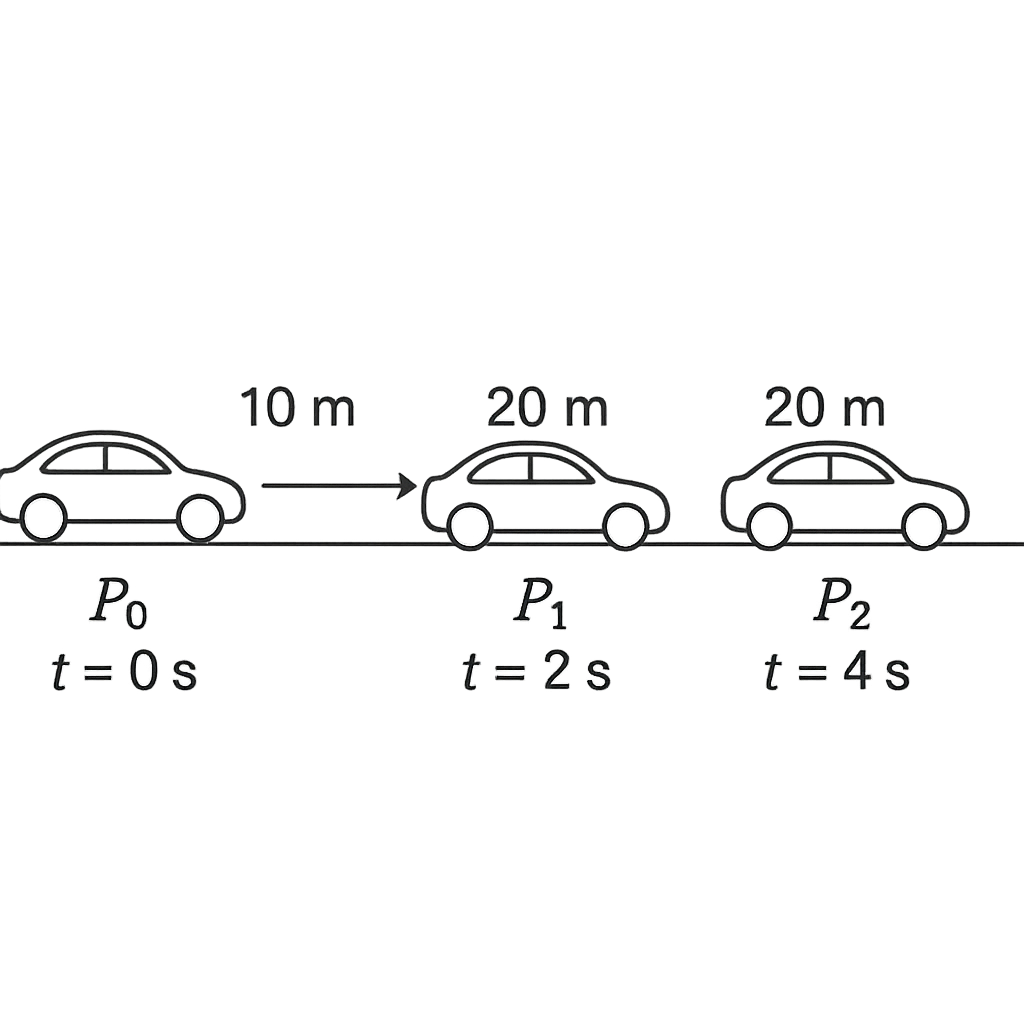
A car moves in a straight line on a horizontal road. Its positions are recorded at equal time intervals of 2 s as shown in the motion diagram. The successive positions are P0 (t = 0 s), P1 (t = 2 s) and P2 (t = 4 s). The distances between the recorded positions are P0P1 = 10 m and P1P2 = 30 m – 10 m = 20 m. The arrows in the diagram indicate the direction of motion (to the right).
Question Parts
(a)
Assuming the car moves with uniform acceleration between the recorded positions, determine the instantaneous speed of the car at t = 1 s and at t = 3 s.
(b)
State the magnitude of the car’s acceleration.
(c)
If the car continues to move with the same acceleration, find the distance it will travel during the next 2‑second interval (from t = 4 s to t = 6 s).
(d)
Explain how the motion diagram helps a student distinguish between the concepts of speed and velocity.
Detailed Essay Solution & Marking Scheme Available

Get the step-by-step mathematical proofs, key points required by examiners, and a comprehensive breakdown from our AI Tutor.

Question 4 View Details
A 5.0 kg block rests on a rough inclined plane that makes an angle of 30° with the horizontal. The coefficients of static and kinetic friction between the block and the plane are 0.40 and 0.30 respectively. A horizontal force of 20 N is applied to the block, pushing it up the slope. The diagram of the situation is provided in the force diagram. Answer the following:
Question Parts
(a)
Determine the magnitude and direction of the resultant force acting on the block.
(b)
State whether the block will (i) start moving up the plane, (ii) remain at rest, or (iii) slide down the plane under the given 20 N horizontal push.
(c)
If the block were to start moving up the plane, calculate its acceleration assuming kinetic friction (μk = 0.30).
(d)
If the block remains at rest, determine the minimum additional horizontal force (in newtons) that must be applied to start moving the block up the plane.
Detailed Essay Solution & Marking Scheme Available

Get the step-by-step mathematical proofs, key points required by examiners, and a comprehensive breakdown from our AI Tutor.

Question 5 View Details
A 2.0 kg block is released from rest at the top of a smooth inclined plane that makes an angle of 30\(^\circ\) with the horizontal. The plane is 5.0 m long. At the bottom of the plane the block compresses a horizontal spring of spring constant \(k = 800\ \text{N·m}^{-1}\). The coefficient of kinetic friction between the block and the plane is 0.15. Assume \(g = 10\ \text{m·s}^{-2}\).
Question Parts
(a)
Calculate the work done by gravity on the block as it moves down the plane.
(b)
Determine the work done against friction during the motion down the plane.
(c)
Find the maximum compression of the spring.
(d)
Compute the average power delivered by the block to the spring during the compression, assuming the compression occurs over a time interval of 0.40 s.
Detailed Essay Solution & Marking Scheme Available

Get the step-by-step mathematical proofs, key points required by examiners, and a comprehensive breakdown from our AI Tutor.

Question 6 View Details
A simple pulley system is used to lift a load weighing 120 N. The arrangement consists of one fixed pulley attached to the ceiling and one movable pulley attached to the load. The rope is pulled vertically upward with a constant effort force of 65 N over a distance of 1.60 m, causing the load to rise vertically through a distance of 0.80 m.
Question Parts
(a)
Determine the ideal mechanical advantage (IMA) of the arrangement.
(b)
Calculate the actual mechanical advantage (AMA) based on the given forces.
(c)
Find the efficiency of the pulley system expressed as a percentage.
(d)
Explain two possible reasons why the efficiency is less than 100 %.
Detailed Essay Solution & Marking Scheme Available

Get the step-by-step mathematical proofs, key points required by examiners, and a comprehensive breakdown from our AI Tutor.

Question 7 View Details
A cylindrical tank of height 12.0 m and cross‑sectional area 0.5 m² is filled with water (density 1000 kg·m⁻³). A small circular hole of area 1.0\times10⁻⁴ m² is opened at the bottom of the tank. The tank rests on a smooth horizontal surface. Water flows out through the hole and the tank loses mass.
Question Parts
(a)
Derive an expression for the instantaneous speed of the water exiting the hole as a function of the water depth h, assuming Torricelli’s law and neglecting viscosity.
(b)
When the water depth is 8.0 m, calculate the rate at which mass is leaving the tank (in kg s⁻¹).
(c)
Assuming the water depth decreases uniformly from 12.0 m to 0 m, estimate the total time required for the tank to empty. (Hint: integrate the relation obtained in part a.)
(d)
Discuss two practical factors that could cause the actual emptying time to differ from the calculated value.
Detailed Essay Solution & Marking Scheme Available

Get the step-by-step mathematical proofs, key points required by examiners, and a comprehensive breakdown from our AI Tutor.

Question 8 View Details
A 2.0‑kg block of copper (specific heat capacity 0.385 kJ·kg⁻¹·K⁻¹) at 150 °C is placed in a well‑insulated container that already contains 3.0 kg of water at 25 °C. The specific heat capacity of water is 4.18 kJ·kg⁻¹·K⁻¹. No heat is lost to the surroundings.
Question Parts
(a)
Write the energy‑balance equation for the final equilibrium temperature \(T_f\) of the system.
(b)
Determine the value of \(T_f\) (in °C) to one decimal place.
(c)
After equilibrium is reached, 0.5 kg of ice at 0 °C is added. Assuming the ice melts completely and the resulting mixture reaches a new equilibrium temperature, calculate this final temperature (in °C) to one decimal place. (Latent heat of fusion of ice = 334 kJ·kg⁻¹.)
(d)
Explain why the assumption of no heat loss is more realistic in this experiment than in the water‑tank experiment of Question 7.
Detailed Essay Solution & Marking Scheme Available

Get the step-by-step mathematical proofs, key points required by examiners, and a comprehensive breakdown from our AI Tutor.

Master the Exam!

You've seen a preview, but there are thousands more questions plus AI tutor to break down complex solutions.

Unlock Full Access Available for Android & Windows
Help others prepare! Share this practice hub:
Chat with Support