neco 2017 geography | Objective

Prepare for your exams with neco questions? Reviewing past/model questions is one of the most effective ways to guarantee a high score. This practice hub features authentic 2017 geography (Objective) questions designed to simulate the real exam environment.

Practice these randomly selected questions to test your readiness.

Question 1 View Details
On a certain day, the maximum temperature recorded at Lagos was \(32^{\\circ}\\text{C}\) with a relative humidity of \(78\\%\). Using the approximation \(Td = T - \\frac{100 - RH}{5}\), calculate the dew point temperature. If the minimum temperature that night was \(24^{\\circ}\\text{C}\), will fog be likely to form (fog forms when the dew point is within \(2^{\\circ}\\text{C}\) of the minimum temperature)?
Correct A. No, fog is unlikely
B. Yes, fog is likely
C. Yes, fog is unlikely
D. No, fog is likely

Correct Answer: A

Want to see the full step-by-step solution? Unlock AI Explanation & Analytics
Question 2 View Details
A town had a population of 150,000 in 2015. The annual birth rate was 28 per 1,000, the death rate 8 per 1,000, and net migration was +1,200 persons per year. Assuming these rates remain constant, in which year will the population first exceed 180,000? Use whole years.
A. 2020
Correct B. 2022
C. 2023
D. 2024

Correct Answer: B

Want to see the full step-by-step solution? Unlock AI Explanation & Analytics
Question 3 View Details
City A is at latitude \(5^{\\circ}\\text{N}\) and City B at latitude \(15^{\\circ}\\text{N}\). A third city C lies exactly midway in latitude between A and B. What is the latitude of city C?
Correct A. 10^{\\circ}\\text{N}
B. 8^{\\circ}\\text{N}
C. 12^{\\circ}\\text{N}
D. 5^{\\circ}\\text{N}

Correct Answer: A

Want to see the full step-by-step solution? Unlock AI Explanation & Analytics
Question 4 View Details
The average temperature of the coldest month in a region is \(12^{\\circ}\\text{C}\) and that of the warmest month is \(28^{\\circ}\\text{C}\). The region receives 900 mm of rainfall annually, with 70\\% of the rainfall occurring during the summer months (April-September). According to the Köppen climate classification, what is the appropriate climate type for this region? (Choose the appropriate code, e.g., Cw, Cfa, Aw, etc.)
A. Csb
B. Cfa
C. Aw
Correct D. Cw

Correct Answer: D

Want to see the full step-by-step solution? Unlock AI Explanation & Analytics
Question 5 View Details
A coastal town is prone to flooding. Historical data shows a 4\\% chance each year of a flood that causes average damage of \(150\) million naira. The town can invest in a sea wall costing \(500\) million naira, which reduces the probability of flooding to 0.5\\% per year (damage remains the same). Should the town invest in the sea wall if it uses a 10‑year planning horizon and a discount rate of 5\\% per year? Assume the town aims to minimize the present value of expected losses plus investment cost. Answer Yes or No.
A. Yes (invest)
B. Yes, invest
Correct C. No
D. Yes

Correct Answer: C

Want to see the full step-by-step solution? Unlock AI Explanation & Analytics
Question 6 View Details
A region has an average annual rainfall of \(1300\) mm, a mean annual temperature of \(18^{\circ}\text{C}\), and lies at an altitude of \(1800\) m. Based on the NECO vegetation classification, which vegetation type is most appropriate for this region?
A. Coastal mangrove
B. Savanna
Correct C. Montane forest
D. Lowland forest

Correct Answer: C

Want to see the full step-by-step solution? Unlock AI Explanation & Analytics
Question 7 View Details
Monthly rainfall (mm) for a location in 2022 is given: Jan \(120\), Feb \(80\), Mar \(150\), Apr \(200\), May \(250\), Jun \(300\), Jul \(350\), Aug \(340\), Sep \(260\), Oct \(180\), Nov \(130\), Dec \(100\). Determine the month whose rainfall deviates most from the annual mean rainfall, expressed as a percentage of the mean, and give that percentage to the nearest tenth of a percent.
A. June, 46.3%
B. August, 65.9%
C. February, 61.0%
Correct D. July, 70.7%

Correct Answer: D

Want to see the full step-by-step solution? Unlock AI Explanation & Analytics
Question 8 View Details
Two steel‑producing industries, A and B, have the following data for the year 2021: Industry A employs \(500\) workers and produces \(25\,000\) tonnes of steel; Industry B employs \(400\) workers and produces \(18\,000\) tonnes. The government wants the average output per worker across both industries to be increased to \(55\) tonnes by raising the output per worker in each industry by the same absolute amount (in tonnes). Calculate the required increase in output per worker (to two decimal places) and the new total annual output for each industry (to the nearest tonne).
A. Increase per worker: 7.00 tonnes; Industry A: 28 500 tonnes; Industry B: 20 500 tonnes
B. Increase per worker: 7.50 tonnes; Industry A: 28 750 tonnes; Industry B: 21 000 tonnes
C. Increase per worker: 6.80 tonnes; Industry A: 27 900 tonnes; Industry B: 20 200 tonnes
Correct D. Increase per worker: 7.22 tonnes; Industry A: 28 611 tonnes; Industry B: 20 889 tonnes

Correct Answer: D

Want to see the full step-by-step solution? Unlock AI Explanation & Analytics
Question 9 View Details
The average discharge of a river is \(150\) m\(^3\) s\(^{-1}\). The river erodes its bedrock at a rate of \(0.02\) mm per year for every \(10\) m\(^3\) s\(^{-1}\) of discharge. Assuming this rate remains constant, what depth (in metres) will the river have eroded after \(10\,000\) years?
A. 4
B. 5
Correct C. 3
D. 2

Correct Answer: C

Want to see the full step-by-step solution? Unlock AI Explanation & Analytics
Question 10 View Details
A topographic map has a scale of \(1\) cm : \(250\) m. On the map, the straight‑line distance between Town X and Town Y is \(6.4\) cm. If a road must be constructed between the towns that is \(15\%\) longer than the straight‑line distance to accommodate terrain, what is the length of the road in kilometres, correct to two decimal places?
A. 1.92
B. 1.60
Correct C. 1.84
D. 1.76

Correct Answer: C

Want to see the full step-by-step solution? Unlock AI Explanation & Analytics
Question 11 View Details
On the map, the straight‑line distance between Town A and Town B measures \(3\) cm. The map scale is \(1\) cm : \(5\) km. What is the actual straight‑line distance between the towns in kilometres? Also, a river shown between the towns measures \(2\) cm on the map. What is the actual length of the river in kilometres?
A. 15 km; 12 km
B. 12 km; 10 km
Correct C. 15 km; 10 km
D. 15 km; 5 km

Correct Answer: C

Want to see the full step-by-step solution? Unlock AI Explanation & Analytics
Question 12 View Details
A topographic map has a contour interval of \(20\) m. Point P lies on a contour line marked \(240\) m. Point Q lies three contour lines above P. On the map the distance between P and Q is \(4\) cm and the map scale is \(1\) : \(50{,}000\). (i) Determine the elevation of Q in metres. (ii) Calculate the average slope between P and Q in degrees, assuming the horizontal distance equals the ground distance derived from the map scale.
A. Elevation = 320 m; Average slope ≈ 2.0°
B. Elevation = 280 m; Average slope ≈ 1.3°
Correct C. Elevation = 300 m; Average slope ≈ 1.7°
D. Elevation = 260 m; Average slope ≈ 2.2°

Correct Answer: C

Want to see the full step-by-step solution? Unlock AI Explanation & Analytics
Question 13 View Details
A community is exposed to annual flooding with probability \(0.12\). If a flood occurs, the average damage cost is \(\text{₦}2.5\) million. A mitigation project costs \(\text{₦}150{,}000\) upfront and reduces the flood probability to \(0.05\). Assuming the project's cost is amortised over 10 years, should the community invest in the mitigation? Compute the expected annual loss before and after mitigation and state the net annual saving (if any).
A. No; net annual loss = ₦30,000
B. Yes; net annual saving = ₦120,000
Correct C. Yes; net annual saving = ₦160,000
D. Yes; net annual saving = ₦200,000

Correct Answer: C

Want to see the full step-by-step solution? Unlock AI Explanation & Analytics
Question 14 View Details
The following table shows the maximum and minimum temperatures (in °C) recorded in a town over a week:\n\nMonday: max 32, min 22\nTuesday: max 35, min 24\nWednesday: max 30, min 20\nThursday: max 33, min 23\nFriday: max 31, min 21\nSaturday: max 34, min 25\nSunday: max 29, min 19\n\n(a) Calculate the average of the daily mean temperatures for the week. (b) Which day had the greatest diurnal temperature range and what was that range (in °C)?
A. Average daily mean = 26°C; Greatest range on Monday = 10°C
Correct B. Average daily mean = 27°C; Greatest range on Tuesday = 11°C
C. Average daily mean = 27°C; Greatest range on Saturday = 9°C
D. Average daily mean = 28°C; Greatest range on Wednesday = 10°C

Correct Answer: B

Want to see the full step-by-step solution? Unlock AI Explanation & Analytics
Question 15 View Details
A rock sample is analysed and found to contain \(45\)% quartz, \(30\)% feldspar, \(15\)% mica and the remaining mineral is amphibole. (i) What percentage of the rock is amphibole? (ii) Based on its mineral composition, classify the rock as igneous, metamorphic or sedimentary.
A. Amphibole = 20%; Rock type = igneous
B. Amphibole = 15%; Rock type = sedimentary
Correct C. Amphibole = 10%; Rock type = metamorphic
D. Amphibole = 5%; Rock type = igneous

Correct Answer: C

Want to see the full step-by-step solution? Unlock AI Explanation & Analytics
Question 16 View Details
An exporter needs to transport a cargo from City A to City D. Two possible routes are available:\n\n**Route 1:** A-B (120 km, speed 60 km\(^{\text{-1}}\)), B-C (80 km, speed 40 km\(^{\text{-1}}\)), C-D (100 km, speed 80 km\(^{\text{-1}}\)). Toll fees are ₦1500, ₦800 and ₦1200 respectively.\n\n**Route 2:** Direct A-D (250 km, speed 70 km\(^{\text{-1}}\)) with a single toll of ₦2500.\n\nFuel consumption depends on speed: for speeds \(\le 60\) km\(^{\text{-1}}\) the vehicle uses \(0.10\) L km\(^{-1}\); for speeds \(>60\) km\(^{\text{-1}}\) it uses \(0.15\) L km\(^{-1}\). Fuel price is ₦165 per litre.\n\nCalculate the total cost (fuel + tolls) for each route, state which route is cheaper, and give the total travel time for the cheaper route (in hours, rounded to two decimal places).
Correct A. Route 2 is cheaper with a total cost of ₦8 688 (rounded) and a travel time of 3.57 h.
B. Route 1 is cheaper with a total cost of ₦8 500 (rounded) and a travel time of 3.90 h.
C. Route 2 is cheaper with a total cost of ₦9 000 (rounded) and a travel time of 3.80 h.
D. Route 1 is cheaper with a total cost of ₦9 200 (rounded) and a travel time of 4.10 h.

Correct Answer: A

Want to see the full step-by-step solution? Unlock AI Explanation & Analytics
Question 17 View Details
Town X has a population of 45 000 people and covers an area of 30 km\(^{2}\). It contains 5 secondary schools, 2 hospitals and 12 primary schools. According to the classification criteria:\n\n- A **town** requires population >20 000 and ≤100 000, population density >1 000 persons km\(^{-2}\), and at least one secondary school per 10 000 people.\n- A **city** requires population >100 000, density >2 000 persons km\(^{-2}\), and at least one hospital per 20 000 people.\n\nUsing these criteria, determine whether the settlement is classified as a town, a city, or another category.
A. Metropolis
Correct B. Town
C. City
D. Village

Correct Answer: B

Want to see the full step-by-step solution? Unlock AI Explanation & Analytics
Question 18 View Details
In 2010 the population of Region Y was 1 200 000. Over the next five years the natural increase (births minus deaths) contributed an average annual growth rate of 2.5 % applied uniformly each year. The census in 2015 recorded a population of 1 380 000.\n\nAssuming the natural increase rate operated continuously for the whole period, calculate the average annual net migration (in persons per year) that must have occurred between 2010 and 2015.
A. 5 100 persons per year (inward)
B. 3 950 persons per year (inward)
C. 2 500 persons per year (inward)
Correct D. 4 462 persons per year (inward)

Correct Answer: D

Want to see the full step-by-step solution? Unlock AI Explanation & Analytics
Question 19 View Details
A rock specimen from an ancient orogenic belt is described as having a coarse‑grained, interlocking texture and is composed mainly of quartz, feldspar and biotite.\n\nBased on texture, mineral composition and geological setting, identify the rock type (igneous, metamorphic or sedimentary), specify whether it is intrusive or extrusive if igneous, and give the common name of the rock.
A. Sandstone, a sedimentary rock
B. Diorite, an intrusive igneous rock
Correct C. Granite, an intrusive igneous rock
D. Gneiss, a metamorphic rock

Correct Answer: C

Want to see the full step-by-step solution? Unlock AI Explanation & Analytics
Question 20 View Details
The following table gives the average monthly temperature (°C) and total rainfall (mm) recorded at City Z over a calendar year.\n\n| Month | Jan | Feb | Mar | Apr | May | Jun | Jul | Aug | Sep | Oct | Nov | Dec |\n|-------|-----|-----|-----|-----|-----|-----|-----|-----|-----|-----|-----|-----|\n| Temp (°C) | 28 | 30 | 32 | 33 | 31 | 29 | 27 | 26 | 27 | 28 | 29 | 28 |\n| Rainfall (mm) | 120 | 110 | 80 | 40 | 20 | 10 | 5 | 8 | 30 | 70 | 100 | 130 |\n\na) Compute the coefficient of variation (CV) of the temperature series, expressed as a percentage to one decimal place. Use the population standard deviation.\nb) Determine the month in which the ratio of rainfall to temperature is highest. Give the month name.\nc) Based on the data, state whether the relationship between temperature and rainfall for the year is positively correlated, negatively correlated, or shows no clear correlation. (No calculation of the correlation coefficient is required; justify briefly.)
Correct A. a) CV = 7.0 %\n b) December\n c) Negative correlation
B. a) CV = 6.5 %\n b) November\n c) Positive correlation
C. a) CV = 8.2 %\n b) January\n c) No clear correlation
D. a) CV = 7.5 %\n b) March\n c) Positive correlation

Correct Answer: A

Want to see the full step-by-step solution? Unlock AI Explanation & Analytics
Question 21 View Details
A map has a scale of \(1\\text{ cm} : 5\\text{ km}\). The distance between Town A and Town B on the map is \(7.2\\text{ cm}\). What is the actual distance in kilometres?
Correct A. 36
B. 40
C. 30
D. 35

Correct Answer: A

Want to see the full step-by-step solution? Unlock AI Explanation & Analytics
Question 22 View Details
In 2015 the population of Country X was 12 million. For the first three years the annual growth rate was \(2.5\%\) per year, after which the growth rate fell to \(1.8\%\) per year for the next two years. What was the population at the end of 2017 (rounded to two decimal places) in millions?
A. 13.24
Correct B. 13.39
C. 13.55
D. 13.02

Correct Answer: B

Want to see the full step-by-step solution? Unlock AI Explanation & Analytics
Question 23 View Details
The bearing of City C from City D is given as N \(45^{\circ}\) E. What is the bearing of City D from City C?
Correct A. S 45° W
B. N 45° W
C. S 45° E
D. N 45° E

Correct Answer: A

Want to see the full step-by-step solution? Unlock AI Explanation & Analytics
Question 24 View Details
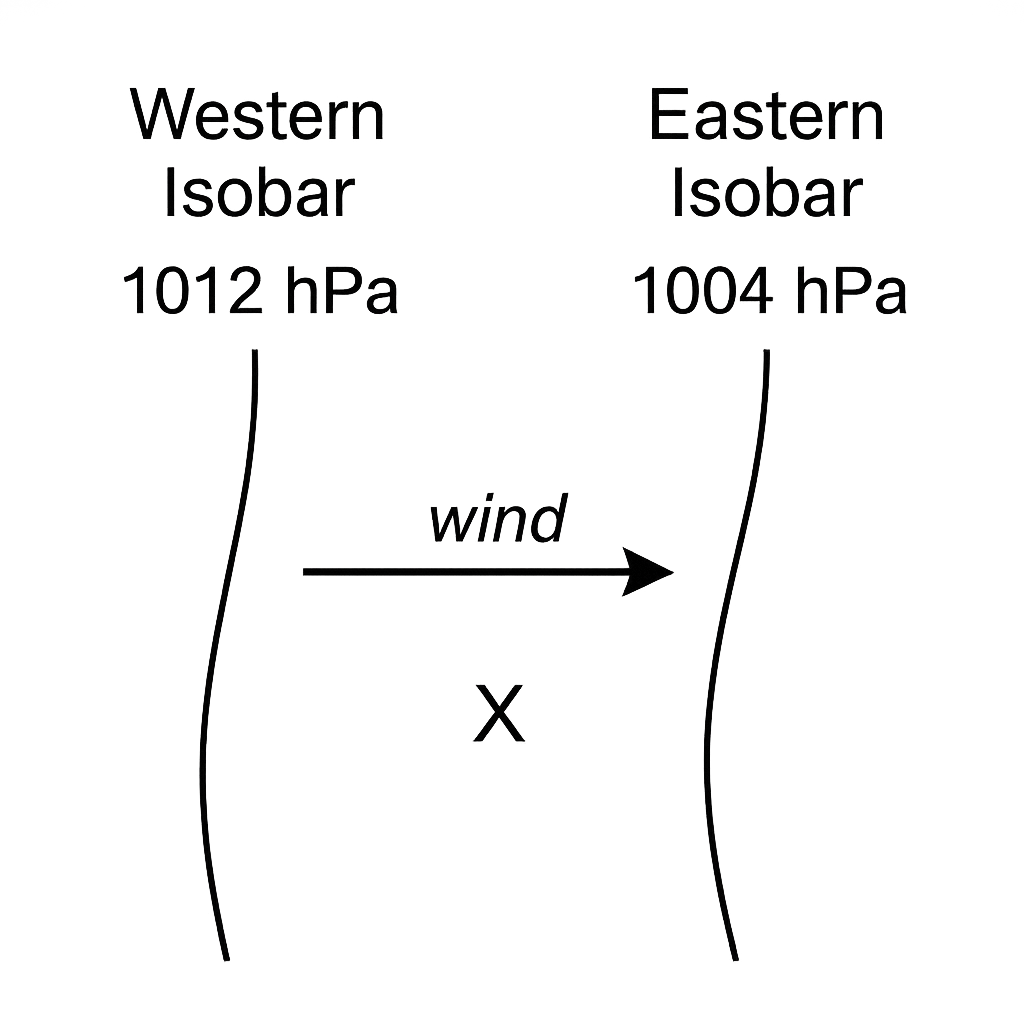
The diagram shows two adjacent isobars: the western isobar is labelled 1012 hPa and the eastern isobar is labelled 1004 hPa. Wind blows parallel to isobars and from high to low pressure. At point X located exactly halfway between the two isobars, what is the wind direction expressed as a compass point (N, NE, E, SE, S, SW, W, NW)?
Correct A. E
B. W
C. NE
D. SE

Correct Answer: A

Want to see the full step-by-step solution? Unlock AI Explanation & Analytics
Question 25 View Details
An ungauged catchment has a total area of 12 km\(^2\) consisting of 3 km\(^2\) forest with runoff coefficient \(C_f = 0.15\) and 9 km\(^2\) agricultural land with runoff coefficient \(C_a = 0.30\). A design storm of 30\,minutes duration has an intensity of 80 mm h\(^{-1}\). The main channel length is 2.5 km and its average slope is 0.02. Using the Kirpich formula \(T_c = 0.0195 L^{0.77} S^{-0.385}\) (with \(L\) in metres and \(S\) dimensionless) to estimate the time of concentration, and then applying the rational method \(Q = \frac{C i A}{360}\) (where \(i\) is in mm h\(^{-1}\) and \(A\) in km\(^2\)), determine the peak discharge \(Q\) in m\(^3\) s\(^{-1}\).
Correct A. 0.70
B. 1.10
C. 0.55
D. 0.85

Correct Answer: A

Want to see the full step-by-step solution? Unlock AI Explanation & Analytics

Master the Exam!

You've seen a preview, but there are thousands more questions plus AI tutor to break down complex solutions.

Unlock Full Access Available for Android & Windows
Help others prepare! Share this practice hub:
Chat with Support