neco 2017 chemistry | Objective

Prepare for your exams with neco questions? Reviewing past/model questions is one of the most effective ways to guarantee a high score. This practice hub features authentic 2017 chemistry (Objective) questions designed to simulate the real exam environment.

Practice these randomly selected questions to test your readiness.

Question 1 View Details
Aluminium metal of 5.0 g (99% pure) reacts with copper(II) sulphate pentahydrate according to \(2 \text{Al} + 3 \text{CuSO}_4\cdot5\text{H}_2\text{O} \rightarrow \text{Al}_2(\text{SO}_4)_3 + 3 \text{Cu}\). The reaction gives an 85% yield of \(\text{Al}_2(\text{SO}_4)_3\). Calculate the mass of \(\text{Al}_2(\text{SO}_4)_3\) obtained.
A. 2.96 g
B. 4.12 g
C. 3.45 g
Correct D. 3.89 g

Correct Answer: D

Want to see the full step-by-step solution? Unlock AI Explanation & Analytics
Question 2 View Details
A 2.00 L container at 27°C contains a mixture of \(\text{O}_2\) and \(\text{N}_2\) gases at a total pressure of 1.20 atm. The mixture is heated to 57°C, raising the pressure to 1.44 atm. The gas is then passed over heated copper, which reacts with all the \(\text{O}_2\) according to \(2 \text{Cu} + \text{O}_2 \rightarrow 2 \text{CuO}\). After the reaction, the remaining gas (only \(\text{N}_2\)) is measured at 27°C and 1 atm and occupies 0.500 L. Determine the mass of \(\text{O}_2\) originally present in the container.
Correct A. 2.47 g
B. 2.05 g
C. 3.12 g
D. 1.89 g

Correct Answer: A

Want to see the full step-by-step solution? Unlock AI Explanation & Analytics
Question 3 View Details
A buffer solution is prepared by mixing 0.250 mol of acetic acid (\(\text{CH}_3\text{COOH}\), \(K_a = 1.8 \times 10^{-5}\)) with its sodium salt. The initial pH of the buffer is 4.75. After adding 0.050 mol of HCl, the pH becomes 4.30. Calculate the initial amount (in moles) of sodium acetate (\(\text{NaCH}_3\text{COO}\)) present in the buffer.
Correct A. 0.106 mol
B. 0.125 mol
C. 0.150 mol
D. 0.090 mol

Correct Answer: A

Want to see the full step-by-step solution? Unlock AI Explanation & Analytics
Question 4 View Details
What is the hybridisation of the central carbon atom in the molecule ethene (\(\text{C}_2\text{H}_4\))?
A. sp
B. sp3
C. sp3d
Correct D. sp2

Correct Answer: D

Want to see the full step-by-step solution? Unlock AI Explanation & Analytics
Question 5 View Details
5.0 g of 2‑propanol (\(\text{C}_3\text{H}_8\text{O}\), molar mass 60.10 g\,mol\(^{-1}\)) that is 92% pure by mass is oxidised with excess potassium dichromate in acidic medium according to \(3 \text{C}_3\text{H}_8\text{O} + \text{K}_2\text{Cr}_2\text{O}_7 + 4 \text{H}_2\text{SO}_4 \rightarrow 3 \text{C}_3\text{H}_6\text{O} + \text{Cr}_2(\text{SO}_4)_3 + \text{K}_2\text{SO}_4 + 7 \text{H}_2\text{O}\). Determine the mass of acetone (\(\text{C}_3\text{H}_6\text{O}\)) formed.
A. 4.00 g
Correct B. 4.44 g
C. 3.92 g
D. 5.12 g

Correct Answer: B

Want to see the full step-by-step solution? Unlock AI Explanation & Analytics
Question 6 View Details
An unknown hydrocarbon has a molar mass of 84 g·mol\(^{-1}\). When 1.00 g of the hydrocarbon is burned completely in excess oxygen, the combustion products are 2.75 g of carbon dioxide and 1.10 g of water. Determine the molecular formula of the hydrocarbon.
A. C7H14
B. C5H12
Correct C. C6H12
D. C6H10

Correct Answer: C

Want to see the full step-by-step solution? Unlock AI Explanation & Analytics
Question 7 View Details
In acidic solution, potassium dichromate reacts with iron(II) sulfate according to the equation:\n\(\mathrm{K_2Cr_2O_7 + 6\,FeSO_4 + 7\,H_2SO_4 \rightarrow Cr_2(SO_4)_3 + 3\,Fe_2(SO_4)_3 + K_2SO_4 + 7\,H_2O}\).\nIf 1.00 g of \(\mathrm{K_2Cr_2O_7}\) reacts completely with excess \(\mathrm{FeSO_4}\), calculate the mass of \(\mathrm{Fe_2(SO_4)_3}\) formed.
Correct A. 4.08 g
B. 3.40 g
C. 5.12 g
D. 2.70 g

Correct Answer: A

Want to see the full step-by-step solution? Unlock AI Explanation & Analytics
Question 8 View Details
A solid sample containing only two oxides of a non‑metal X, namely \(\mathrm{XO}\) and \(\mathrm{XO_2}\), is reduced with hydrogen gas. From 1.80 g of the sample, 0.89 g of water are produced and 1.01 g of the metallic element X are recovered. Determine the atomic mass of X (to the nearest whole number) and the mass percent of each oxide in the original sample.
A. Atomic mass ≈ 26; XO ≈ 50.0 % and XO₂ ≈ 50.0 %
B. Atomic mass ≈ 30; XO ≈ 60.0 % and XO₂ ≈ 40.0 %
C. Atomic mass ≈ 28; XO ≈ 48.0 % and XO₂ ≈ 52.0 %
Correct D. Atomic mass ≈ 28; XO ≈ 55.5 % and XO₂ ≈ 44.5 %

Correct Answer: D

Want to see the full step-by-step solution? Unlock AI Explanation & Analytics
Question 9 View Details
A non‑volatile solute with molar mass 58.44 g·mol\(^{-1}\) is dissolved in 500 g of water to form a solution whose boiling point is 101.2 °C at 1 atm. Given the ebullioscopic constant of water \(K_b = 0.512\) °C·kg·mol\(^{-1}\), calculate the mass percent of the solute in the solution.
A. 9.6 %
B. 13.8 %
Correct C. 12.0 %
D. 10.5 %

Correct Answer: C

Want to see the full step-by-step solution? Unlock AI Explanation & Analytics
Question 10 View Details
Two isomers of butane, n‑butane and isobutane, are each mixed with excess chlorine gas and irradiated with UV light. Under identical conditions, the rate of chlorination (measured as the increase in pressure of HCl) for n‑butane is observed to be twice that for isobutane. If a mixture containing 2.00 mol of n‑butane and 2.00 mol of isobutane is irradiated for 30 min, and the integrated first‑order rate for isobutane gives 0.10 mol HCl per mol of isobutane, calculate the total moles of HCl produced.
A. 0.50 mol
B. 0.80 mol
C. 0.30 mol
Correct D. 0.60 mol

Correct Answer: D

Want to see the full step-by-step solution? Unlock AI Explanation & Analytics
Question 11 View Details
Given 15.0 g of aluminium (Al) and 30.0 g of copper(II) chloride (CuCl_{2}) are reacted according to \(2\,Al + 3\,CuCl_{2} \rightarrow 2\,AlCl_{3} + 3\,Cu\). The reaction has an 85\% yield based on copper. Calculate the mass of copper actually obtained (in grams).
A. 13.5 g
B. 9.8 g
Correct C. 12.1 g
D. 10.2 g

Correct Answer: C

Want to see the full step-by-step solution? Unlock AI Explanation & Analytics
Question 12 View Details
A hydrocarbon containing only carbon and hydrogen is combusted completely, producing 44.1 g of carbon dioxide and 18.2 g of water. Determine the empirical formula of the hydrocarbon and, given that its molar mass is 84 g·mol\(^{-1}\), state its molecular formula.
Correct A. C6H12
B. C5H10
C. C7H14
D. C6H10

Correct Answer: A

Want to see the full step-by-step solution? Unlock AI Explanation & Analytics
Question 13 View Details
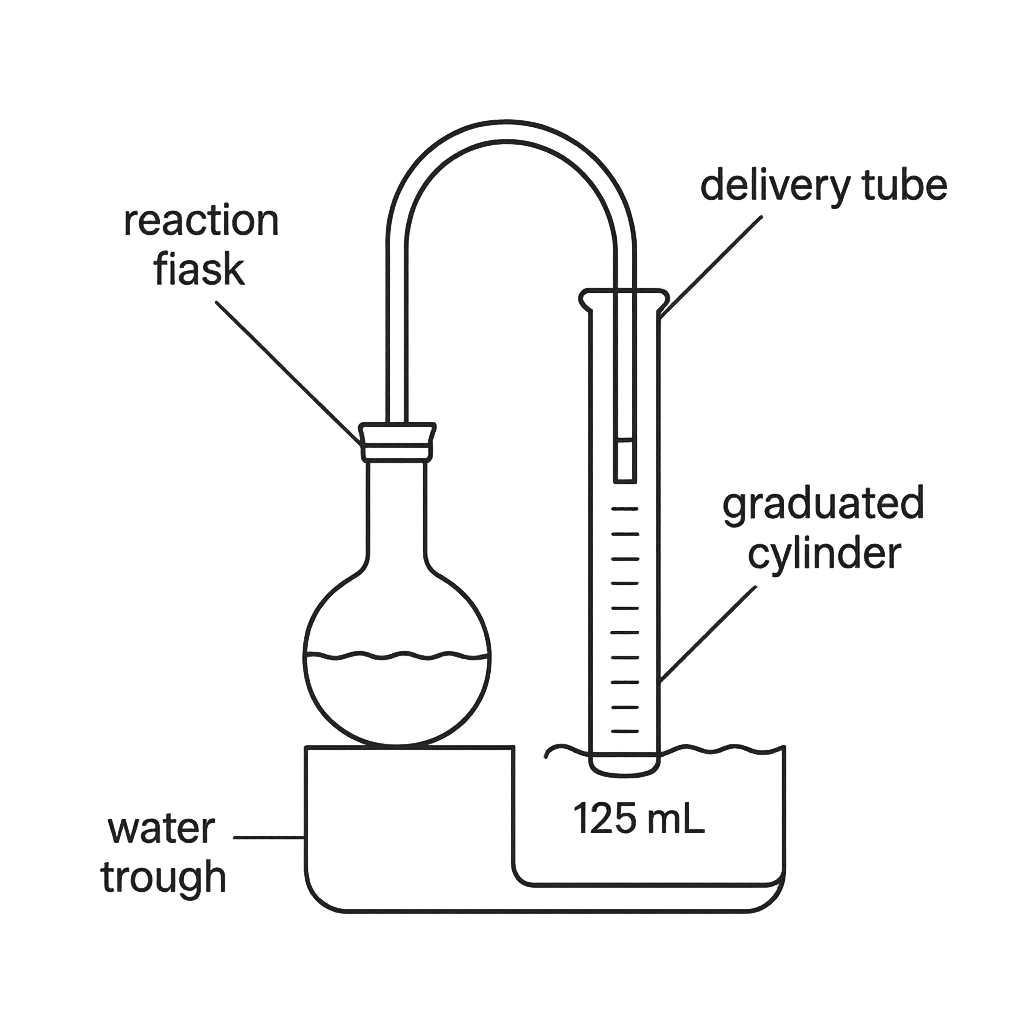
In the apparatus shown, a reaction produces a gas that is collected over water. The graduated cylinder reads 125.0 mL of gas at 25\(^\circ\)C and atmospheric pressure of 760 mmHg. The vapor pressure of water at this temperature is 23.8 mmHg. Calculate the number of moles of dry gas collected (express your answer in scientific notation to two significant figures).
A. 3.8×10⁻³ mol
B. 4.9×10⁻⁴ mol
C. 5.1×10⁻³ mol
Correct D. 4.9×10⁻³ mol

Correct Answer: D

Want to see the full step-by-step solution? Unlock AI Explanation & Analytics
Question 14 View Details
A 0.250 g sample of impure calcium carbonate is treated with excess 0.150 M hydrochloric acid (25.0 mL). The excess acid is then back‑titrated with 0.100 M sodium hydroxide, requiring 12.5 mL of NaOH. Calculate the percent purity of CaCO_{3} in the original sample.
A. 62.5 %
Correct B. 50.0 %
C. 55.0 %
D. 40.0 %

Correct Answer: B

Want to see the full step-by-step solution? Unlock AI Explanation & Analytics
Question 15 View Details
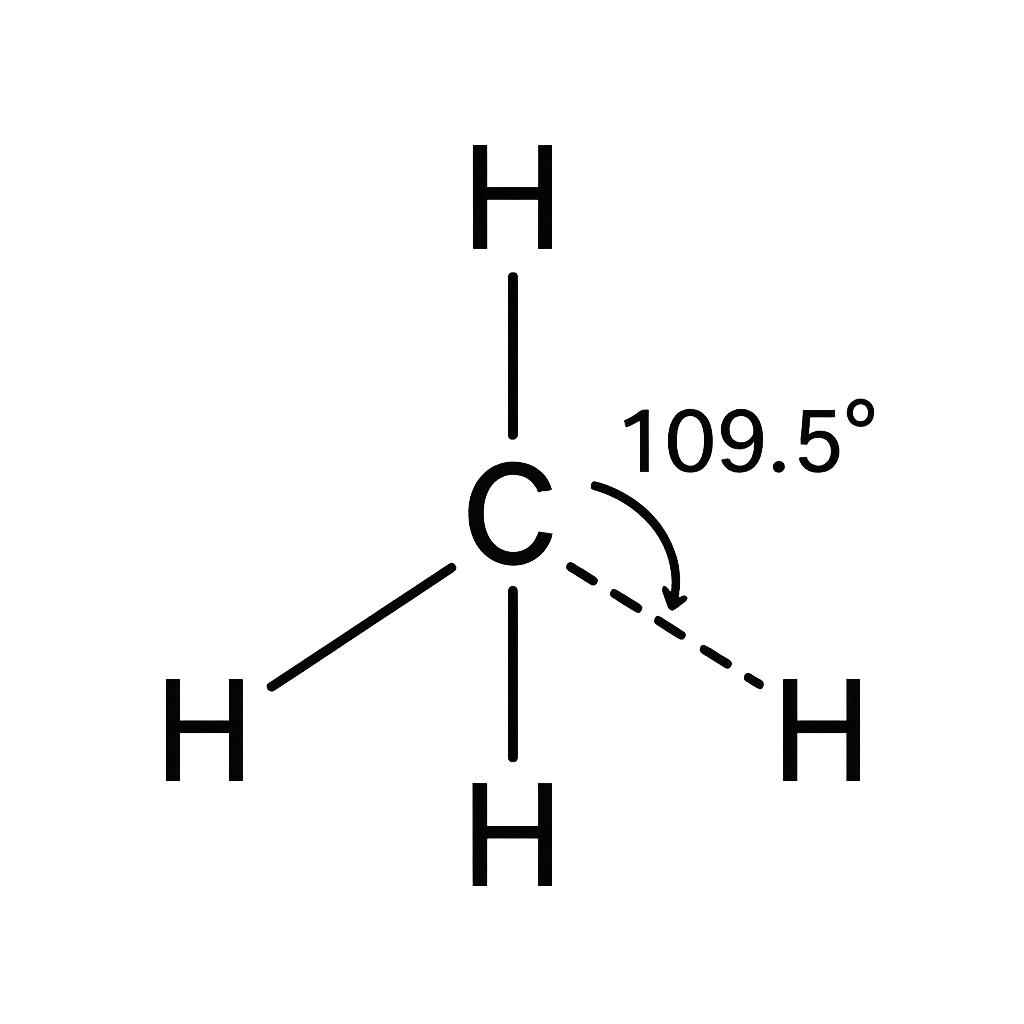
The diagram shows a methane (CH_{4}) molecule with the carbon atom at the centre and four hydrogen atoms arranged tetrahedrally. State the hybridisation of the carbon atom and the approximate H-C-H bond angle.
A. sp3, 120°
B. sp2, 120°
C. sp, 180°
Correct D. sp3, 109.5°

Correct Answer: D

Want to see the full step-by-step solution? Unlock AI Explanation & Analytics
Question 16 View Details
Metal M forms a trivalent oxide M2O3. The standard Gibbs free energy of formation (in kJ·mol^{-1}) of the oxide and of carbon monoxide are temperature‑dependent as follows: \(\Delta G_f^\circ(\text{M}_2\text{O}_3) = -\bigl(400 + 0.2\,T\bigr)\) and \(\Delta G_f^\circ(\text{CO}) = -\bigl(110 + 0.1\,T\bigr)\), where \(T\) is in kelvin. Carbon and the metal are in their standard states (\(\Delta G_f^\circ = 0\)). The reduction reaction is \(\text{M}_2\text{O}_3 + 3\,\text{C} \rightarrow 2\,\text{M} + 3\,\text{CO}\). (a) Determine the lowest temperature at which the reduction becomes spontaneous (\(\Delta G^\circ < 0\)). (b) Using that temperature, calculate the equilibrium constant \(K\) for the reaction at \(900\ \text{K}\).
Correct A. 700 K; K \approx 1.5 \times 10^{1}
B. 800 K; K \approx 1.0 \times 10^{1}
C. 700 K; K \approx 3.0 \times 10^{0}
D. 600 K; K \approx 2.0 \times 10^{1}

Correct Answer: A

Want to see the full step-by-step solution? Unlock AI Explanation & Analytics
Question 17 View Details
500 g of a non‑volatile solute are dissolved in 500 g of benzene (\(K_b = 5.2\ \text{K·kg·mol}^{-1}\)). At \(25^{\circ}\text{C}\) the vapor pressure of pure benzene is \(1.00\ \text{atm}\) while that of the solution is \(0.85\ \text{atm}\). Determine the molar mass of the solute.
Correct A. 177 g·mol^{-1}
B. 150 g·mol^{-1}
C. 250 g·mol^{-1}
D. 200 g·mol^{-1}

Correct Answer: A

Want to see the full step-by-step solution? Unlock AI Explanation & Analytics
Question 18 View Details
An aqueous buffer contains \(0.500\ \text{L}\) of a solution with acetic acid (\(pK_a = 4.76\)) and its sodium acetate. The initial pH is \(4.74\). A \(0.150\ \text{M}\) NaOH solution is added, raising the pH to \(5.00\). Calculate the volume (in mL) of NaOH required.
A. 132 mL
B. 172 mL
Correct C. 146 mL
D. 158 mL

Correct Answer: C

Want to see the full step-by-step solution? Unlock AI Explanation & Analytics
Question 19 View Details
A \(0.100\ \text{M}\) solution of the diprotic acid \(\text{H}_2\text{A}\) ( \(K_{a1}=1.0\times10^{-2},\; K_{a2}=1.0\times10^{-7}\) ) is titrated with \(0.100\ \text{M}\) NaOH. Determine the pH at the first equivalence point and suggest a suitable indicator for the titration.
A. pH \approx 3.2; indicator: methyl orange
Correct B. pH \approx 4.5; indicator: bromocresol green
C. pH \approx 4.5; indicator: phenol red
D. pH \approx 5.0; indicator: phenolphthalein

Correct Answer: B

Want to see the full step-by-step solution? Unlock AI Explanation & Analytics
Question 20 View Details
An aqueous solution of an unknown metal salt is subjected to the following qualitative tests:\n1. Addition of dilute \(\text{HCl}\): no visible change.\n2. Addition of dilute \(\text{NH}_4\text{OH}\): a pale‑blue precipitate forms which dissolves on adding excess \(\text{NH}_4\text{OH}\), giving a deep‑blue solution.\n3. Introduction of \(\text{H}_2\text{S}\) gas in acidic medium (pH≈1): no precipitate.\n4. Addition of \(\text{NaOH}\): a blue precipitate forms which also dissolves in excess \(\text{NH}_4\text{OH}\).\n5. Addition of \((\text{NH}_4)_2\text{S}\) in alkaline medium: a black precipitate appears instantly. Identify the metal ion present in the solution.
A. Co^{2+}
Correct B. Cu^{2+}
C. Ni^{2+}
D. Zn^{2+}

Correct Answer: B

Want to see the full step-by-step solution? Unlock AI Explanation & Analytics
Question 21 View Details
In a galvanic cell the half‑cells are Zn(s) | Zn^{2+} (0.010 M) || Cu^{2+} (x M) | Cu(s). The standard reduction potentials are (E^{\circ}(\text{Zn}^{2+}/\text{Zn}) = -0.76\,\text{V}\) and (E^{\circ}(\text{Cu}^{2+}/\text{Cu}) = +0.34\,\text{V}\). At (25^{\circ}\text{C}\) the cell emf is measured as 1.05 V. Calculate the concentration x of Cu^{2+} in the cell.
A. 2.0×10^{-3} M
Correct B. 2.0×10^{-4} M
C. 1.0×10^{-4} M
D. 2.0×10^{-5} M

Correct Answer: B

Want to see the full step-by-step solution? Unlock AI Explanation & Analytics
Question 22 View Details
A 2.00 g sample of compound A (M = 60 \text{g mol}^{-1}) reacts with 3.00 g of compound B to give gaseous product C according to \(2\,\text{A} + 3\,\text{B} \rightarrow 4\,\text{C}(g)\). When the reaction is carried out at (25^{\circ}\text{C}\) and 1 atm, 5.60 L of C are collected. Determine the molar mass of B.
A. 13.2 g\/mol
Correct B. 17.5 g/mol
C. 20.0 g\/mol
D. 15.0 g\/mol

Correct Answer: B

Want to see the full step-by-step solution? Unlock AI Explanation & Analytics
Question 23 View Details
A polymer blend shows a single glass‑transition temperature of 40 \(^{\circ}\)C. The blend consists of polymer A with \(T_{g}=100\) \(^{\circ}\)C and polymer B with \(T_{g}=-20\) \(^{\circ}\)C. Assuming the Fox equation \(\frac{1}{T_{g}}=\frac{w_{A}}{T_{gA}}+\frac{w_{B}}{T_{gB}}\) (temperatures in K), calculate the weight fraction \(w_{A}\) of polymer A in the blend.
A. 0.70
B. 0.40
Correct C. 0.60
D. 0.55

Correct Answer: C

Want to see the full step-by-step solution? Unlock AI Explanation & Analytics
Question 24 View Details
A 0.250 g sample of impure calcium carbonate is treated with excess 0.100 M HCl. After the reaction, the remaining acid is back‑titrated with 0.0800 M NaOH, requiring 12.5 mL of NaOH to reach the endpoint. If the volume of HCl initially added was 25.0 mL, determine the percent purity of CaCO₃ in the sample.
A. 35.0%
B. 25.0%
C. 45.0%
Correct D. 30.0%

Correct Answer: D

Want to see the full step-by-step solution? Unlock AI Explanation & Analytics
Question 25 View Details
In an electroplating operation a current of 2.00 A is passed for 3.00 h. The current efficiency for copper deposition is 85 %. Given that the molar mass of Cu is 63.55 g mol^{-1} and its valency is 2, calculate the mass of copper deposited on the cathode.
A. 5.12 g
B. 4.85 g
C. 7.30 g
Correct D. 6.05 g

Correct Answer: D

Want to see the full step-by-step solution? Unlock AI Explanation & Analytics

Master the Exam!

You've seen a preview, but there are thousands more questions plus AI tutor to break down complex solutions.

Unlock Full Access Available for Android & Windows
Help others prepare! Share this practice hub:
Chat with Support