neco 2017 chemistry | Essay

Prepare for your exams with neco questions? Reviewing past/model questions is one of the most effective ways to guarantee a high score. This practice hub features authentic 2017 chemistry (Essay) questions designed to simulate the real exam environment.

Practice these randomly selected questions to test your readiness.
Question 1 View Details
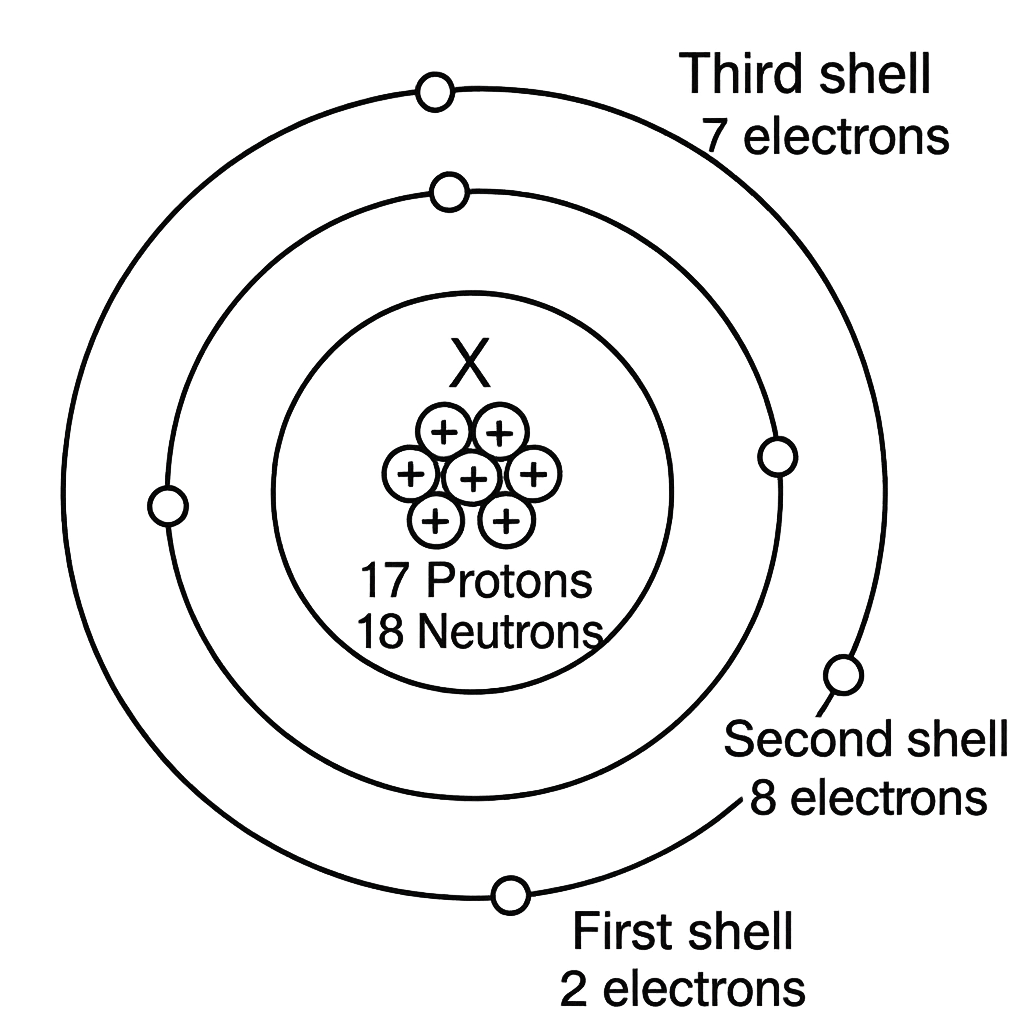
The diagram shows a simplified Bohr model of an unknown element X.
Question Parts
(a)
Identify the element and write its chemical symbol.
(b)
Determine the atomic number (Z), mass number (A) and the number of neutrons in the nucleus.
(c)
Write the ground‑state electron configuration of the element using the Aufbau principle (show the distribution of electrons in shells).
(d)
State two common oxidation states of this element and briefly justify each based on the electron configuration.
Detailed Essay Solution & Marking Scheme Available

Get the step-by-step mathematical proofs, key points required by examiners, and a comprehensive breakdown from our AI Tutor.
Question 2 View Details
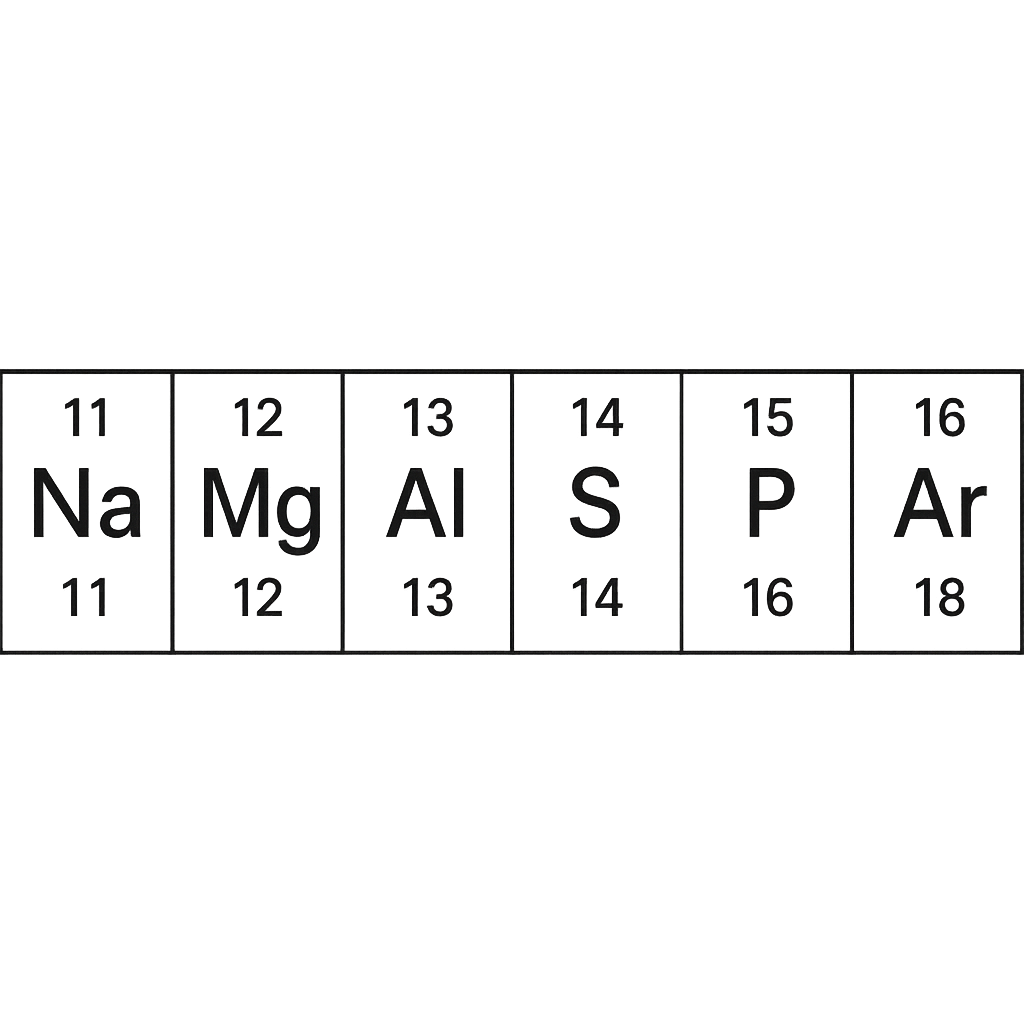
The diagram presents a segment of the periodic table showing period 3 elements (Na to Ar) with their atomic numbers and symbols.
Question Parts
(a)
State the group number and family name of sulphur (S).
(b)
Arrange the elements Na, Mg, Al, Si, P, S, Cl in order of increasing first ionisation energy and give a concise explanation for the observed trend.
(c)
Write the ground‑state electron configurations for magnesium (Mg) and phosphorus (P).
(d)
Explain why chlorine readily forms a –1 ion whereas sodium readily forms a +1 ion.
Detailed Essay Solution & Marking Scheme Available

Get the step-by-step mathematical proofs, key points required by examiners, and a comprehensive breakdown from our AI Tutor.
Question 3 View Details
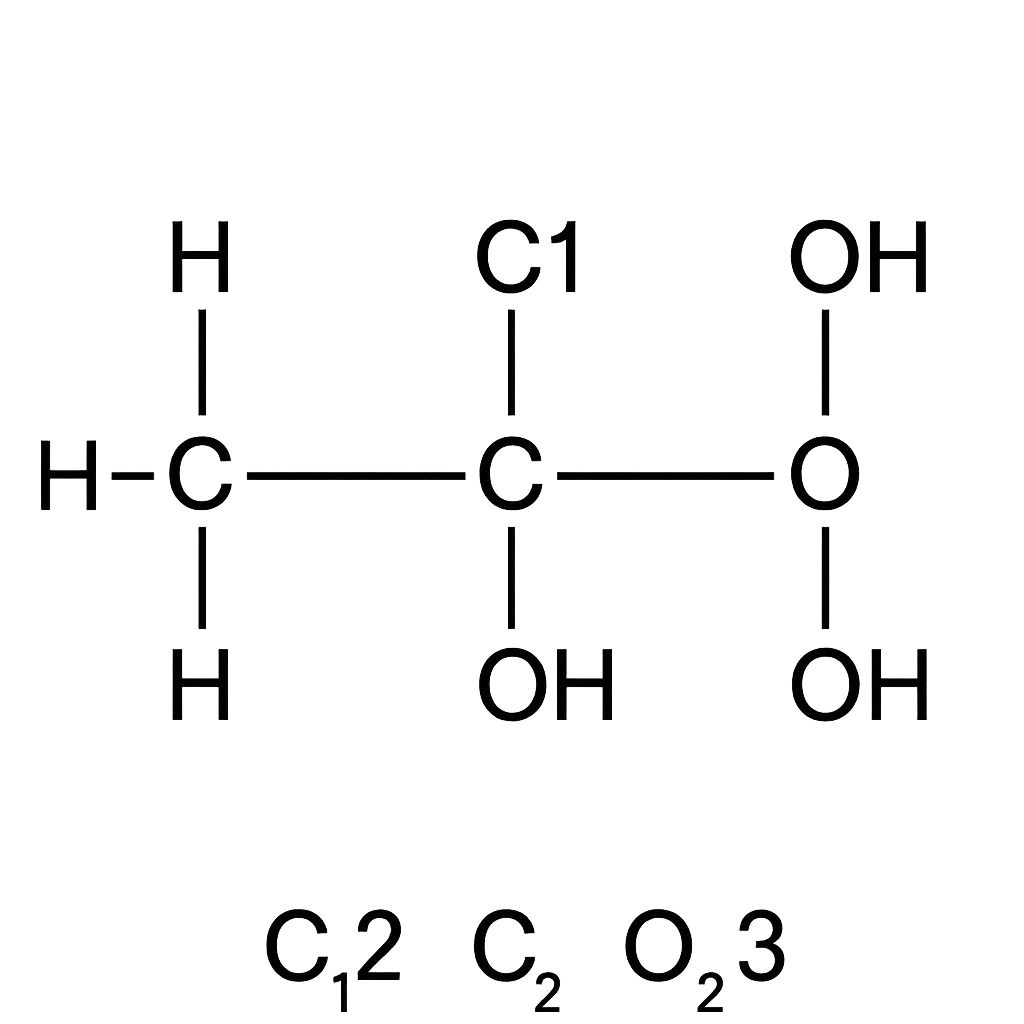
Answer the following questions on chemical bonding.
Question Parts
(a)
Draw the Lewis structure of sulfur tetrafluoride (SF₄). Explain why sulfur can accommodate more than an octet of electrons.
(b)
Using VSEPR theory, predict the molecular geometry of SF₄ and give the approximate bond angles between bonded atoms.
(c)
The average bond dissociation energies are: C–C single bond = 347 kJ mol⁻¹, C=C double bond = 614 kJ mol⁻¹. Explain, with reference to bond order and electron sharing, why the double bond is stronger and how this influences the reactivity of alkenes compared with alkanes.
(d)
Given electronegativities: S = 2.58, F = 3.98. Determine the polarity of the S–F bond and state the direction of the molecular dipole moment of SF₄. Justify your answer based on the geometry obtained in part (b).
Detailed Essay Solution & Marking Scheme Available

Get the step-by-step mathematical proofs, key points required by examiners, and a comprehensive breakdown from our AI Tutor.
Question 4 View Details
The structural diagram of an organic compound is shown in the illustration. The compound consists only of carbon (C), hydrogen (H) and oxygen (O) atoms. Using the diagram, answer the following questions.
Question Parts
(a)
Write the molecular formula of the compound shown in the diagram.
(b)
Calculate the molar mass of the compound (use C = 12.01 g mol⁻¹, H = 1.008 g mol⁻¹, O = 16.00 g mol⁻¹). Give your answer to two decimal places.
(c)
A 0.250 g sample of the compound is completely combusted according to the balanced equation: C₃H₈O₂ + 4 O₂ → 3 CO₂ + 4 H₂O. Calculate the theoretical mass of CO₂ that can be obtained from this sample. Give your answer to three significant figures.
(d)
If the actual mass of CO₂ collected from the experiment is 0.380 g, determine the percent yield of the combustion.
Detailed Essay Solution & Marking Scheme Available

Get the step-by-step mathematical proofs, key points required by examiners, and a comprehensive breakdown from our AI Tutor.

Question 5 View Details
A 5.00 g sample of a mixture containing metallic magnesium (Mg) and magnesium oxide (MgO) is treated with excess hydrochloric acid. The reactions are: \(\text{Mg} + 2\text{HCl} \rightarrow \text{MgCl}_2 + \text{H}_2\) \(\text{MgO} + 2\text{HCl} \rightarrow \text{MgCl}_2 + \text{H}_2\text{O}\) The total volume of hydrogen gas collected over water at 25 °C and 1 atm (after correcting for water vapour pressure) is 1.12 L. Determine:
Question Parts
(a)
The mass of pure magnesium present in the original mixture.
(b)
The mass of magnesium oxide present in the mixture.
(c)
The percent purity of magnesium in the original mixture (expressed to one decimal place).
Detailed Essay Solution & Marking Scheme Available

Get the step-by-step mathematical proofs, key points required by examiners, and a comprehensive breakdown from our AI Tutor.

Question 6 View Details
The phase diagram of a pure substance X shows that its normal boiling point (1 atm) is 350 K. Two vapor‑pressure measurements are recorded: - At 300 K, the vapour pressure is 0.10 atm. - At 320 K, the vapour pressure is 0.30 atm. Assume the enthalpy of vaporisation (ΔHvap) is constant over this temperature range. Answer the following:
Question Parts
(a)
Explain, using the phase diagram, how pressure and boiling point are related for substance X.
(b)
Calculate the enthalpy of vaporisation (ΔHvap) of X in kJ mol⁻¹ using the two given vapour‑pressure data points.
(c)
Using the ΔHvap obtained in part (b), estimate the boiling point of X when the external pressure is 0.50 atm. Give your answer to the nearest kelvin.
Detailed Essay Solution & Marking Scheme Available

Get the step-by-step mathematical proofs, key points required by examiners, and a comprehensive breakdown from our AI Tutor.

Question 7 View Details
A 0.250 mol sample of a weak diprotic acid H2A (Ka1 = 1.2×10^-4, Ka2 = 4.0×10^-9) is dissolved in 1.00 L of water at 25 °C.
Question Parts
(a)
Write the step‑wise dissociation equations for H2A and state which dissociation is predominant in aqueous solution. Give a brief explanation.
(b)
Assuming only the first dissociation contributes significantly, calculate the pH of the solution.
(c)
A 25.0 mL aliquot of the above solution is titrated with 0.100 M NaOH. (i) Determine the volume of NaOH required to reach the first equivalence point. (ii) Calculate the pH at the first equivalence point.
(d)
After the addition of 0.050 L of 0.100 M NaOH to the 25.0 mL aliquot (i.e., 5.0×10^-3 mol OH⁻, which is beyond the first equivalence point), identify the predominant ionic species present and calculate the pH of the solution at this stage.
Detailed Essay Solution & Marking Scheme Available

Get the step-by-step mathematical proofs, key points required by examiners, and a comprehensive breakdown from our AI Tutor.

Question 8 View Details
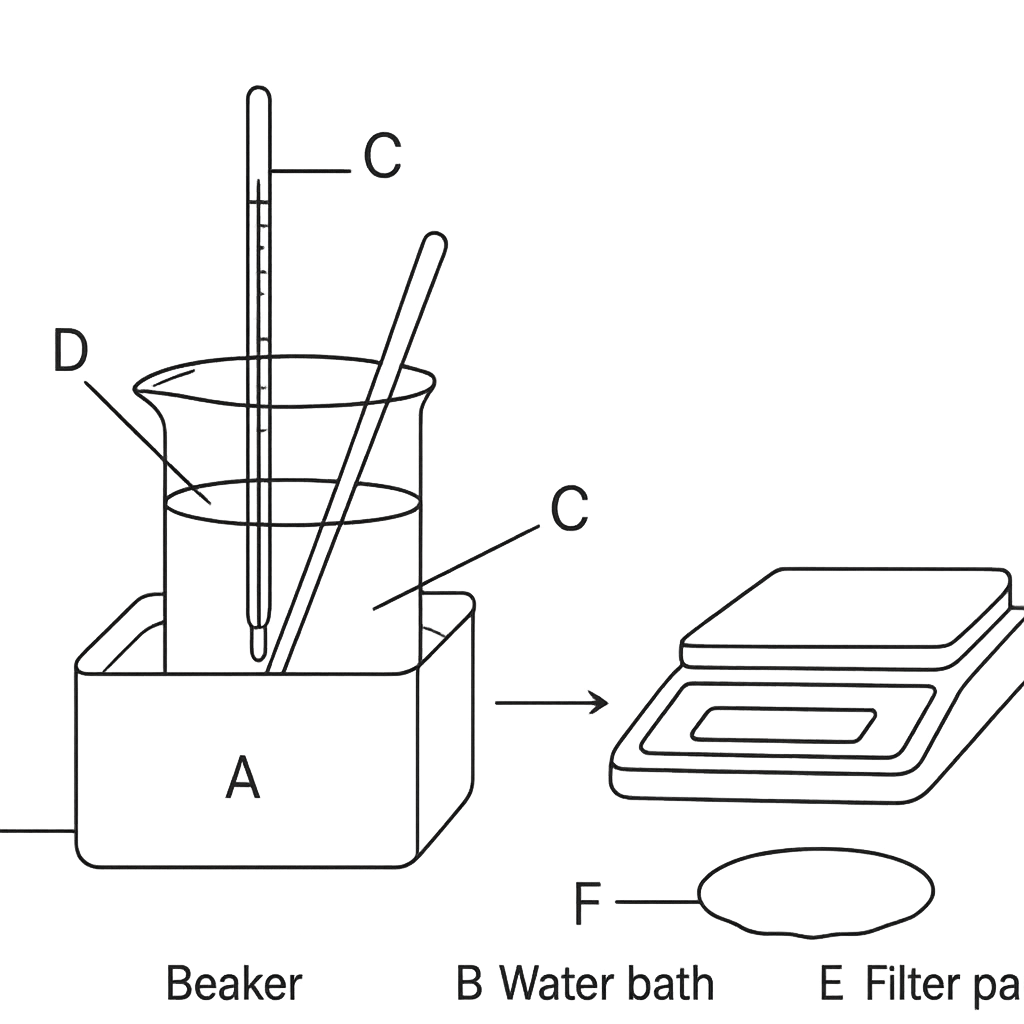
A student investigates the solubility of potassium nitrate (KNO\(_3\)) in water using the apparatus shown. The student records the mass of KNO\(_3\) that dissolves in 100 mL of distilled water at the temperatures indicated below: | Temperature (°C) | Mass of KNO\(_3\) dissolved (g) | |------------------|---------------------------------| | 20 | 13.3 | | 40 | 20.9 | | 60 | 31.6 | | 80 | 45.8 | The thermometer used has an uncertainty of \(\pm0.5\)°C. The apparatus consists of a 250 mL beaker, a water bath with temperature control, a thermometer, a stirring rod, a balance and filter paper as illustrated. Answer the following questions:
Question Parts
(a)
Describe qualitatively the solubility curve that would be obtained from the data and explain the relationship between temperature and the solubility of KNO\(_3\).
(b)
Estimate, by linear interpolation, the mass of KNO\(_3\) that will dissolve in 100 mL of water at 70°C. Show all steps.
(c)
The student wishes to prepare a saturated solution of KNO\(_3\) at 70°C in 250 mL of water. Using your result from part (b), calculate the mass of KNO\(_3\) required. Then, if the solution is allowed to cool to 20°C without any crystallisation control, determine how much KNO\(_3\) will precipitate out. State any assumptions made.
(d)
Identify two possible sources of experimental error in this determination of solubility and explain how each could affect the reported solubility values.
Detailed Essay Solution & Marking Scheme Available

Get the step-by-step mathematical proofs, key points required by examiners, and a comprehensive breakdown from our AI Tutor.

Master the Exam!

You've seen a preview, but there are thousands more questions plus AI tutor to break down complex solutions.

Unlock Full Access Available for Android & Windows
Help others prepare! Share this practice hub:
Chat with Support