neco 2017 agricultural_science | Objective

Prepare for your exams with neco questions? Reviewing past/model questions is one of the most effective ways to guarantee a high score. This practice hub features authentic 2017 agricultural_science (Objective) questions designed to simulate the real exam environment.

Practice these randomly selected questions to test your readiness.

Question 1 View Details
A hermetic storage bag contains harvested maize. The respiration rate at \(20^{\circ}\text{C}\) is 0.12% per day. The rate follows a Q10 of \(Q_{10}=2\), i.e., it doubles for every 10°C increase. During a typical day the temperature varies linearly from \(20^{\circ}\text{C}\) at 6 am to \(30^{\circ}\text{C}\) at 2 pm, then back to \(20^{\circ}\text{C}\) at 10 pm, and remains \(20^{\circ}\text{C}\) overnight. Assuming the instantaneous respiration rate scales with temperature according to the Q10 rule, calculate the average daily respiration loss percentage (to three decimal places).
Correct A. 0.155%
B. 0.145%
C. 0.165%
D. 0.125%

Correct Answer: A

Want to see the full step-by-step solution? Unlock AI Explanation & Analytics
Question 2 View Details
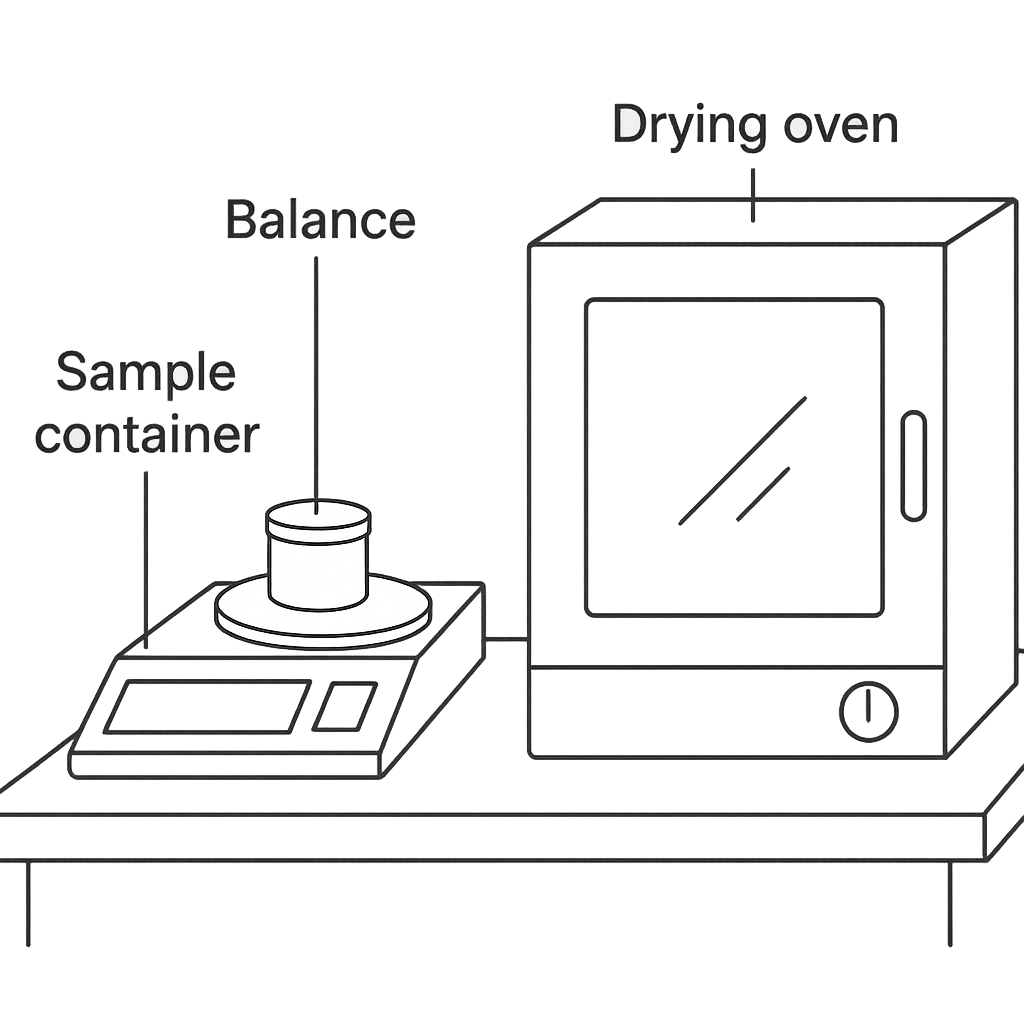
A soil sample weighing 150\,g is placed in a pre‑weighed container and oven‑dried at 105\,°C until constant weight. After drying, the container with the dry soil weighs 120\,g. Determine the gravimetric moisture content of the sample as a percentage of the dry soil mass.
A. 20%
B. 30%
Correct C. 25%
D. 40%

Correct Answer: C

Want to see the full step-by-step solution? Unlock AI Explanation & Analytics
Question 3 View Details
A pond is initially stocked with 2,000 tilapia. The population follows discrete logistic growth: \( N_{t+1}=N_{t}+rN_{t}\left(1-\frac{N_{t}}{K}\right)-H \), where \(r=0.5\) per year, \(K=8,000\) fish, and \(H\) is the constant number of fish harvested each year. The manager wants the population after 5 years to be at least 3,000 fish. Determine the maximum integer value of \(H\) (fish per year) that satisfies this condition.
Correct A. 620
B. 600
C. 650
D. 580

Correct Answer: A

Want to see the full step-by-step solution? Unlock AI Explanation & Analytics
Question 4 View Details
A tractor pulls a three‑share moldboard plough. The draft per share is given by \( D = a + b v^{2} \) where \(a = 150\) N, \(b = 30\) N·s² m⁻² and \(v\) is the forward speed in metres per second. The tractor operates at 20 km h⁻¹. Assuming a drivetrain efficiency of 85 %, calculate the required engine power in kilowatts (kW), rounded to one decimal place.
A. 19.8 kW
B. 20.0 kW
C. 23.5 kW
Correct D. 21.1 kW

Correct Answer: D

Want to see the full step-by-step solution? Unlock AI Explanation & Analytics
Question 5 View Details
In a 5‑ha maize field the initial disease incidence is 5 %. The weekly incidence follows the logistic update \( I_{t+1}=I_{t}+r I_{t}(1-I_{t}) \) with \(r=0.3\). A fungicide applied at the end of week 3 reduces the incidence instantly by 40 %. Determine the disease incidence (as a percentage) at the end of week 6, rounded to one decimal place.
A. 10.9%
Correct B. 13.1%
C. 12.4%
D. 14.8%

Correct Answer: B

Want to see the full step-by-step solution? Unlock AI Explanation & Analytics
Question 6 View Details
A farmer has two ploughs. The single‑bottom plough requires a draft of \(150\) N per metre width, and its working width is \(0.30\) m. The three‑bottom plough requires \(400\) N per metre width and its working width is \(0.90\) m. The field area is 5 ha (\(50\,000\) m\(^2\)) and the soil moisture adds \(10\%\) to the draft force. Fuel consumption is proportional to the product of draft force and distance travelled. The single‑bottom plough can till 1 ha per hour, while the three‑bottom plough's speed is reduced by \(20\%\) because of the heavier draft. Which plough will use less fuel to till the whole field? Show your calculations.
A. three‑bottom plough
B. fuel consumption cannot be determined from the given data
Correct C. single‑bottom plough
D. both ploughs use the same amount of fuel

Correct Answer: C

Want to see the full step-by-step solution? Unlock AI Explanation & Analytics
Question 7 View Details
A farmer has 10 ha of land. He can either grow maize continuously for two years, applying \(150\) kg N ha\(^{-1}\) fertilizer each year, or adopt a two‑year rotation of maize (year 1) and cowpea (year 2). Maize yields \(5\) t ha\(^{-1}\) and needs \(120\) kg N ha\(^{-1}\); cowpea yields \(2\) t ha\(^{-1}\) and fixes \(40\) kg N ha\(^{-1}\). Grain nitrogen contents are \(1.2\%\) for maize and \(2.5\%\) for cowpea. In the rotation, maize receives only \(80\) kg N ha\(^{-1}\) fertilizer in year 1 and cowpea receives no fertilizer in year 2. Calculate the total net nitrogen surplus (fertilizer + fixation - removal by harvest) over the two‑year period for each option and state which option gives the higher surplus.
A. rotation
Correct B. continuous maize
C. both options give equal surplus
D. maize-cowpea rotation

Correct Answer: B

Want to see the full step-by-step solution? Unlock AI Explanation & Analytics
Question 8 View Details
In a 4‑ha tomato field a survey shows that \(30\%\) of the plants are infected with early blight with an average leaf‑area severity of \(40\%\), and \(10\%\) are infected with bacterial wilt with an average plant‑death severity of \(70\%\). The disease‑severity index (DSI) is calculated as \(\text{DSI}= \sum (\text{incidence}\times\text{severity})/100\). A fungicide reduces early‑blight severity by \(25\%\) (relative) while a bactericide reduces bacterial‑wilt incidence by \(50\%\) (relative). Compute the original DSI, the DSI after treatment, and state whether the final DSI is below the acceptable threshold of \(20\).
A. 15.0, acceptable
B. 12.5, unacceptable
C. 18.0, acceptable
Correct D. 12.5, acceptable

Correct Answer: D

Want to see the full step-by-step solution? Unlock AI Explanation & Analytics
Question 9 View Details
A farmer applies \(200\) kg N ha\(^{-1}\) fertilizer. If \(30\%\) of the nitrogen is taken up by the crop, \(20\%\) is lost by volatilisation, and \(10\%\) is lost by denitrification, how many kilograms of nitrogen per hectare are lost by leaching?
A. 60
Correct B. 80
C. 140
D. 120

Correct Answer: B

Want to see the full step-by-step solution? Unlock AI Explanation & Analytics
Question 10 View Details
A batch of \(500\) kg fresh cassava roots contains \(60\%\) moisture (wet basis). The roots are to be dried to \(15\%\) moisture for storage. Drying removes only water, so the dry‑matter mass remains unchanged. After drying, the product is packed in bags each holding \(25\) kg (wet basis at \(15\%\) moisture). During storage each bag loses \(2\%\) of its weight due to respiration, and \(5\%\) of the bags develop mould and are discarded. Calculate the total mass of marketable dry matter (in kilograms, to one decimal place) remaining after storage.
A. 196.0
Correct B. 186.2
C. 185.0
D. 190.0

Correct Answer: B

Want to see the full step-by-step solution? Unlock AI Explanation & Analytics
Question 11 View Details
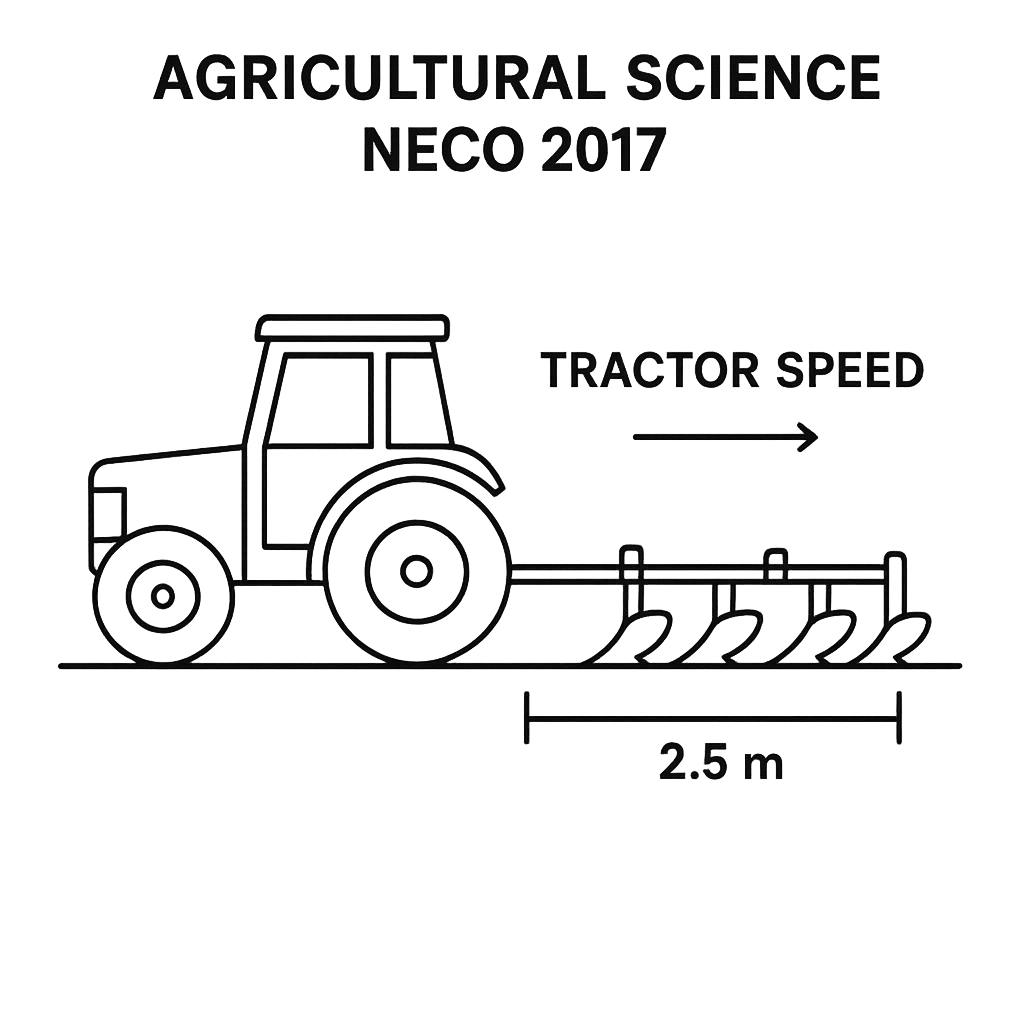
A tractor is used to pull a \(2.5\) m wide plough. The average draft required for the soil is \(150\) N per metre width. The tractor operates at a field efficiency of \(80\%\). To achieve a field capacity of \(1.5\) ha h\(^{-1}\), what minimum horsepower must the tractor develop, assuming a \(20\%\) mechanical loss? (1 hp = 746 W)
Correct A. 2 hp
B. 2.4 hp
C. 3 hp
D. 1.8 hp

Correct Answer: A

Want to see the full step-by-step solution? Unlock AI Explanation & Analytics
Question 12 View Details
A hand hoe has a total handle length of \(1.2\) m. The farmer can apply a maximum effort of \(120\) N at the handle end. To loosen soil the hoe must exert at least \(250\) N at the tip. If the fulcrum is placed a distance \(a\) metres from the tip, determine the greatest possible value of \(a\) (in metres, to two decimal places) that will allow the required tip force.
A. 0.50
Correct B. 0.39
C. 0.33
D. 0.45

Correct Answer: B

Want to see the full step-by-step solution? Unlock AI Explanation & Analytics
Question 13 View Details
In a field, \(30\%\) of the nitrogen applied is taken up by the crop, \(20\%\) is lost by leaching, and \(10\%\) is lost by volatilisation. The remaining nitrogen is lost by denitrification. What percentage of the applied nitrogen is lost by denitrification?
A. 45
Correct B. 40
C. 30
D. 55

Correct Answer: B

Want to see the full step-by-step solution? Unlock AI Explanation & Analytics
Question 14 View Details
A farmer expects a maize yield of \(5\) tonnes per hectare. Fixed costs are \(\text{₦}150\,000\) ha\(^{-1}\). Variable costs amount to \(\text{₦}30\) per kilogram of maize produced. If the market price is \(\text{₦}45\) kg\(^{-1}\), calculate the profit (or loss) per hectare. Then determine the minimum market price per kilogram required to achieve a profit of at least \(\text{₦}50\,000\) ha\(^{-1}\).
A. 90
B. 60
C. 80
Correct D. 70

Correct Answer: D

Want to see the full step-by-step solution? Unlock AI Explanation & Analytics
Question 15 View Details
A herd of \(200\) goats has \(5\%\) of the animals currently showing clinical signs of disease X and therefore cannot be vaccinated. A vaccine against disease X provides immunity to \(85\%\) of the animals that receive it. The farmer wants at least \(80\%\) of the total herd to be immune. How many healthy goats must be vaccinated now to meet this target?
A. 190
B. 188
C. 160
Correct D. 189

Correct Answer: D

Want to see the full step-by-step solution? Unlock AI Explanation & Analytics
Question 16 View Details
A farmer raises goats and chickens. The farm incurs a fixed annual cost of N300,000. The variable cost per goat is N10,000 and per chicken is N2,000. Each goat sells for N18,000 and each chicken for N5,000. The farmer plans to keep a total of 100 animals and wants to earn a profit of at least N200,000. How many goats must he raise at minimum to meet this profit target? Assume the remaining animals are chickens. Use the profit expression \( \text{Profit} = (18,000 g + 5,000 c) - (300,000 + 10,000 g + 2,000 c) \ge 200,000 \), with \( c = 100 - g \).
A. 45
B. 55
C. 30
Correct D. 40

Correct Answer: D

Want to see the full step-by-step solution? Unlock AI Explanation & Analytics
Question 17 View Details
An agricultural economist studies the market for maize. The market demand is given by \( Q = 500 - 5P \) (kg), where \( P \) is the price per kilogram in naira. The farmer's variable cost of production is N10 per kilogram and the fixed cost is N5,000.\n\n(a) Determine the price that maximises profit and compute the maximum profit.\n\n(b) Suppose the government introduces a per‑kilogram tax of \( t \) naira, which adds to the variable cost. Assuming the farmer again chooses the profit‑maximising price, find the value of \( t \) that reduces the maximum profit by exactly 25 % compared with the situation in part (a). Give your answer for \( t \) to two decimal places.
A. 4.92
B. 6.33
Correct C. 5.85
D. 7.15

Correct Answer: C

Want to see the full step-by-step solution? Unlock AI Explanation & Analytics
Question 18 View Details
Refer to the diagram of a maize plant. The diagram indicates that each leaf is 30 cm long and 5 cm wide, and the plant bears 8 leaves. Because of overlapping, only 80 % of the total leaf surface is effective for photosynthesis. Each square centimetre of effective leaf area can fix 0.05 µmol of CO₂ per second.\n\nCalculate the total amount of CO₂ (in µmol) that the plant can fix per second under these conditions.
A. 38
Correct B. 48
C. 480
D. 60

Correct Answer: B

Want to see the full step-by-step solution? Unlock AI Explanation & Analytics
Question 19 View Details
Refer to the diagram of a hand‑hoe lever system. The pivot O is located 0.30 m from the blade where the soil resistance of 150 N acts perpendicular to the blade. The farmer applies a force at the handle point H, which is 1.20 m from the pivot and makes an angle of 30° with the horizontal. Assuming the system is in static equilibrium, determine the magnitude of the force the farmer must exert at H (in newtons).
Correct A. 75
B. 90
C. 43
D. 38

Correct Answer: A

Want to see the full step-by-step solution? Unlock AI Explanation & Analytics
Question 20 View Details
In a field of 200 cassava plants, a survey found that 30 plants showed symptoms of a fungal leaf spot disease. For the diseased plants, the average percentage of leaf area affected was 12 %.\n\nCalculate (i) the disease incidence (%), (ii) the disease severity index (DSI) using the formula \( \text{DSI} = \frac{\text{Incidence} \times \text{Severity}}{100} \). Give your answer for DSI to one decimal place.
A. 1.5
B. 2.0
C. 1.2
Correct D. 1.8

Correct Answer: D

Want to see the full step-by-step solution? Unlock AI Explanation & Analytics
Question 21 View Details
A field of \(1\ \text{ha}\) has a soil bulk density of \(1.3\ \text{g/cm}^3\) and a plough layer depth of \(15\ \text{cm}\). Calculate the mass of soil in the plough layer in tonnes.
Correct A. 1,950 tonnes
B. 2,100 tonnes
C. 1,800 tonnes
D. 1,500 tonnes

Correct Answer: A

Want to see the full step-by-step solution? Unlock AI Explanation & Analytics
Question 22 View Details
A teak plantation is established at a spacing that gives \(2,500\) seedlings per hectare. After \(20\) years the average timber volume is \(120\ \text{m}^3/\text{ha}\). The market price is \(\text{₦}30,000\) per \(\text{m}^3\) and the total cost of planting and maintenance over the rotation is \(\text{₦}1,200,000\) per hectare. Assuming a discount rate of \(8\%\) per annum, determine the present value of the net revenue per hectare. Based on a required rate of return of \(10\%\), should the farmer adopt this plantation?
Correct A. Approximately \text{₦}514,000; Yes, adopt
B. Approximately \text{₦}450,000; Yes, adopt
C. Approximately \text{₦}600,000; No, reject
D. Approximately \text{₦}514,000; No, reject

Correct Answer: A

Want to see the full step-by-step solution? Unlock AI Explanation & Analytics
Question 23 View Details
A disc plough \(0.6\ \text{m}\) wide is operated at a forward speed of \(5\ \text{km/h}\). Soil moisture reduces the effective field capacity by \(15\%\). (a) Compute the effective field capacity in hectares per hour. (b) Estimate the time required to plough a \(12\)-hectare field.
A. Effective capacity 0.255 ha/h; time ≈ 55.0 h
Correct B. Effective capacity 0.255 ha/h; time ≈ 47.1 h
C. Effective capacity 0.300 ha/h; time ≈ 40.0 h
D. Effective capacity 0.215 ha/h; time ≈ 55.8 h

Correct Answer: B

Want to see the full step-by-step solution? Unlock AI Explanation & Analytics
Question 24 View Details
A rabbit farm raises \(200\) weaned kits. Each kit gains an average of \(1.2\ \text{kg}\) over a \(10\)-week growth period. The feed conversion ratio (FCR) is \(3.5\ \text{kg feed per kg gain}\). Feed costs \(\text{₦}150\) per kg. The market price of a mature rabbit is \(\text{₦}2,500\). Calculate (a) the total feed cost, (b) the total revenue, and (c) the net profit.
A. Feed cost \text{₦}130,000; revenue \text{₦}500,000; profit \text{₦}370,000
Correct B. Feed cost \text{₦}126,000; revenue \text{₦}500,000; profit \text{₦}374,000
C. Feed cost \text{₦}120,000; revenue \text{₦}500,000; profit \text{₦}380,000
D. Feed cost \text{₦}126,000; revenue \text{₦}480,000; profit \text{₦}354,000

Correct Answer: B

Want to see the full step-by-step solution? Unlock AI Explanation & Analytics
Question 25 View Details
A field receives \(120\ \text{kg N/ha}\) as urea fertilizer. The crop takes up \(30\%\) of the applied nitrogen, \(20\%\) is lost by volatilisation, and the remaining nitrogen is lost by leaching. How many kilograms of nitrogen per hectare are lost by leaching?
A. 48 kg N/ha
Correct B. 60 kg N/ha
C. 30 kg N/ha
D. 84 kg N/ha

Correct Answer: B

Want to see the full step-by-step solution? Unlock AI Explanation & Analytics

Master the Exam!

You've seen a preview, but there are thousands more questions plus AI tutor to break down complex solutions.

Unlock Full Access Available for Android & Windows
Help others prepare! Share this practice hub:
Chat with Support