neco 2017 agricultural_science | Essay

Prepare for your exams with neco questions? Reviewing past/model questions is one of the most effective ways to guarantee a high score. This practice hub features authentic 2017 agricultural_science (Essay) questions designed to simulate the real exam environment.

Practice these randomly selected questions to test your readiness.

Question 1 View Details
A farmer intends to improve the ecological sustainability of his 5‑hectare mixed farm that grows maize, cowpea and raises goats.
Question Parts
(a)
Define agricultural ecology and explain why it is important for sustainable farming.
(b)
Identify two major abiotic factors and two major biotic factors that influence crop productivity on the farm, giving a specific example for each.
(c)
Propose an integrated farm management strategy that combines at least three ecological practices to enhance biodiversity and soil health. Justify how each practice contributes to the overall sustainability of the farm.
Detailed Essay Solution & Marking Scheme Available

Get the step-by-step mathematical proofs, key points required by examiners, and a comprehensive breakdown from our AI Tutor.
Question 2 View Details
A soil laboratory is set up to determine the bulk density of a field soil using the core method. The arrangement of the equipment is shown in the diagram.
Question Parts
(a)
Describe the step‑by‑step procedure for determining bulk density using the core method as illustrated in the diagram.
(b)
A cylindrical core of internal diameter 5 cm and length 10 cm was used. The wet mass of the core with soil was 850 g and the dry mass after oven‑drying was 720 g. Calculate the bulk density of the soil in g cm⁻³. Show all calculations.
(c)
Assuming a particle density of 2.65 g cm⁻³ for the soil minerals, (i) calculate the porosity of the soil, and (ii) discuss what the obtained bulk density and porosity indicate about soil compaction for agricultural use.
Detailed Essay Solution & Marking Scheme Available

Get the step-by-step mathematical proofs, key points required by examiners, and a comprehensive breakdown from our AI Tutor.

Question 3 View Details
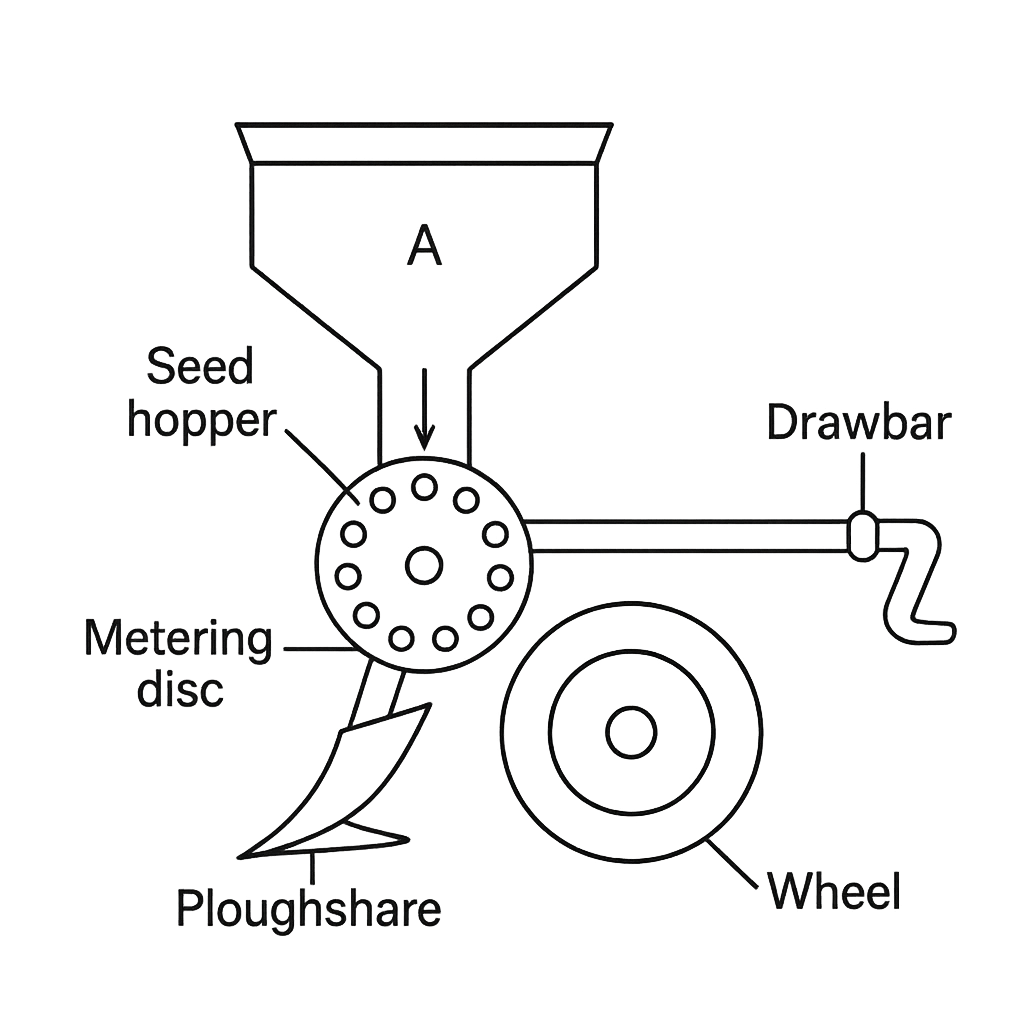
The diagram shows a hand‑operated seed drill used for planting maize.
Question Parts
(a)
Identify the function of each labelled part (A, B, C, D and E) shown in the diagram.
(b)
The metering disc (B) has 12 equally spaced holes. The wheel (E) has a radius of 0.30 m and makes one full revolution. Assuming the wheel rolls without slipping, calculate (i) the number of seeds deposited per metre of forward travel, and (ii) the average spacing between successive seeds (in centimetres, to one decimal place).
(c)
State two agronomic advantages of using a seed drill instead of broadcasting seeds.
Detailed Essay Solution & Marking Scheme Available

Get the step-by-step mathematical proofs, key points required by examiners, and a comprehensive breakdown from our AI Tutor.

Question 4 View Details
A farmer intends to use a 40 kW tractor to operate a rotary tiller via the power take‑off (PTO).
Question Parts
(a)
The PTO rotates at 540 rpm. The rotary tiller requires a torque of 250 Nm at its shaft. Determine whether the tractor’s PTO can supply the required torque. Show all calculations.
(b)
If the tractor’s PTO could only deliver a maximum of 12 kW, calculate the minimum torque that the rotary tiller could receive at 540 rpm. Also, list two safety precautions that must be observed when operating a PTO‑driven implement.
Detailed Essay Solution & Marking Scheme Available

Get the step-by-step mathematical proofs, key points required by examiners, and a comprehensive breakdown from our AI Tutor.

Question 5 View Details
A farmer intends to establish a mixed cropping system of maize and cowpea on a 5‑hectare farm.
Question Parts
(a)
Determine the area to allocate to each crop if the farmer wants a maize to cowpea area ratio of 3:2.
(b)
Using the recommended fertilizer rates of 120 kg N ha⁻¹ for maize and 30 kg N ha⁻¹ for cowpea, calculate the total amount of nitrogen fertilizer required for the whole farm. The fertilizer contains 46 % nitrogen by weight. State the number of 50‑kg fertilizer bags the farmer must purchase.
(c)
The expected yields are 5 t ha⁻¹ for maize and 1.2 t ha⁻¹ for cowpea. Market prices are ₦40 000 per tonne of maize and ₦70 000 per tonne of cowpea. Fertilizer costs ₦12 000 per bag. Compute the gross income, total fertilizer cost, and net profit. Then, discuss two agronomic advantages of intercropping maize with cowpea.
Detailed Essay Solution & Marking Scheme Available

Get the step-by-step mathematical proofs, key points required by examiners, and a comprehensive breakdown from our AI Tutor.

Question 6 View Details
A smallholder keeps a dairy herd of 20 Friesian cows. Each cow produces an average of 22 L of milk per day. The farmer plans to feed the cows a total mixed ration (TMR) containing 16 % crude protein (CP). The required CP intake per cow is 1.2 kg per day.
Question Parts
(a)
Calculate the total daily CP requirement for the herd. If the TMR provides 0.8 kg CP per kg of feed, determine the amount of feed (in kg) that must be offered each day.
Detailed Essay Solution & Marking Scheme Available

Get the step-by-step mathematical proofs, key points required by examiners, and a comprehensive breakdown from our AI Tutor.

Question 7 View Details
A farmer has a 2.5 ha maize field. During the early vegetative stage he observes leaf rolling and white exudates on the undersides of leaves. Laboratory analysis identifies the pest as the African maize stalk borer (Busseola fusca). The farmer wishes to adopt an integrated pest management (IPM) approach.
Question Parts
(a)
Describe the life cycle of Busseola fusca and indicate which stage causes the greatest damage to maize.
(b)
The farmer intends to use a biopesticide containing Bacillus thuringiensis (Bt) that is recommended at 1.5 L per hectare. The product is supplied in 250 mL bottles and each bottle costs ₦450. Calculate the number of bottles required for the whole field and the total cost.
(c)
Explain two cultural control methods and two biological control agents that can be incorporated into the IPM programme for Busseola fusca.
(d)
The economic injury level (EIL) for Busseola fusca is estimated at 5 % of plants infested, each infested plant causing a yield loss of 0.8 kg. The market price of maize is ₦30 per kg. Determine the EIL in terms of the number of infested plants per hectare, assuming a planting density of 60,000 plants per hectare. Based on your calculation, advise whether the farmer should apply the biopesticide.
Detailed Essay Solution & Marking Scheme Available

Get the step-by-step mathematical proofs, key points required by examiners, and a comprehensive breakdown from our AI Tutor.

Question 8 View Details
A farmer's cassava farm covering 3 ha shows leaf chlorosis, necrotic stem lesions and severe root rot. Laboratory tests confirm the causal agent as Fusarium wilt (Fusarium oxysporum f. sp. manihotis). The farmer seeks effective management strategies.
Question Parts
(a)
Outline the disease cycle of Fusarium wilt in cassava, highlighting the primary inoculum and the main mode of spread.
Detailed Essay Solution & Marking Scheme Available

Get the step-by-step mathematical proofs, key points required by examiners, and a comprehensive breakdown from our AI Tutor.

Master the Exam!

You've seen a preview, but there are thousands more questions plus AI tutor to break down complex solutions.

Unlock Full Access Available for Android & Windows
Help others prepare! Share this practice hub:
Chat with Support