igcse model questions vol1 2025 physics | Objective

Prepare for your exams with igcse model questions vol1 questions? Reviewing past/model questions is one of the most effective ways to guarantee a high score. This practice hub features authentic 2025 physics (Objective) questions designed to simulate the real exam environment.

Practice these randomly selected questions to test your readiness.

Question 1 View Details
Two identical loudspeakers each produce a sound intensity level of \(80\ \text{dB}\) at a point that is \(2\ \text{m}\) from each speaker. The speakers are \(6\ \text{m}\) apart. Determine the sound intensity level at the point that is midway between the speakers (i.e. \(3\ \text{m}\) from each), assuming the intensities from the two speakers add incoherently.
Correct A. 79.5 dB
B. 80.5 dB
C. 77.2 dB
D. 78.0 dB

Correct Answer: A

Want to see the full step-by-step solution? Unlock AI Explanation & Analytics
Question 2 View Details
A block of mass \(5\ \text{kg}\) is lifted at constant speed by a compound pulley system consisting of one fixed pulley and one movable pulley. The system has an overall efficiency of \(80\%\) because of friction in the pulleys. Calculate the minimum pulling force that must be applied to the rope.
A. 33.5 N
Correct B. 30.6 N
C. 28.0 N
D. 35.0 N

Correct Answer: B

Want to see the full step-by-step solution? Unlock AI Explanation & Analytics
Question 3 View Details
A battery of emf \(E\) volts and internal resistance \(r\ \Omega\) is first connected to a single external resistor \(R_{1}=4\ \Omega\). The terminal voltage measured across the battery is \(12\ \text{V}\). When a second resistor \(R_{2}=6\ \Omega\) is connected in parallel with \(R_{1}\), the terminal voltage falls to \(10\ \text{V}\). Determine the values of \(E\) and \(r\). Then calculate the power dissipated in \(R_{2}\) under the second condition.
A. 20.3 W
B. 8.9 W
Correct C. 16.7 W
D. 12.5 W

Correct Answer: C

Want to see the full step-by-step solution? Unlock AI Explanation & Analytics
Question 4 View Details
A vernier caliper has a least count of \(0.05\ \text{mm}\). Using the caliper, a student measures the length of a metal rod and records a reading of \(250.0\ \text{mm}\). From the diagram of the caliper (see visual), determine the percentage uncertainty in the measured length.
A. 0.01 %
B. 0.2 %
Correct C. 0.02 %
D. 0.5 %

Correct Answer: C

Want to see the full step-by-step solution? Unlock AI Explanation & Analytics
Question 5 View Details
A block of mass \(8\ \text{kg}\) rests on a rough inclined plane that makes an angle of \(30^{\circ}\) with the horizontal. The coefficient of static friction between the block and the plane is unknown. The block is held stationary by a rope that runs parallel to the plane and exerts a tension of \(30\ \text{N}\) upwards along the plane. Using the force diagram (see visual), find the minimum coefficient of static friction required to keep the block at rest.
A. 0.20
B. 0.16
C. 0.12
Correct D. 0.14

Correct Answer: D

Want to see the full step-by-step solution? Unlock AI Explanation & Analytics
Question 6 View Details
A 5.0 kg block rests on a rough plane inclined at \(30^{\circ}\) to the horizontal. The coefficient of kinetic friction between the block and the plane is 0.20. A horizontal force of magnitude \(P\) N is applied to the block, causing it to accelerate up the incline at \(1.5\ \text{m s}^{-2}\). Determine the value of \(P\) (to the nearest newton).
A. 70
B. 61
C. 45
Correct D. 53

Correct Answer: D

Want to see the full step-by-step solution? Unlock AI Explanation & Analytics
Question 7 View Details
A converging lens of focal length \(12\ \text{cm}\) forms a sharp real image of a candle on a screen placed \(48\ \text{cm}\) from the lens. The candle is then moved \(6\ \text{cm}\) farther from the lens, and the screen is repositioned so that a sharp image is again obtained. Find the new distance between the lens and the screen (in cm, to one decimal place).
Correct A. 13.2
B. 14.8
C. 10.5
D. 12.6

Correct Answer: A

Want to see the full step-by-step solution? Unlock AI Explanation & Analytics
Question 8 View Details
A diffraction grating produces a first‑order maximum for light of wavelength \(480\ \text{nm}\) at an angle of \(20^{\circ}\) to the central maximum. The same grating produces a second‑order maximum for a different colour at an angle of \(30^{\circ}\). Determine the wavelength of this second colour (in nanometres, to the nearest nanometre).
Correct A. 351
B. 658
C. 328
D. 702

Correct Answer: A

Want to see the full step-by-step solution? Unlock AI Explanation & Analytics
Question 9 View Details
An electron in a hydrogen atom is initially in the \(n=5\) energy level. It first drops to \(n=2\) and then to the ground state \(n=1\), emitting a photon at each transition. Using the Rydberg constant \(R = 1.097\times10^{7}\ \text{m}^{-1}\), calculate (a) the total energy released in the two transitions per mole of hydrogen atoms (in kJ\,mol\(^{-1}\), to three significant figures) and (b) the wavelength of the photon emitted in the second transition (in nm, to three significant figures).
A. 1.10e3 kJ mol^{-1}, 150 nm
B. 1.40e3 kJ mol^{-1}, 110 nm
C. 1.26e3 kJ mol^{-1}, 130 nm
Correct D. 1.26e3 kJ mol^{-1}, 122 nm

Correct Answer: D

Want to see the full step-by-step solution? Unlock AI Explanation & Analytics
Question 10 View Details
A \(200\ \text{g}\) piece of aluminium (specific heat capacity \(c_{\text{Al}} = 0.900\ \text{J g}^{-1}\text{K}^{-1}\)) at \(150^{\circ}\text{C}\) is placed into \(300\ \text{g}\) of water (specific heat capacity \(c_{\text{w}} = 4.18\ \text{J g}^{-1}\text{K}^{-1}\)) at \(25^{\circ}\text{C}\) in an insulated container. After reaching thermal equilibrium, the mixture cools to \(30^{\circ}\text{C}\) losing heat to the surroundings. Assuming no phase change, calculate the total heat lost to the surroundings during the cooling (in joules, to three significant figures).
Correct A. 1.53e4 J
B. 1.42e4 J
C. 1.68e4 J
D. 1.53e3 J

Correct Answer: A

Want to see the full step-by-step solution? Unlock AI Explanation & Analytics
Question 11 View Details
A car travels \(30\ \text{km}\) north and then \(40\ \text{km}\) east. Find the magnitude of the resultant displacement and state its direction as an angle east of north.
A. 55 km, 40.0° east of north
Correct B. 50 km, 53.1° east of north
C. 70 km, 45.0° east of north
D. 30 km, 60.0° east of north

Correct Answer: B

Want to see the full step-by-step solution? Unlock AI Explanation & Analytics
Question 12 View Details
A sample contains \(2.0\times10^{6}\) atoms of isotope A which decays to isotope B with a half‑life of 30 min. Isotope B further decays to a stable isotope C with a half‑life of 10 min. After exactly 1 hour, what fraction of the original atoms are present as isotope B? Give your answer as a decimal to three significant figures.
A. 0.083
B. 0.200
Correct C. 0.117
D. 0.150

Correct Answer: C

Want to see the full step-by-step solution? Unlock AI Explanation & Analytics
Question 13 View Details
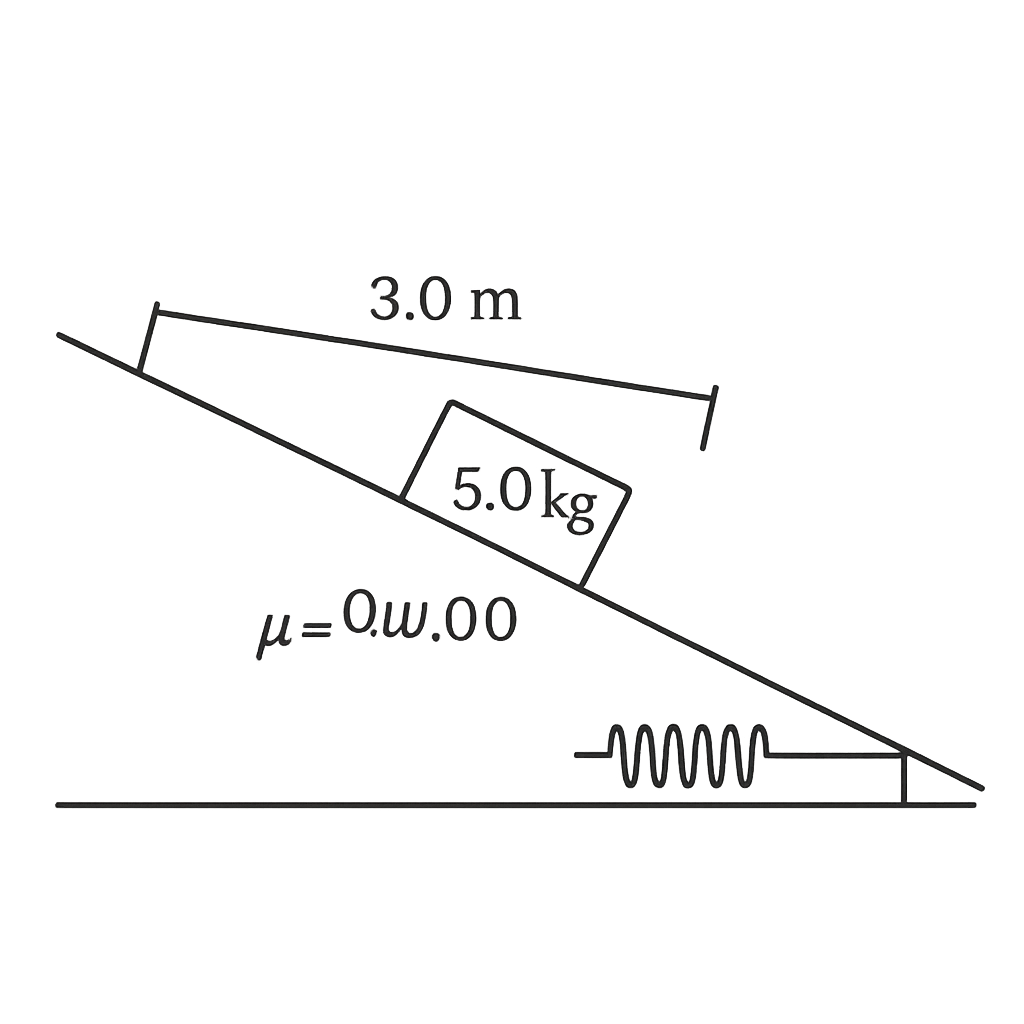
A 5.0 kg block is released from rest at the top of a rough inclined plane that is 3.0 m long and makes an angle of 30° with the horizontal. The coefficient of kinetic friction between the block and the plane is \(\mu_k = 0.20\). At the bottom of the incline the block compresses a horizontal spring of spring constant \(k = 800\ \text{N m}^{-1}\). Using the diagram, determine the maximum compression of the spring. (Give your answer in metres to two decimal places.)
A. 0.28
B. 0.42
Correct C. 0.35
D. 0.50

Correct Answer: C

Want to see the full step-by-step solution? Unlock AI Explanation & Analytics
Question 14 View Details
An electron in a hydrogen atom makes a transition from the \(n=5\) level to the \(n=2\) level, emitting a photon. The same photon is then used to try to ionise a neutral helium atom from its ground state (\(n=1\)). Determine whether the photon has enough energy to ionise helium; if it does not, calculate the additional energy required. Use the Rydberg constant \(R_H = 1.097\times10^{7}\ \text{m}^{-1}\) and the ionisation energy of helium \(E_{ion}(He)=24.6\ \text{eV}\).
Correct A. Photon insufficient; additional 21.7 eV required
B. Photon insufficient; additional 18.3 eV required
C. Photon sufficient; no additional energy required
D. Photon insufficient; additional 24.1 eV required

Correct Answer: A

Want to see the full step-by-step solution? Unlock AI Explanation & Analytics
Question 15 View Details
A motor drives gear A (diameter 200 mm) at 1500 rpm. Gear A meshes with gear B (diameter 400 mm) which is fixed on the same shaft as gear C (diameter 150 mm). Gear C meshes with gear D (diameter 300 mm) that is attached to a pulley of radius 0.25 m driving a conveyor belt. The overall mechanical efficiency of the gear train is 85 %. (a) Find the angular speed of the pulley in rad s⁻¹. (b) Determine the power delivered to the conveyor belt if the motor supplies 2.0 kW of mechanical power.
A. ω = 78.5 rad s⁻¹; Power = 1.70 kW
B. ω = 39.3 rad s⁻¹; Power = 2.00 kW
Correct C. ω = 39.3 rad s⁻¹; Power = 1.70 kW
D. ω = 26.2 rad s⁻¹; Power = 1.45 kW

Correct Answer: C

Want to see the full step-by-step solution? Unlock AI Explanation & Analytics
Question 16 View Details
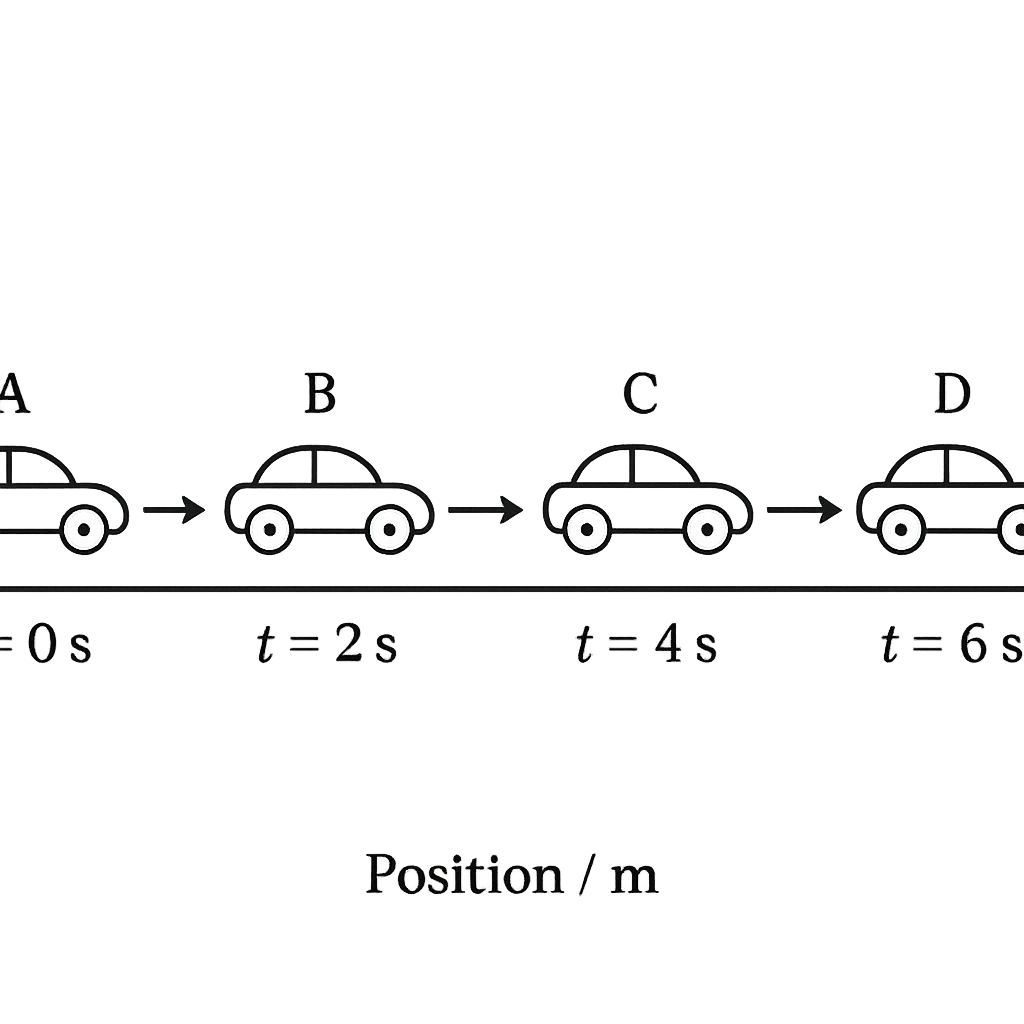
The diagram shows a car moving in a straight line. At t = 0 s the car is at the origin, at t = 2 s it is 4 m from the origin, at t = 4 s it is 12 m from the origin, and at t = 6 s it is 24 m from the origin. Assuming the car moves with constant acceleration, determine (a) the magnitude of the acceleration in \(\mathrm{m\,s^{-2}}\), and (b) the speed of the car at t = 5 s.
A. a = 0.5 m s⁻², v(5 s) = 3 m s⁻¹
B. a = 1 m s⁻², v(5 s) = 5 m s⁻¹
Correct C. a = 1 m s⁻², v(5 s) = 6 m s⁻¹
D. a = 2 m s⁻², v(5 s) = 10 m s⁻¹

Correct Answer: C

Want to see the full step-by-step solution? Unlock AI Explanation & Analytics
Question 17 View Details
A rectangular block measures 12.0 cm by 8.0 cm by 5.0 cm and has a mass of 1.20 kg. Calculate its density in \(\mathrm{kg\,m^{-3}}\).
Correct A. 2.5 × 10³ kg m⁻³
B. 3.0 × 10³ kg m⁻³
C. 2.5 × 10² kg m⁻³
D. 2.0 × 10³ kg m⁻³

Correct Answer: A

Want to see the full step-by-step solution? Unlock AI Explanation & Analytics
Question 18 View Details
A long solenoid 0.50 m in length has 800 turns and carries a current that increases uniformly from 0 to 4.0 A in 0.20 s. A circular conducting loop of radius 5.0 cm is placed coaxially at the centre of the solenoid. (a) Find the magnitude of the induced emf in the loop during the current change. (b) If the loop has a resistance of 2.0 Ω, calculate the average induced current. (c) When the current has reached its maximum value, a proton moves perpendicular to the magnetic field inside the solenoid with a speed of \(2.0 \times 10^{6}\) m s\(^{-1}\). Determine the magnetic force on the proton.
A. ε ≈ 1.6×10⁻⁴ V, I_ind ≈ 8.0×10⁻⁵ A, F ≈ 1.3×10⁻¹⁵ N
B. ε ≈ 3.2×10⁻³ V, I_ind ≈ 1.6×10⁻³ A, F ≈ 2.6×10⁻¹⁴ N
C. ε ≈ 4.0×10⁻⁴ V, I_ind ≈ 2.0×10⁻⁴ A, F ≈ 3.2×10⁻¹⁵ N
Correct D. ε ≈ 3.2×10⁻⁴ V, I_ind ≈ 1.6×10⁻⁴ A, F ≈ 2.6×10⁻¹⁵ N

Correct Answer: D

Want to see the full step-by-step solution? Unlock AI Explanation & Analytics
Question 19 View Details
A cyclist travels 150 m in 12 s at a constant speed, then accelerates uniformly and covers the next 200 m in 10 s. (a) What was the cyclist's speed during the first 150 m? (b) What is the magnitude of the acceleration during the second segment? (c) What is the average speed over the whole 350 m journey?
A. v₁ = 13.0 m s⁻¹, a = 1.5 m s⁻², average speed ≈ 15.0 m s⁻¹
Correct B. v₁ = 12.5 m s⁻¹, a = 1.5 m s⁻², average speed ≈ 15.9 m s⁻¹
C. v₁ = 10.0 m s⁻¹, a = 2.0 m s⁻², average speed ≈ 14.3 m s⁻¹
D. v₁ = 12.5 m s⁻¹, a = 2.5 m s⁻², average speed ≈ 16.5 m s⁻¹

Correct Answer: B

Want to see the full step-by-step solution? Unlock AI Explanation & Analytics
Question 20 View Details
A ball is thrown from ground level and lands at the same level. It travels a horizontal range of 40.0 m and reaches a maximum height of 5.0 m. Neglect air resistance. Determine (a) the initial speed of the ball, and (b) the launch angle above the horizontal. Give the angle in degrees to one decimal place.
A. initial speed ≈ 27.5 m s⁻¹, launch angle ≈ 18.4°
B. initial speed ≈ 19.8 m s⁻¹, launch angle ≈ 31.2°
C. initial speed ≈ 24.3 m s⁻¹, launch angle ≈ 22.0°
Correct D. initial speed ≈ 22.1 m s⁻¹, launch angle ≈ 26.6°

Correct Answer: D

Want to see the full step-by-step solution? Unlock AI Explanation & Analytics
Question 21 View Details
A battery of emf \(20.0\ \text{V}\) and internal resistance \(r\) supplies a circuit consisting of a \(6.0\ \Omega\) resistor in series with a parallel combination of a \(3.0\ \Omega\) resistor and an unknown resistor \(R_{x}\). The total current drawn from the battery is \(2.00\ \text{A}\), and the power dissipated in the \(3.0\ \Omega\) resistor is \(9.00\ \text{W}\). Determine the internal resistance \(r\) of the battery (give your answer to two decimal places).
A. 1.00 Ω
Correct B. 1.40 Ω
C. 0.70 Ω
D. 2.20 Ω

Correct Answer: B

Want to see the full step-by-step solution? Unlock AI Explanation & Analytics
Question 22 View Details
Two point charges are placed on the x‑axis. A charge \(q_{1}=+8.0\ \text{nC}\) is at the origin, and a charge \(q_{2}=-2.0\ \text{nC}\) is at \(x=0.20\ \text{m}\). Find the position on the x‑axis where the net electric field has magnitude \(5.0\times10^{4}\ \text{N C}^{-1}\) and is directed to the right. Then calculate the electric potential at that point due to both charges (give the potential in volts, to three significant figures).
A. x = 0.0450 m, V = 2.10×10³ V
B. x = 0.0250 m, V = 1.20×10³ V
Correct C. x = 0.0382 m, V = 1.77×10³ V
D. x = 0.0382 m, V = 2.00×10³ V

Correct Answer: C

Want to see the full step-by-step solution? Unlock AI Explanation & Analytics
Question 23 View Details
A boat sails \(30.0\ \text{km}\) due north and then \(40.0\ \text{km}\) due east. Determine the magnitude of the resultant displacement and the angle it makes east of north (give the angle to one decimal place).
A. 50.0 km, 45.0° east of north
B. 70.0 km, 45.0° east of north
Correct C. 50.0 km, 53.1° east of north
D. 60.0 km, 53.1° east of north

Correct Answer: C

Want to see the full step-by-step solution? Unlock AI Explanation & Analytics
Question 24 View Details
A \(300\ \text{g}\) iron block (specific heat capacity \(c_{\text{Fe}} = 0.45\ \text{J g}^{-1}\text{K}^{-1}\)) initially at \(200^{\circ}\text{C}\) is placed into an insulated container containing \(200\ \text{g}\) of water (specific heat capacity \(c_{\text{water}} = 4.18\ \text{J g}^{-1}\text{K}^{-1}\)) initially at \(20^{\circ}\text{C}\). After the system reaches thermal equilibrium the temperature is \(40^{\circ}\text{C}\). (i) Calculate the heat lost by the iron block. (ii) What percentage of this heat is transferred to the water? (Give your answer to one decimal place.)
A. Heat lost by iron = 2.16×10⁴ J; 65.0% transferred to water
B. Heat lost by iron = 1.80×10⁴ J; 70.2% transferred to water
Correct C. Heat lost by iron = 2.16×10⁴ J; 77.4% transferred to water
D. Heat lost by iron = 2.50×10⁴ J; 80.1% transferred to water

Correct Answer: C

Want to see the full step-by-step solution? Unlock AI Explanation & Analytics
Question 25 View Details
A car travels \(120\ \text{km}\) in \(2.5\ \text{h}\). Express its average speed in metres per second, correct to three significant figures.
Correct A. 13.3 m/s
B. 14.0 m\/s
C. 13.0 m\/s
D. 12.0 m\/s

Correct Answer: A

Want to see the full step-by-step solution? Unlock AI Explanation & Analytics

Master the Exam!

You've seen a preview, but there are thousands more questions plus AI tutor to break down complex solutions.

Unlock Full Access Available for Android & Windows
Help others prepare! Share this practice hub:
Chat with Support