igcse model questions vol1 2025 biology | Objective

Prepare for your exams with igcse model questions vol1 questions? Reviewing past/model questions is one of the most effective ways to guarantee a high score. This practice hub features authentic 2025 biology (Objective) questions designed to simulate the real exam environment.

Practice these randomly selected questions to test your readiness.

Question 1 View Details
A plant leaf loses water by transpiration at a rate of \(5\) mL per hour. The total cross‑sectional area of all xylem vessels in the leaf is \(0.2\) mm\(^2\), but only \(80\%\) of this area is functional for water transport. Assuming water moves as a continuous stream, calculate the average velocity of water in the functional xylem (in mm s\(^{-1}\)), giving your answer to two decimal places.
A. 6.54 mm s⁻¹
Correct B. 8.68 mm s⁻¹
C. 4.12 mm s⁻¹
D. 10.23 mm s⁻¹

Correct Answer: B

Want to see the full step-by-step solution? Unlock AI Explanation & Analytics
Question 2 View Details
In a bacterial culture the population increased from \(2 \times 10^{5}\) cells to \(1.6 \times 10^{6}\) cells in 4 hours, assuming exponential growth.\n(a) Determine the generation time (in hours) of the bacteria under these conditions.\n(b) If the temperature is raised so that the generation time decreases by 20 %, calculate the expected population after a further 6 hours. Give your answer in scientific notation to two significant figures.
Correct A. 7.9×10⁷ cells
B. 1.1×10⁸ cells
C. 5.2×10⁷ cells
D. 3.8×10⁷ cells

Correct Answer: A

Want to see the full step-by-step solution? Unlock AI Explanation & Analytics
Question 3 View Details
Each mitochondrion in a cell produces \(30\) ATP molecules per minute. A particular cell currently contains two mitochondria and requires \(120\) ATP molecules per minute to meet its energy demand. How many additional mitochondria must the cell synthesize to satisfy this demand? Give your answer as a whole number.
Correct A. 2
B. 4
C. 3
D. 1

Correct Answer: A

Want to see the full step-by-step solution? Unlock AI Explanation & Analytics
Question 4 View Details
A muscle cell oxidises glucose aerobically at a rate of \(0.5\) g of glucose per minute. The overall reaction is\n\(\mathrm{C_{6}H_{12}O_{6} + 6\,O_{2} \rightarrow 6\,CO_{2} + 6\,H_{2}O}\).\nCalculate the volume of oxygen consumed at STP per minute. (Molar mass of glucose = \(180\) g mol\(^{-1}\); molar volume of a gas at STP = \(22.4\) L mol\(^{-1}\)). Give your answer in litres to three significant figures.
Correct A. 0.373 L min⁻¹
B. 0.500 L min⁻¹
C. 0.250 L min⁻¹
D. 0.600 L min⁻¹

Correct Answer: A

Want to see the full step-by-step solution? Unlock AI Explanation & Analytics
Question 5 View Details
A bacterial culture contains \(1.0 \times 10^{8}\) cells, of which \(0.01\%\) initially carry a plasmid conferring antibiotic resistance. During conjugation each resistant cell can transfer the plasmid to five susceptible cells per hour, and newly resistant cells become donors in the following hour. Assuming no cell division, how many resistant cells are present after 3 hours? Give your answer in scientific notation.
Correct A. 2.16×10⁶ cells
B. 3.24×10⁶ cells
C. 2.16×10⁵ cells
D. 1.08×10⁶ cells

Correct Answer: A

Want to see the full step-by-step solution? Unlock AI Explanation & Analytics
Question 6 View Details
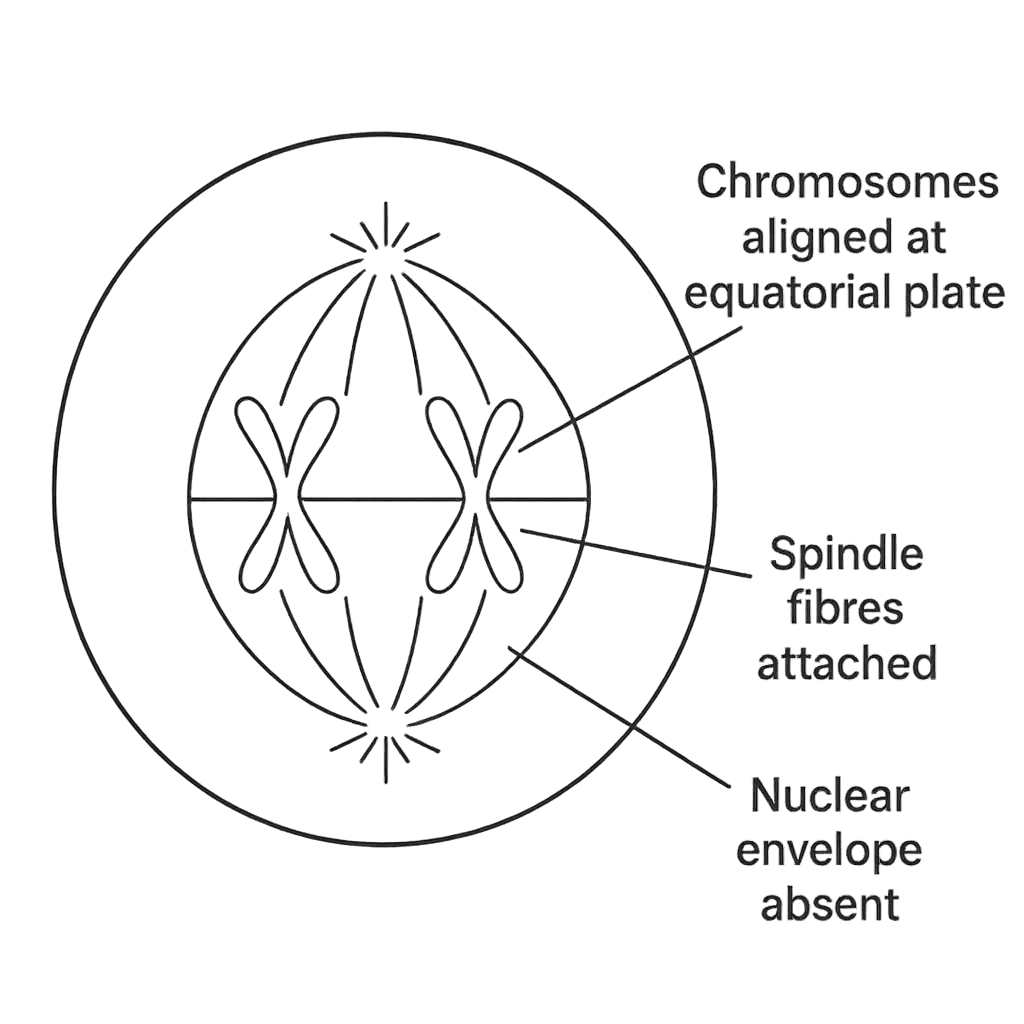
The diagram shows a single animal cell undergoing mitosis. Identify the stage of mitosis depicted.
A. Telophase
B. Anaphase
C. Prophase
Correct D. Metaphase

Correct Answer: D

Want to see the full step-by-step solution? Unlock AI Explanation & Analytics
Question 7 View Details
A rabbit has a gestation period of 31 days and requires a 10‑day postpartum recovery before it can conceive again. The average litter size is 6. A horse has a gestation period of 340 days, needs a 30‑day recovery period, and usually produces a single foal. Assuming both animals can breed continuously over a 5‑year period and that no offspring die, which species will produce the greater total number of offspring in those 5 years?
A. Both produce equal numbers
B. Neither species produces offspring
Correct C. Rabbit
D. Horse

Correct Answer: C

Want to see the full step-by-step solution? Unlock AI Explanation & Analytics
Question 8 View Details
A resting adult produces metabolic heat at a rate of \(100\ \text{W}\). In a cold environment the heat loss by convection from the skin can be approximated by \(Q = hA\,(T_{\text{body}}-T_{\text{env}})\) where \(hA = 5\ \text{W/°C}\). The body temperature is \(37\ \text{°C}\) and the ambient temperature is \(-5\ \text{°C}\). How many watts of additional heat must be generated by shivering to keep the body temperature constant?
Correct A. 110 W
B. 100 W
C. 150 W
D. 210 W

Correct Answer: A

Want to see the full step-by-step solution? Unlock AI Explanation & Analytics
Question 9 View Details
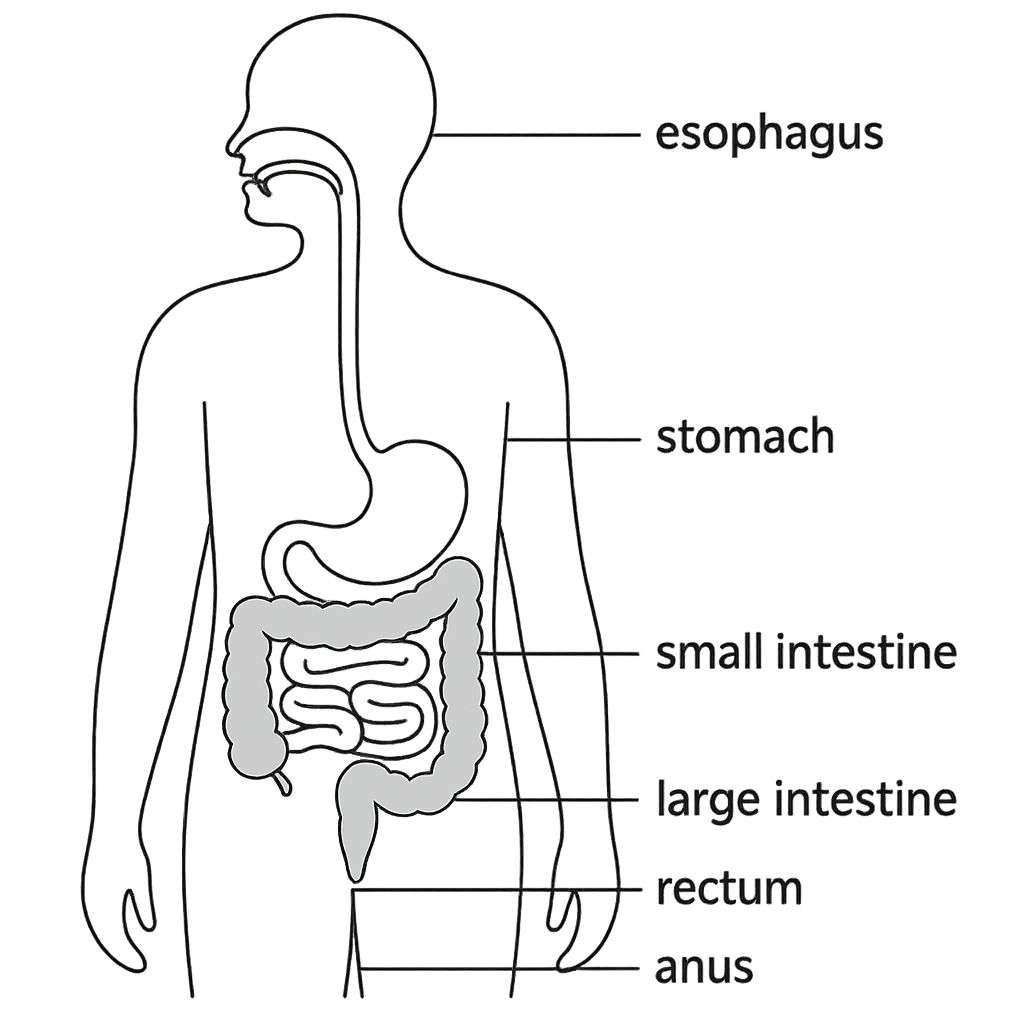
The labelled diagram shows the human digestive system, indicating the small intestine and the large intestine. A meal contains 600 g of carbohydrate, 300 g of protein and 200 g of fat (total 1100 g). Seventy percent of each macronutrient reaches the small intestine, the remaining 30 % passes to the large intestine. In the small intestine, 90 % of the carbohydrate, 80 % of the protein and 85 % of the fat are absorbed; in the large intestine, 5 % of the carbohydrate, 10 % of the protein and 5 % of the fat are absorbed. How many grams of each macronutrient are ultimately absorbed from the meal?
A. Carbohydrate: 408 g, Protein: 198 g, Fat: 129 g
B. Carbohydrate: 378 g, Protein: 168 g, Fat: 119 g
C. Carbohydrate: 345 g, Protein: 198 g, Fat: 115 g
Correct D. Carbohydrate: 387 g, Protein: 177 g, Fat: 122 g

Correct Answer: D

Want to see the full step-by-step solution? Unlock AI Explanation & Analytics
Question 10 View Details
Renal plasma flow (RPF) to each kidney is \(600\ \text{mL/min}\). The filtration fraction (FF) is 20 %. Only 1 % of the filtrate leaves the kidneys as urine because 99 % is re‑absorbed. Calculate the volume of urine produced per minute by one kidney.
A. 12 mL/min
Correct B. 1.2 mL/min
C. 2.4 mL/min
D. 0.6 mL/min

Correct Answer: B

Want to see the full step-by-step solution? Unlock AI Explanation & Analytics
Question 11 View Details
In a large population of a plant species the recessive phenotype (aa) occurs in \(9\%\) of individuals. Assuming Hardy-Weinberg equilibrium, calculate (a) the expected frequency of heterozygotes (Aa). (b) If individuals with genotype aa have a 40\% lower chance of surviving to reproduce, what is the expected heterozygote frequency in the next generation? Give your answer as a percentage to one decimal place.
A. a) 45.0 %; b) 41.5 %
B. a) 38.0 %; b) 35.0 %
Correct C. a) 42.0 %; b) 39.8 %
D. a) 40.5 %; b) 37.2 %

Correct Answer: C

Want to see the full step-by-step solution? Unlock AI Explanation & Analytics
Question 12 View Details
A person has a glomerular filtration rate (GFR) of \(120\ \text{mL min}^{-1}\). The plasma glucose concentration is \(7\ \text{mmol L}^{-1}\). The renal tubules normally reabsorb 99\% of the filtered glucose. (a) If the urine flow rate is \(1.5\ \text{mL min}^{-1}\), calculate the concentration of glucose in the urine (mmol L\(^{-1}\)). (b) A drug reduces the reabsorption efficiency to 95\%. Assuming the urine flow rate remains unchanged, what is the new urine glucose concentration? Give answers to one decimal place.
A. a) 5.0 mmol L⁻¹; b) 25.0 mmol L⁻¹
B. a) 6.3 mmol L⁻¹; b) 30.0 mmol L⁻¹
C. a) 4.2 mmol L⁻¹; b) 22.0 mmol L⁻¹
Correct D. a) 5.6 mmol L⁻¹; b) 28.0 mmol L⁻¹

Correct Answer: D

Want to see the full step-by-step solution? Unlock AI Explanation & Analytics
Question 13 View Details
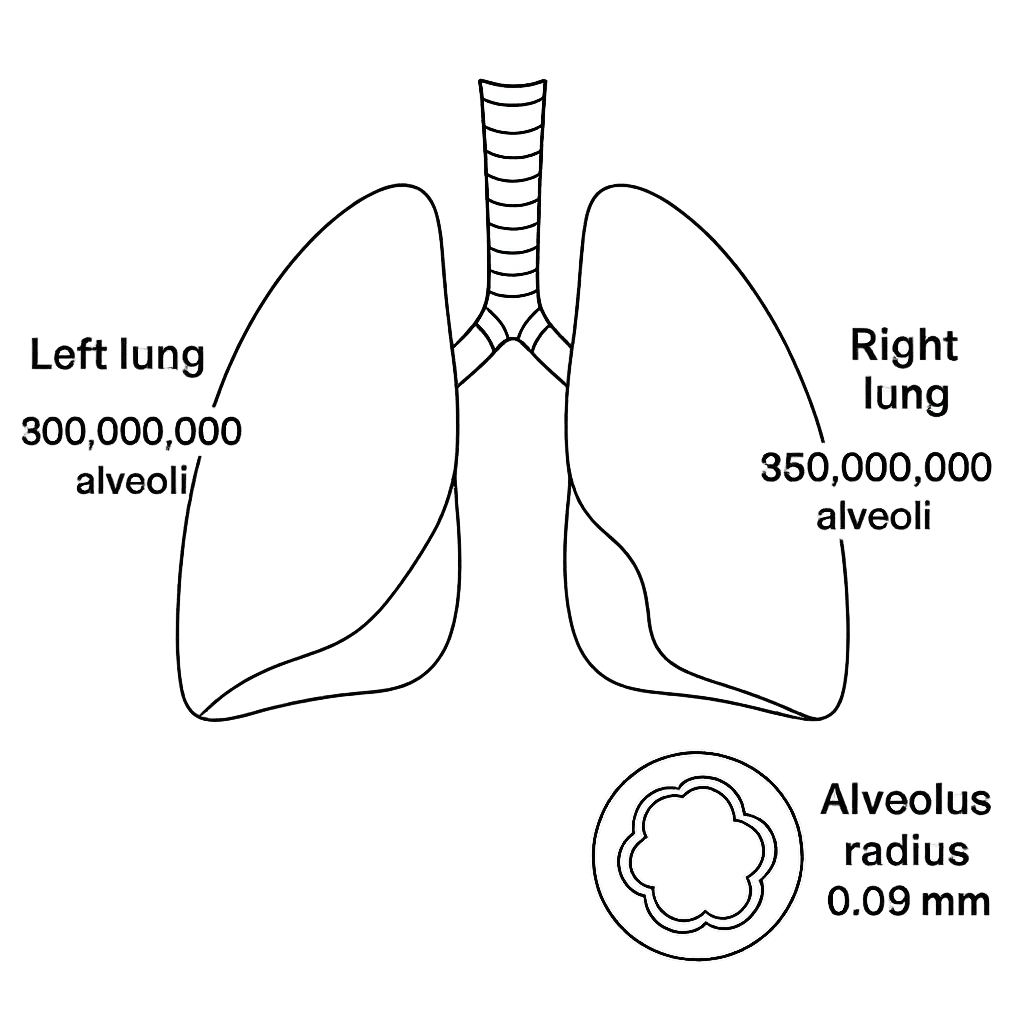
The diagram shows a labelled cross‑section of the human lungs. It indicates that the left lung contains 300 million alveoli and the right lung 350 million alveoli. Each alveolus is approximated as a sphere with an inner radius of \(0.09\ \text{mm}\). (a) Calculate the total inner surface area of all alveoli (in square metres) that is available for gas exchange. (b) If the effective surface area is reduced by 12 % due to a disease, what is the remaining surface area? Give your answers to two significant figures.
A. a) 58 m²; b) 51 m²
B. a) 62 m²; b) 55 m²
Correct C. a) 66 m²; b) 58 m²
D. a) 70 m²; b) 62 m²

Correct Answer: C

Want to see the full step-by-step solution? Unlock AI Explanation & Analytics
Question 14 View Details
A human somatic cell (diploid, 2n = 46) undergoes meiosis. How many chromosomes are present in each daughter cell at the end of meiosis I?
A. 24 chromosomes
B. 46 chromosomes
C. 22 chromosomes
Correct D. 23 chromosomes

Correct Answer: D

Want to see the full step-by-step solution? Unlock AI Explanation & Analytics
Question 15 View Details
A diet provides \(2500\ \text{kcal}\) per day. Carbohydrates supply 55 % of the energy, proteins 15 % and fats the remainder. Only 90 % of the carbohydrate energy, 95 % of the protein energy and 98 % of the fat energy are absorbed. (a) Calculate the net energy actually available to the body from this diet (in kcal, to one decimal place). (b) If the person replaces 250 kcal of carbohydrate energy with an equal amount of fat energy (so total intake remains 2500 kcal), recalculate the net available energy. Give both answers to one decimal place.
A. a) 2318.8 kcal; b) 2338.8 kcal
Correct B. a) 2328.8 kcal; b) 2348.8 kcal
C. a) 2328.8 kcal; b) 2358.8 kcal
D. a) 2338.8 kcal; b) 2348.8 kcal

Correct Answer: B

Want to see the full step-by-step solution? Unlock AI Explanation & Analytics
Question 16 View Details
The class Reptilia is divided into (4) orders. The average number of families per order is (6), but one order (Order X) has twice as many families as the average. The remaining orders each have the same number of families. If the total number of genera in Reptilia is (168) and each family contains the same number of genera, how many genera are in Order X?
A. 168
B. 42
C. 126
Correct D. 84

Correct Answer: D

Want to see the full step-by-step solution? Unlock AI Explanation & Analytics
Question 17 View Details
A woman records the day of her luteinising hormone (LH) surge for three consecutive menstrual cycles: Cycle A - 13 January, Cycle B - 10 February, Cycle C - 7 March. The first day of bleeding in the corresponding cycles was 1 January, 28 January and 25 February respectively. Assuming the luteal phase is a constant (14) days, calculate the average length of the follicular phase (in days) across the three cycles, giving your answer to one decimal place.
A. 13.0
B. 10.5
Correct C. 11.7
D. 12.3

Correct Answer: C

Want to see the full step-by-step solution? Unlock AI Explanation & Analytics
Question 18 View Details
A small mammal has a surface area of \(0.02\;\text{m}^2\) and a thermal conductance of \(0.5\;\text{W·m}^{-2}\!·^\circ\text{C}^{-1}\). Its body temperature is \(37^\circ\text{C}\) while the ambient temperature is \(5^\circ\text{C}\). If its basal metabolic rate supplies \(0.20\;\text{W}\) of heat, calculate the additional metabolic heat (in watts, to two decimal places) that must be produced to maintain body temperature.
A. 0.20
B. 0.15
Correct C. 0.12
D. 0.08

Correct Answer: C

Want to see the full step-by-step solution? Unlock AI Explanation & Analytics
Question 19 View Details
In a simple reflex arc the sensory neuron is \(0.8\;\text{m}\) long, the interneuron \(0.4\;\text{m}\) and the motor neuron \(0.6\;\text{m}\). Their conduction velocities are \(80\;\text{m·s}^{-1}\), \(40\;\text{m·s}^{-1}\) and \(60\;\text{m·s}^{-1}\) respectively. Each synapse introduces a delay of \(0.5\;\text{ms}\). Determine the total time (in milliseconds) from the initial stimulus to the resulting muscle contraction.
Correct A. 31
B. 35
C. 29
D. 33

Correct Answer: A

Want to see the full step-by-step solution? Unlock AI Explanation & Analytics
Question 20 View Details
A person at rest has a heart rate of \(70\;\text{bpm}\) and a stroke volume of \(70\;\text{mL}\). During moderate exercise the heart rate rises to \(110\;\text{bpm}\) and stroke volume increases by \(20\%\). Calculate the factor by which cardiac output (in L·min\(^{-1}\)) increases, giving your answer to two significant figures.
A. 1.5
B. 2.0
C. 2.3
Correct D. 1.9

Correct Answer: D

Want to see the full step-by-step solution? Unlock AI Explanation & Analytics
Question 21 View Details
An adult weighing 70 kg follows a diet that provides a total of 2000 kcal per day. The macronutrient distribution is 55 % carbohydrate, 35 % fat and 10 % protein. (Carbohydrate and protein each supply 4 kcal g⁻¹, fat supplies 9 kcal g⁻¹.) The recommended protein intake is 0.8 g per kg body weight per day. (a) Calculate the amount of protein (in grams) supplied by the diet. (b) Determine how many additional grams of protein the adult must obtain to meet the recommendation, assuming the extra protein replaces an equal caloric amount of carbohydrate while total energy intake remains 2000 kcal.
A. Protein supplied: 60 g; additional protein required: 0 g (replacing 0 g carbohydrate)
B. Protein supplied: 55 g; additional protein required: 1 g (replacing 1 g carbohydrate)
C. Protein supplied: 45 g; additional protein required: 11 g (replacing 11 g carbohydrate)
Correct D. Protein supplied: 50 g; additional protein required: 6 g (replacing 6 g carbohydrate)

Correct Answer: D

Want to see the full step-by-step solution? Unlock AI Explanation & Analytics
Question 22 View Details
In a beetle population the frequency of allele \(A\) is \(p = 0.6\) and of allele \(a\) is \(q = 0.4\). Fitness values are: \(w_{AA}=0.9\), \(w_{Aa}=1.0\), \(w_{aa}=0.6\). Assuming random mating and Hardy-Weinberg proportions, calculate the frequency of allele \(A\) in the next generation. State whether the frequency of \(A\) is expected to increase or decrease.
Correct A. p' ≈ 0.627; the frequency of allele A will increase
B. p' ≈ 0.590; the frequency of allele A will decrease
C. p' ≈ 0.610; the frequency of allele A will increase
D. p' ≈ 0.640; the frequency of allele A will increase

Correct Answer: A

Want to see the full step-by-step solution? Unlock AI Explanation & Analytics
Question 23 View Details
In a lake ecosystem the annual net primary productivity (NPP) of phytoplankton is 1500 g m⁻² yr⁻¹. Zooplankton consume 20 % of this production, small fish consume 30 % of the zooplankton production, and large fish consume 25 % of the small‑fish production. (a) Calculate the annual production (in g m⁻² yr⁻¹) that reaches the large‑fish level. (b) Determine the overall ecological efficiency from primary production to large fish, expressed as a percentage, and comment on how this compares with the typical 10 % rule.
A. 300 g m⁻² yr⁻¹; overall efficiency 20 % (far above the 10 % rule)
B. 22.5 g m⁻² yr⁻¹; overall efficiency 10 % (matches the rule)
C. 90 g m⁻² yr⁻¹; overall efficiency 6 % (higher than typical)
Correct D. 22.5 g m⁻² yr⁻¹; overall efficiency 1.5 % (much lower than the 10 % rule)

Correct Answer: D

Want to see the full step-by-step solution? Unlock AI Explanation & Analytics
Question 24 View Details
A rabbit population follows the logistic growth model \(N(t)=\dfrac{K}{1+\left(\dfrac{K-N_{0}}{N_{0}}\right)e^{-rt}}\) where \(K=2000\) individuals, intrinsic rate \(r=0.8\) month⁻¹ and initial size \(N_{0}=200\). Estimate the time (in months) required for the population to reach 1500 individuals. Give your answer to one decimal place.
A. 2.8 months (approximately)
B. 3.2 months (approximately)
Correct C. 4.1 months (approximately)
D. 5.6 months (approximately)

Correct Answer: C

Want to see the full step-by-step solution? Unlock AI Explanation & Analytics
Question 25 View Details
Two species of birds differ by 5 % in their mitochondrial DNA sequences. The molecular clock for this gene is 1 % sequence divergence per million years per lineage. (a) Estimate the time since the two species diverged. (b) A third species differs by 7 % from the first species. Has this third species diverged earlier or later than the second species? Justify your answer.
Correct A. a) 2.5 million years; b) earlier (the third species diverged about 3.5 million years ago)
B. a) 5 million years; b) later (the third species diverged about 2.5 million years ago)
C. a) 2.0 million years; b) earlier (the third species diverged about 4.0 million years ago)
D. a) 3.0 million years; b) earlier (the third species diverged about 2.5 million years ago)

Correct Answer: A

Want to see the full step-by-step solution? Unlock AI Explanation & Analytics

Master the Exam!

You've seen a preview, but there are thousands more questions plus AI tutor to break down complex solutions.

Unlock Full Access Available for Android & Windows
Help others prepare! Share this practice hub:
Chat with Support